QIDI Plus 4 & X-Max 3 Heat Creep Troubleshooting

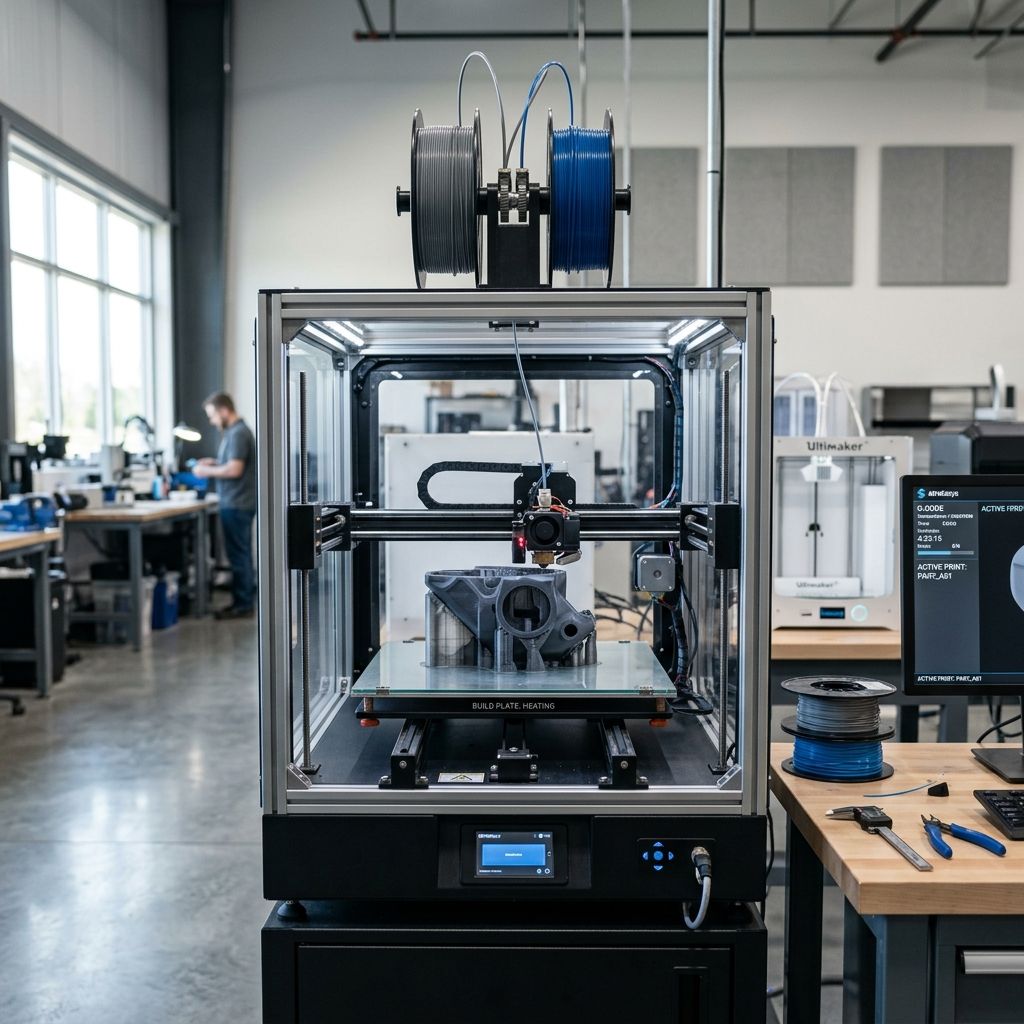
QIDI Plus 4 & X-Max 3: Field-Grade Troubleshooting and Mechanical Realities
A deep-dive technical analysis of high-speed CoreXY platforms, thermal soak failures, and the physical limits of proprietary extrusion systems based on 2,000+ hours of shop-floor operation.
Technical Specifications & Baseline Constraints
- Motion System: CoreXY with 10mm/12mm Hardened Linear Rails (X/Y)
- Extrusion: 9.5:1 Gear Ratio High-Torque Dual-Gear Drive
- Thermal Envelope: 65°C Active Chamber Heating (Plus 4) / Passive-Active Hybrid (X-Max 3)
- Nozzle Standard: Proprietary Bi-Metal / Hardened Steel Integrated Assemblies
- Typical Failure Point: Toolhead cable fatigue and heater cartridge lead-wire fracture
If you've spent any time on a shop floor, you know that "high-speed" usually translates to "high-maintenance." The QIDI Plus 4 and X-Max 3 are impressive pieces of hardware for the price point, but they are pushed to the absolute edge of their mechanical tolerances. When you're throwing a heavy toolhead around at 600mm/s with 20,000mm/s² acceleration, the physics of inertia and thermal expansion don't care what the marketing brochure promised. I've had these machines running 24/7 in a production environment, and the failures are predictable once you understand the stress points.
The first thing we noticed in the shop is that these machines are "thermal sponges." On the X-Max 3, the large build volume creates a significant temperature gradient between the top of the chamber and the floor. On the Plus 4, the active heating is a game changer for warp-prone materials like PA-CF or PC, but it introduces a whole new set of headaches for the electronics and the extrusion path. If you aren't managing your heat-soak periods, your first layer might be perfect, but your 20th layer will be a mess of dimensional inaccuracies.
Nightmare 1: Heat Creep and Filament Softening in the Extruder Drive
This is the "silent killer" of long-duration prints on both the Plus 4 and the X-Max 3. Because these machines are fully enclosed and designed to maintain high chamber temperatures, the ambient air inside the enclosure often exceeds the glass transition temperature of lower-temp filaments like PLA or even some PETG blends. I've seen dozens of instances where the extruder gears which are metal and conduct heat from the motor get warm enough to soften the filament before it even enters the heatbreak.
The physics are simple: the stepper motor generates heat, the gears act as a heat sink, and the enclosed air is already at 50-60°C. The filament loses its structural integrity, the dual gears chew a divot into the side of the plastic, and the print fails four hours into a twelve-hour job. You'll hear a "clicking" sound that's the gears skipping over the mangled filament. By the time you find it, the extruder is jammed tight with a plug of semi-molten plastic.
Expert Fix: The "Door Crack" and Fan Optimization
If you're running PLA on an X-Max 3 or Plus 4, open the top lid or the front door. I don't care how much the marketing says it's an "enclosed solution" the thermodynamics of the toolhead cannot keep up with a 60°C chamber when the filament softens at 55°C. For industrial materials (ABS/ASA), ensure your toolhead fan is hitting at least 80% to keep the "cold side" of the heatbreak actually cold. I've also found that replacing the stock thermal paste on the heatbreak with a high-performance boron nitride paste can buy you an extra 5-10°C of headroom before the creep becomes fatal.
Nightmare 2: Proprietary Nozzle Fatigue and Flow Rate "Choking"
QIDI uses an integrated nozzle/heating block design. On paper, it's great for heat transfer. In the real world, it's a single point of failure that is expensive to replace. We've observed that the hardened steel nozzles used for CF-filled filaments tend to develop a "micro-chatter" on the internal bore after about 500 hours of abrasive use. This isn't visible to the naked eye, but it increases the internal friction of the melt zone, leading to "under-extrusion at speed."
When you're pushing 30-35mm³/s of flow, the plastic needs to move through that nozzle with zero resistance. If the internal bore is scored by carbon fiber or glass beads, you get turbulent flow. This manifests as "fuzzy" walls or intermittent gaps in the outer perimeter. I've had guys spend days tuning their Klipper pressure advance settings when the real problem was just a worn-out internal bore that was dragging on the filament path.
Furthermore, the heater cartridge wires on the Plus 4 are subjected to massive G-forces. Every time the head snaps back and forth for an infill line, those copper strands are flexing. I've seen the crimp connectors inside the toolhead sleeve fail because they weren't strain-relieved properly at the factory. If you get a "Heater Timeout" or "MINTEMP" error, don't just restart the print. Check the wiring harness for signs of fraying or blackening at the connector pins.
- Wear Indicator: If your "Flow Rate Calibration" drops by more than 15% over a month, the nozzle bore is compromised.
- Material Choice: Use the Copper-alloy nozzles for high-speed PETG/PLA; keep the Hardened Steel strictly for abrasives. The thermal conductivity of the steel is significantly lower.
- Torque Spec: These are bimetal assemblies. Do NOT over-torque them when hot, or you will snap the thin-walled throat. 1.5Nm to 1.8Nm is the sweet spot.
Nightmare 3: Z-Axis Sync and Bed Leveling Drift
The Plus 4 and X-Max 3 use a multi-motor Z-axis setup. In theory, the "Auto Z-Tilt" or "Bed Leveling" should compensate for everything. In practice, the heavy heated beds on these machines have significant thermal mass. When you heat that bed to 100°C for an ABS print, the metal expands. If the lead screws aren't perfectly synchronized or if there's any "slop" (backlash) in the nuts, the bed will tilt slightly as it heats up.
I've seen "ghosting" on the Z-axis that people mistake for vibration. It's actually the bed physically shifting because the linear bearings are binding slightly as the frame expands. The X-Max 3, with its massive build plate, is particularly prone to this. If you don't let the machine "heat soak" for at least 20 minutes before starting a large print, your mesh bed leveling will be invalid by the time the print hits layer 50. The bed is literally moving as it reaches thermal equilibrium.
The 20-Minute "Soak" Protocol
For high-tolerance industrial parts, follow this workflow to avoid Z-drift:
- Power on and set chamber heater to target (e.g., 55°C).
- Set bed temperature 5°C higher than your printing target.
- Wait 20 minutes. This allows the linear rails and the aluminum bed plate to finish their thermal expansion.
- Run the G28 (Homing) and G29 (Bed Leveling) ONLY after the soak.
- Start the print. I've seen dimensional accuracy improve from ±0.3mm to ±0.08mm just by following this "lazy" start.
Physics of Failure: Why the Linear Rails Get "Crunchy"
The rails on these machines are often shipped with a generic "preservative" oil, not a lubricant. I've seen beginners run these for 100 hours straight out of the box. By hour 101, the X-axis is screaming. The high speeds of the Plus 4 generate significant friction heat in the ball carriages. If the oil dries out or gets contaminated with "filament dust" (tiny particles of plastic shed by the extruder gears), the balls in the carriage will start to skid instead of roll.
Once they skid, they develop flat spots. Once you have flat spots, your "Input Shaping" calibrations are useless because the friction is no longer linear. You'll see "VFA" (Vertical Fine Artifacts) on your prints that look like ghosting but don't go away no matter how slow you print. This is the mechanical signature of a dying bearing.
Detailed Maintenance Workflow: The "Deep Clean"
Don't just spray WD-40 on it. That's a solvent, not a lubricant, and you'll ruin the seals. Here is how we maintain the production fleet:
Step-by-Step Rail Rejuvenation
1. Degrease: Use isopropyl alcohol (99%) on a lint-free rag to wipe every inch of the X and Y rails. Move the toolhead to get behind the carriages.
2. Inspect: Look for "pitting" or dark streaks on the rail. If you see them, the rail is toast. Your preload is gone.
3. Lubricate: Use a high-quality synthetic grease like Super Lube 21030 (PTFE based) or Mobilux EP2. Do not use "dry" lubes; they don't have the film strength for 600mm/s moves.
4. Purge: Apply the grease, move the toolhead back and forth 20 times, and then wipe off the excess. Excess grease just attracts dust and creates a grinding paste.
Troubleshooting Matrix: Field Scenarios
Over the last year, we've cataloged the weirdest behaviors observed on the X-Max 3 and Plus 4. Use this as a quick reference when things go sideways.
- Symptom: First layer is perfect in the center but "scuffed" on the edges.
Reality: The bed plate is bowing. Check the tension on the bed-leveling knobs (if applicable) or the under-bed screws. High-temp magnets can lose strength over time if hit with 120°C+ repeatedly. - Symptom: Sudden "Layer Shift" on the Y-axis.
Reality: Check the set-screws (grub screws) on the motor pulleys. At 20k acceleration, these screws want to back out. Use blue thread-locker; it's mandatory in a professional shop. - Symptom: "Klipper Shutdown" during high-flow sections.
Reality: The MCU is overheating. The cooling fan for the mainboard is often small and can get clogged with dust. Check the bottom of the machine for airflow obstructions. - Symptom: Brittle prints despite using brand-new filament.
Reality: The chamber heater is "cooking" the filament on the spool if it's mounted internally. For long prints, an external dry-box is a must.
The "Slop" Factor: Belt Tensioning
The CoreXY belt path on these machines is quite long. Most users over-tighten them, thinking "tighter is better." This is a mistake. Over-tensioning puts a radial load on the motor bearings they weren't designed for, leading to premature failure and "whining" noises. It also stretches the belts, causing the pitch to change slightly meaning your 100mm calibration cube is now 100.2mm and you can't figure out why.
In my shop, we use a frequency-based tensioning method. Using a mobile phone app (like a guitar tuner or a dedicated gate-tension app), pluck the long spans of the belts. You're looking for a specific Hz range (usually around 110-130Hz depending on the specific machine version). If one belt is at 110Hz and the other is at 140Hz, your circles will come out as ovals. The symmetry of tension is more important than the absolute value.
Another point of failure is the idler pulleys. QIDI uses shielded bearings, but they aren't "sealed." In a dusty workshop environment, the fine particles from sanding or post-processing will get into those bearings. If an idler starts to seize, it will create "vibration artifacts" that look exactly like bad software settings. If you touch the idler after a print and it's hot to the touch, replace it. A bearing should never be hot; that's energy being converted into friction and heat instead of motion.
Mind the torque on the toolhead screws. Every time you swap a nozzle or clear a jam, you're stressing the plastic or soft-metal threads in the carriage. I've seen plenty of "modders" strip the threads for the cooling duct, which then sags and catches on the print, knocking it off the bed. If you strip a thread, don't just glue it. Use a threaded insert (Heatsert) to repair the carriage properly. It's a 10-minute fix that saves a $100 part.
One final note on the Plus 4's active heating: it is an inductive-style load on the power supply. If you are running the bed, the nozzle, and the chamber heater all at 100% duty cycle, you are redlining that PSU. If your screen flickers or the machine reboots when the heaters kick in, you've likely got a loose terminal screw on the DC output of the power supply. I've found half a turn of a screwdriver can be the difference between a reliable machine and a "ghost in the machine" reboot cycle. Tighten your terminals every six months. Vibration loosens everything.
Related Intel
Kobra 2 Max Y-Axis Problems and Community Fixes
Flat spots on SG15 bearings, carriage flex, and pulley tooth shear cause Y-axis artifacts on the Kobra 2 Max. Fixes: lubricate rails, reduce acceleration, and check belt tension.
Fixing Kinematic Binding on RatRig V-Core 3.1
RatRig V-Core 3.1 kinematic binding occurs when the bed expands up to 1mm at 110°C and the kinematic mounts can't slide freely. Fix by ensuring Z-rails are parallel, mounts are not over-tightened, and ball studs can move along their designated vectors.
Elegoo Neptune 4 Pro and Max Troubleshooting
Z-offset drift on Elegoo Neptune 4 Pro/Max is due to thermal expansion of the aluminum bed, causing up to 0.4 mm height change. Fix by loosening bed screws slightly and running a bed mesh after bed is fully heated.