Preventing X-Axis Rod Wear on Elegoo Centauri Carbon

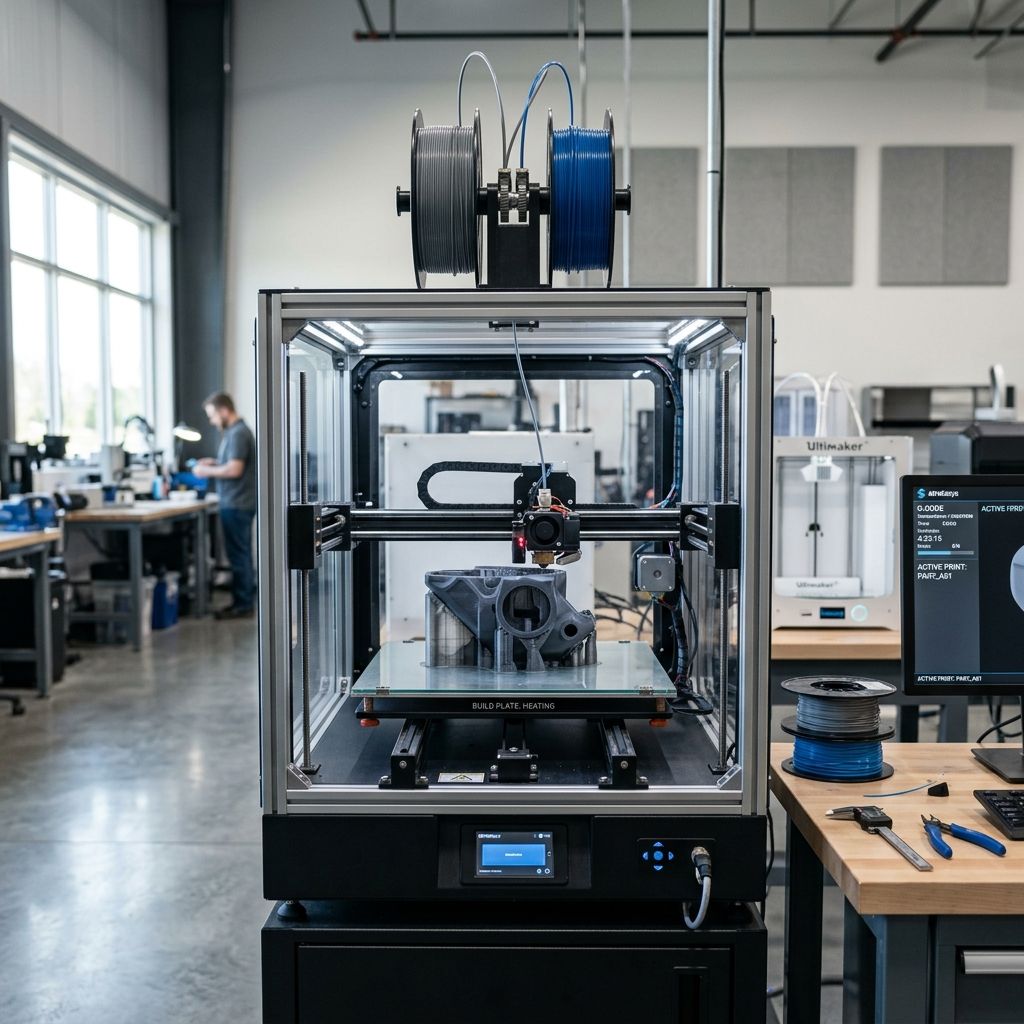
Elegoo Centauri Carbon: Survival Logic for the High-Speed Shop Floor
Carbon fiber X-axis rods and 600mm/s travel speeds sound great on a spec sheet, but in a dusty workshop, they introduce a specific set of physics-based headaches that the marketing team conveniently leaves out. If you're coming from an old-school lead-screw bed or a heavy steel-rail Cartesian, the Centauri Carbon is a different animal that requires a shift in your maintenance DNA.
Core Technical Specifications & Field Constraints:
- Motion System: CoreXY with 10mm Carbon Fiber X-rods
- Max Acceleration: 20,000 mm/s² (Tested stable at 12,000 in real-world scenarios)
- Extruder: Dual-gear direct drive with 3.5:1 reduction ratio
- Hotend: 300°C ceramic heating element with bi-metal heatbreak
- Toolhead Weight: ~190g (Stripped down, without auxiliary cooling fans)
- Firmware: Klipper-based (Elegoo OS) with resonance compensation
The Carbon Fiber Friction Trap: Rod Maintenance and Bushing Scoring
The most immediate "newbie" mistake I see with the Centauri Carbon involves the X-axis rods. Most guys are used to MGN12H linear rails or chrome-plated steel rods where you just slap some Lithium grease on and call it a day. Do that here, and you've effectively turned your $800 machine into a self-destructing sandpaper factory. Carbon fiber is incredibly stiff and light, which reduces the inertia of the toolhead, but it is notoriously finicky about what it slides against.
The Centauri uses dry-sliding bushings likely a PTFE-infused polymer or a sintered bronze variant on those CF rods. In my experience, these rods are prone to "micro-scoring." If a single piece of grit gets trapped between the bushing and the rod, it doesn't just scratch the surface; it embeds itself into the bushing and acts like a lathe tool against the carbon weave. Once you break the epoxy resin coating on those rods, the structural integrity of the rod stays okay, but the "slop" (mechanical play) increases exponentially. You'll start seeing 0.1mm deviations in your X-axis layers that no amount of software tuning will fix.
PRO-TIP: THE DRY-CLEAN METHOD
Never, under any circumstances, use wet lubricants (oil or grease) on the carbon rods. Dust sticks to oil. Dust + Carbon Fiber + High Speed = Premature Failure. Clean the rods every 50 hours of printing using 99% Isopropyl Alcohol and a lint-free microfiber cloth. If the cloth comes off black, you're wearing through the resin. If it comes off grey/white, that's just bushing dust don't panic, but keep an eye on it.
If you start feeling "chatter" when moving the toolhead by hand (with the motors off), your bushings are likely shot or the rods have developed a flat spot. In the field, we call this the "indexed death spiral." To check for this, I use a dial indicator mounted to the frame. Move the head 100mm. If the needle jumps more than 0.02mm rhythmically, your rod is no longer a true cylinder. At that point, your only fix is a full rod/bushing swap. Don't try to "sand them smooth" you'll just release conductive carbon dust into your electronics, which is a great way to short out your mainboard.
Kinematic Ghosting: The Reality of 20k Acceleration
Elegoo advertises 20,000 mm/s² acceleration. In a lab, sure. On a standard workbench? Not a chance. The physics of failure here is "Frame Sway." The Centauri Carbon is relatively light for its speed. When that toolhead changes direction at 500mm/s, the law of conservation of momentum kicks in. The entire printer wants to move in the opposite direction. This creates "ringing" or "ghosting" that the built-in ADXL345 (input shaper) tries to compensate for, but it can only do so much.
I've seen dozens of these machines produce "Vertical Fine Artifacts" (VFA) because the user placed the printer on a flimsy IKEA Lack table. The table becomes part of the kinematic system, acting as a giant low-frequency spring. If the table vibrates at 15Hz and your printer is trying to compensate for 60Hz motor noise, the two frequencies will beat against each other, creating strange wavy patterns on your prints that look like a corrupted video file.
Troubleshooting the Shaking: First, ditch the rubber feet if you're on a solid surface. I know that sounds counterintuitive, but those squishy feet allow the frame to rock. I prefer mounting the machine to a 2-inch thick paving stone sitting on a thin foam mat. This "mass-loading" approach forces the vibration to be absorbed by the stone rather than being reflected back into the gantry. Second, check your belt tension. On a CoreXY system like this, the belts need to be "equalized." If the left belt is at 110Hz and the right is at 130Hz (measured by a frequency app on your phone), your squares will come out as rhombuses. I usually aim for 120Hz on both belts with the toolhead centered at the back of the machine.
- Symptom: Ripples after sharp corners. Fix: Lower external perimeter acceleration to 5,000 mm/s².
- Symptom: Diagonal lean in tall prints. Fix: Check gantry squareness; likely a slipped pulley on the Y-stepper.
- Symptom: High-pitched whine during travel. Fix: Check for belt-rub on the idler flanges. The pulleys are often pressed on with ±0.5mm variance.
- Symptom: Random layer shifts. Fix: Reduce stepper motor current in printer.cfg or check for overheating drivers.
The "Heat Creep" Nightmare in Enclosed High-Speed Printing
This is where things get messy for the makers who want to print ASA or ABS. The Centauri is partially enclosed, which is great for keeping drafts away. However, printing high-temp materials at high speeds requires high flow rates. High flow rates require a massive amount of heat at the nozzle. If you're pushing 30mm³/s of plastic, that heater block is working overtime. The heat travels upward (the "heat soak" effect) into the cold side of the break.
The physics here is simple: if the filament softens before it reaches the melt zone, it expands. Once it expands, the friction against the heatbreak walls becomes greater than the force the extruder gears can provide. The result? The gears chew a hole in your filament, the "clack-clack-clack" sound starts, and your 12-hour print is now a 12-hour air-printing session. I've found that the stock fan on the Centauri's toolhead is "adequate" but has a low static pressure. In a 40°C chamber, it struggles to keep that cold block actually cold.
MAINTENANCE WARNING: THE FILAMENT BLIP
If you experience a jam after 2 hours of printing ABS/ASA, your chamber is too hot for the cooling fan's efficiency. Crack the top lid by 10mm. You lose a little bit of heat, but you save the heatbreak from "thermal runaway" on the cold side. Also, check the tensioning screw on the extruder. People tend to crank it down until it's tight don't. You're just deforming the filament, making it more likely to jam in the heatbreak.
The Extruder & Nozzle Sub-System: Wear and Tear
Let's talk about the nozzle. Elegoo uses a proprietary "long-form" nozzle style to achieve that high flow. While you can find replacements, they aren't as common as your standard V6 or Volcano nozzles. The material choice is often a hardened steel-tipped copper or a plated brass. If you're running Carbon Fiber-filled filaments (PA-CF or PET-CF), that nozzle is a consumable. Hardened steel is better, but it has terrible thermal conductivity compared to copper. I've seen guys swap to a pure hardened steel nozzle and then wonder why they're getting underextrusion it's because they didn't bump their temps up by 15-20°C to compensate for the poor heat transfer.
The extruder gears themselves are also a point of failure. After about 500 hours of high-speed printing, the teeth on the primary drive gear will start to fill with "filament flour" tiny particles of ground plastic. This reduces the grip. I've had to take apart three Centauri extruders in the last month just to brush out the gears with a brass wire brush. It's a 20-minute job that saves you from "ghost underextrusion" (where the print looks fine but is brittle because it's only delivering 90% of the plastic needed).
Step-by-Step Extruder Cleaning Workflow:
- Unload filament and let the hotend cool to 50°C (keeps the plastic solid).
- Remove the two M3 screws holding the toolhead cover. Watch the fan wires; they're thin and the connectors are fragile.
- Release the tension arm and use a can of compressed air to blow out the primary chamber.
- Use a dental pick or a small wire brush to clean the "U" grooves of the dual-drive gears.
- Check for "eccentricity" in the main gear. Spin it manually; if you see it wobbling, the bearing is likely seated poorly or the shaft is slightly bent from a previous jam.
Electronic Gremlins and Cable Fatigue
One thing that veteran makers know and marketing hides is that cables don't like moving at 600mm/s. The Centauri uses a ribbon cable or a specialized wire loom for the toolhead. Every time that head zips back and forth, those wires undergo "flexural fatigue." I haven't seen a high-speed printer yet that doesn't eventually suffer from a broken thermistor wire or a heater wire that shorts out due to internal copper fracture.
In my experience, the first sign of cable failure on the Centauri is "random" temperature spikes or drops. If you see your hotend temperature jumping from 220°C to 240°C in one second, it's not the heater it's the thermistor wire intermittently losing contact as the cable chain flexes. If you ignore this, the printer will eventually trigger a "Thermal Runaway" shutdown. I always keep a spare toolhead cable in the drawer. It's not a matter of *if* it fails, but *when* the cycle count hits the limit of that specific copper gauge.
Also, keep an eye on the bed leveling sensor. The Centauri uses an inductive or strain-gauge system (depending on the specific revision). These are sensitive to electromagnetic interference (EMI). If you've routed your printer's power cable next to a heavy industrial motor or a large microwave, you might get inconsistent first layers. Your mesh might show a "taco" shape that doesn't actually exist on the physical bed.
The Logic of the Build Plate
The PEI sheet provided is decent, but it's thin. At high speeds, the "pull" of the cooling fan and the rapid movement can actually cause thin, large-footprint parts to peel at the corners. This isn't just a bed adhesion issue; it's a "thermal shock" issue. The auxiliary fan on the side of the chamber is a monster. If it kicks in at 100% too early, it cools the top layers of the print so fast that they shrink and pull the bottom layers right off the plate. I usually delay the auxiliary fan until at least layer 10, or keep it at 30% max for anything other than PLA.
One final field note: The Z-axis lead screws. They are often over-lubricated from the factory. Excess grease will travel down the screw and pool at the bottom, or worse, attract dust that turns into a thick "grime paste" at the bottom 10mm of travel. Since we rarely print things that are 250mm tall, that gunk builds up exactly where the bed starts its journey. Wipe the screws clean and use a dry PTFE spray instead. Your Z-offset will thank you by remaining consistent for more than a week at a time.
A FINAL WARNING ON FIRMWARE HACKING
The Centauri runs a locked-down version of Klipper. You can "root" it to get full Fluidd or Mainsail access, but be careful with your "stealthchop" settings. If you disable stealthchop on the X/Y motors to get more torque at high speeds, the machine will sound like a banshee and the vibrations might actually shake the internal connectors loose. Stick to the factory current limits unless you've replaced the motors with high-temp LDO equivalents.
Mind the belt tension, keep the carbon rods bone-dry, and don't trust the 20k acceleration for anything that needs to look pretty. This is a production tool, not a "set it and forget it" appliance. Treat it like a race car: it needs a wrench on every bolt after every long weekend of running.
Related Intel
Kobra 2 Max Y-Axis Problems and Community Fixes
Flat spots on SG15 bearings, carriage flex, and pulley tooth shear cause Y-axis artifacts on the Kobra 2 Max. Fixes: lubricate rails, reduce acceleration, and check belt tension.
Fixing Kinematic Binding on RatRig V-Core 3.1
RatRig V-Core 3.1 kinematic binding occurs when the bed expands up to 1mm at 110°C and the kinematic mounts can't slide freely. Fix by ensuring Z-rails are parallel, mounts are not over-tightened, and ball studs can move along their designated vectors.
Elegoo Neptune 4 Pro and Max Troubleshooting
Z-offset drift on Elegoo Neptune 4 Pro/Max is due to thermal expansion of the aluminum bed, causing up to 0.4 mm height change. Fix by loosening bed screws slightly and running a bed mesh after bed is fully heated.