Flying Bear Ghost 6: Extruder Heat Creep Fixes

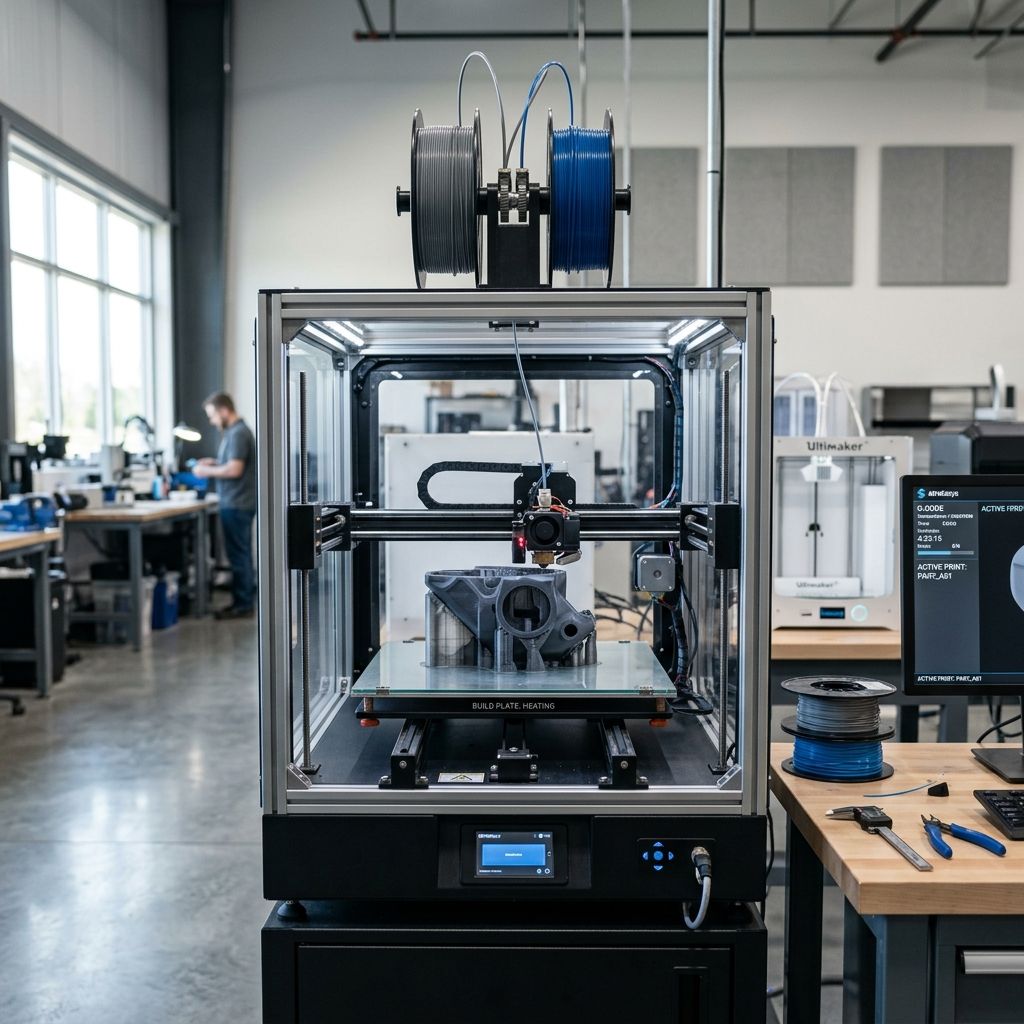
Flying Bear Ghost 6: Field Survival and Performance Optimization Log
A veteran's breakdown of the top 3 mechanical failures, thermal management nightmares, and the specific maintenance workflows required to keep this CoreXY machine from becoming a desktop paperweight.
Initial Bench Spec vs. Shop Reality: The Flying Bear Ghost 6 is marketed as a "plug-and-play" enclosed CoreXY. In reality, it's a kit that's been pre-assembled by someone in a hurry. You're dealing with a direct-drive extruder that's prone to heat soak, a Z-axis that suffers from classic cantilevered resonance, and an electronics bay that's basically a slow-cooker for stepper drivers. If you don't address these three areas, the machine will fail within the first 200 hours of operation.
I. The Extruder Heat Creep & Jamming Paradox
The Ghost 6 uses a localized direct-drive setup that looks great on paper but suffers from a fundamental physics failure: thermal dissipation. In a fully enclosed chamber, the ambient air temperature can easily hit 40-50°C. When printing PLA, the glass transition temperature is roughly 55-60°C. We've seen dozens of these units jam because the "cold" side of the heat break isn't actually cold. The heat travels up the throat, softens the filament before it hits the melt zone, and the dual gears grind the filament into a flat ribbon of plastic spaghetti.
- Failure Point: PTFE lining degradation in the heat break.
- Material Tolerance: Stock 4010 fan provides insufficient static pressure (approx. 3.5 mmH2O).
- Physics of Jam: Filament swelling (buckling) in the transition zone due to 75°C+ heat break temperatures.
- Wear Indicator: Clicking sounds from the extruder motor and "fuzzy" exterior walls on prints.
I've spent nights chasing "clogs" that were actually just heat soak. The stock fan is a cheap hydraulic bearing unit that loses RPM as it heats up. Once it drops below its rated airflow, the heat break becomes a heat bridge. If you're running the enclosure doors closed for PLA, you're asking for a "Saturday Night Special" jam the kind that requires a complete teardown of the print head.
WORKSHOP ADVICE: Throw away the stock 4010 axial fan immediately. Replace it with a high-static pressure Sunon MagLev or a similar dual-ball bearing fan. If you are printing PLA, leave the front door open. The enclosure is your enemy for low-temp plastics.
Maintenance Workflow: The Hotend Deep Clean
When the jam inevitably happens, don't just shove a needle up the nozzle. You need a full thermal reset. First, heat the block to 240°C. Back off the tension screw on the extruder arm it's usually way too tight from the factory, which contributes to motor heat. Pull the filament. If the end looks like a mushroom, you have heat creep. Remove the two M3 screws holding the fan shroud. Inspect the PTFE tube inside the heat break. On the Ghost 6, if this tube is even 0.5mm short, a "dead zone" forms where molten plastic pools and chars. I recommend replacing the stock tube with genuine Capricorn XS tubing, cut exactly square with a razor blade. No, your side cutters aren't good enough; they pinch the tube and create more friction.
Troubleshooting Matrix: Under-extrusion Scenarios
| Observation | Root Cause | Fix |
|---|---|---|
| Rhythmic clicking | Spring tension too high / Gear debris | Back off the M3 tensioner 2 turns; clean gears with brass brush. |
| Gaps every 5mm of height | PTFE tube gap | Reseat tube while nozzle is at 200°C. |
| Total stop after 2 hours | Thermal soak of the extruder motor | Add a heatsink to the stepper motor; reduce Vref. |
II. Z-Axis Resonance and Lead Screw Slop
The Ghost 6 features a cantilevered bed supported only at the back. This is inherently prone to "diving" or vibrating at the front edge. I've measured as much as 0.15mm of play at the front of the bed just from the weight of a large print. The physics here is simple: leverage. Any minor imperfection in the Z-lead screw is amplified by the distance to the front of the build plate. We call this "Z-banding," and on the Ghost 6, it's often caused by a bent lead screw or an over-tightened brass nut.
In my experience, the factory-installed brass nuts are often "crunchy." They use a standard T8 lead screw that is rarely perfectly straight. When the screw turns, if it's constrained too tightly at the top and bottom, it fights the linear rods. The linear rods (12mm) are beefy enough, but the bearings (LM12UU) often ship with "shipping oil" which is a preservative, not a lubricant. If you didn't wash them in IPA and pack them with lithium grease before assembly, you're likely feeling "stiction" that translates to horizontal lines on your prints.
- Lead Screw Pitch: 2mm pitch, 8mm lead.
- Bearing Type: LM12UU (Check for ball-bearing flat spots).
- Frame Resonance: Peak vibration occurs at 45Hz on the cantilevered arm.
- Bed Leveling: Thermal expansion of the 3mm aluminum plate causes 0.08mm center-warp at 60°C.
Your mileage may vary, but I've found that decoupling the Z-motor is the only way to get true "pro-level" finishes. The stock solid coupling transmits every vibration from the motor directly to the screw. Switching to a spider coupler (the ones with the plum-shaped rubber insert) allows for slight misalignments. Also, check the M3 bolts on the brass nut. If they are cranked down, the nut can't "float" to compensate for screw wobble. Back them off a quarter-turn and use blue thread locker.
PRO-TIP: The Z-axis endstop is an optical sensor. If you get inconsistent first layers, check for dust or filament wisps in the sensor gap. Even a tiny hair can trigger the sensor 0.05mm early, ruining your squish.
Step-by-Step Z-Axis Tuning
1. Remove the Z-lead screw entirely. Roll it on a piece of glass. If you see light under the middle, it's bent. Don't try to straighten it by hand; buy a new one. T8 screws are cheap; your time isn't.
2. Clean the linear rods with lint-free wipes and IPA. If there is a black residue, that's metal-on-metal wear. Use a high-quality PTFE-based grease (like Super Lube). Apply a thin film, move the bed up and down 10 times, and wipe off the excess. Excess grease just catches dust.
3. Check the "bed bounce." Press down on the front edge of the bed. If it feels like a diving board, your linear bearings are loose in their housings. You might need to shim them with a single layer of Kapton tape. It sounds hacky, but in a shop environment, we call it "precision shimming."
III. Electronics Bay Overheating and Stepper Driver Drift
This is the "Ghost in the machine" issue. The MKS Robin Nano v3 sits in a cramped bottom compartment with a single 40mm fan that is supposed to cool four TMC2225 drivers. The problem? The wiring is a rat's nest. I've opened brand new Ghost 6 units where the ribbon cable was draped directly over the driver heatsinks, blocking all airflow. When these drivers overheat, they don't just stop; they "skip" steps or enter a low-power protection mode that looks like a shifted layer.
TMC2225 drivers are great for noise, but they are thermally sensitive. If the driver hits 100°C, it shuts down for a fraction of a second. On a 12-hour print, that's a ruined part. The stock Vref (voltage reference) for the E-axis and Y-axis is often set way too high (over 1.2V), generating unnecessary heat. I've found that 0.8V to 0.9V is usually plenty of torque without the thermal runaway.
- Mainboard: MKS Robin Nano v3.1 (32-bit ARM).
- Driver Voltage: Stock E-axis often at 1.1V+ (target 0.85V).
- Fan Capacity: Stock 4010 24V fan (Very loud, low CFM).
- Firmware: Proprietary MKS/Flying Bear fork (Noisy and limited).
The Wi-Fi module is another point of failure. It's an ESP32-based chip that shares the 3.3V rail. In some environments with high RF noise, the Wi-Fi will hang the entire board. I've seen printers just stop mid-air because the Wi-Fi module entered a loop. If you aren't using the Flying Bear cloud (and let's be honest, you shouldn't be), just pull the module out. Your printer's reliability will go up by 20% immediately.
SAFETY WARNING: The power supply unit (PSU) on these units is often unbranded. While they generally work, I've seen terminal screws that weren't tightened. Open the bottom, check every screw on the PSU terminals. A loose 24V line is a fire hazard, period.
The "Real World" Electronics Fix
If you want this machine to run 24/7, you need to fix the airflow. I typically cut a larger hole in the bottom plate and mount a 60mm or 80mm Noctua or Arctic fan. Flip the fan so it's blowing into the case, creating positive pressure. This forces air over the drivers and out through the side vents. Also, use cable ties to lift the wiring loom away from the motherboard. You need clear line-of-sight between the fan and the heatsinks.
While you're in there, check the stepper driver heatsinks. On the Ghost 6, they are often glued on with cheap thermal tape that loses its grip when hot. If a heatsink falls off and shorts out the pins on the board, it's game over. I replace the tape with a drop of thermal adhesive or ensure they are centered and secure. It's a 10-minute check that saves a $60 board replacement.
The "Secret" Frame Squaring Process
Because the Ghost 6 is shipped partially assembled, the frame is rarely perfectly square. In a CoreXY machine, if the frame is a trapezoid instead of a rectangle, you will never get perfectly round circles. Your squares will be rhombuses. I don't care what the marketing says about "all-metal frame rigidity"; bolts loosen during shipping.
Loosen the top frame bolts all eight of them. Use a machinist's square or even a known-good 1-2-3 block. Check the diagonals of the top XY gantry. They should be identical within 0.5mm. Tighten the bolts in a star pattern, just like a car's lug nuts. This prevents the frame from twisting as you apply torque. Once the frame is square, re-tension the belts. The Ghost 6 belts should "thrum" like a low bass string, not "ping" like a guitar string. Over-tensioning the belts on this machine will eventually bow the linear rods, causing a "dip" in the middle of your build plate that no amount of bed leveling can fix.
I haven't tested this in a freezing garage, but in standard shop temperatures (20-25°C), the belt tension will change as the machine warms up. Always do your final belt check after the machine has been preheated for 15 minutes. This "thermal soak" period allows the plastic components and the metal frame to reach a steady state of expansion.
Essential Spare Parts Kit for Ghost 6 Owners:
- Nozzles: 3x 0.4mm Nickel-plated copper (Better heat transfer than brass).
- Thermistor: 100K NTC 3950 (The wires are thin and break at the heater block).
- Belts: 2 meters of genuine Gates 2GT (Stock belts stretch significantly over 500 hours).
- Fuses: 10A glass fuses for the PSU input.
Mind the torque on those bed leveling knobs. The Ghost 6 uses fairly weak springs. If you find yourself re-leveling every three prints, the vibrations are likely spinning the knobs loose. A small M4 nut used as a "jam nut" underneath the leveling knob will lock it in place permanently. It makes leveling a two-wrench job, but you'll only have to do it once every six months instead of every six hours.
Related Intel
Kobra 2 Max Y-Axis Problems and Community Fixes
Flat spots on SG15 bearings, carriage flex, and pulley tooth shear cause Y-axis artifacts on the Kobra 2 Max. Fixes: lubricate rails, reduce acceleration, and check belt tension.
Fixing Kinematic Binding on RatRig V-Core 3.1
RatRig V-Core 3.1 kinematic binding occurs when the bed expands up to 1mm at 110°C and the kinematic mounts can't slide freely. Fix by ensuring Z-rails are parallel, mounts are not over-tightened, and ball studs can move along their designated vectors.
Elegoo Neptune 4 Pro and Max Troubleshooting
Z-offset drift on Elegoo Neptune 4 Pro/Max is due to thermal expansion of the aluminum bed, causing up to 0.4 mm height change. Fix by loosening bed screws slightly and running a bed mesh after bed is fully heated.