Bambu Lab X1-Carbon & X1E: Production 3D Printer Analysis

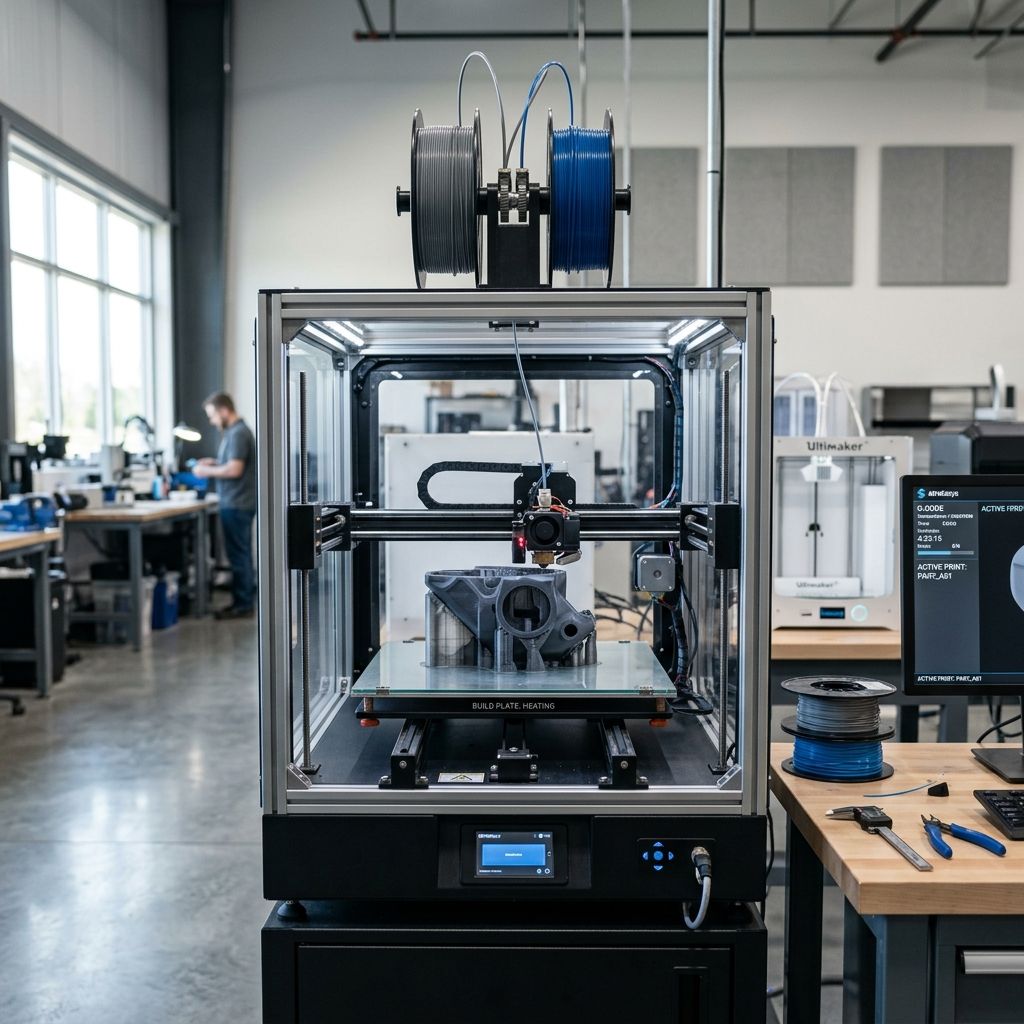
Bambu Lab X1-Carbon & X1E: An Architectural Analysis of Production-Grade Additive Manufacturing Systems
For engineering teams and professional studios, the transition from prototyping to end-use part production hinges on machinery that guarantees repeatability, material versatility, and uncompromising structural integrity. This analysis deconstructs the Bambu Lab X1-Carbon and its industrial counterpart, the X1E, evaluating their architecture not as consumer gadgets, but as capital investments for demanding technical applications.
Executive Summary: Market Position & Strategic Value Proposition
The Bambu Lab X1-Carbon redefined expectations for enclosed, coreXY fused filament fabrication (FFF) systems by integrating LiDAR-based first-layer inspection, active vibration compensation, and a hardened toolhead path in a sub-$1,500 package. Its success is rooted in a systems-engineering approach that prioritizes closed-loop control. The X1E variant builds upon this with explicit certifications (UL/CE), enhanced firmware for engineering materials, a fortified chassis, and Ethernet connectivity, targeting light industrial and professional workshop environments. The combined value proposition is not merely speed, but predictable outcomes reducing the statistical variance in print quality that plagues open-loop systems and directly translating to lower scrap rates, less operator intervention, and faster time-to-functional part.
I. Core Mechanical Architecture & Structural Integrity
The foundational superiority of these systems lies in their integrated chassis design and motion platform. Unlike modular DIY printers, the X1 series employs a rigid, formed sheet metal frame with precision welded and machined reference points. This monocoque-inspired structure provides a stable kinematic base, critically damping resonance that degrades surface finish and dimensional accuracy at high speeds.
A. Motion System & Vibration Mitigation
The coreXY kinematics, driven by dual high-precision steppers on the X and Y axes, decouple the moving mass from the toolhead. This allows for rapid directional changes (jerks) exceeding 10,000 mm/s² without significant toolhead oscillation. The proprietary active vibration compensation (AVC) system is not software smoothing; it is a real-time feedforward algorithm. An onboard accelerometer measures chassis vibrations induced by movement profiles, and the firmware dynamically adjusts stepper microsteps to counteract these forces before they manifest as ringing artifacts. This is critical for maintaining geometric fidelity on thin walls and sharp corners when using stiff materials like PA-CF or PC.
- System Kinematics: CoreXY-HB (High-Belt-Tension) with 6mm GT2 belts, dual-drive Y-axis.
- Maximum Theoretical Speed: 500 mm/s (process-limited, not mechanically limited).
- Acceleration Control: Input Shaping (Klipper-derived) + Active Vibration Compensation (AVC).
- Frame Resonance Frequency: Deliberately engineered >80Hz to avoid common print speed harmonics.
- Linear Rail Specification: MGN12H on X and Y axes, pre-loaded for minimal play under lateral load.
B. Enclosure & Thermal Management
The sealed chamber is a non-negotiable feature for engineering polymers. The X1-Carbon maintains an ambient chamber temperature of 45-55°C passively. The X1E adds a dedicated chamber heater, capable of reaching 65°C, which is essential for preventing interlayer delamination in semicrystalline materials like PEEK or PEI (Ultem). The front door incorporates a high-temperature glass pane with a robust gasket, maintaining thermal uniformity. A key design insight is the dual-fan, negative-pressure exhaust system. It actively vents volatile organic compounds (VOCs) and ultrafine particles (UFPs) through a HEPA filter (X1E standard, X1-Carbon optional), while maintaining slight negative pressure to prevent heat loss a balance often mismanaged in DIY enclosed designs.
II. The Toolhead: A Hardened Extrusion System with Closed-Loop Feedback
The toolhead represents the highest concentration of technical innovation. It is a self-contained, smart peripheral that manages thermal, mechanical, and flow control autonomously.
A. Hotend Assembly & Material Compatibility
Both systems use a "hardened" all-metal hotend, but the definition is critical: The nozzle, heat break, and extruder gears are coated with a physical vapor deposition (PVD) tungsten carbide layer. This provides a surface hardness exceeding 70 HRC, offering exceptional abrasion resistance against carbon-fiber, glass-fiber, and mineral-filled filaments. The melt zone is a high-efficiency, low-volume design, minimizing thermal lag and enabling rapid flow rate changes. The maximum melt capacity is process-limited to approximately 32 mm³/s with standard engineering PLA; with high-temperature polymers, this drops to ~18 mm³/s, which remains competitive for the form factor.
- Hotend Type: High-flow, all-metal, V6-style thread with proprietary coating.
- Maximum Nozzle Temperature: 300°C (X1-Carbon) / 320°C (X1E).
- Thermal Stability: ±0.5°C via PID control with automatic tuning per material profile.
- Critical Wear Components: Tungsten carbide-coated nozzle, hardened steel extruder gears (5.2:1 ratio).
- Filament Path Tolerance: <0.05mm deviation to prevent grinding with brittle filaments.
B. Multi-Axis LiDAR & First-Layer Metrology
The integrated LiDAR scanner performs three distinct, critical functions that directly impact first-pass yield. First, it conducts a non-contact bed topography map, compensating for micron-level warping in the build plate a feature that nullifies manual bed leveling. Second, it performs a filament flow calibration by printing a series of lines and measuring their cross-sectional profile via laser reflectance, dynamically adjusting the extrusion multiplier to achieve nominal line width. Third, and most significantly for unattended operation, it scans the first layer's perimeter, detecting voids, over-extrusion, or detachment with sub-50 micron resolution. This is a true process control loop, providing a binary "pass/fail" gate before committing to a long-duration print.
III. Operational Analysis: ROI, Efficiency, and Total Cost of Operation (TCO)
The business case for these systems is built on operational efficiency and asset utilization, not just acquisition cost.
A. Direct Cost Drivers & Scrap Reduction
The closed-loop system directly targets the largest hidden costs in professional 3D printing: failed prints and manual calibration time. A failed print wastes material, machine time, and operator labor. The LiDAR first-layer inspection and automatic calibration suite reduce first-layer failure rates by an estimated 80-90% compared to open-loop systems. For a workshop running 20 prints per day, this can save multiple kilograms of filament and hours of labor per week. The automatic filament switching system (AMX) on the X1-Carbon further increases asset utilization by allowing sequential prints in different materials without operator presence, effectively turning the printer into a batch production cell.
Professional Advisory: Calibration & Maintenance Cycle
Do not misinterpret "automatic" as "zero-maintenance." The LiDAR sensor lens requires bi-weekly cleaning with isopropyl alcohol to maintain calibration accuracy. The carbon rod linear axes need re-lubrication with a PTFE-based grease every 500-700 operational hours. The hardened extruder gears, while wear-resistant, must be inspected for particulate buildup every 150 hours when printing abrasive composites. Neglecting these creates a false sense of security; the system's feedback can only compensate within mechanical limits. Schedule these tasks as non-negotiable PMs.
B. Throughput & Effective Cycle Time
While marketing highlights peak speeds of 500 mm/s, effective cycle time is governed by volumetric flow rate, cooling capacity, and material-specific thermal dynamics. For a standard 20% infill PLA part, the X1 series can achieve effective print speeds 2-3x faster than a typical Cartesian printer while maintaining equal or better surface quality due to AVC. However, the true efficiency gain is in the "click-to-print" workflow. The integrated slicing engine (Bambu Studio) is pre-tuned with hundreds of material profiles, eliminating days of process development. For a firm introducing a new material, this reduces process qualification time from weeks to hours.
- ROI Factor - Labor: Reduction in manual calibration and supervision time (~5-10 hrs/week).
- ROI Factor - Material Yield: Scrap rate reduction from ~15% to an estimated 3-5%.
- ROI Factor - Uptime: AMS-enabled sequential printing increases machine utilization to >85%.
- TCO Consideration: Proprietary consumables (nozzle, cutter) carry a 15-20% cost premium vs. generic parts.
- Payback Period: For a service bureau, estimated 6-9 months based on increased throughput and yield.
IV. Comparative Technical Specifications: X1-Carbon vs. X1E
The choice between models is an exercise in risk mitigation and compliance, not just feature comparison.
| Parameter | Bambu Lab X1-Carbon | Bambu Lab X1E | Industrial Implication |
|---|---|---|---|
| Certification | CE, FCC (Consumer) | UL Listed, CE (Industrial), ETL | X1E is eligible for insured workshops and regulated industries. |
| Chassis Reinforcement | Standard Sheet Metal | Added Cross-Bracing, Thicker Gauge | Enhanced long-term geometric stability under thermal cycling. |
| Chamber Temperature | Passive (45-55°C max) | Active Heater (Up to 65°C) | Critical for achieving optimal crystallinity in high-temp polymers. |
| Firmware & Connectivity | Cloud-Centric, Wi-Fi | Ethernet, LAN-Only Mode, Enhanced Logging | X1E fits within enterprise IT security and network policies. |
| Extruder Drive | Hardened Steel Gears | Hardened Steel Gears + Enhanced Cooling | X1E sustains high torque for longer durations with filled filaments. |
| Safety Features | Basic Thermal Runaway | Advanced Thermal Fuses, Current Monitoring | Formal risk mitigation for unattended operation. |
V. Critical Assessment: Pros, Cons & Integration Challenges
- Pros - Systems Integration: Unprecedented level of sensor fusion (LiDAR, accelerometer, hall effect, optical) for a desktop-class machine.
- Pros - Build Quality: Industrial-grade linear rails, precision-machined components, and robust wiring harnesses.
- Pros - Material Library: Pre-tuned profiles for over 200 third-party filaments, drastically reducing setup friction.
- Cons - Proprietary Ecosystem: Lock-in to Bambu-specific consumables (nozzles, cutter, AMS hubs) at a cost premium.
- Cons - Repairability Score: Modular but not simplistic. Hotend replacement requires firmware recognition steps beyond a simple thermistor swap.
- Cons - Cloud Dependency (X1-Carbon): Full functionality requires cloud connection, a potential data sovereignty and uptime concern.
- Integration Challenge - Venting: The rear exhaust port diameter may not match standard workshop ducting, requiring an adapter.
- Integration Challenge - Network: The X1E's Ethernet is a necessity for corporate networks where Wi-Fi is forbidden for machinery.
VI. Material Science & Process Window Validation
The true test of a production-grade system is its ability to reliably process advanced polymers with narrow process windows.
A. Semicrystalline Polymers (PA, PEEK, PEI)
For nylon (PA) and its carbon-filled variants, the primary challenge is moisture absorption and warping. The X1E's heated chamber mitigates warping by keeping the entire part above its glass transition temperature during the build, allowing internal stresses to relax. The sealed AMS units provide a dry storage environment during multi-day prints. For PEEK and PEI, the chamber temperature of 65°C is the minimum threshold to prevent catastrophic delamination; successful prints require meticulous bed adhesion management (engineering plate with high-temp adhesive) and slow cooling cycles.
B. Amorphous Polymers (PC, ABS, ASA)
With amorphous materials like polycarbonate (PC), the chamber's primary role is to prevent thermal cracking by ensuring a uniform, draft-free cooling environment. The X1 series' chamber excels here. The key operational adjustment is the reduction in maximum volumetric speed to ~18 mm³/s to prevent shear-induced degradation in the nozzle. The hardened steel, coated nozzle is critical for maintaining a consistent orifice diameter over time when printing glass-filled PC, which would rapidly erode a brass nozzle.
Safety & Operational Protocol: High-Temperature Materials
When printing polymers exceeding 280°C (PC, Nylon, PEI), you are operating a high-temperature industrial device. Ensure the printer is on a non-flammable surface with >20cm clearance on all sides. The chamber and nozzle will reach surface temperatures capable of causing severe burns. Always use thermal gloves during post-processing or nozzle swaps. The HEPA filtration system on the X1E is mandatory for these materials, as they emit styrene (ABS/ASA) or caprolactam (PA) vapors. Never bypass safety interlocks or disable chamber temperature monitoring.
VII. Strategic Verdict: Investment Justification
The Bambu Lab X1-Carbon is not merely a faster consumer printer; it is a benchmark for integrated, sensor-rich process control in desktop FFF. Its architecture demonstrates a mature understanding of the multi-variable dependencies in extrusion-based additive manufacturing. For the professional user the engineering firm, architectural model shop, or product design studio it represents the inflection point where the total cost of ownership (factoring in labor, scrap, and reliability) justifies the capital expenditure over a cluster of cheaper, less reliable machines.
The X1E is the logical evolution for environments where compliance, networking, and the absolute maximum performance from high-temperature materials are non-negotiable. Its price premium is directly attributable to certification costs, enhanced safety hardware, and the active chamber heater features that have tangible value in a commercial or institutional setting.
Ultimately, the selection criteria should be binary: If your operation requires formal safety certifications, handles advanced polymers daily, and answers to a corporate IT department, the X1E is the only viable option. For all other professional applications where reliability, speed, and a broad material palette are the primary drivers, the X1-Carbon delivers an unparalleled price-to-performance ratio, establishing a new baseline for what a professional-grade desktop 3D printer must be.
Related Intel
Creality K1C and K2 Pro Extrusion and Resonance Fixes
A field-tested troubleshooting guide for the Creality K1C and K2 Pro, covering all-metal Unicorn nozzle heat creep jams, CoreXY belt resonance frequency tuning, and Z-axis gantry tramming.
Creality K1 SE Common Problems and Workshop Fixes
Solve Creality K1 SE common problems including CoreXY belt tension imbalance, Unicorn nozzle heat creep, extruder gear grinding, and strain gauge leveling drift with practical workshop protocols.
Elegoo Centauri Carbon Workshop Troubleshooting Guide
Troubleshoot Elegoo Centauri Carbon failures with practical workshop solutions for acoustic CoreXY belt tuning, accelerometer sensor drift, and extruder gear wear.