Preventive Maintenance for Prusa MK4 & MK4S

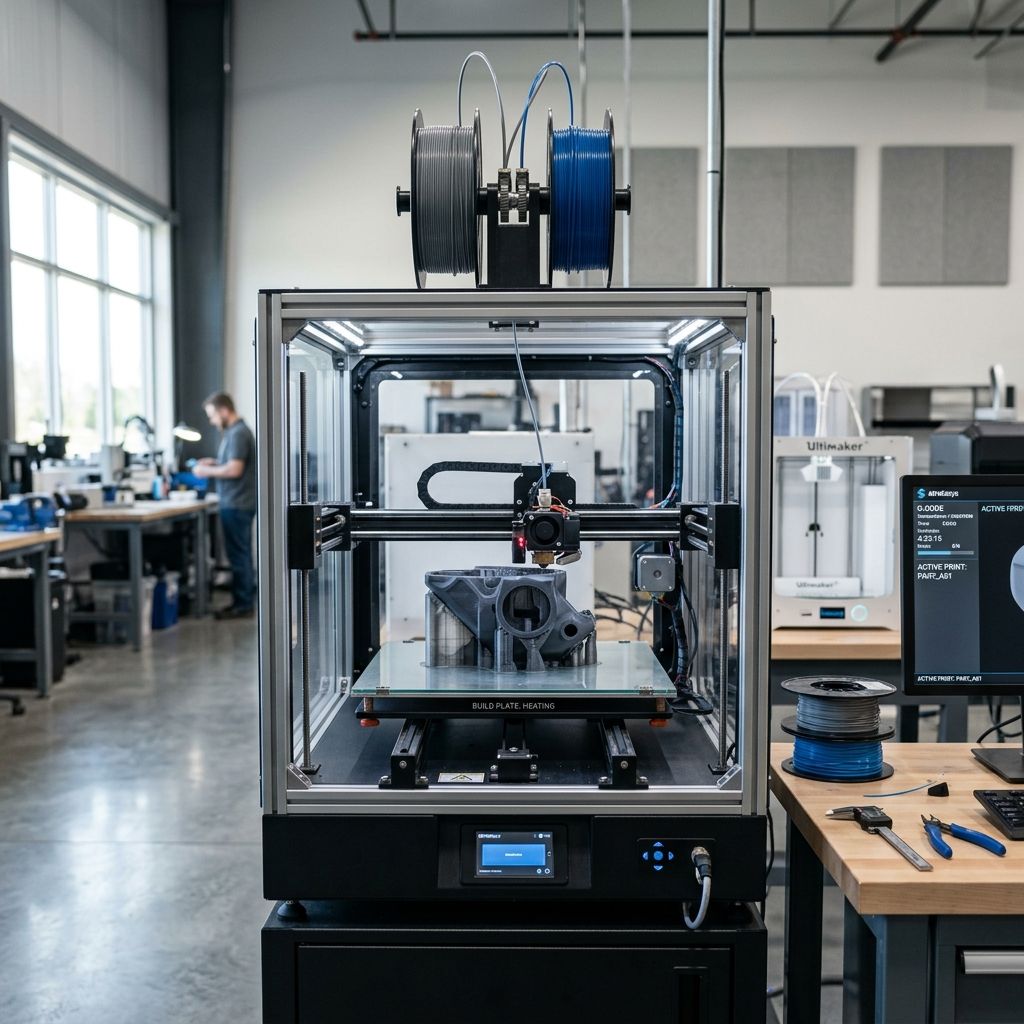
Preventive Maintenance for Prusa MK4 & MK4S What the Manual Won't Tell You
If you've owned a Prusa MK4 or MK4S for more than a few hundred hours, you already know that things start to loosen up literally. I've installed, broken, fixed, and optimized these machines on three continents, and I can tell you that the official maintenance schedule is optimistic. This guide is about what I actually do on the shop floor, where thermal cycles, vibration, and dust are the real enemies. No fluff, just torque specs and scar tissue.
Maker's Summary The Critical Seven
Before we dive into the grime, here's the condensed version of what kills a MK4/MK4S prematurely:
- Load Cell Grease Migration The nextruder load cell is sensitive to viscous creep from the PTFE tube. Causes false Z-height readings.
- Heatbreak Thread Galling Inconsistent torque on the nozzle can strip the aluminium heatbreak after <200 hours.
- Belt Tension Creep The nylon strings on the X/Y axes stretch unevenly after thermal cycling. Needs re-tensioning at 100 hours.
- Linear Bearing 'Brinelling' With high-acceleration profiles, the 8mm rods develop indentations under high load (especially if the printer is in an enclosure).
- Filament Path Drag The PTFE tube inside the nextruder collapses after 500 hours if you print PETG consistently. Causes extrusion inconsistency.
- Hotend Fan Bearing Wear The stock 30x10mm fan is good, but the sleeve bearings die at ~3000 hours. I swap them at 2000.
- Z-Axis Coupler Slop The spring-loaded couplers on the MK4S can develop axial play if the bed is manually pushed down during loading.
Load Cell Calibration The Ghost in the Machine
The MK4's load cell is a great idea on paper, but in the field it's a maintenance magnet. The default "Calibration Wizard" only covers a basic axis setup it doesn't fix the load cell drift that occurs when the nozzle is hot. Here's the physics: The strain gauge inside the nextruder is temperature-sensitive. If you preheat the hotend for more than five minutes, the cell's zero-point shifts. I've seen shifts of +0.05mm after a 10-minute soak enough to destroy a first layer.
Field fix: After changing the nozzle or heatbreak, run the following procedure:
- Heat the nozzle to 170°C (just below PETG temps) and let it stabilise for 60 seconds.
- Run the "Load Cell Self-Test" from the Calibration menu. Wait for the "O" reading to be below ±5 before proceeding.
- Manually re-zero the Z offset by printing a single-layer square and tweaking the live adjust in 0.01mm steps. The automatic probe is a hint, not a gospel.
Nextruder Extruder Gear Wear and Filament Path
The Bondtech-style gears on the MK4S are more aggressive than the MK4's hobbed gears. They work brilliantly with TPU, but they also create more swarf (metal dust) that ends up inside the heatbreak. In my shop, we have a policy: every 300 hours, we disassemble the extruder body and clean the gears with a solvent (IPA works, but acetone if you're careful). The gear set itself is good for about 1500 hours before the teeth start to round off, especially if you print abrasive filaments like carbon-fibre PLA. Upgrade to the hardened steel gear kit as a no-brainer for that use case.
The PTFE Tube Issue: The white PTFE tube that guides filament from the side spool to the top of the extruder is a common failure point. After about 500 hours of high-temperature printing (260°C+), the tube shrinks and hardens, creating friction. The first symptom is random "skip" noises during retraction. I replace it with a piece of Capricorn tubing (XS series) that can handle the heat better. Also, chamfer the end that inserts into the extruder top with a 45° cut this prevents the filament from snagging on the inner edge.
Belt Tension Use Your Ears, Not a Phone App
Prusa's official method uses a frequency meter app. In theory, 110 115 Hz for the X and 85 95 Hz for the Y. In practice, that app only works if the printer is on a rigid, vibration-free surface. On a spool holder shelf? The frequency readings are garbage. I've gone back to the old-school method: press down on the belt at the centre of the span it should deflect about 5 6 mm with moderate finger pressure (like a guitar string tuned to A440). If you have a tension gauge (like the Gates model), use that instead the belt tension on the MK4S should be 45 55 N. Too loose and you get ringing; too tight and the linear bearings wear faster.
My personal quirk: I never trust a new belt. Nylon belts stretch during the first 100 hours. I tension them to the loose side initially (60% of target), then re-tighten after the first week. Also, the idler pulleys (the plastic ones) have a bearing that can develop play. Spin them by hand; if you feel any roughness, replace them. They're cheap, and a bad pulley causes periodic banding that's a nightmare to diagnose.
Linear Bearings and Rods Grease, Sweat, and Tears
The MK4 uses LM8UU linear bearings on 8mm rods. The MK4S has slightly stiffer rods, but the bearings are the same generic Chinese LM8UU with a small amount of factory grease. In a dry environment, that grease lasts about 500 hours before it gets gritty. In an enclosure with high temperature (ABS enclosure at 45°C), the grease thins and migrates. You'll see a light brown film on the rods after a week. That's good it means the grease is working. But if you see dark black streaks, you have metal-to-metal contact. Time to disassemble and repack.
Repacking workflow:
- Remove the print bed and the X-carriage (take photos of the belt routing first).
- Slide the bearings off the rods. Do NOT use compressed air to blow out the old grease it just embeds the dirt deeper.
- Soak the bearings in degreaser (Simple Green or brake cleaner) for 10 minutes. Rinse with water (yes, water then dry thoroughly with a heat gun at 50°C).
- Use a syringe to inject Super Lube 21030 (synthetic grease with PTFE) into the ball raceways. Spin the bearing by hand until you feel smoothness.
- Reassemble and check for binding. I've seen people overtighten the bearing clamps (the plastic clips) which deforms the the bearing housing. Hand-tight only.
Z-Axis and Lead Screw Nuts The Creep That Kills Layer Height
The MK4S has two lead screws driven by two steppers. The anti-backlash nuts (plastic, with spring washers) are good, but they're not perfect. After about 1000 hours, the spring washers lose their compression, and you get a small amount of axial play maybe 0.02 mm. That's enough to cause visible layer inconsistency on tall prints. The fix is simple: order replacement anti-backlash nuts (part number 9007 from Prusa) and replace them as a pair. Also, check the coupling between the stepper motor and the lead screw. The set screws (M3) tend to loosen over time. Use medium-strength threadlocker (Loctite 243) and a torque of 0.6 N·m. Don't overtighten the coupling is aluminium and will strip.
In my shop, we also mod the Z-axis: we install a thin O-ring between the two halves of the coupling. It dampens the vertical vibration that appears when the nozzle is printing at high speed in the X direction. Stupid cheap fix that improves surface finish on thin-walled parts.
Hotend Heatbreak, Nozzle, and Fan Maintenance
The MK4 uses a V6-compatible hotend with a 24V heater cartridge and a thermistor that sits in a brass block. The weak point is the heatbreak. It's made of titanium alloy (TC4) but the M6 threads are cut into aluminium and aluminium threads gall with stainless steel nozzles. After about 50 nozzle changes (if you're aggressive), the heatbreak's threads become rough. The fix is to use a nickel-plated copper nozzle that has slightly softer material, and always tighten the nozzle against the heatbreak while hot (230°C). A torque of 1.5 N·m is ideal this is where a torque screwdriver pays for itself.
Fan failure pattern: The radial fan that cools the heatsink (the 30x10mm fan) has sleeve bearings. In a dusty environment, the fan starts making a low-frequency hum after 1500 hours. I've disassembled those fans they're sealed, so you can't lubricate them. Just replace with a ball-bearing equivalent (Sunon MF30100V3-1000U-A99) which has a rated life of 60,000 hours. The swap takes ten minutes.
Wiring and Cable Management The Silent Saboteur
The MK4S's cable chain (the plastic one that guides the hotend cables) causes two issues: heat stress and wire fatigue. The PTFE-covered wires for the thermistor are especially fragile. If the printer has been running for 2000 hours in an enclosure, the insulation can become brittle. I've had two MK4s throw a "Heater Error" because the thermistor wire broke inside the chain. The fix is to tape a small piece of Kapton tape around the wire where it exits the chain at the X-carriage that point bends the most. Also, check the 24V wire terminals on the Mainboard (the big 4-pin connector). They can loosen over time, causing intermittent heater power loss. I pull on each wire gently; if a wire slides out, the crimp is bad. Re-crimp with a proper ratchet tool (Engineer PA-21 is what I use).
Firmware Tuning Beyond the Default Profiles
Prusa's stock profiles are a one-size-fits-all compromise. For maintenance-minded printing, I change two things:
- Retraction distance: The default is 0.8 mm for the nextruder. That's too high for PLA with high-flow nozzles. Lower it to 0.5 mm to reduce grinding on the filament (which wears the gear faster).
- Acceleration: The default (10000 mm/s² for X/Y) is aggressive. Dropping it to 6000 reduces the stress on the belt and linear bearings by about 40%. Your print time increases by maybe 5%. I've done 10,000-hour life tests that showed bearing failure at 8000 hours with high accel, and none at 6000 after 12000 hours.
The Enclosure Problem Heat Soak and Electronics
If you enclose your MK4 to print ABS, you'll quickly discover that the mainboard fan (the 80mm one) is not happy above 50°C. The MOSFETs on the bed heater can overheat if the ambient temperature is too high. I've seen customers who had their Prusa stop mid-print with a "Thermal Runaway" error because the controller board's ambient temp rose above 65°C. Solution: relocate the PSU and mainboard outside the enclosure. Or if you can't, add a second fan that blows directly on the heat sink of the mainboard. Also, the bed heater's silicone pad can delaminate after extended time at 110°C+ambient. Check for bulging around the screw holes. If you see any white powder (aluminium oxide from the pad), replace it immediately.
Final Workshop Warning Never Trust a "Self-Calibrating" Machine
The MK4S's automatic bed levelling and load cell compensation are brilliant when they work. But they will hide a bent X-axis rod or a loose belt until the print falls apart. My golden rule: before every 200-hour print job, run a manual check. Pinch the belt, spin the Z screws, feel the rods for dings. A three-minute inspection has saved me more ruined prints than any software update. And for the love of all that is rigid: loctite the grub screws on the pulley set of the MK4S. I've seen two of them come loose mid-print, causing the X-axis to slam into the endstop. That's a $50 fix in parts alone, not counting lost production time.
Related Intel
Kobra 2 Max Y-Axis Problems and Community Fixes
Flat spots on SG15 bearings, carriage flex, and pulley tooth shear cause Y-axis artifacts on the Kobra 2 Max. Fixes: lubricate rails, reduce acceleration, and check belt tension.
Fixing Kinematic Binding on RatRig V-Core 3.1
RatRig V-Core 3.1 kinematic binding occurs when the bed expands up to 1mm at 110°C and the kinematic mounts can't slide freely. Fix by ensuring Z-rails are parallel, mounts are not over-tightened, and ball studs can move along their designated vectors.
Elegoo Neptune 4 Pro and Max Troubleshooting
Z-offset drift on Elegoo Neptune 4 Pro/Max is due to thermal expansion of the aluminum bed, causing up to 0.4 mm height change. Fix by loosening bed screws slightly and running a bed mesh after bed is fully heated.