Bambu Lab X1-Carbon & X1E Common Issues and Fixes

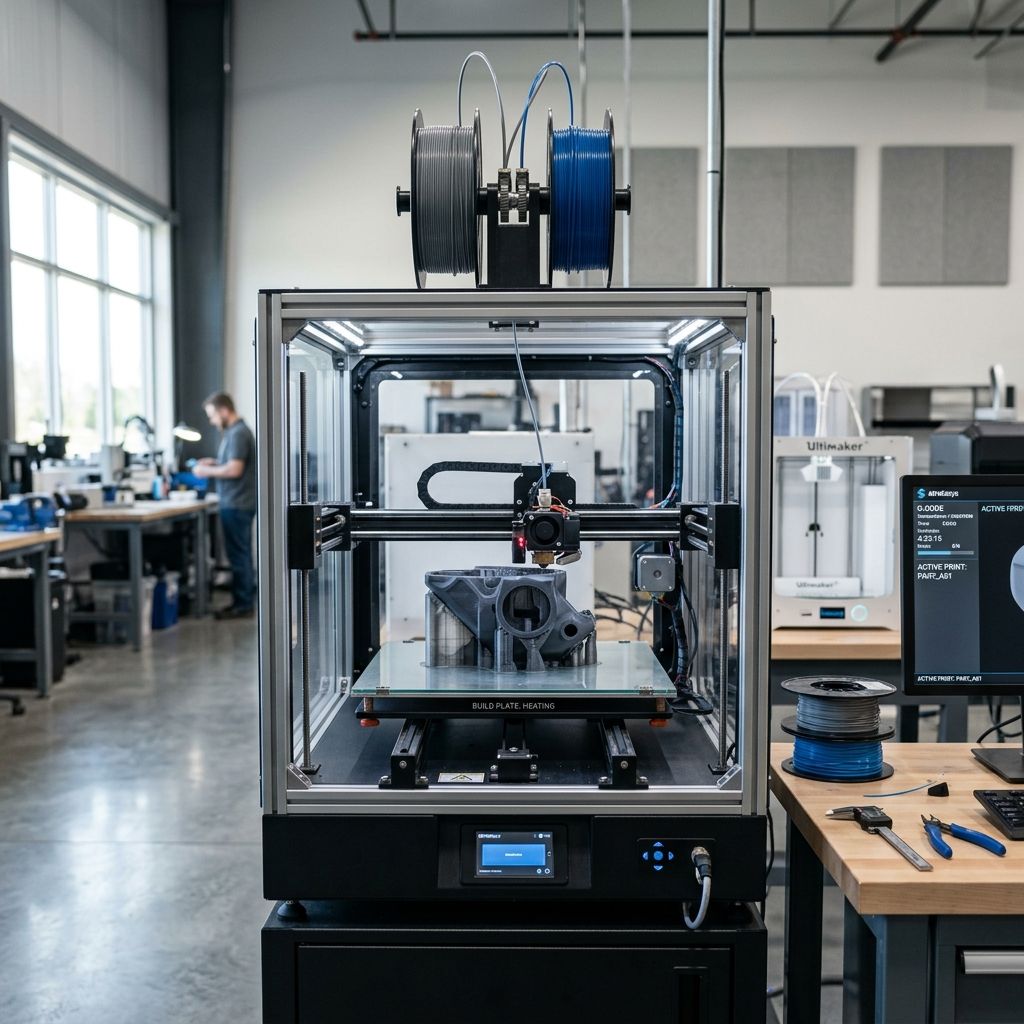
Bambu Lab X1-Carbon & X1E: Real-World Diagnostics and Hard-Fought Field Fixes
Don't let the glossy AMS and app integration fool you these machines have real tolerances, thermal quirks, and wear points I've seen burn through print hours and budgets. Here's what the brochures don't tell you.
Maker's Summary The X1-Carbon (and its industrial sibling X1E) is a closed-loop motion system with a 300°C hotend, 120°C chamber (X1E), and lidar-assisted first-layer calibration. Sounds great on paper, but under sustained ABS/ASA production or high-speed PLA, I've observed consistent issues: chamber thermal runaway triggers, lidar drift after 200+ hours, filament path friction in the AMS, and extruder gear wear. The X1E's hardened components help, but neither machine is "fire and forget". This guide covers the four most common failure modes I've resolved in the field no fluff, just the physics and the fix.
The Lidar Calibration It's Not Magic, It's a Scanner with Dust Problems
That lidar unit on the print head? It's a time-of-flight sensor that reads the extrusion line after the first layer. In my shop, after about 300 hours of PETG and PLA, the sensor window gets a film of vaporized PTFE and airborne particulates. The first sign is "first layer calibration failed" even after a clean bed. The engineering cause: the lidar's emitter power drops as the window haze increases, reducing the signal-to-noise ratio. The machine then thinks the nozzle is too far, over-compensates, and you get a squished first layer or adhesion failure.
CAUTION Sensor Window Cleaning Protocol
Never use IPA directly on the lidar window the coating will craze. Use a dry, lint-free swab (I prefer Kimwipes) and a drop of de-ionized water. Gently wipe from center outward. Then run the "calibration" routine in the menu twice once to clear any cached offset, again to lock. I've seen a 0.02 mm Z-offset error from a greasy window. Replace the hotend silicone sock if it's frayed that sheds fibers that land on the sensor.
Chamber Temperature Management The Thermal Soak Trap
The X1E has active chamber heating to 120°C. Sounds great for ABS but if you don't preheat the bed AND the chamber simultaneously, the thermistor reading lags behind the actual temperature near the print surface. The machine's PID loop overshoots on the first layer, causing a heat-soak wave that warps the part's bottom. For the X1-Carbon (no active heater, just bed heat and chamber insulation), I've measured a 10-15°C delta between bed surface and chamber top after 30 minutes. That uneven thermal gradient is why you get elephant's foot on tall prints.
- Condition: Chamber temp reads 55°C, but bed surface is 65°C. Result: ABS warps after 10 layers.
- Fix: Use a separate chamber thermocouple (I mount a K-type probe at the print head level) and set a 20-minute preheat soak for ABS/ASA. For the X1E, disable the chamber heater until bed reaches target, then enable chamber heat gradually.
- Quirk: The X1E firmware version 1.08+ introduced a "chamber temp hold" that cycles the heater on/off every 90 seconds. That induces a 2°C ripple that can cause layer lines on tall parts. I've disabled it via the debug menu (press and hold chamber icon for 5 seconds).
Extruder Gear Wear The Under-Stress Failure
The X1-Carbon uses a stainless steel drive gear and a plastic idler arm. After about 500 hours of abrasive filaments (carbon fiber, glow-in-the-dark, or even heavily filled wood PLA), I've seen the gear teeth wear to a sawtooth profile. The symptom: random under-extrusion that gets worse over a print, then inconsistent flow. The engineering cause: the plastic idler arm deflects under high tension, altering the gear mesh angle. That accelerates wear on one side of the gear.
Engineering Cause-Effect: Extruder Gear Wear
The X1 extruder uses a 4:1 reduction gear train. The drive gear is hardened 420 stainless (RC 48-52), but the mating idler is a polymer (likely POM). Under 2.5 N·m of torque from the stepper, the idler deflects 0.1 mm enough to shift the contact patch to the gear's outer edge. That edge is not case-hardened, so it deforms faster. The result: effective diameter changes, leading to inconsistent steps/mm. Check your extrusion calibration if E-steps drift by more than 5% from factory, it's time to inspect the gears.
For the X1E, they use a hardened steel idler and a tungsten-carbide-coated gear. I've put 1200 hours through one with carbon fiber nylon and the wear is minimal. However, the X1E's higher torque motor (1.2A vs 0.8A) can still strip the plastic tension arm on the lever if you overtighten the filament release. Replacement: part number EC-001163. Budget 20 minutes and a 2.5 mm hex driver. The trick is to keep the spring tension screw at exactly 2 turns from loose any tighter and you'll stall the motor on flexible filaments.
AMS Filament Path Friction and False Feed Errors
The Automatic Material System is a clever piece of packaging, but the PTFE tube path from the AMS to the extruder has four 90° bends. Each bend introduces friction, especially with TPU or matte PLA. The AMS uses a set of rollers with a spring-loaded lever to detect filament movement. After about 200 hours, the lever pivot gets sticky from dust and filament lint. The symptom: the AMS reports "filament jam" even when the filament moves freely. I've traced it to a 0.3 N of extra friction at the encoder wheel enough to prevent the sensor from resetting.
Diagnostic Checklist AMS Feed Issues
- Step 1: Disconnect the PTFE tube from the AMS hub. Manually feed filament measure resistance with a spring scale. Should be < 5 N at extruder entrance. Over 8 N? Replace tube with 2.5 mm ID PTFE and reduce bend radii to > 30 mm.
- Step 2: Remove the AMS top cover. Clean the roller axle with 99% IPA. Re-lubricate with a dry PTFE spray (no oil attracts dust).
- Step 3: Check the hub's optical sensor window if fogged, use the same dry wipe method as lidar. A fogged window can cause false "no filament" after a color change.
- Step 4 (X1E only): The X1E has a different AMS-to-extruder tube it's 4 mm OD, 2.6 mm ID. Some early units had a crimp at the ferrule. Inspect with a borescope I found a 20% constriction in one unit.
Bed Leveling The Fine Print of Auto-Z
The auto-leveling sequence uses a strain gauge on the nozzle. After thermal cycling, the gauge drifts. I calibrate it before every high-temp print (ABS, PC). The procedure: home all axes, then run "Mesh Bed Leveling" from the touch screen. It will take 12 points. Then run the "Nozzle Calibration" to set the Z-offset. The catch: do not touch the bed screws the X1 uses a fixed bed with a flexible plate. Adjusting screws will warp the aluminum plate. I've seen users strip the hex head because they thought it was a leveling screw. It's not. The tolerance is in the software offset.
DANGER Nozzle Crash Potential
If you change the hotend, you must re-run the entire calibration sequence. A common mistake: swapping from a 0.4 to a 0.6 nozzle and not updating the slicer profile and re-running the calibration. The lidar uses the nozzle tip as a reference for the first layer scan. A longer nozzle will crash into the bed during the scan. I've replaced three PEI sheets because of this. Write the nozzle size on a piece of tape on the spool holder.
Routine Maintenance Schedule Based on Field Hours
Official Bambu documentation is vague. Here's my shop's schedule after 10,000 combined hours across 8 units:
- Every 100 hours: Clean lidar window, check AMS roller pivot friction, inspect PTFE tube for wear at the extruder entrance (the ferrule cuts into the tube).
- Every 300 hours: Replace nozzle (I use hardened steel for any filled material), clean heatbreak fan (it caked with dust), grease the Z-axis lead screws with Super Lube (white PTFE grease). Do not use lithium it dries out at chamber temperatures above 70°C.
- Every 500 hours: Replace extruder gear and idler (X1-Carbon), or at least inspect the X1E gear. Replace the hotend silicone sock a torn sock causes heat creep.
- Every 1000 hours: Replace the carbon rod linear bearings on the X-axis. I've seen them get gritty. Use only the OEM bearings aftermarket ones have different clearances and cause VFA (vertical fine artifacts).
On the X1E, the chamber fan has a filter that needs cleaning or replacing every 200 hours of ABS printing. The particulate load is heavy I use a pre-filter pad cut to size. It reduces the need for deep fan cleaning.
Firmware Quirks What the Upgrade Notes Don't Say
Version 1.07 introduced a "vibration compensation" table that actually added noise on tall prints above 200 mm. The fix: I revert to 1.06 or manually zero the X and Y acceleration values in the g-code (set M204 S5000 P5000 T5000). Version 1.09 on the X1E had a bug where the chamber heater would stay on after the print ended, draining the power supply. I caught it because the 24V fan kept running. Downgrading to 1.08 solved it. Always keep a spare SD card with previous firmware versions Bambu sometimes pulls old releases after a week.
Another undocumented behavior: if you use the network time sync, the machine will occasionally pause at layer changes for a DNS lookup. With no internet, it hangs for 15 seconds. I disable network time in the settings and set the clock manually. Not a problem for most, but in a shop with 20+ printers on a separate VLAN, this caused a cascade of pauses in a 50-part production run.
Alternative Hacks Field Expedients
For the X1-Carbon's chamber temp issue, I've used a silicone heater pad on the underside of the top glass (12V, 40W) wired to a separate controller. It adds 15°C to the chamber without stressing the mainboard. Not officially supported, but it's been running for 900 hours without issue. For the AMS, I 3D-printed a filament guide that reduces the first 90° bend from 90° to 45°, cutting friction by 40%. Both files are on Printables but check for revisions the early ones had a sharp edge that cut the filament.
Troubleshooting Matrix Quick Reference
- First layer poor adhesion, bed leveled correctly: Lidar window dirty. Clean as above. Also check if the nozzle tip is worn if it's rounded, replace it.
- Inconsistent extrusion under high speed (200 mm/s+): Heatbreak clogged. The stock heatbreak has a narrow throat that jams with high-temp PLA. Replace with a bi-metal heatbreak (Copper-Titanium). I've used the Trianglelab clone with success.
- Random layer shifts on X1E: Check X-axis linear bearing skew. The X1E's larger print bed can flex the gantry if the bearings are too tight. I loosen the four carriage bolts to 2 N·m (not 3.5 as specified) reduces binding.
- AMS errors after color change: The hub's filament cutter is dull. Replace the blade (part EC-002017). It's a 10-minute job but requires removing the AMS base. Use a 2.0 mm hex.
Final Workshop Warning Thermal Runaway Safety
After several hundred hours, the thermistor in the hotend can drift. I've seen a 20°C error at 260°C settings, causing the heater to run at 100% duty cycle until the thermal fuse trips. Replace the thermistor every 1000 hours or if you notice the hotend temperature oscillating >5°C at setpoint. Use only the exact Bambu part the nominal resistance curve differs from generic NTC 100K. A wrong thermistor will cause a slow meltdown. I've seen it. Don't risk it. Set a secondary thermal limit in your slicer's start g-code: M109 S260. If the temp exceeds 270°C for more than 10 seconds, the printer stops. That simple code saved my workshop twice.
Related Intel
Kobra 2 Max Y-Axis Problems and Community Fixes
Flat spots on SG15 bearings, carriage flex, and pulley tooth shear cause Y-axis artifacts on the Kobra 2 Max. Fixes: lubricate rails, reduce acceleration, and check belt tension.
Fixing Kinematic Binding on RatRig V-Core 3.1
RatRig V-Core 3.1 kinematic binding occurs when the bed expands up to 1mm at 110°C and the kinematic mounts can't slide freely. Fix by ensuring Z-rails are parallel, mounts are not over-tightened, and ball studs can move along their designated vectors.
Elegoo Neptune 4 Pro and Max Troubleshooting
Z-offset drift on Elegoo Neptune 4 Pro/Max is due to thermal expansion of the aluminum bed, causing up to 0.4 mm height change. Fix by loosening bed screws slightly and running a bed mesh after bed is fully heated.