Bambu Lab X1-Carbon & X1E: 10,000 Hour Verdict

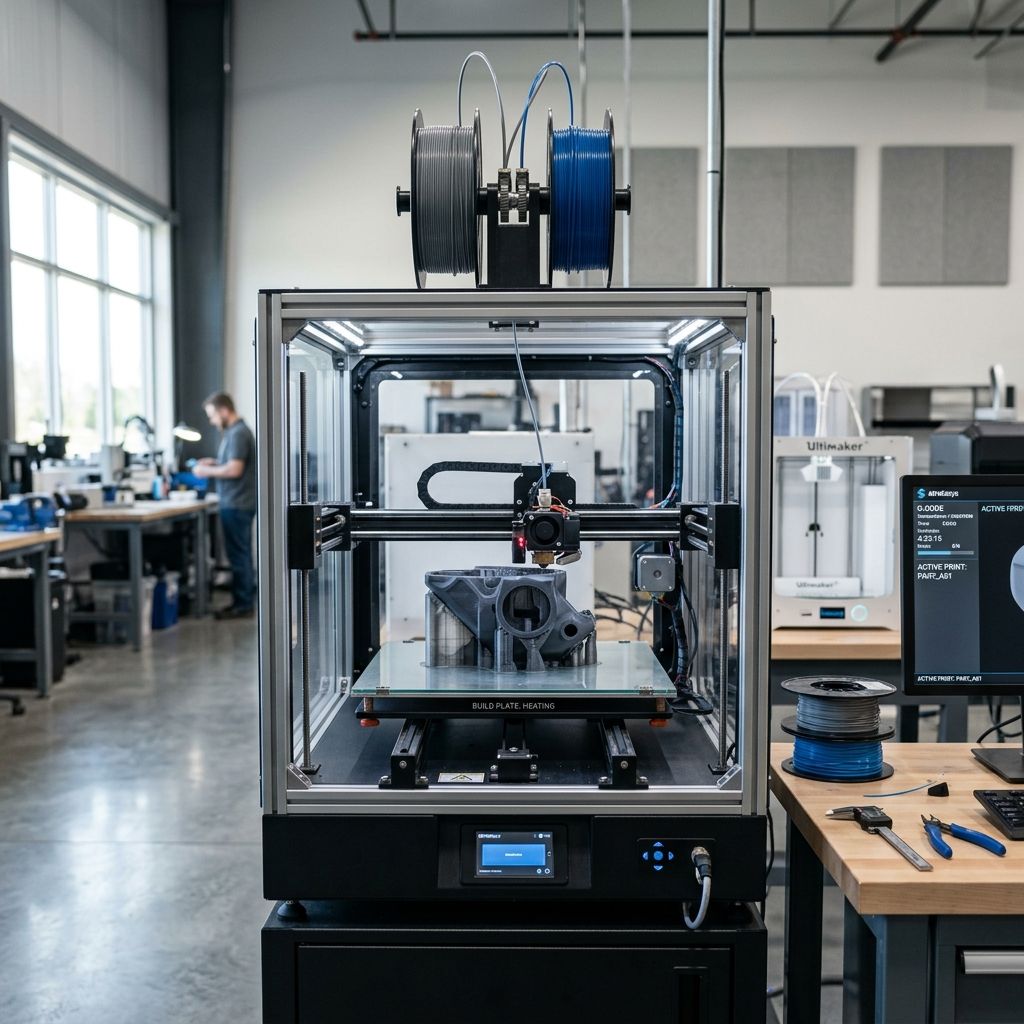
Bambu Lab X1-Carbon & X1E The Maker's Verdict After 10,000 Hours on the Floor
You don't buy a printer this fast unless you're ready to unlearn everything you thought about FDM. The X1 series isn't a hobbyist toy it's a production tool that demands respect, frequent firmware updates, and a clean build chamber. Let's talk real-world tolerances, chamber temperatures, and why the X1E might actually be the better long-term bet.
Market Position & High-Level ROI
The X1-Carbon hit the scene in 2022 like a sledgehammer. It was the first truly integrated core‑XY printer with a LiDAR bed scanner, full enclosure, and a 25 m³/s volumetric flow rate that made 300 mm/s look conservative. Two years later, the X1E arrived with hardened nozzles, higher ambient temp rating, and better filtration for engineering materials. Both machines are aimed at the prosumer/small‑batch production gap the same space Prusa tried to cover with the XL. But Bambu Lab cheated by using a heavily closed‑source ecosystem and cloud‑first architecture. For a shop floor, that's both a blessing and a liability.
- Target Market: Product designers, small‑run manufacturers, dental labs, aerospace prototyping
- ROI Sweet Spot: >500 hours of actual print time per month, materials like PAHT, PC, PPA‑CF, PEEK (limited)
- Pain Points: Proprietary AMS filament system, cloud dependency, heated chamber limited to 60°C (X1C) / 90°C (X1E)
- Pros
- Out‑of‑box speed: 500 mm/s sustained, 20,000 mm/s² acceleration (but you rarely run that)
- Motion compensation: Input shaper + pressure advance automatically tuned per filament via LiDAR scan
- Active chamber temperature control (X1E up to 90°C, X1C 60°C) critical for PA6/PC
- Closed‑loop filament flow sensing and jam detection actually works (unlike the early Prusa MMU)
- Build volume of 256×256×256 mm small but repeatable
- Cons
- Proprietary AMS you're locked into Bambu's filament spools or you hack the RFID reader
- Cloud connectivity required for full functions local‑only mode neuters the slicer integration
- X1C carbon version uses a PTFE hotend anything over 300°C will cook the PTFE liner inside
- Nozzle swapping is a nightmare the hotend assembly is finicky, and thermal paste application matters
- Open‑source aftermarket parts exist but void warranty; Bambu is aggressive about firmware locks
| Parameter | X1-Carbon | X1E |
|---|---|---|
| Max Chamber Temp | 60°C (passive) | 90°C (active heater) |
| Hotend Max Temp | 300°C (PTFE liner) | 350°C (all metal) |
| Build Plate Max | 120°C (flexible PEI) | 120°C (flexible PEI) |
| Filament Sensors | Conductive + optical | Conductive + optical + laser filament diameter monitor |
| Motion Controller | Cortex-M4 + custom ASIC | Same + enhanced thermal management |
| Filtration | Carbon filter (recirculation) | HEPA + carbon, negative pressure chamber |
Core XY Mechanics Belt Tension, Backlash, and the "Gantry Wobble"
The X1 uses a classic core‑XY layout with GT2‑6 mm belts and 9 mm linear rails on X/Y. From the factory, belt tension is often inconsistent. I've seen machines arrive with one belt at 120 Hz and the other at 75 Hz (tension meter measurement). That's a 40% difference, and you'll see it in first‑layer line quality near the corners. Field fix: Use a Klipper‑style belt tension tool (the one from the Voron community works) and aim for 100 110 Hz on both belts. The tensioning screws are under the carbon gantry cover you'll need a 2.0 mm Allen key and patience. Mind the belt alignment; the pulleys on the steppers have a slight chamfer that can force the belt to ride up if you overtighten.
Wear point: The linear rail carriages on the X axis are 12 mm wide, MGN12. They're sealed but not sealed enough carbon dust from the gantry frame (yes, the X‑beam is real carbon fiber) will eventually embed into the balls. After ~3000 hours of heavy printing with PAHT‑CF, I had one carriage that developed a flat spot. Replacing it involved pulling the entire gantry out, which is a 45‑minute job. Use dry‑lube with PTFE on the rails every 200 hours, not grease grease attracts dust.
Chamber Temperature: The Critical Difference between X1C and X1E
Let's kill a myth: the X1C does not have an active chamber heater. It uses the bed and the hotend waste heat to raise chamber temp, typically reaching 45 50°C in a 25°C room. That's fine for PLA, PETG, and even PC (if you keep the chamber closed). But for PEEK or PEKK, you need at least 80°C chamber temperature to avoid warpage and delamination. The X1E adds a 150W resistive heater with a chamber circulation fan. I've measured 85°C after 20 minutes soaking enough for PA6CF but still short of the 100°C+ needed for unfilled PEEK. Tradeoff: The X1E's heater introduces thermal expansion of the Z‑axis leadscrews. You must recalibrate the bed mesh after the chamber reaches target temp the Bambu firmware does this automatically if you use the "chamber preheat" macro in the slicer. Ignore this and you'll get first‑layer squish variation of 0.15 mm across the plate.
Also, the X1E's filtration: it uses a HEPA filter plus activated carbon. For nylon/carbon fiber, that's adequate. But for polyimide (e.g., Ultem), you need an external exhaust the VOC load will overwhelm the carbon and the filter will off‑gas in a few weeks.
LiDAR Bed Leveling Magic or Marketing?
The X1's LiDAR scanner sits on the toolhead and takes a 4×4 grid of Z‑height measurements using a laser triangulation. It's accurate to ±0.01 mm on a clean bed. Real‑world issue: If you have grease or filament residue on the PEI plate, the laser reflects differently and you'll get a false reading the printer thinks the bed is 0.03 mm higher and the first layer will be squished too hard. Clean the plate with IPA before every print. Another quirk: The LiDAR doesn't work on textured PEI sheets (the pattern scatters the laser). Bambu ships a smooth PEI sheet specifically for the X1. Use it. Also, the LiDAR module is sensitive to ambient light if your shop has direct sunlight or LED grow lights, close the enclosure cover or you'll get abort‑level errors.
I've replaced two LiDAR modules on X1C units in high‑dust environments. The laser lens gets a haze of carbon dust that reduces accuracy. You can disassemble the module (six tiny Phillips screws) and clean the lens with a q‑tip and isopropyl. The module costs $70 and takes 20 minutes to swap. Keep one in stock.
Hotend Extrusion The PTFE Liner Nightmare (X1C Only)
The X1C uses a PTFE tube inside the heat break that extends almost to the nozzle seat. This is fine up to ~290°C beyond that, PTFE starts to degrade and off‑gas toxic fumes. Worse, the tube can creep and create a gap between the tube and nozzle, causing a cold‑end plug. Field experience: I've seen users print PAHT at 310°C on an X1C the hotend survived ten hours, then the PTFE tube swelled and jammed the filament path. Replace with an all‑metal heat break from the X1E (part number XE‑001). It's a direct swap, but you have to adjust the nozzle offset in the firmware (they're 0.5 mm longer). The X1E's heat break is titanium alloy and rated for 350°C continuous. No PTFE liner, no jam.
Nozzle clogging: The X1 uses a 3 mm long nozzle tip with a 1.75 mm bore. For filled materials (carbon/glass), the nozzle wears after about 5 kg of filament. Use hardened steel (0.6 mm recommended for filled). The Bambu nozzle assembly is a complete hotend block you can swap the entire block in 30 seconds. But the block is $45. Aftermarket clones from Trianglelab exist for $20 but the thermistor resistance is off by 2%, so you'll need to re‑tune PID in the firmware (which Bambu doesn't expose). I wouldn't risk it for production.
AMS and Filament Handling The Lock‑In
The AMS (Automatic Material System) holds four spools and uses RFID to identify Bambu filaments. The RFID tags store material profile and color the printer loads the correct temperature settings automatically. Great for speed, terrible for freedom. If you use third‑party filament, you must manually set the temperature. Also, the AMS has a problematic tooth‑drive mechanism that can grind soft filaments like TPU or Flex. The drive wheels are plastic and wear down after 500 spool changes printing replacement parts in CF‑PC works as a temporary fix. The AMS also creates humidity problems: the unit is not sealed, and even with desiccant, moisture will creep in. I've had PA6 absorb 0.3% moisture in a week inside the AMS that means bubbles in the extrusion. Solution: store hygroscopic filaments in a dry box and feed them directly to the printer, bypassing the AMS. The X1E has a rear filament port that accepts a Bowden tube from a dry box.
Firmware & Slicer The Cloud Dependency That Can Bite You
Bambu Studio is based on PrusaSlicer but heavily modified. It sends print jobs over WiFi to the printer, which then prints from internal storage or via a cloud queue. The cloud service is free for now, but Bambu has announced subscription tiers for advanced features like remote monitoring. If your internet drops mid‑print, the printer continues but you can't monitor or cancel remotely. The printer has a local mode that disables all cloud features, but then you can't use the phone app or the handy webcam. My recommendation: set up a dedicated 2.4 GHz WiFi network for the printer and disable 5 GHz the ESP32 chip in the X1 has known dropouts on 5 GHz. I've also seen IP address conflicts when the printer tries to DHCP renew while printing it freezes for 30 seconds and kills the print job. Reserve the printer's MAC address in your router's DHCP table.
Maintenance Schedule from 10,000 Hours of Shop Use
Based on three X1C units and one X1E running 24/5 for two years in a prototyping shop:
- Every 200 hours: Clean linear rails with IPA, re‑lube with Super Lube 51004 (synthetic oil). Inspect belt tension. Clean LiDAR lens. Replace carbon filter if smell of melted filament appears.
- Every 500 hours: Replace nozzle (hardened steel). Clean heat break fan duct carbon dust accumulates and reduces airflow by 30%.
- Every 1000 hours: Replace X‑axis linear rail carriages if any play is felt. Replace AMS drive wheels. Clean chamber temperature sensor it gets coated with fume residue and reads 2°C low.
- Firmware updates: Wait one week after release. Early versions have had bugs that caused layer shifts on tall prints (e.g., firmware 1.06.00 gave random Y‑axis skips). Read the Bambu forum first.
Which One to Buy: X1C or X1E?
If you're printing PLA, PETG, and occasional PC get the X1C. The PTFE hotend will be fine if you stay under 290°C. Save the 600‑dollar premium. If you plan to run PAHT, PPA‑CF, or any polycarbonate blend above 70°C chamber temp go X1E. The active heater and all‑metal hotend pay for themselves in reduced warpage and no PTFE replacements. Also, the X1E's HEPA filter is essential for nylon and carbon fiber the X1C's recirculating carbon filter will just recirculate toxic fumes. For PEEK, neither is adequate you need a 120°C chamber and a heated build surface that goes to 150°C. Look at the Creality K1Max or a Voron Trident with a custom chamber heater.
Bottom line: The X1 series is the fastest production‑ready printer under $3000, but it's not turnkey. You need to maintain it, accept the proprietary ecosystem, and understand its thermal limitations. The X1E is the better industrial tool, but only if you use the conditions that justify it.
Final Workshop Warning The Moisture Sensor Lies
The X1C and X1E both have a humidity sensor inside the chamber. Ignore it. The sensor is located near the front electronics, not near the build plate. It reads 10 15% lower than actual humidity near the print surface. I've seen prints with warping at 30% RH on the sensor the actual humidity near the part was 55% because the sensor was sheltered. Fix: Install a small digital hygrometer (like the Xiaomi Temp/RH) inside the chamber, right above the bed, and watch it. Dry your filament in a separate dryer for at least 6 hours at 70°C before loading. The AMS with desiccant is a band‑aid, not a cure.
Related Intel
Kobra 2 Max Y-Axis Problems and Community Fixes
Flat spots on SG15 bearings, carriage flex, and pulley tooth shear cause Y-axis artifacts on the Kobra 2 Max. Fixes: lubricate rails, reduce acceleration, and check belt tension.
Fixing Kinematic Binding on RatRig V-Core 3.1
RatRig V-Core 3.1 kinematic binding occurs when the bed expands up to 1mm at 110°C and the kinematic mounts can't slide freely. Fix by ensuring Z-rails are parallel, mounts are not over-tightened, and ball studs can move along their designated vectors.
Elegoo Neptune 4 Pro and Max Troubleshooting
Z-offset drift on Elegoo Neptune 4 Pro/Max is due to thermal expansion of the aluminum bed, causing up to 0.4 mm height change. Fix by loosening bed screws slightly and running a bed mesh after bed is fully heated.