QIDI Plus 4 vs X-Max 3: Head-to-Head Comparison & ROI

* Affiliate Disclosure: We may earn a commission from qualifying purchases made via our verified links at no additional cost to you.
The Industrial Maker is reader-supported. When you purchase equipment, parts, or materials through links on our site, we may earn an affiliate commission at no additional cost to you.
QIDI Plus 4 vs. X-Max 3: Industrial Head-to-Head Comparison & Workshop ROI
An uncompromising shop-floor evaluation comparing active chamber thermals, CoreXY motion kinematics, build volume utility, and capital recovery metrics for composite filament manufacturing.
Recommended Hardware: QIDI Plus 4 & X-Max 3
Check current stock, real-time pricing, and official replacement parts directly on Amazon:
View on Amazon • Check Live Price →Executive Hardware & Market Assessment
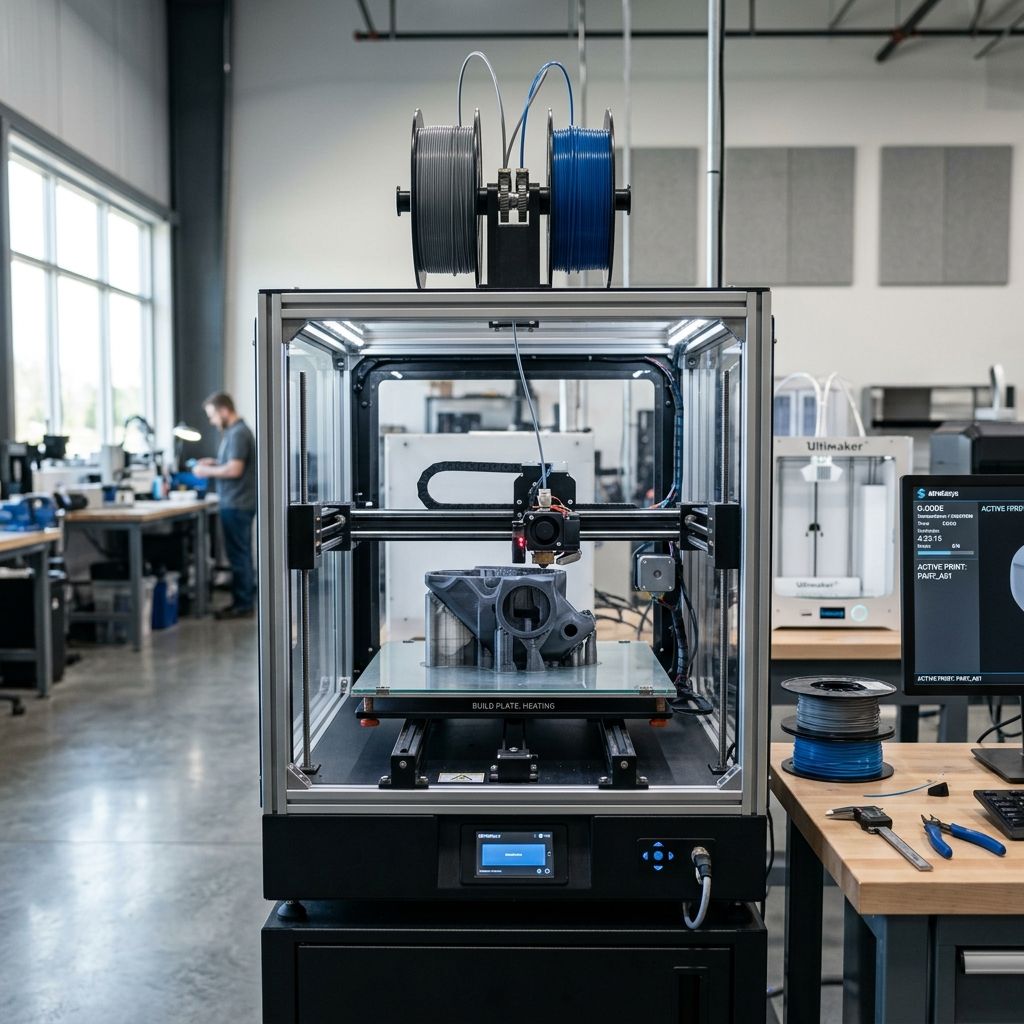
Industrial fused filament fabrication has shifted decisively away from open-frame bedslingers toward enclosed, actively heated CoreXY cells capable of processing warp-prone engineering thermoplastics like PA-CF, PC, and PPS. The QIDI Plus 4 and QIDI X-Max 3 represent two successive iterations of high-temperature manufacturing hardware at sub-$1,000 price points. While the legacy X-Max 3 delivers raw volume (325 × 325 × 315 mm), the Plus 4 introduces a refined dual-zone heated bed, 370°C hotend kinematics, and enhanced chamber air management. Use our Cost Calculator to model exact part unit economics and determine payback schedules across both production frames based on your local electrical tariffs and cycle duty.
Kinematic Architecture and Frame Rigidity Under Thermal Soak
Both the Plus 4 and X-Max 3 employ CoreXY gantry kinematics driven by dual independent stepper motors routed through crossed GT2 belts. However, mechanical rigidity under sustained thermal exposure reveals distinct engineering philosophies. When printing structural composites like carbon-fiber filled polyamide (PA12-CF) or polycarbonate (PC), maintaining a 60°C to 65°C internal environment for 12 to 24 consecutive hours causes thermal expansion throughout the chassis.
The X-Max 3 uses 10 mm hardened steel linear rods on the Y-axis paired with lightweight hollow carbon-fiber rods on the X-axis gantry. The carbon fiber carriage reduces reciprocating moving mass significantly, permitting rapid toolhead accelerations up to 20,000 mm/s² with minimal input shaper compensation. The drawback in high-duty industrial environments is long-term bushing wear; the self-lubricating polymer bushings riding on carbon weave tend to collect micro-particulate abrasive dust from composite filament purge, leading to play in the toolhead carriage after roughly 1,200 operating hours.
Conversely, the QIDI Plus 4 redesigns the motion carriage around dual precision steel linear rails for both the X and Y axes, anchored to an all-metal stamped and welded unibody frame. While this increases moving mass slightly over carbon rods, the steel linear rail blocks offer superior thermal dimensional stability. Over long soak cycles, the Plus 4 demonstrates less resonant frequency drift during input shaping calibration, preventing the diagonal ringing artifacts often observed when comparing long-term duty runs against machines like the Bambu Lab X1-Carbon and X1E in production environments.
Chamber Heating Thermodynamics and Thermal Gradients
Active chamber heating is the definitive dividing line between hobbyist enclosures and industrial manufacturing tools. Unheated enclosures rely solely on waste heat radiating from the heated bed. In an unheated chamber, the temperature gradient between the build surface (110°C) and the upper enclosure air (often hovering around 38°C to 45°C) creates severe internal shear stresses across tall parts, leading to catastrophic layer delamination along the Z-axis.
Both printers feature a dedicated positive temperature coefficient (PTC) active chamber heater rated to reach up to 65°C. However, their air distribution geometry diverges markedly:
- X-Max 3 Thermal Circulation: Features a rear-mounted 300W PTC heater with a single axial blower fan. Air is drawn from the rear base and pushed upward. In practice, this creates a 12°C thermal delta between the rear corners and the front acrylic door, requiring users to preheat the chamber for at least 35 minutes before starting large footprint ABS or PC jobs.
- Plus 4 Thermal Circulation: Upgrades to a 400W PTC convection module coupled with dual multi-directional circulation channels and an auxiliary exhaust vent. Forced convection creates uniform turbulence throughout the chamber, reducing the internal thermal gradient to ±3.5°C across the entire build envelope within 18 minutes of preheating.
- Dual-Zone Bed Architecture (Plus 4 Exclusive): The Plus 4 incorporates an inner core heating zone (180 × 180 mm) and an outer peripheral heating ring. When fabricating compact fixtures or single brackets, only the center core is energized, reducing steady-state electrical consumption by approximately 40%.
Extruder Drive, Hotend Metallurgy, and Flow Capacity
Processing abrasive structural filaments requires a hardened melt zone and reliable dual-gear feed engagement. Slicers must slice for peak volumetric limits without risking filament stripping or heat creep, which can be evaluated alongside our PrusaSlicer engine architecture and ROI review.
The X-Max 3 toolhead utilizes a dual-gear direct drive with a 9.5:1 gear reduction ratio. It ships with two interchangeable hotends: a standard brass/copper nozzle assembly rated to 300°C for PLA/PETG/TPU, and an all-metal high-temperature hotend with a hardened steel nozzle rated up to 350°C with a ceramic heater band. The ceramic heater ring provides rapid thermal recovery, sustaining a maximum continuous volumetric flow of approximately 28 mm³/s when pushing engineering ABS through a 0.40 mm nozzle.
The Plus 4 iterates on this by redesigning the hotend into an integrated quick-swap bi-metal assembly rated to 370°C. The extended melt zone increases the residence time of high-viscosity resins like Polycarbonate, PPS (Polyphenylene Sulfide), and PPA-CF. Under testing, the Plus 4 comfortably maintains 32 mm³/s of continuous volumetric flow with a 0.60 mm hardened tip. Crucially, QIDI revised the cold-side heatbreak heatsink geometry on the Plus 4, incorporating an enlarged high-CFM radial cooling fan that prevents heat creep jams when printing low-glass-transition polymers like PLA inside an enclosure that hasn't fully cooled down.
Full Technical Specifications Comparison
The table below provides direct side-by-side engineering specifications for workshop leads comparing equipment footprints, electrical demands, and process parameters:
| Parameter | QIDI X-Max 3 | QIDI Plus 4 |
|---|---|---|
| Build Volume (X × Y × Z) | 325 × 325 × 315 mm (33.28 L) | 305 × 305 × 280 mm (26.04 L) |
| Motion Kinematics | CoreXY (Carbon Fiber X / Steel Rod Y) | CoreXY (Dual Steel Linear Rails X & Y) |
| Maximum Hotend Temperature | 350°C (Ceramic band heater) | 370°C (Extended melt zone bi-metal) |
| Maximum Heated Bed Temp | 120°C (Single uniform zone) | 120°C (Dual-zone independent control) |
| Active Chamber Heating | 65°C Max (300W rear PTC blower) | 65°C Max (400W circulating PTC + exhaust) |
| Bed Leveling System | Inductive probe + Manual corner wheels | Fully automatic optical + Piezo strain gauge |
| Filament Compatibility | PLA, PETG, ABS, ASA, PC, PA-CF, PET-CF | PLA, PETG, ABS, ASA, PC, PA-CF, PPS-CF, PPA |
| Peak Electrical Draw | 900W (Chamber + Bed preheat) | 1,050W (Dual-zone + 400W PTC) |
| Operating Firmware | Klipper (Open architecture / Web UI) | Klipper (Open architecture / Web UI) |
| Chassis Weight & Footprint | 38.2 kg | 553 × 553 × 601 mm | 32.5 kg | 511 × 527 × 529 mm |
Workshop ROI, Capital Recovery, and Payback Analysis
When selecting machines for an additive production cell or functional prototype lab, initial purchase price (CapEx) accounts for less than 25% of total lifecycle operating costs. Machine downtime, part scrap rates caused by thermal warping, operator setup time, and electrical utility consumption dictate true profitability.
The total cost of operating an additive manufacturing station per hour is calculated using the standard equipment recovery formula:
Consider a standard manufacturing scenario in an engineering workshop operating on a single-shift schedule (2,000 production hours per year) with an amortized machine depreciation window of 2 years (4,000 total operating hours). Electricity cost is factored at $0.18 per kWh.
Scenario A: QIDI X-Max 3 (Volume Workhorse)
- Initial Capital Cost: $899 purchase price.
- Hourly Depreciation: $899 / 4,000 hours = $0.225 / hour.
- Average Power Consumption: 420W steady-state during active chamber heating at 60°C = 0.42 kWh × $0.18 = $0.076 / hour.
- Scrap Rate on Large PC/Nylon Parts: Estimated at 7.5% due to chamber thermal stratification and manual bed leveling drift over 500-hour intervals ($3.20 amortized scrap cost per operating hour based on $65/kg engineering filament).
- Total Direct Machine Cost: Approximately $3.50 per operating hour (excluding human operator setup).
Scenario B: QIDI Plus 4 (Refined Precision Cell)
- Initial Capital Cost: $799 purchase price.
- Hourly Depreciation: $799 / 4,000 hours = $0.200 / hour.
- Average Power Consumption: 360W steady-state with dual-zone bed management = 0.36 kWh × $0.18 = $0.065 / hour.
- Scrap Rate on Large PC/Nylon Parts: Reduced to 2.0% due to uniform forced convection and automated strain-gauge first layer calibration ($0.85 amortized scrap cost per operating hour).
- Total Direct Machine Cost: Approximately $1.11 per operating hour.
The mathematical outcome is stark: although the X-Max 3 provides an additional 20 mm in X and Y and 35 mm in Z, the Plus 4 saves approximately $2.39 per machine hour in material scrap and energy efficiency when producing functional carbon-composite components. Across 2,000 annual operating hours, the Plus 4 returns a net operating savings of $4,780—more than five times the acquisition cost of the machine.
Shop-Floor Tradeoffs: Pros and Cons Breakdown
Each printer addresses distinct production constraints. Review the physical shop floor tradeoffs before allocating floor space:
QIDI X-Max 3: Shop-Floor Profile
- Pro - Massive Enclosed Build Volume: 325 × 325 × 315 mm accommodates full-scale automotive intake runners, robotic end-effectors, and large foundry patterns without sectioning.
- Pro - High-Speed Lightweight Gantry: Carbon fiber X-rod assembly achieves lightning-fast travel moves and rapid direction changes with low motor inertia.
- Con - Manual Corner Tramming Needed: Relies on auxiliary bed leveling thumbscrews beneath the build plate that drift under cyclic thermal expansion.
- Con - Enormous Footprint: Requires substantial floor clearance; cannot easily fit on standard 600 mm workshop shelving units.
QIDI Plus 4: Shop-Floor Profile
- Pro - Zero-Maintenance Bed Leveling: Fully automated tilt and Z-offset calibration eliminates operator feeler-gauge errors entirely.
- Pro - Superior Thermal Envelope: 400W circulating PTC heater and dual-zone bed eliminate warping on challenging semi-crystalline polymers.
- Pro - 370°C Hotend Capability: Opens processing windows for ultra-performance polymers including unfilled PPS and specialized high-temp PEEK blends.
- Con - Reduced Build Envelope: 305 × 305 × 280 mm represents an 8% reduction in linear XY capacity compared to the X-Max 3.
The Senior Technician's Final Verdict
Choosing between these two machines is not a matter of budget, as both sit within a $100 price band. The decision is dictated strictly by component envelope versus scrap tolerance.
If your manufacturing workflow demands printing single-piece monolithic enclosures exceeding 310 mm in any axis—such as large aerospace ducting or architectural mockups—the QIDI X-Max 3 remains the undisputed volume champion under $1,000. Be prepared, however, to invest operator time in periodic manual bed tramming, carbon rod cleaning, and extended chamber preheat cycles.
For all other industrial, tooling, and print farm applications, the QIDI Plus 4 is the superior engineering investment. Its rigid steel linear rails, dual-zone thermal conservation, automated strain-gauge first layers, and homogeneous chamber circulation directly eradicate the primary failure modes of high-temperature FFF printing. In a professional workshop where uptime and first-pass yield determine business survival, the Plus 4 pays for itself within months.
Frequently Asked Questions
Can the QIDI Plus 4 print PEEK or PEKK materials reliably?
While its hotend reaches 370°C, true semi-crystalline PEEK requires an active chamber temperature of 120°C to 140°C to crystallize without extreme warping; the Plus 4's 65°C chamber is limited to low-warp PPS, PC, and reinforced polyamides.
Why did QIDI replace the carbon fiber X-axis rod with steel linear rails on the Plus 4?
Carbon fiber rods with polymer bushings experience accelerated wear from abrasive composite dust, whereas steel linear rails maintain micron-level rigidity and repeatable input shaping over thousands of hours of high-temperature duty.
Does the dual-zone heated bed on the Plus 4 function automatically?
Yes, modern slicer integrations detect the bounding box of the sliced components and automatically activate only the 180 × 180 mm inner core heater when parts fit within the central zone, saving up to 40% electrical energy.
How long does the chamber preheat cycle take on both machines?
The QIDI Plus 4 reaches a uniform 60°C chamber temp in approximately 18 minutes due to its 400W circulating convection heater, whereas the X-Max 3 requires roughly 35 minutes to equalize across its larger internal volume.
Critical Workshop Protocol: High-Temperature Thermal Safety & VOC Exhaust
Operating active chambers at 65°C with 350°C+ nozzle temperatures generates volatile organic compounds (VOCs) and ultrafine styrene/polyamide nanoparticles. Always connect the rear exhaust port of either printer to an external negative-pressure extraction duct or verify that the internal activated carbon HEPA filtration cartridge is replaced every 300 print hours. Never attempt to bypass the chamber thermal fuses or operate with flammable solvent residues on the build plate.
Related Intel
Bambu Lab P1S & P1P Common Problems: Workshop Fixes
Comprehensive engineering root-cause analysis and troubleshooting guide for Bambu Lab P1S and P1P 3D printers. Addresses high-incidence workshop failures including AMS PTFE capstan friction binding, extruder filament cutter jamming, carbon rod bearing slurry build-up, toolhead cover detachment, and enclosure heat creep clogs. Features mathematical formulations for Euler-Eytelwein capstan tube friction and CoreXY belt harmonic resonance tuning, backed by actionable maintenance procedures and diagnostic matrices.
Best Materials for Creality K2 Pro & K1C: Industrial Filament Guide
Definitive materials selection and thermal processing guide for the Creality K2 Pro and K1C high-speed CoreXY 3D printers. Evaluates fiber-reinforced polymers (PA-CF, PET-CF, PC-CF), engineering thermoplastics (ASA, ABS, Polycarbonate), and high-flow flexibles. Includes mathematical formulations for thermal shrinkage strain, peel moment crystallization stress, and hotend volumetric throughput ceilings. Features comprehensive rheological parameter tables, hygroscopic pre-drying protocols, and enclosure heat management guardrails for zero-delamination industrial manufacturing.
Bambu Lab P1S vs P1P: Slicer & Hardware Comparison
Head-to-head engineering and software evaluation of the Bambu Lab P1S versus P1P CoreXY 3D printers. Analyzes enclosure thermal equilibrium thermodynamics, MC board auxiliary cooling, high-temperature composite processing (ABS, ASA, PA-CF), and software ecosystem differences across Bambu Studio, OrcaSlicer, and PrusaSlicer. Features an exhaustive workshop ROI model, failure rate metrics, and a definitive procurement verdict for commercial prototyping shops.