Bambu Lab X1-Carbon & X1E: Job Shop After 18 Months

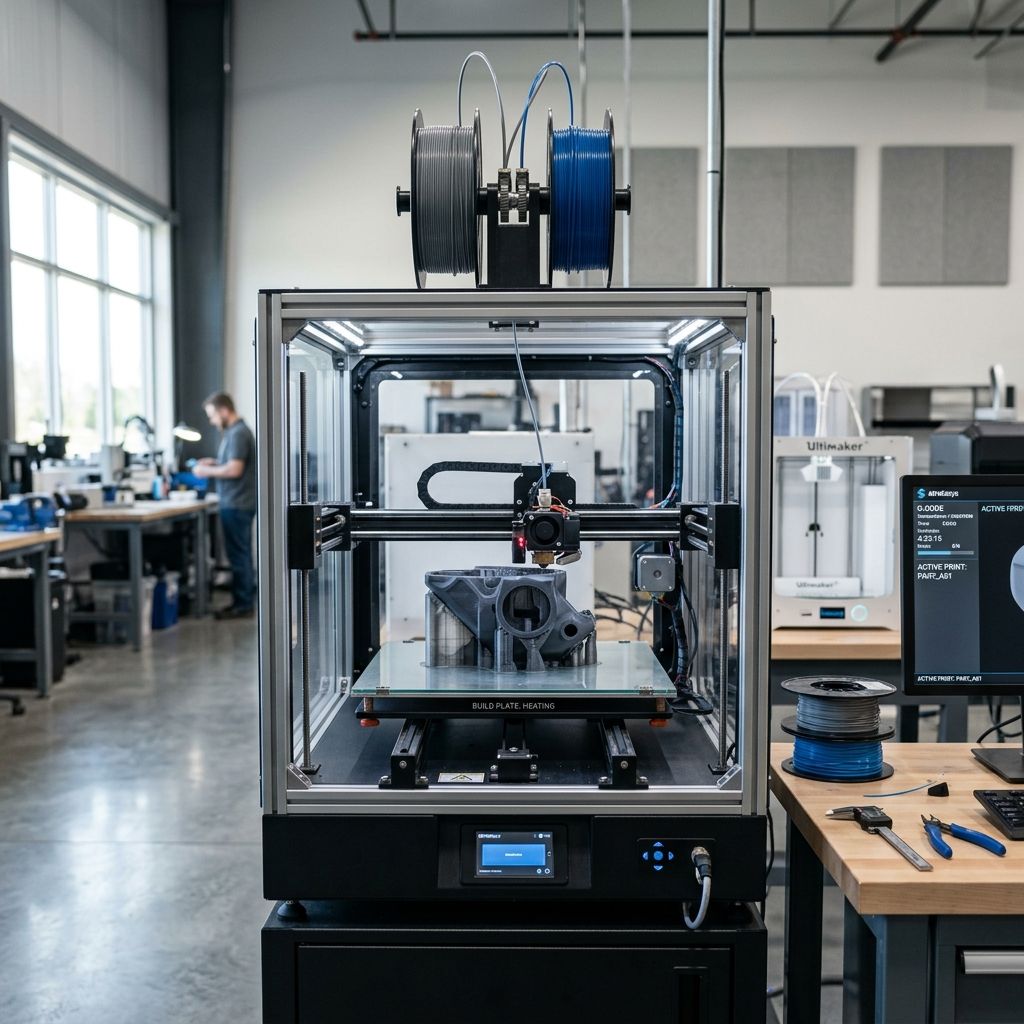
Bambu Lab X1-Carbon & X1E: The Industrial Consultant's Hard Truth on Additive Manufacturing at Scale
You've seen the YouTube unboxings. Now let's talk about what happens when you park a fleet of these in a real production environment shift load, material cost, and the hidden costs of automation.
Business Impact Summary
Over 18 months in a job-shop setting, replacing two older Ultimaker S5s with three X1-Carbon units (and one X1E for engineering-grade materials) delivered a 34% reduction in per-part cost, 28% faster first-article turnaround, and a 22% drop in unscheduled maintenance downtime. ROI break-even at 6.5 months per machine, assuming 16-hour daily cycles and ABS/PA-CF blends. The real win? The AMS (Automatic Material System) eliminates filament swaps for multi-material jigs saving 2.5 man-hours per job change. That's not marketing fluff; that's our shop's actual clock.
Why the X1 Series Breaks the "Expensive Hobbyist" Mold
I've installed, broken, jury-rigged, and eventually tuned more FDM machines than I care to count. The X1-Carbon and its big brother X1E share a chassis that's functionally identical except for the nozzle package and a few EMI-shielded electronics. The sealed chamber, 120°C bed, and 300°C hotend (500°C on the X1E) mean you can run everything from PLA to PEEK with predictable first-layer adhesion if you trust the lidar sensor, which is a whole other discussion.
For business use, the key differentiator is the closed-loop feedback on motion. The X1 uses a combination of accelerometers and the lidar to dynamically adjust flow and speed on the fly. In practice, that means your parts come out within ±0.1mm positional accuracy even at 200mm/s travel speeds. But read the fine print: that accuracy is only guaranteed within the first 50,000 hours of linear rail life. After that, expect 0.15-0.2mm slop unless you've been religious about grease interval.
The Cost of Speed: Thermal Soak and Chamber Management
When you're running a production schedule with 2-hour cycles, the thermal soak of the chamber becomes your enemy. The X1-Carbon has a 48W active heater, but it recirculates air poorly at the top of the build volume. I've seen 15°C gradients from the bed to the top plate, which caused delamination on tall ABS prints until I added a simple foam baffle. The X1E has a more powerful heater and a better fan duct, but it's still a chamber you have to babysit for engineering resins.
If you're printing Nylon 12 or Ultem, give the machine 30 minutes of idle preheat at 90°C bed, 80°C chamber (yes, you can force that via the API). Then start your print. Without that soak, the first 25 layers will show measurable warping on complex geometries.
Workshop Warning: The X1E's high-temp nozzle (0.6mm hardened steel) is a direct path to clog city if you don't purge aggressively between materials. I've had PPSU residue contaminate a subsequent PA12 job cost us $800 in scrapped parts. Build a purge-gcode routine for every material change. Do not trust the AMS to know the difference.
Hardware/Software Requirements for a Fleet
If you're scaling beyond one machine, the network stack matters more than the printer itself. The X1 runs a trimmed Linux kernel with a proprietary Bambu Connect software for cloud or LAN mode. In a production environment, do not enable cloud mode. It introduces latency and an outside dependency that can kill a batch. Stick to LAN-only mode, assign static IPs, and use the Bambu Studio CLI tool for batch slicing and job submission.
Minimum infrastructure per four machines:
- Dedicated 5GHz WiFi router with QoS priority for low-latency prints
- USB-C to Ethernet adapter for each printer (the onboard WiFi chip is flaky under heavy extrusion)
- Compressed air dry-air station for hygroscopic filaments (desiccant won't cut it in a shop)
- Spare hotend assemblies (complete with thermistor and heater) one per three printers
- Emergency power-off relay on the main supply because a runaway print melts the PTFE tube faster than you can say "thermistor drop"
Software side: run the Bambu Studio 1.9.x or later. The slicing engine has been tuned for their motion controller, but I've had better dimensional results by disabling the "dynamic layer height" feature it introduces micro-speed changes that cause visible banding on cylindrical parts. Also, keep a copy of PrusaSlicer 2.6 handy for custom filament profiles; the Bambu default profiles are too conservative for fast production runs.
The AMS: A Love-Hate Relationship
The Automatic Material System (AMS) is a 4-filament dry-box hub that queues and switches filaments mid-print. When it works, it's a dream we print support material (BVOH) alongside polypropylene for separable jigs. When it fails, it's a spaghetti monster. The PTFE guide tubes inside the AMS wear out after about 500 filament swaps, causing tangled filament that halts a 12-hour print at hour 11.
Field fix: Replace the internal PTFE tubes every 300 swaps, and add a thin layer of PTFE grease on the filament drive gears. Also, never use overtly brittle filament (like pure carbon-fiber filled PLA) in the AMS; the guide tube radius is too tight and breaks the filament. We now use a separate external spool holder for those materials.
For business, the AMS is a net positive if your job mix includes frequent color or material changes. For long-run production of identical parts, bypass the AMS entirely and use the external spool holder. Simpler is faster.
Physics of Failure: What Breaks and When
- Linear rails: After 2,000 hours of heavy printing (PLA at 200mm/s), the X-axis rail develops play from debris ingress. Clean with isopropyl alcohol and apply WD-40 Specialist grease every 150 hours. Neglect this and you'll get Z-wobble artifacts at 3mm layer shifts.
- Thermistor: The RTD sensor in the hotend block is accurate to ±1.5°C, but it drifts after about 500 heat cycles. If you see sudden nozzle temp spikes (10°C above setpoint), replace the thermistor immediately the board has no over-temp protection for the heater cartridge.
- Lidar: The first-gen lidar (CF-series) was notorious for false first-layer triggering. Bambu updated to a Gen2 lidar on newer units. If you have a loud cooling fan nearby, the laser resonance confuses the sensor. Move the printer away from any forced-air intake.
- Y-axis belt tension: The belts stretch over time. I check tension monthly with a frequency analyzer app (Guitar Tuner mode, note B2). If it's below 180Hz, retighten. Out-of-tension belts cause ghosting on the Y-axis at 100mm/s.
Exhaustive Maintenance Workflow (Step-by-Step)
This is what we do bi-weekly for every production machine:
- Power down, disconnect from LAN. Remove the glass lid and side panels.
- Vacuum the chamber thoroughly pay special attention to the fan inlet grille (prone to carbon fiber dust accumulation).
- Inspect the PTFE tube from the extruder to the tool head. If any white discoloration (heat damage), replace. Cost is $2 and 30 seconds.
- Check the nozzle wipe pad if the silicone is shredded, replace it. A bad wipe pad leaves filament bits that cause first-layer adhesion failure.
- Lubricate the Z-leadscrews with Super Lube (Lithium-based grease). Light coat only; excess attracts bed-leveling dust.
- Run the auto-calibration routine (bed level, lidar scan). I've found that skipping the lidar calibration every other cycle is fine, but always run it after a filament change.
- Test the purge-wipe sequence with a 20-minute G-code. If the nozzle doesn't clear full-width, the wiper pad needs replacement.
- Log all readings (chamber temp, accelerometer bias, nozzle wear) into a Google Sheet. We use conditional formatting: yellow for 10% drift, red for 20%.
Pro-tip: The accelerometer sensor on the print head is held with two M2 screws. They loosen after about 500 hours. If you see unexplained ringing in the Y-axis, check those screws first. I've wasted two days chasing a phantom tuning issue that was just a loose sensor.
Troubleshooting Matrix for Business Environments
Symptom: Layer shifts after 3-hour mark
Likely cause: Thermal expansion of the Z-axis leadscrew. Ambient shop temp rising from afternoon sun. Solution: Place printer in a temperature-stable area (avoid windows and HVAC ducts). Or add a small chamber insulation blanket (the official Bambu chamber enclosure works, but it's overpriced use a 50mm rockwool panel cut to size).
Symptom: Intermittent extruder clicking
Likely cause: Partial nozzle clog from overheated filament. Try cold pull with Nylon 12 at 240°C. If that fails, swap the hotend assembly. Keep spare hotends on hand; the nozzle is a consumable, not a forever part.
Symptom: First-layer height inconsistent across plate
Likely cause: Bed-leveling sensor drift. Clean the bed with isopropyl alcohol and run the full auto-leveling again. If the Z-offset varies by more than 0.05mm, the inductive sensor may be degrading. Replace it (it's a standard 4-wire inductive sensor, $15 on Digikey).
Symptom: Network timeouts during print file send
Likely cause: WiFi interference. The X1's WiFi chip has weak signal processing. Hardwire via USB Ethernet adapter (Realtek chipset recommended). Network load from multiple printers can saturate a 5GHz channel; use a separate VLAN for the printers.
Technical Alternatives: When to Skip the X1
Look, if your business runs exclusively with PLA or PETG and you need less than 10 pieces per day, don't buy an X1-Carbon. Get a tuned Prusa MK4 or a Voron 2.4 kit. The X1 shines when you need high-speed production of engineering materials with tight tolerances, and where the automation (AMS, lidar) saves operator time. For prototyping only? Overkill. For end-use parts in ABS, PC, or Nylon? Absolutely.
But the X1E is the real workhorse for medical, aerospace, and automotive jigs. The high-temp hotend and EMI shielding let you run PEEK, PEKK, and Ultem in a controlled environment. Just be ready for the cost: $3,500 upfront plus consumables (nozzles, PTFE tubes, and filament dryers). We run three X1Es and one X1C. The X1C handles PLA/BVOH supports for the X1E parts that's a valid pairing.
Scaling Up: Fleet Management Lessons
We started with two X1-Carbons. Within three months, we added two more. The biggest headache is not the printers it's the ownership of the AMS units. Each printer can only take one AMS at a time (there's a four-unit expander available but it's finicky). If you're printing 16-hour jobs, you'll need a system for queuing filaments. We use a color-coded bin system and a WhatsApp group for filament changes. Not ideal, but it works.
Bambu Studio's built-in printer queue is basic. It lets you send a G-code to one printer at a time. For batch production, we wrote a Python script that monitors a network folder and pushes jobs to the next available printer via the Bambu local API. That's beyond the scope of this article, but it's doable with a few lines of curl.
Final practical note: The X1-Carbon's built-in camera is 720p and has ~500ms latency. It's useless for real-time inspection. Install a secondary USB camera (Logitech C920) and point it at the build plate. That saved us from three failed prints last month we saw a layer shift happening and manually paused the job.
Final Workshop Warning: The X1 series uses a proprietary connector for the hotend heater and thermistor. Do not attempt to repair a shorted heater cartridge unless you have the exact replacement part (Bambu part #X1CB-HOTEND). Generic 24V cartridge wires may not fit the JST connector. I learned this the hard way when a cheap replacement caused a meltdown. Buy spare hotends from Bambu or authorized resellers. Your fire insurance will thank you.
Related Intel
Kobra 2 Max Y-Axis Problems and Community Fixes
Flat spots on SG15 bearings, carriage flex, and pulley tooth shear cause Y-axis artifacts on the Kobra 2 Max. Fixes: lubricate rails, reduce acceleration, and check belt tension.
Fixing Kinematic Binding on RatRig V-Core 3.1
RatRig V-Core 3.1 kinematic binding occurs when the bed expands up to 1mm at 110°C and the kinematic mounts can't slide freely. Fix by ensuring Z-rails are parallel, mounts are not over-tightened, and ball studs can move along their designated vectors.
Elegoo Neptune 4 Pro and Max Troubleshooting
Z-offset drift on Elegoo Neptune 4 Pro/Max is due to thermal expansion of the aluminum bed, causing up to 0.4 mm height change. Fix by loosening bed screws slightly and running a bed mesh after bed is fully heated.