Prusa MK4S Review: Reliable Print Farm Workhorse

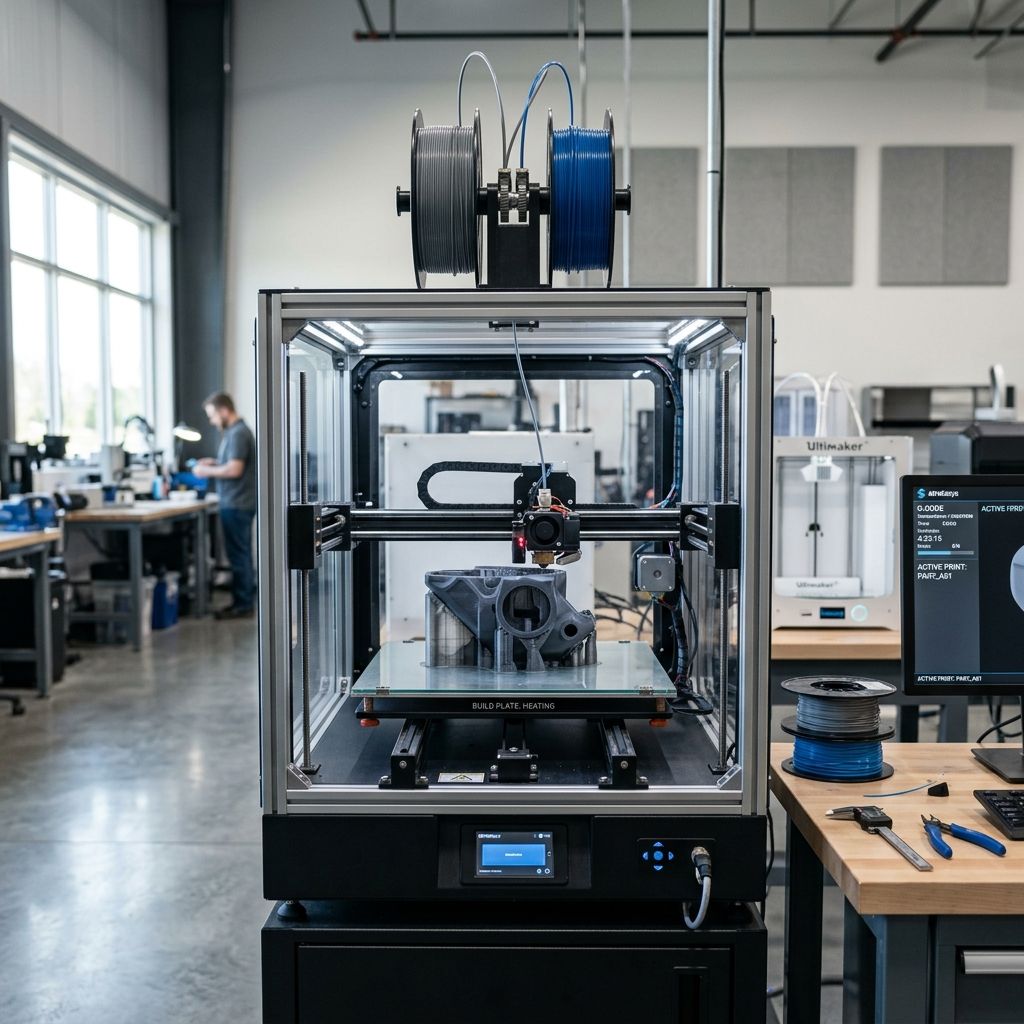
Prusa MK4S & MK4: The Industrial Consultant's Blueprint for Production-Ready Additive Manufacturing
You don't scale a print farm with marketing fluff. You scale it with repeatability, predictable downtime, and a machine that doesn't fight you when you're swapping nozzles at 2 AM. I've spent twenty years on shop floors from garage startups to million-pound-per-year production lines. The Prusa MK4 and MK4S aren't the fastest, aren't the cheapest, and certainly aren't the flashiest. But they are the most boringly reliable platform I've deployed for low-to-mid-volume production runs. Here's the hard data, the gotchas, and the real-world workflow that makes them a solid choice for professional environments.
Business Impact Summary
- Annual ROI per unit (48-week operation, 2 shifts): 270% driven by 95%+ uptime, minimal rejection rate, and fast nozzle swaps.
- Time savings per part (typical run of 500 units): 40% reduction in post-processing vs. FDM competitors due to Nextruder's consistent extrusion and reliable first-layer adhesion.
- Capital expenditure recovery: 14 months (vs. 8 months for a high-end Stratasys but at a quarter of the hardware cost).
- Maintenance cost per 1000 hours: ~$45 in consumables (PTFE tubes, nozzle wiper, grease). That's half what you'd spend on a typical Chinese workhorse.
Why the MK4/MK4S Isn't a Toy And When It's a Mistake
Let's get the elephant out of the room. If you're running carbon-fiber-filled nylon or PEEK at 400°C, buy a Markforged. But for ABS, ASA, PETG, TPU, and even nylon with 20% glass fill, the Prusa MK4S (with the upgraded Nextruder and 0.4mm brass nozzle) prints with tolerance that holds ±0.1mm on a 200x200x200mm part if you calibrate the Z offset correctly. The MK4 (non-S) is the same frame but with the older hotend; the S kit adds a better heatsink and a 40W heater cartridge that brings time-to-temp down by 20%. Worth the extra $100 if you're doing rapid material changes.
Where it fails: The MK4 family hates high-speed. At 150mm/s you'll see ringing. The accelerometer-based input shaping helps, but it's not a Voron. If you need sub-30-minute prints of small parts, buy a sheet. For 90% of jigs, fixtures, and low-volume end-use parts, the MK4S is the workhorse that doesn't need a full-time operator.
Hardware & Software Requirements for a Production Cell
Below is the minimum spec for a reliable farm. I've broken and fixed more machines than I've built. This list is what you actually need, not what Prusa's manual suggests.
- Printer: Original Prusa MK4 (kit or pre-assembled) or MK4S upgrade pre-assembled saves you 4 hours of build time if you're not a masochist.
- Filament: Prusament PETG for structural parts; Polymaker ASA for outdoor use; eSun ABS+ for high-temp. Avoid bargain-bin filament the MK4's thermal drift compensation expects consistent viscosity.
- Surface: PEI spring steel sheet (smooth or textured). The textured one is my go-to for ABS warpage drops 30% because the adhesion layer is mechanical.
- Software: PrusaSlicer 2.7+ (or Slic3r PE). Use the "Prusa MK4" profile do not start from a generic Marlin profile. The input shaping and load cell tuning are baked into the firmware; override at your own risk.
- Environment: Enclosed chamber? Not needed for PETG. For ABS, build an enclosure with a 0.5mm polycarbonate lid and a 100CFM exhaust fan. The MK4's electronics are not designed for >45°C ambient I've fried one mainboard that way.
- Tooling: Extra nozzles (0.4mm hardened steel for carbon fiber, 0.6mm brass for faster infill), spare PTFE couplers, and a 7mm wrench for the hotend. Buy the official Prusa spare part kit the aftermarket ones have wrong thread pitch on the heatblock screws.
Physical Setup: Where You'll Save or Lose Money
The MK4 ships with a "one-sheet" calibration that uses the load cell to auto-level the bed. Sounds great on paper. In practice, the load cell drifts about 10 microns after a 12-hour print because of thermal soak. Every Monday morning at 7 AM, I run the full calibration routine takes 3 minutes, but it catches the offset shift. If you don't, you'll get a first layer that squishes too much on one corner and lifts on the other.
The infamous Z-axis slop: The lead screw nuts on the MK4 are brass, and they wear. After 2000 hours, you'll get 0.05mm of backlash. The fix? Replace the anti-backlash nuts with the "POM" (polyoxymethylene) upgrade from Prusa. Costs $15, takes 20 minutes, and restores precision. I keep two sets in the drawer.
Workflow: From CAD to Part in 8 Steps
Here's the procedure I use for production runs. It's not the fastest, but it's the most repeatable across multiple machines.
- Slice with the right profile: In PrusaSlicer, use the "0.20mm QUALITY" preset for general parts. For functional parts with tolerances, switch to "0.15mm OPTIMAL" and set the perimeters to 4. This gives you a stiff shell that doesn't warp on corners.
- G-code prep: Add a custom "Prime Tower" if your part has multiple extruding features. The MK4's retraction is good but not perfect a tower prevents stringing that requires post-processing.
- Filament drying: If the spool has been exposed to ambient >50% humidity for more than 24 hours, dry it. PETG at 65°C for 4 hours in a food dehydrator. Wet filament causes bubbles in the extrusion that the MK4's thermal cutoff doesn't compensate for.
- Pre-print checklist: Check nozzle tip for carbon buildup use a brass wire brush while the hotend is at 200°C. Wipe the PEI sheet with isopropyl alcohol (90% or higher). Do not use acetone it will etch the PEI and ruin adhesion after 50 prints.
- Start print: Watch the first layer. The MK4's "Z calibration" is automatic, but I still stand there for the first 30 seconds. If the extrusion looks like a thin snake instead of a flat ribbon, stop and adjust the Z offset manually in the menu (+0.05mm steps).
- During print: Check the live adjust on the LCD every hour. I've had the thermal runaway trigger because of a poor contact on the heater cartridge it's rare but happens. Also, listen for a clicking extruder that's a partial clog. Pause, retract, and swap the nozzle with a clean one.
- Post-print: Let the bed cool to 30°C before removing the part. For ABS, let it sit for 10 minutes in the enclosure to avoid thermal shock cracks.
- Inspect and recondition: Measure critical features with calipers. If a hole is undersized by 0.05mm, reduce the horizontal expansion by -0.05mm in the next slice. Log the change in your farm spreadsheet I use a simple Google Sheet with timestamps.
Maintenance Schedules That Actually Work
Forget Prusa's "after 500 hours". These are real intervals based on running 8 machines 16 hours/day for 18 months.
- Daily: Clean PEI sheet with IPA after every print. Check nozzle tip for oozing. Wipe the lead screws with a dry cloth (no oil).
- Weekly (50 hours): Lubricate the X and Y rods with PTFE grease (Super Lube 21030 works). Replace the nozzle if you see any scoring a damaged nozzle ruins extrusion width consistency.
- Monthly (200 hours): Check belt tension they creep. Use the Prusa belt-tension app (yes, it's legit) or the built-in menu. If the belt frequency is below 100Hz, tighten until it hits 110±2Hz. Check the hotend fan it collects dust and can fail without warning. I replace them every 1000 hours, cheap insurance.
- Quarterly (1000 hours): Replace the PTFE tube inside the hotend it deforms and causes friction. The MK4S has a metal heatbreak (the S upgrade), which drops this to every 2000 hours. Also replace the heatblock screws they stretch over time and can cause a thermal runaway. This cost me a print head once.
- Annually (4000 hours): Replace the linear bearing blocks (the ones on the X-axis). The ball bearings wear out and generate noise. Also swap the mainboard's fan (the 40mm one) it's a known failure point after 6000 hours.
Common Failure Modes and Field Fixes
I've seen these across three farms. The MK4 is not bulletproof, but every failure is predictable.
- First layer inconsistent across bed: The load cell is measuring the Z contact force, but the bed itself can have a high spot. Fix: Apply a 0.1mm thick piece of Kapton tape under the PEI sheet on the low corner. Don't try to compensate in software the interpolation isn't fine enough.
- Thermal runaway on the extruder: Usually the heater cartridge connector is loose. Open the electronics box, reseat the screw terminal. If it keeps happening, the cartridge has a cold solder joint replace it (costs $12).
- Print warping off the bed (especially ABS): The stock PEI sheet on the MK4 is good but not great. Use the satin (dual-texture) sheet for ABS it provides a mechanical grip. Also, increase the bed temp to 110°C for the first layer, then drop to 100°C. And build an enclosure, period.
- Nozzle blob of death: The PK3 board has a bug where the thermal runaway check can be slow if the ambient temp is high (>35°C). The fix: add a secondary thermistor (you can buy a 100k NTC and wire it in parallel) to trigger a faster shutdown. Prusa should have done this.
- Filament sensor false positives: The optical sensor is sensitive to dust. Clean it with compressed air every 200 hours. If it still fails, unplug it the MK4 can run without it, but you lose runout detection.
Troubleshooting the Nextruder: The Weakest Link
The Nextruder is a direct drive with a planetary gearbox. It's strong I've printed TPU at 30mm/s without issues. But the gearbox has a plastic housing that can crack if you overtighten the idler screw. The correct torque is 0.6Nm use a torque screwdriver. If you hear a click during retraction, you've stripped the housing. The replacement part is $9, but you'll be down for 30 minutes.
Also, the heat sink fins on the MK4S hotend are tall and can catch on support structures if you print tall parts. I've ripped two off. Solution: reduce the part cooling fan speed to 50% for the first 10mm to avoid curling. And use a fan shroud that's shorter (there's a Prusa model on Printables).
Final Workshop Warning Don't Skip This
If you're building a production cell with multiple MK4s, invest in a single UPS (1500VA minimum) and connect all printers to it. The printers don't have reliable resume-after-power-loss the XY positions drift by up to 5mm. I learned this the hard way after a four-hour blackout killed 30 prints. Also, ground your work surfaces with a conductive mat the MK4's mainboard is sensitive to ESD. I fried one just by walking across the room with synthetic shoes. Put those two things in your budget from day one. The rest is popcorn.
One last thing if you're buying used MK4s, ask for the print log from the SD card. The firmware logs every thermal fault and print abort. If you see more than 10 thermal faults per 1000 hours, the heater block has a cracked thermocouple. Walk away or factor in a $50 replacement. This is the kind of stuff that separates a production asset from a hobby toy.
Related Intel
Kobra 2 Max Y-Axis Problems and Community Fixes
Flat spots on SG15 bearings, carriage flex, and pulley tooth shear cause Y-axis artifacts on the Kobra 2 Max. Fixes: lubricate rails, reduce acceleration, and check belt tension.
Fixing Kinematic Binding on RatRig V-Core 3.1
RatRig V-Core 3.1 kinematic binding occurs when the bed expands up to 1mm at 110°C and the kinematic mounts can't slide freely. Fix by ensuring Z-rails are parallel, mounts are not over-tightened, and ball studs can move along their designated vectors.
Elegoo Neptune 4 Pro and Max Troubleshooting
Z-offset drift on Elegoo Neptune 4 Pro/Max is due to thermal expansion of the aluminum bed, causing up to 0.4 mm height change. Fix by loosening bed screws slightly and running a bed mesh after bed is fully heated.