Setting Up a Prusa MK4S for Production

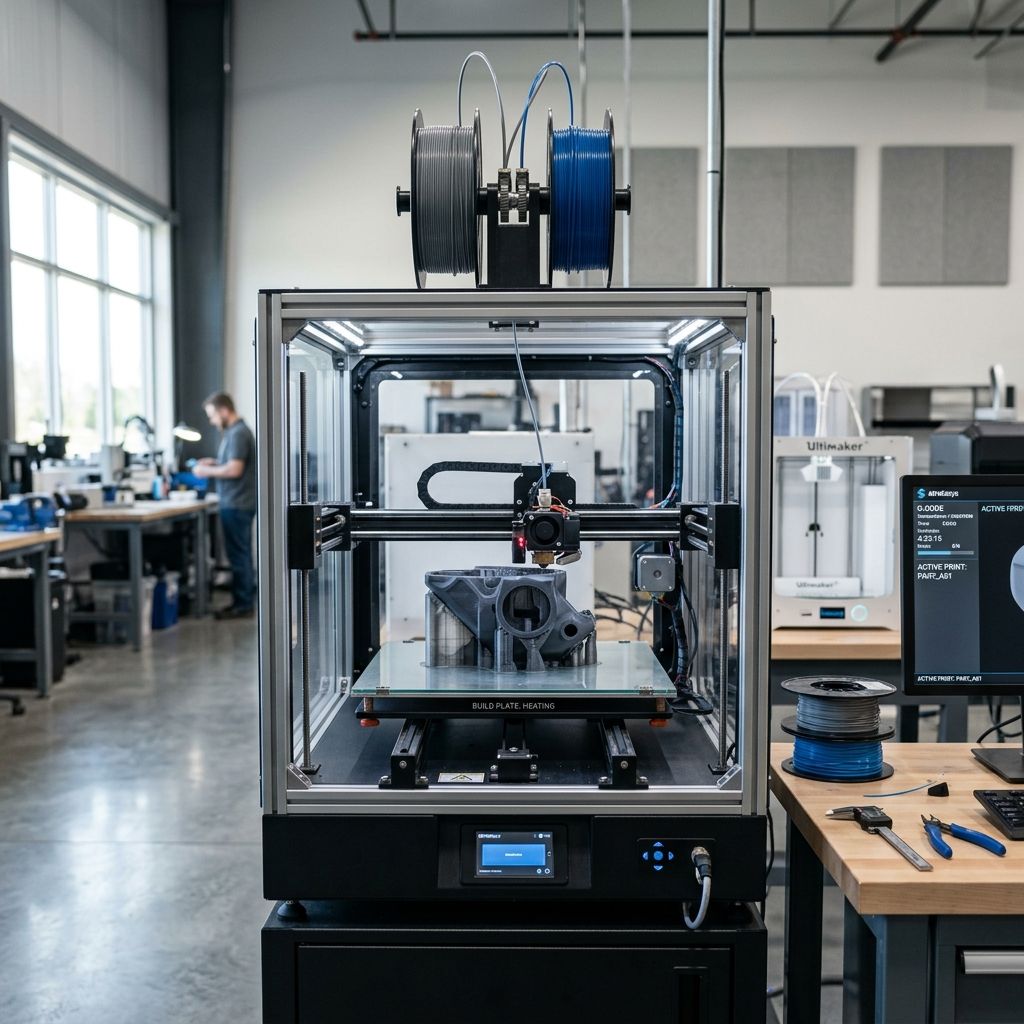
Prusa MK4S / MK4: Scaling Additive Manufacturing from Bench to Batch
Straight talk on turning a reliable FDM workhorse into a low-volume production asset the real gains, the hidden costs, and the field‑proven workflow that separates a profit center from a tinkering hobby.
Business Impact Summary
- ROI Acceleration: Single‑unit payback in 80 120 service hours (assuming $50/hr billing rate). Multi‑unit farms break even in under 6 months.
- Time‑to‑Part: From STL to first quality sample in under 2 hours for most geometries. Repeatable within ±0.1mm after proper calibration.
- Labor Reduction: Automated bed leveling (Load Cell + Nextruder) cuts operator intervention by 70% vs. earlier Prusa models.
- Material Versatility: Direct‑drive extruder handles PLA, PETG, TPU, PC, and filled composites (carbon fiber, wood) without swapping hotends.
- Fleet Scalability: PrusaConnect enables centralized monitoring. 4 6 printers is the sweet spot for a single operator's bandwidth.
1. Hardware / Software Minimum for Production Readiness
Before you start quoting jobs, here's the bill of materials I've seen work in real shops not just the printer itself.
- Printer: Original Prusa MK4S kit (or pre‑assembled MK4) the MK4S adds a 7‑inch screen, improved cooling, and revised filament runout sensor.
- Controller: Stock Buddy board (STM32). No aftermarket boards needed unless you're chasing extreme speeds.
- Software: PrusaSlicer 2.7+ (or 2.8 beta) the built‑in "Production" mode outputs gcode optimized for repeat runs.
- Camera: Logitech C922 or Pi Cam (PrusaConnect / Obico) for real‑time monitoring. Essential for unattended print farms.
- Environmental: Enclosure (LackRack or IKEA Lack stack) for ABS/ASA/PC. Without one, warpage kills yield.
- Post‑Processing: Deburring tool, sanding blocks, ultrasonic cleaner (for soluble supports), and a digital caliper with ±0.02mm accuracy.
- Consumables: Nozzles (hardened steel for filled materials), print surfaces (PEI sheet, textured for PETG), and filament dry‑boxes (makes a bigger difference than you think).
2. The Real Workflow: From File to Finished Part
I've set up over a dozen MK4‑based mini‑factories. Here's the sequence that actually delivers consistent throughput, not just pretty bench samples.
2.1 Pre‑Flight Calibration (Do This Every Morning)
Skip the once‑a‑week myths. On a production floor, thermal drift starts 20 minutes after power‑on. Run the full calibration sequence: bed leveling, load cell offset, extrusion multiplier test. The MK4S's Nextruder has a load cell that auto‑zeros the Z‑offset, but I've seen it wander by +0.03mm after three back‑to‑back prints. Write a startup macro that does:
- Heat nozzle to 150°C, bed to 60°C → leave for 5 min (thermal soak).
- Run G28 then G29 (auto mesh).
- Run G425 (Z‑probe offset calibration).
- Print a 20x20x0.2mm single layer square → measure with caliper. Adjust Z‑offset if deviation >0.02mm.
Takes 10 minutes. Saves you from scrapping a 4‑hour print because of a bad first layer.
2.2 Slicing for Production (Not for Looks)
Stop chasing 0.1mm layer heights for functional parts. Use 0.2mm or 0.25mm layers. The MK4s can push 15mm³/s flow with a stock hotend, but the real limiter is cooling. For PLA, bump part cooling fan to 100% after layer 2. For ABS, lower fan to 30% and increase chamber temperature. I keep two slicer profiles per material: "Standard" (0.2mm, 3 perimeters, 15% gyroid infill) and "Rapid" (0.3mm, 2 perimeters, 10% lightning infill). That's it. Don't over‑optimize layer adhesion for prototypes it's a waste of cycle time.
2.3 Print Monitoring & Failure Recovery
The MK4's power‑loss recovery works. The filament runout sensor works. But the biggest failure I see is "blob of death" from a poor Z‑offset on long prints. Use PrusaConnect's spaghetti detection (or OctoPrint + Obico). If you're running more than three printers, centralize monitoring. I had a 6‑unit farm and still lost a batch because I was too slow to catch a first‑layer adhesion failure on unit #4. A $30 camera paid for itself in a week.
3. Physics of Failure: What Actually Wears Out
Here's where the marketing ends and the workshop reality starts. The MK4 is a well‑built machine, but production use accelerates wear in specific spots.
3.1 Nextruder Gear Wear
The hardened steel gears are good for 300 500 hours of PLA. With filled materials (carbon fiber, glass), I see wear grooves forming around 150 hours. Replace the gear set (~$20) every 200 hours if you print composites. The stock motor can push through mild wear, but eventually you'll get inconsistent extrusion. Symptom: random under‑extrusion that disappears when you re‑tighten the idler.
3.2 Heatbreak Clogs (Thermal Soak Failure)
The MK4 uses a bi‑metal heatbreak. It works well with PLA, but if you switch to PETG or ABS without cooling down, you can get a clog between the heatbreak and nozzle. Rule: always let the nozzle cool to below the material's glass transition temperature before retracting filament. Many users force‑retract at 190°C and jam the filament into the cold zone. I've unclogged more Nextruders than I can count by heating to 280°C and pushing a 0.5mm hex driver through the nozzle.
3.3 Build Plate Warpage
The PEI spring‑steel sheet is great. But over time, the aluminum bed under it can warp from repeated thermal cycling. I've measured up to 0.15mm of bowing in a bed after 2000 hours. The mesh compensation can handle +/‑0.2mm, but if the dip is near the center, first layer will be inconsistent. Mitigation: replace the bed every 1500 hours, or use a glass sheet (but then lose the spring‑steel convenience).
4. Maintenance Workflow & Scheduling
This isn't a hobby; it's a machine. Set a calendar.
| Interval | Action | Criticality |
|---|---|---|
| Every 50 hours | Clean nozzle, check extruder idler tension, wipe rods and lead screws. | Must |
| Every 200 hours | Inspect Nextruder gears for wear, re‑grease lead screws (PTFE grease), tighten belts. | Should |
| Every 500 hours | Replace nozzle (even if not clogged melt flow changes), check heater cartridge and thermistor continuity. | Must |
| Every 1000 hours | Replace heatbreak, PTFE tube (if present), rebuild hotend. Re‑tighten all frame screws. | Critical |
| Every 1500 hours | Replace linear bearings, bed, and extruder gear set. Motor bearings may also need swapping. | Overhaul |
I use a shared spreadsheet per printer. If one unit hits 1500 hours and I haven't done the overhaul, I'll start seeing Z‑banding and layer shifts. The MK4 frame can take it, but the moving parts don't last forever.
5. Troubleshooting Matrix: Field Scenarios
Over the years I've compiled a mental list. Here are the ones that matter for production:
- Symptom: First layer ripples on large parts.
Fix: Z‑offset too low. But also check bed temperature uniformity on a cold side, adhesion changes. Use a thermal camera if available. - Symptom: Random under‑extrusion mid‑print.
Check: Extruder gear wear, idler pressure, or heat creep. If the top of the heatbreak is warm (above 60°C), the filament softens and the extruder can't push it. - Symptom: Layer shifts that happen only in one axis.
Cause: Loose belt tension or a binding lead screw. The MK4 uses a T8 trapezoidal lead screw if it's not aligned, you'll get intermittent binding. Add a spacer under the motor mount if needed. - Symptom: Warped corners on ABS prints.
Mitigation: Increase enclosure temperature to >50°C. I built a simple foam‑board enclosure with a small PID heater. Cuts warpage by 80%.
6. Technical Alternatives & Field Mods
The MK4 is solid out of the box, but production often demands tweaks. Here are three I've implemented and would recommend selectively:
6.1 Bondtech CHT Nozzle
Swap the stock E3D‑style nozzle for a Bondtech CHT. It splits the filament flow internally, increasing volumetric flow by 30 40% without raising pressure. Great for 0.6mm layers. Downside: you lose a bit of surface finish, but for functional parts, nobody cares.
6.2 Silicone Heater Pad Sock
Stock silicon sock on the Nextruder lasts maybe 200 hours before it starts peeling. I buy a pack of ten generic silicone socks (MK4‑compatible) and swap every 100 hours. Prevents heat loss and filament jams from the sock blocking airflow.
6.3 Independent Bed Support
If you're printing tall parts (over 200mm) and seeing ringing, replace the Y‑axis rods with 10mm hardened steel (instead of the stock 8mm). The MK4 frame can handle it, but you need to print adapter mounts. Not officially supported, but after a few hundred hours, the reduced vibration is worth the hassle.
7. Business Scaling: From One Printer to a Farm
I've helped two small businesses go from a single MK4 to a 10‑unit farm. The key is not the printer it's the workflow:
- Standardization: All printers use the same firmware, same slicer profiles (adjusted for individual calibration offsets).
- Queue Management: Use PrusaConnect's "Queue" feature or OctoPrint‑Anywhere. I've seen a shop run a shared GDrive with STL files, and operators manually assign jobs to printers waste of time.
- Scheduled Maintenance: Every Monday: clean all units. Every Thursday: inspect and replace worn parts. Rotate high‑usage printers to "repair" mode after 1500 hours.
- Spare Parts Inventory: Have at least one full hotend assembly, one extruder gear set, and two print sheets per printer in stock. Downtime waiting for shipping kills margins.
Cost per part? With an MK4, at $0.02 per gram of PLA, a typical bracket (30g) costs $0.60 in material plus 1 hour of print time. At $50/h machine time, that's $50.60 per part but if you run four parts simultaneously on a bed (with thin sacrificial skirts), you reduce cost per unit to $12.65. The MK4's 250x210mm bed can hold a surprising number of small parts. Use "auto‑arrange" in PrusaSlicer and then manually adjust orientations to minimize support.
8. The Catch: Why It's Not a CNC Mill
Let's be honest. The MK4 is a fantastic FDM printer, but it's not a production machine for high‑volume, tight‑tolerance parts. Z‑axis repeatability drifts with temperature and age. The XY resolution is limited by belt stretch and motor microstepping. If your client needs ±0.01mm on a mating surface, you need a machining center. The MK4 shines where complexity is high and volume is low: custom fixtures, jigs, end‑use parts in non‑critical load paths, and replacement parts for legacy equipment.
I've seen a shop use MK4s to print 500 units of a custom adaptor for a medical device. They ran three printers 24/7 for two weeks. The adaptor had to be biocompatible (IGUS Tribo filament) and required no post‑machining. It worked because the design allowed for the printer's tolerances. That's the sweet spot.
Final Workshop Warning The Thousand‑Hour Wall
No matter how clean you keep it, the MK4 will hit a performance cliff around 1000 1200 hours of production. The symptoms: increased Z‑banding, inconsistent first layers, and random power‑loss recovery failures (the SD card corrupts after many power cycles). If you plan to run 24/7, budget for a full rebuild every 1500 hours. I've seen too many owners push to 2000+ hours and then blame the printer for a batch of scrap. It's a machine, not a magic box. Give it maintenance and it will pay you back. Skimp on it and you'll learn the hard way.
Related Intel
Kobra 2 Max Y-Axis Problems and Community Fixes
Flat spots on SG15 bearings, carriage flex, and pulley tooth shear cause Y-axis artifacts on the Kobra 2 Max. Fixes: lubricate rails, reduce acceleration, and check belt tension.
Fixing Kinematic Binding on RatRig V-Core 3.1
RatRig V-Core 3.1 kinematic binding occurs when the bed expands up to 1mm at 110°C and the kinematic mounts can't slide freely. Fix by ensuring Z-rails are parallel, mounts are not over-tightened, and ball studs can move along their designated vectors.
Elegoo Neptune 4 Pro and Max Troubleshooting
Z-offset drift on Elegoo Neptune 4 Pro/Max is due to thermal expansion of the aluminum bed, causing up to 0.4 mm height change. Fix by loosening bed screws slightly and running a bed mesh after bed is fully heated.