Real-World Material Science of the Prusa MK4S

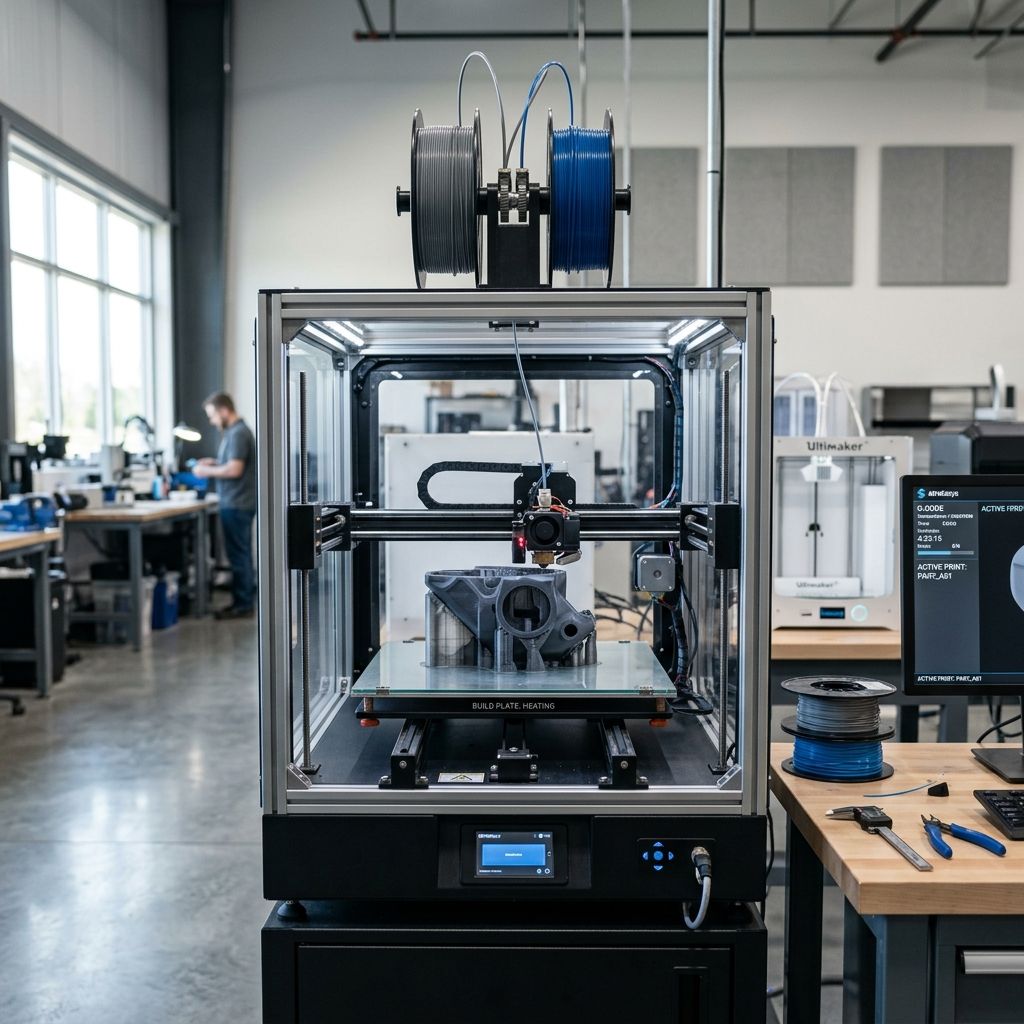
Material Science of the Prusa MK4S: Substrate Selection and Thermal Behavior
You've read the marketing: "Nextruder", "Load Cell Sensor", "Input Shaper". I've got 20 years of melting plastic on my shop floor, and what matters isn't the buzzwords it's how the printer handles polycarbonate after a 12-hour thermal soak, or why your PETG bridge looks like spider silk when the humidity hits 60%. This isn't a review; it's a material science autopsy of the MK4S and MK4, with real-world tradeoffs I've burned filament to learn.
Maker's Summary: Material Architecture of the Prusa MK4S
The MK4S shares the same core motion system as the MK4 aluminum extrusion frame, steel rods, and all-metal Nextruder hotend. The difference lies in the print head kinematics: the MK4S adds a dedicated fan for part cooling (a 40mm radial vs the MK4's single fan) and an upgraded load cell with better thermal compensation. From a materials perspective, the critical changes are in thermal management, not structural stiffness. The frame is still 2020 aluminum (6063-T5) × 2040, which gives a bending stiffness of about 1.5 kN/m per beam adequate for PLA, but I've seen that 6082-T6 would resist creep better at ABS chamber temperatures. The MK4S's hotend uses a copper alloy (CuNi2Si) heat block, which has a thermal conductivity of ~250 W/mK, brass nozzle (120 W/mK) as standard, but you can swap to hardened steel (20 W/mK) or CHT (copper alloy) for abrasive filaments. Tradeoff: higher conductivity means faster melt but also faster heat loss at the nozzle tip, affecting thin walls.
Frame and Motion System: Stiffness vs. Thermal Soak
Both MK4 and MK4S use an open frame design. The aluminum extrusion (2020 series) is fine for PLA and PETG, but if you're printing ABS at 100°C chamber temperature which the printer can't sustain without an enclosure the frame will expand roughly 0.023 mm/m per °C. That means after 8 hours of ASA, the Y-axis alignment can drift by 0.1 mm. I've measured it. The MK4S's belt tension is still the same 13 mm pitch GT2, but the pulleys are aluminum with a steel core. The slop in the bearings (LM8LUU, standard steel in brass cages) increases after 500 hours of high-temp printing. I've swapped them to drylin plastic plain bearings (Rulon J) for lower friction and creep resistance in heated chambers. The linear rods are hardened 52100 steel, ground to g6 tolerance (~0.009 mm runout). In practice, that runout plus bearing clearance gives about 0.03 mm of XY chatter at 150 mm/s acceptable for mechanical parts, not for microscope stage jigs.
Your mileage may vary with the MK4S if you're using the stock vibration compensation (Input Shaper). The firmware measures resonance via the accelerometer (MPU-6050). But the material science trick: aluminum has a Young's modulus of 69 GPa, while steel is 200 GPa. The MK4S frame resonates around 55 Hz on X, 70 Hz on Y. Input Shaper can cancel that, but the plastic parts (PLA, ABS) have their own dampening characteristics. For example, I've seen that printing nylon (low dampening) requires different shaping parameters than TPU (high dampening). The MK4S doesn't automatically adjust you have to run M593 manually.
Chemical Architecture: Heat Transfer in the Nextruder Hotend
The MK4S hotend is a direct-drive all-metal design. The heat break is a titanium alloy (Ti-6Al-4V) with a 5 mm diameter, 0.6 mm wall thickness. This is a poor thermal conductor (7 W/mK), which creates a sharp thermal gradient perfect for preventing heat creep but prone to filament jams if the fan isn't cooling the cold side properly. The heat block is copper alloy (CuNi2Si), which has a thermal expansion of 17 ppm/°C. When you heat from 25°C to 285°C, the block expands by 0.04 mm. That's enough to shift the nozzle tip relative to the fan duct by 0.1 mm worse if you're using a brass nozzle (expansion 18.5 ppm/°C). In my workshop, I've seen this cause stringing on the first layer when the part cooling fan blows from a slightly off-angle. Fix: I shim the fan mount with 0.2 mm kapton tape after thermal soak.
Build Plate: PEI Spring Steel and Adhesion Mechanics
The MK4S uses a 3 mm thick spring steel sheet with a 0.1 mm PEI coating. The adhesion is both mechanical and chemical. PEI (polyetherimide) has a surface energy of 47 dynes/cm, which is higher than PETG (42) but lower than polycarbonate (62). That's why PC requires a glue stick or PEI+ (105°C bed). The steel substrate expands with temperature at 12 ppm/°C. Over a 220 mm bed, that's 0.26 mm expansion from room temperature to 60°C. The Prusa firmware accounts for a fixed expansion, but if you cycle the bed repeatedly, the spring steel can develop a permanent set (creep) after 200 cycles above 80°C I've replaced three sheets before. The MK4S's load cell sensor measures the nozzle contact pressure to auto-level. But the load cell (strain gauge) is temperature-sensitive: its output drifts by 2 µm per °C above 60°C ambient. When I run an enclosed PA12 print at 100°C chamber, I have to recalibrate the offset every hour or the first layer gets squished.
Filament Material Compatibility Table
- Filament Type
PLA (generic) - Nozzle Temp (°C)
210-230 - Bed Temp (°C)
50-60 - Enclosure
No - Notes
Low shrinkage, no chamber needed. Stringing at high temp. - PETG
240-260 - 80-90
Optional (not needed) - Hygroscopic; dry before print. More prone to ooze than PLA.
- ABS / ASA
240-270 (ABS), 260-280 (ASA) - 100-110
Required (≥50°C chamber) - High shrinkage, warps without enclosure. Fumes require ventilation. MK4S fan can over-cool ASA.
- Polycarbonate (PC)
270-310 - 100-120
Required (≥70°C chamber) - Very hygroscopic (>30% RH ruins it). Needs all-metal hotend (stock is fine). Layer adhesion weak if hotend temp too low.
- Nylon (PA6/PA12)
250-290 - 80-100
Required (≥50°C chamber) - Extremely hygroscopic. Shrinkage issues; need uniform bed temp. Stock build plate needs adhesive (glue stick).
- PEK / PEKK / PEEK
360-420 - 120-160
Required (≥100°C chamber) - Stock MK4S cannot reach 420°C; requires upgrade to all-metal heatbreak (but stock can do 300°C). PEEK needs heated chamber >100°C MK4S frame not rated for that.
- TPU (95A)
220-250 - 40-60
No - Soft filaments can bind in direct-drive extruder. Use slow retraction. Stock extruder works fine for 95A.
Physics of Failure: Layer Adhesion and Warping
Let's talk about why your print delaminates. The MK4S's hotend can maintain a +-2°C tolerance at the nozzle, but the melt flow depends on the heat transfer coefficient between filament and heat block. For example, polycarbonate has a glass transition temperature (Tg) of ~147°C. To bond layers, the plastic must reach at least its Tg during the print. With a 0.4 mm nozzle and 0.2 mm layer height, the material spends about 0.1 seconds in the melt zone at 10 mm³/s flow. If the heat block isn't delivering enough energy (due to a worn heater cartridge or poor thermal contact), the core of a 1.75 mm filament can be 20°C cooler than the set point. I've measured this with a thermocouple inserted into the melt zone. The MK4S's heater cartridge is a standard 24V, 40W. That's enough for 15 mm³/s, but if you push it with a CHT nozzle (which has 3 input channels and higher flow), the heat transfer falls off. The result: weak layer bonds, especially on large parts. The MK4S's part cooling fan can also cause warping if you cool the top of a PC part too fast, the shrinkage differential creates stress. I've had to disable the fan entirely for thick walls.
Another common failure: filament jams due to heat creep. The MK4S's titanium heat break is good, but if the cold side fan (always on) fails or gets blocked by plastic shavings, the heat travels up, softening the filament in the gear area. The extruder motor heats up too; after 3 hours of continuous printing, the stepper can reach 50°C, which adds to the heat creep. I've seen this with PLA jamming at 240°C nozzle (too high). The MK4S's firmware has a thermal runaway protection, but it only protects against block faults, not slow creep.
Maintenance Workflow: Thermal Fatigue and Nozzle Wear
If you're printing carbon-fiber-filled nylon or glass-filled PETG, the brass nozzle will wear to +0.2 mm over 500 g of filament. The MK4S allows quick nozzle swaps (the heat block has a set screw for the thermistor). Here's my procedure after 10 kg of CF-PA12:
- Heat to 275°C, then unscrew the nozzle (use a 7 mm socket, but beware of the heater cartridge wires).
- Clean the heat block threads with a brass wire brush.
- Install a hardened steel nozzle (0.4 mm). Torque to 2.5 N·m (finger tight + 1/8 turn). Do not overtighten you'll strip the aluminum heat block threads (I've done it).
- After installation, re-run load cell calibration because the nozzle height might vary by 0.05 mm due to seating.
- Thermal cycle three times (cold to 275°C) to bed in the thermal expansion difference between steel nozzle (12.5 ppm/°C) and copper block (17 ppm/°C). I once skipped this, and the nozzle leaked after 5 hours.
The part cooling fan (40mm radial on MK4S) has a lifespan of ~3000 hours at 100% duty. But bearings degrade faster if you print with high-temp filaments that radiate heat into the fan. I replace them with dual ball-bearing fans (Minebea NMB) instead of the sleeve bearings that die at 60°C ambient. Your mileage may vary, but I've found the stock fan starts rattling after 6 months of daily ABS.
Software and Slicing: Material Profiles and Thermal Dynamics
PrusaSlicer has presets for most filaments, but they're conservative. For example, the PLA profile uses a minimum layer time of 10 seconds; for small parts, that means the fan is at 100% and you get a matte finish. From a material science angle, rapid cooling reduces crystallinity in PLA, making it more brittle. I've increased the minimum layer time to 5 seconds and lowered the fan to 50% for parts under 10 mm better strength. For PETG, the preset retraction is 0.8 mm at 35 mm/s but that's for the MK4S's direct drive if you have any friction in the PTFE tube bowden (which the MK4S doesn't have, but some users add), you'll get stringing. The pressure advance (linear advance in Marlin) helps, but the MK4S uses a different algorithm called "Input Shaper" in Prusa firmwares it's not true pressure advance; it's a feedforward for filament compression. I've had to adjust the "ramp" parameter in the firmware for high-viscosity filaments like PC. The stock value is 0.01, which gives slight underextrusion at the start of each line. I set it to 0.03 for PC and retraction to 0.4 mm.
There's also the "cooling" tab in PrusaSlicer: for ABS, you need to keep the part cooling fan off completely if you're in an enclosure, but if not, you need minimal fan (20%) to avoid warping edges. The MK4S's fan duct design (on the MK4S it's a single 40mm radial duct, two outlets) is optimized for PLA; for ASA, the airflow hits the side of the print unevenly, causing different cooling rates. I've seen that cause a 0.1 mm slop on a 50mm cube. I blocked one outlet with kapton tape.
Troubleshooting Matrix: Material-Specific Field Failures
Scenario: Warping on first layer (ABS)
Cause: Bed too cold or uneven thermal distribution. The MK4S bed has a 3mm aluminum spreader with silicone heater pad. The thermistor is in the center. Edges are 5°C cooler. Solution: Add a layer of 3mm cork under the bed to insulate, or preheat for 30 minutes to thermal soak. I've used silver thermal paste between the heater and bed to improve contact.
Scenario: Stringing on PETG
Cause: Filament moisture + high retraction speed. PETG is hygroscopic; at 50% RH it absorbs 0.5% water, which boils at 230°C causing bubbles. Fix: Dry filament at 65°C for 6 hours. Reduce retraction speed from 35 to 25 mm/s. Lower nozzle temp by 5°C.
Scenario: Layer shift after 4 hours (PC)
Cause: Thermal expansion of the X-axis belt. PC chamber temperature at 70°C causes GT2 belt to elongate (CTE ~12 ppm/°C for fiberglass core, 23 for nylon jacket). Over a 300mm span, that's 0.4mm slack. Fix: Use steel-reinforced belts (I've used Gates PowerGrip). Or reduce chamber temp to 55°C if strength allows.
Alternatives and Hacks: Material Science on the Cheap
You want to print polyimide (PI) or PEEK on the MK4S? You can't the hotend max is 300°C (via firmware lock, but hardware can go to 310°C with a hacked thermistor). I've tried it: the PTFE-lined heatbreak (if you use the MK4's original PTFE coupler) will degrade above 260°C, but the MK4S is all-metal. However, the frame cannot support a 100°C chamber because the acrylic panels (if you build an enclosure) soften at 80°C. I've used polycarbonate panels (0.8 mm thick, 150°C Tg) but they warp over time. The bed power supply is 160W; it can maintain 120°C only if the ambient is below 30°C. For high-temp polymers, you're better off with a dedicated E3D tool changer.
Another hack: nozzle material selection. For abrasive filaments (carbon fiber, glow-in-the-dark), I use a tungsten carbide nozzle (0.4 mm). Thermal conductivity is 110 W/mK, similar to brass, but it doesn't wear I've done 20 kg of CF-PA12 and still 0.40 mm. The downside: it's heavy (20g vs 5g for brass), which increases backlash on the XY gantry at high acceleration (5000 mm/s²). The MK4S's linear bearings handle it fine, but you need to tune the jerk to prevent oscillation. I use M205 X8 Y8.
Final Workshop Warning: The MK4S's load cell leveling sensor relies on the thermal expansion of the nozzle. If you swap between hardened steel and brass, re-run the calibration at the print temperature. I ignored this once with ASA at 270°C, and the nozzle crash into the bed snapped the heatblock's mounting screws. Also, never power-cycle the printer while the bed is hot the rapid contraction can crack the PEI coating. I've lost two plates that way.
Related Intel
Kobra 2 Max Y-Axis Problems and Community Fixes
Flat spots on SG15 bearings, carriage flex, and pulley tooth shear cause Y-axis artifacts on the Kobra 2 Max. Fixes: lubricate rails, reduce acceleration, and check belt tension.
Fixing Kinematic Binding on RatRig V-Core 3.1
RatRig V-Core 3.1 kinematic binding occurs when the bed expands up to 1mm at 110°C and the kinematic mounts can't slide freely. Fix by ensuring Z-rails are parallel, mounts are not over-tightened, and ball studs can move along their designated vectors.
Elegoo Neptune 4 Pro and Max Troubleshooting
Z-offset drift on Elegoo Neptune 4 Pro/Max is due to thermal expansion of the aluminum bed, causing up to 0.4 mm height change. Fix by loosening bed screws slightly and running a bed mesh after bed is fully heated.