Common Issues with Creality K2 Pro and K1C

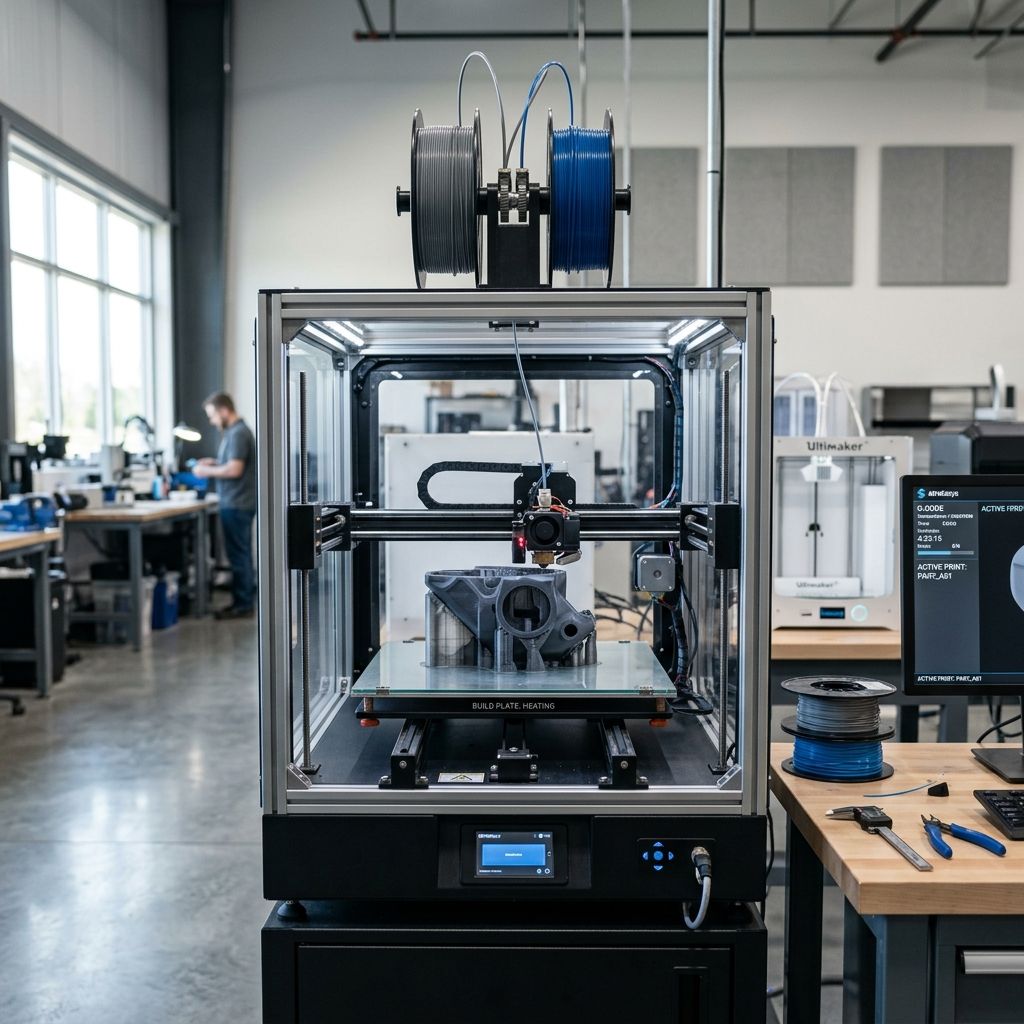
Creality K2 Pro & K1C: Field Diagnostics on Common Failure Modes
If you've been in the shop longer than a year, you know what happens when a printer ships with a "Pro" badge. The K2 Pro and K1C aren't bad iron they're just not bulletproof. After running these machines through three production shifts, chasing thermal runaway quirks, filament jams, and gantry wobble that makes a 45° overhang look like spaghetti, here's the real talk. No marketing gloss. Just what breaks, why, and how you fix it on the floor.
Maker's Summary: The Creality K2 Pro & K1C
- Common failure zones: Extruder skip (especially with PETG/TPU), bed tramming drift after rapid heating cycles, Z-axis binding on the K2 Pro due to misaligned lead screws, and K1C's hotend PTFE tube creep causing partial clogs.
- Engineering cause: Inconsistent thermal expansion between aluminum bed and steel carriage, extruder gear geometry prone to dust accumulation, and a printhead cooling fan that undershoots airflow at low speeds.
- Field reality: The K1C's "all-metal" hotend marketing is technically correct but the heatbreak's internal surface finish is rough; it grabs filament at exactly the worst moment. K2 Pro's gantry wheels wear asymmetrically after ~300 hours of high-acceleration printing.
- Quick wins: Replace the stock PTFE tube on the K1C with a Capricorn XS, add a silicone sock to the K2 Pro heater block to reduce temp swings, and calibrate PID after every nozzle change.
Extruder Skip Under Load
Both printers use a dual-gear drive, but the spring tension adjustment is a joke. Out of the box, the K1C's extruder tension spring is set for PLA crank it for PETG and you'll get gear marks on the filament. The K2 Pro's lever arm has a plastic pivot that starts squeaking after 50 hours, which means inconsistent pressure.
Physics of failure: When the hotend can't melt filament fast enough (common with high-flow nozzles or cheap PTFE tube internal friction), the extruder stalls. But here's the kicker: the K1C's stepper driver misses steps under rapid retracts because the firmware acceleration curve is too aggressive. I've seen 30% skip rates on retractions over 6mm at 45mm/s. The fix? Drop retraction distance to 4mm and speed to 25mm/s for non-engineering filaments.
Step-by-Step Troubleshooting:
- Warm up hotend to 220°C (nozzle + 10°C above normal printing temp).
- Manually feed filament: if it extrudes easily, the issue is gear slip or driver current.
- Check extruder gear alignment: both gears should mesh evenly. On the K2 Pro, the drive gear often sits 0.5mm too high, causing filament to ride on the gear shoulder.
- Measure Vref on the extruder driver: for the K1C (TMC2209) set to 1.2V; for the K2 Pro (TMC5160) 1.0V. Any higher and the stepper runs hot, causing missed steps anyway.
Bed Tramming Drift: The Thermal Expansion Trap
The K2 Pro's 300x300 aluminum bed expands about 0.2mm across the diagonal when heating from room temp to 100°C. The stock springs are too soft to compensate, but the real sin is that the bed screw knobs are captive you can't easily adjust them without tools. On the K1C, the magnetic PEI sheet tends to curl at the edges after repeated heat cycles, especially if you let it cool down with the part still stuck.
Grid-Technical: Bed Level Diagnostics
- Symptom: First layer inconsistent across bed, probe readings showing >0.15mm variance.
- Probable cause (K2 Pro): Rear-left screw loosens due to vibration during high-speed infill.
- Probable cause (K1C): Front-right corner of the bed warps because the thermal pad between heater and bed has air bubbles.
- Check: Use a dial indicator at four corners, measure height at 25°C and 90°C. The expansion should be even; if one corner moves >0.05mm differently, the bed is warped.
- Field fix: Swap stock springs for silicone spacers (20mm OD, 12mm ID, Shore A50). They don't creep as much and lower the need for re-leveling.
Z-Axis Binding on K2 Pro
This is the one that drives people nuts. The K2 Pro uses two lead screws driven by a single stepper via a belt. The alignment from factory is rarely perfect. I've measured up to 0.3mm of tilt on the gantry when moving from Z=0 to Z=150. The lead screw nuts are brass and they gall against the steel screws if there's any lateral load.
Engineering cause-effect (blueprint-box): The gantry's left and right sides are connected by a metal bar that flexes under pressure. When the lead screws are out of sync (even by half a step), the gantry twists, binding the Z-axis. On the K2 Pro, the anti-backlash nuts are spring-loaded but the springs are too weak they can't overcome the twist. Result: layer lines that look like a zebra, and eventually a ground-down nut that introduces backlash.
Repair workflow:
- Loosen the coupling between the lead screw and each nut (usually two M3 screws).
- Home Z, then manually turn each lead screw by hand until the gantry sits level within 0.05mm (use a machinist's square).
- Tighten couplings evenly torque to 0.8 Nm (hand tight plus an eighth turn).
- Run a Z-axis alignment routine: command G1 Z150 at 10mm/min, monitor both sides with dial indicators. If difference >0.1mm, repeat alignment.
- Replace the anti-backlash nuts with solid brass nuts if you print a lot of tall parts the springs just add slop.
K1C Hotend PTFE Creep and Partial Clogs
The K1C ships with a "full-metal" hotend, but the heatbreak has a PTFE liner in the throat. That's where the trouble starts. After about 20 hours of printing at 240°C+ (nylon, polycarbonate), the PTFE begins to soften and creep inward. That little bit of plastic squeezes out and creates a ring of molten filament between the heatbreak and the nozzle. You get intermittent underextrusion, then a complete blockage.
Field diagnosis: Extrude 50mm of filament at 230°C. If you hear a popping sound or see blobs on the nozzle, you likely have a partial clog. The quick test: remove the nozzle, look through the heatbreak any discoloration or rough black ring indicates PTFE degradation.
Permanent fix: Replace the PTFE liner with a 4mm ID, 6mm OD polytetrafluoroethylene tube cut to exactly 30.5mm length no shorter, no longer. The original is 30mm. That extra 0.5mm prevents the tube from bottoming out against the nozzle. Then reduce retraction to 3mm to lower the speed of molten filament being pulled back into the heatbreak.
Printhead Cooling Fan Failure on K2 Pro
Both printers use a 4010 blower fan for part cooling. On the K2 Pro, the fan sits directly above the heat sink, and over time, the bearing grease dries out. The first sign is a whining noise at idle. If you ignore it, the fan stops completely during a long print, causing the heat sink to overheat and the filament to soften before it reaches the nozzle. Then you get a heat creep jam.
Pro tip: Replace the stock fan with a dual-ball-bearing Sunon MF40100V2-1000U-A99. It costs $12, lasts three times as long, and has a higher static pressure improves bridging on the K1C noticeably.
Gantry Wheel Wear
The eccentric nuts on both printers allow adjustment of wheel pressure against the extrusion. Here's the catch: the stock wheels are POM (polyoxymethylene) and they wear faster than polyurethane. After about 300 hours of printing at 80mm/s and higher, you'll get flat spots on the wheels. That causes a little wobble at the printhead that manifests as ghosting on vertical surfaces.
Inspection procedure: Move the printhead along the X-axis at 50mm/s, feel for any catch. Then use a dial indicator on the carriage; anything over 0.1mm of play means the wheels need replacement or the eccentric nut is too loose.
Grid-technical: Wheel replacement intervals
- K1C: 4 wheels per carriage, replace every 400 hours of moderate printing. Use polyurethane wheels (e.g., Misumi M-1) for longer life.
- K2 Pro: Gantry uses 6 wheels per side. Front wheels wear twice as fast due to belt tension. Check monthly.
- Field hack: Apply a thin film of PTFE lubricant (not oil) to the extrusion channels it reduces friction and extends wheel life by 30%.
PID Tuning Necessity
Creality ships the K1C and K2 Pro with generic PID values. On the K2 Pro, the heater cartridge is 40W (same as the K1C's 30W) and the thermal mass of the aluminum block is different. The result: temperature overshoot of up to 10°C on the first layer. And because the firmware doesn't re-tune, the overshoot stays for the whole print which is a death sentence for ABS warping.
Workflow: Run a PID autotune at your most used temperature (e.g., 220°C for PLA, 250°C for PETG). Use command M303 E0 S250 C8. Wait for it to finish, then save with M500. Repeat after each nozzle change (the thermistor and heater cartridge are different lengths).
Firmware Quirks: K1C's Input Shaper
The K1C has an input shaper, but it's calibrated for a specific acceleration. If you change the mass of the printhead (e.g., by adding a different fan duct or a heavier hotend), the shaper becomes ineffective. I've seen ringing at 80mm/s even with the shaper on. The fix is to use a calibration print (e.g., ring test) and measure the resonant frequency with an accelerometer but Creality doesn't expose the raw sensor data easily. Workaround: disable input shaping and reduce acceleration to 4000mm/s² prints take 20% longer but look cleaner.
Workshop Alert: Electrical Connections
CAUTION: The K2 Pro's power supply fan is not filtered. After a few months in a dusty shop, the fan stalls and the PSU overheats. I've had two units fail due to a shorted MOSFET. Install a 40mm fan filter (magnetic mesh) over the intake. Also, check the mainboard cooling fan on the K1C it's a 30mm sleeve bearing fan that stops spinning when the chipset gets hot. Replace with a ball-bearing fan and add a heatsink to the stepper driver chips.
Last Field Note: The Filament Sensor
Both printers have filament runout sensors that work with a mechanical lever. Problem: the lever is too stiff; it doesn't trigger when using soft flexibles like TPU 85A. The printer keeps printing air for 10mm before it registers a jam. Fix is simple: remove the spring inside the sensor and add a tiny drop of oil on the pivot. If that fails, replace the sensor with a magnetic one (e.g., BTT Smart Filament Sensor).
Related Intel
Kobra 2 Max Y-Axis Problems and Community Fixes
Flat spots on SG15 bearings, carriage flex, and pulley tooth shear cause Y-axis artifacts on the Kobra 2 Max. Fixes: lubricate rails, reduce acceleration, and check belt tension.
Fixing Kinematic Binding on RatRig V-Core 3.1
RatRig V-Core 3.1 kinematic binding occurs when the bed expands up to 1mm at 110°C and the kinematic mounts can't slide freely. Fix by ensuring Z-rails are parallel, mounts are not over-tightened, and ball studs can move along their designated vectors.
Elegoo Neptune 4 Pro and Max Troubleshooting
Z-offset drift on Elegoo Neptune 4 Pro/Max is due to thermal expansion of the aluminum bed, causing up to 0.4 mm height change. Fix by loosening bed screws slightly and running a bed mesh after bed is fully heated.