Bambu A1 Bed Cable and AMS Lite Issues

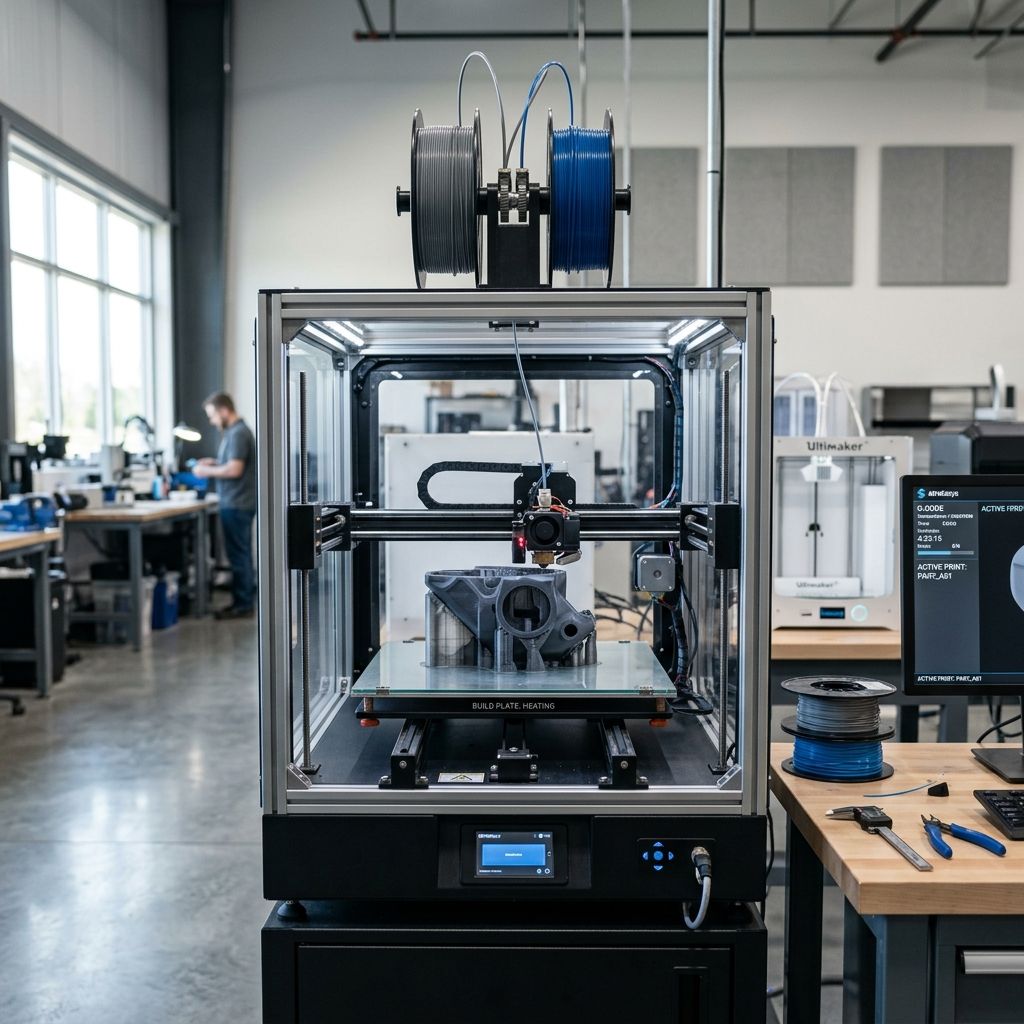
The Bambu A1 & A1 Mini Technical Field Log: Beyond the Marketing Hype
A deep dive into the mechanical realities, thermal fatigue points, and long-term maintenance of the A1 series from the perspective of a 20-year shop veteran.
System Architecture Overview
The Bambu Lab A1 and A1 Mini represent a pivot back to the "bed-slinger" format but with a heavy emphasis on closed-loop control. Unlike the CoreXY P1/X1 series, these machines deal with the high-inertia physics of moving the entire mass of the print bed on the Y-axis. While the software compensation (Input Shaping) is excellent, the mechanical toll on cables, linear rails, and the cantilevered Z-axis (on the Mini) creates a specific set of failure modes that differ from their enclosed siblings.
- Motion System: All-metal linear rails (A1) vs. Linear rods with u-groove bearings (Mini).
- Filament Sensing: Multi-stage (AMS Lite hub sensor + Toolhead hall effect sensor).
- Flow Control: Active eddy-current sensor for real-time pressure compensation.
- Toolhead: Quick-swap hotend assembly with integrated cooling and nozzle wiper.
Failure Case 01: The Thermal Fatigue of the Bed Cable & Connector
We need to talk about the elephant in the room: the bed cable. Bambu already had a massive recall on the A1 cable for a reason. In a bed-slinger, the Y-axis cable is under constant dynamic stress. It's not just moving; it's flexing at a high frequency. When you run 100+ hour prints, that copper undergoes work-hardening. If the strain relief isn't perfectly engineered, the internal strands of the 220V/110V AC lines (or the DC lines on the Mini) start to snap one by one.
In my experience, the "fix" provided by the manufacturer a reinforced plastic shroud is a band-aid for a fundamental mechanical constraint. The physics of failure here is simple: bend radius. If your printer is pushed too close to a wall, or if you've printed a custom cable drag chain that's too tight, you're creating a localized stress riser. I've seen cables where the insulation looks fine, but the internal resistance has spiked because half the copper strands are gone. This leads to "Heatbed Temperature Abnormality" errors or, in the worst-case scenario, thermal runaway or arcing.
PRO-TIP: The "Wall Clearance" Rule
Never trust the footprint dimensions in the manual. Give the A1 at least 150mm of clearance behind the bed at its furthest extension. If that cable touches a wall even once per cycle, you are accelerating the fatigue life of that copper by a factor of ten. I also recommend checking the connector at the base of the printer every 500 hours for any signs of browning or brittle plastic.
The maintenance workflow for the bed cable involves more than just a visual check. You need to perform a "wiggle test" while monitoring the bed temperature on the screen. If the temp jumps by more than 2-3 degrees while you gently manipulate the cable near the strain relief, your cable is compromised. Don't wait for it to spark. Replace the entire assembly. The A1 Mini is less prone to this due to its smaller bed mass and lower current draw, but the cantilevered design means the Z-axis cable chain often rubs against the frame, which is its own kind of headache.
Failure Case 02: AMS Lite Friction & The "PTFE Tax"
The AMS Lite is a brilliant piece of engineering, but it's an open-air system that relies on four very long PTFE tubes. In an industrial setting, we call this a "friction tax." Every millimeter of tubing adds drag. Every curve in that tube increases the torque required from the extruder motor. If you're using generic filament with slightly inconsistent diameters (anything over 1.78mm), you're going to get "Failed to Extrude" or "Failed to Pull Back Filament" errors constantly.
The 4-into-1 PTFE manifold (the "hub") on top of the toolhead is a common wear point. Inside that hub are four small plastic entry ports and a spring-loaded filament sensor. Dust from the filament gets trapped in there. If you're printing with abrasive materials like Matte PLA or Glow-in-the-dark, those internal plastic paths get "sawed" into. Eventually, the filament catch on the internal lip, and the AMS Lite will report a motor overload.
The Deep-Dive Fix for AMS Lite Reliability:
Forget the factory layout if you're having issues. I've found that the default "top-mount" position for the AMS Lite on the A1 creates too sharp of an entry angle for the PTFE tubes. We've had much better luck mounting the AMS Lite on a side-stand to keep the tubes as straight as possible. Here is the technician's workflow for optimizing the path:
- Tube Length Calibration: Don't just use the stock lengths if your setup is custom. Every extra inch of PTFE is an extra gram of friction. Trim them so they have a gentle "C" curve, never an "S" curve.
- The Capricorn Myth: While Capricorn XS is great for high heat, its tighter tolerances (1.9mm ID) can actually be a nightmare for the AMS Lite. Stick to 2.0mm ID high-quality PTFE to allow for filament bulging at the tips after a retraction.
- Tip Shaping: The A1 toolhead has a built-in filament cutter. If your blade is dull (it happens after about 2,000 cuts), it doesn't "cut" the filament; it "mashes" it. A mashed, flattened tip will never retract through the 4-into-1 hub. Check your cutter blade every month. If you see a "hook" on the end of your retracted filament, the blade is toast.
Physics of Retraction Failure
When the AMS Lite pulls filament back, the filament is often warm and slightly swollen from the "heat creep" zone of the hotend. If the cooling fan on the toolhead isn't 100% efficient, that swollen bulb has to pass through the PTFE tube. The friction (F) is a function of the normal force (filament expansion) and the coefficient of friction of the PTFE. If F exceeds the 40N pull force of the AMS motor, it stalls.
Failure Case 03: The Eddy Current Sensor & Nozzle Seating
This is where the A1 gets "fancy" and where it can break in ways an Ender 3 never could. The A1 uses an eddy-current sensor to measure the pressure of the filament in the nozzle. It's a coil that detects the tiny movements of the hotend assembly. If your nozzle isn't seated *perfectly* and I mean to the micron the sensor readings will be noisy. This results in "Dynamic Flow Calibration" failures or inconsistent extrusion that looks like "wood grain" on your print walls.
The "quick-swap" nozzle system uses a small metal latch. I've seen these latches lose their spring tension after a few dozen swaps, or worse, a tiny bit of plastic debris gets stuck behind the heater block. This creates a "soft" mount. When the extruder pushes filament, the whole heater block moves slightly before the plastic exits the nozzle. This "slop" destroys the accuracy of the pressure advance algorithm.
The Maintenance Workflow for Nozzle Integrity:
I don't care what the brochure says about 10-second swaps. Every time you swap a nozzle, you need to perform the following:
- Clean the Mate: Use a brass brush to ensure the back of the heater block and the contact points on the toolhead are surgically clean. Even a fingerprint can cause a slight thermal variance, though it's the physical debris that kills the sensor accuracy.
- Thermal Paste Check: Bambu uses a specific silicone-based thermal grease between the heater and the nozzle. If this dries out or gets wiped off during a swap, you'll get "Heater Temperature Fluctuating" errors. Keep a tube of high-temp (300°C+) thermal paste in your toolbox.
- The Latch Torque: When you close that latch, it should "snap." If it feels mushy, the metal tang is bent. You can carefully bend it back with needle-nose pliers, but you're better off keeping a spare latch assembly (they're cheap).
WARNING: Carbon Fiber & The Eddy Sensor
In my experience, the eddy current sensor gets "confused" by highly conductive or metallic-filled filaments. If you're printing iron-filled PLA or certain high-loading Carbon Fiber PETG, the sensor's magnetic field is affected. If you see wild flow rate fluctuations, turn off "Flow Calibration" in the slicer and go back to a manual K-factor. Don't fight the physics; the sensor is doing its job, but the material is interfering with the field.
The Linear Rail vs. Rod Maintenance Reality
The A1 uses stainless steel linear rails. These are superior to the V-slot wheels of the past, but they are not "maintenance-free." They come from the factory with a light machine oil that is, frankly, garbage. It's a shipping rust-inhibitor, not a lubricant. Within 200 hours, you'll start to hear a "chirping" sound during high-speed moves.
The A1 Mini uses a cantilevered rod system. This is a nightmare for resonance. Because the X-axis is only supported on one side, any "slop" in the Z-axis bearings is magnified at the end of the X-rail. This is basic lever-arm physics. If your Z-axis bearings have even 0.05mm of play, you'll see 0.2mm of "wobble" at the far edge of the build plate.
How to Actually Lubricate the A1 Series:
Step away from the WD-40. You need a NLGI Grade 2 grease for the rails. I prefer Super Lube with PTFE. Use the printed grease tool (Bambu provides the file) to inject the grease directly into the carriage bearings. Move the axis back and forth ten times, then wipe off the excess. If you leave the excess grease on the rail, it acts as a magnet for filament dust, creating a grinding paste that will pit the stainless steel balls in the bearing.
For the A1 Mini rods: Use a light machine oil (like 3-in-1 or sewing machine oil). Do NOT use grease on the linear rods; the u-groove bearings are designed to glide on a thin film of oil. Grease will just cause them to slide instead of roll, creating flat spots on the bearings.
Troubleshooting Matrix: Field Scenarios
- Symptom: First layer is perfect in the center, but "scuffed" on the edges.
Reality: Your bed plate is likely warped, but the A1's multi-point leveling should handle it. If it doesn't, check the four screws under the heatbed. They are often over-torqued from the factory, physically bowing the aluminum plate. Loosen them and re-snug them to "finger tight" plus a quarter turn. - Symptom: Random "CLACK" sound during printing.
Reality: This is almost always the filament pooper (the purge wiper). If the screw holding the wiper is loose, the nozzle will catch on it. It sounds like the printer is breaking, but it's just a 2mm alignment issue. Lock-tite that screw. - Symptom: Z-banding or "ribbing" on tall prints (A1 Mini).
Reality: Check the lead screw for "swarf" (tiny metal shavings). Because the Z-axis is exposed, bit of filament often fall into the grease of the lead screw. It only takes one tiny grain of plastic to cause a vertical skip.
A Final Note on the "Silent Mode"
The A1's "Silent Mode" works by reducing accelerations and using the TMC driver's StealthChop feature. However, in my shop, we never use it. Why? Because the lower motor current increases the chance of a skipped step if the nozzle hits a small blob of over-extrusion. If you want a quiet shop, build an enclosure (though be careful with the A1's electronics cooling) or put it on a concrete paver. Don't compromise the motor's holding torque for the sake of a few decibels. These machines are tools, not library appliances.
Mind the tension on the X-axis belt it should "thrum" like a low bass note when plucked, not "twang" like a guitar string. Over-tensioning is the fastest way to kill the stepper motor bearings, and on these integrated machines, replacing a motor is a four-hour teardown you want to avoid.
Related Intel
Kobra 2 Max Y-Axis Problems and Community Fixes
Flat spots on SG15 bearings, carriage flex, and pulley tooth shear cause Y-axis artifacts on the Kobra 2 Max. Fixes: lubricate rails, reduce acceleration, and check belt tension.
Fixing Kinematic Binding on RatRig V-Core 3.1
RatRig V-Core 3.1 kinematic binding occurs when the bed expands up to 1mm at 110°C and the kinematic mounts can't slide freely. Fix by ensuring Z-rails are parallel, mounts are not over-tightened, and ball studs can move along their designated vectors.
Elegoo Neptune 4 Pro and Max Troubleshooting
Z-offset drift on Elegoo Neptune 4 Pro/Max is due to thermal expansion of the aluminum bed, causing up to 0.4 mm height change. Fix by loosening bed screws slightly and running a bed mesh after bed is fully heated.