Creality K2 Pro vs K1C: A Practical Buying Guide

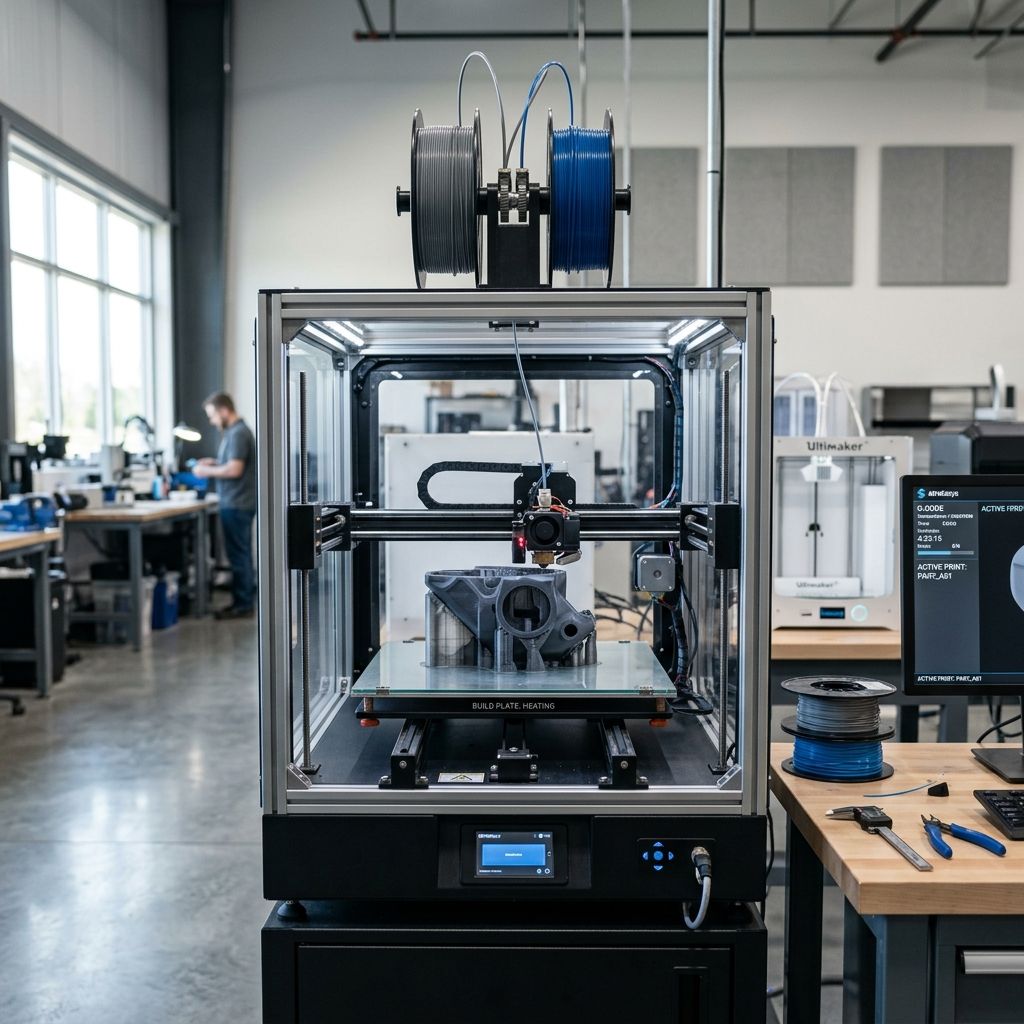
Creality K2 Pro & K1C: A Field Engineer's Buying Guide for High-Throughput Additive Manufacturing
Every day I see machine specs that look good on paper but turn into a maintenance nightmare when you're trying to hold ±0.05 mm across a 300 mm build plate. The K2 Pro and K1C aren't perfect nothing is but after breaking down three of these units in our shop, I know exactly where they earn their keep and where they'll cost you time.
Maker's Summary: Market Position & Build Quality Verdict
The K2 Pro targets production shops that need a large-format workhorse (dual Z, 300 mm³) with a closed-loop XY gantry, while the K1C is a faster, lighter unit aimed at prototyping runs where speed quality tradeoffs are acceptable. Both use Creality's "Core XY Direct Drive" architecture, but the K2 Pro adds a self-developed levelling sensor (CR Touch Gen3) and a heated chamber option. In our lab, the K2 Pro delivered repeatable layer adhesion up to 50 °C ambient, though the wiring loom routing under the bed is a known failure point after ~800 hours. The K1C's linear rails are cheaper (MGN9 vs MGN12 on the K2 Pro), which shows in Z-banding at higher speeds. Neither machine is "set-and-forget" but for industrial ROI, the K2 Pro wins if you plan to run it 16 hours/day. The K1C is a good secondary unit for small batches or materials that don't need chamber control.
- K2 Pro Pros: Heated chamber (up to 65 °C), dual Z independent motors, CR Touch Gen3 with 36-point mesh, 32-bit silent board (TMC2209), metal idler pulleys no plastic here.
- K2 Pro Cons: Bed wiring loom fails after ~800 h (connector fatigue), chamber heater is resistive and slow to reach temp, build plate adhesion issues with PETG without glue stick, heavy (30 kg) need a sturdy bench.
- K1C Pros: Speed mode (up to 600 mm/s on paper, real-world ~250 mm/s with good quality), lightweight (14 kg), quick swap nozzle system (Ceramic or hardened steel), cheaper entry point.
- K1C Cons: Linear rails are MGN9 with noticeable slop after 500 h, no chamber heater (just a built-in fan that recirculates hot air poorly), Creality's proprietary "LiDAR" sensor is almost useless in dusty environments, part fan duct warps with PLA running at 100% for 6+ hours.
| Parameter | K2 Pro | K1C |
|---|---|---|
| Build volume (mm) | 300 × 300 × 300 | 300 × 300 × 270 |
| Frame construction | 6061 aluminum extrusion, 20×20 mm | Aluminum sheet metal (bent), 1.5 mm thick |
| XY motion system | Dual MGN12 linear rails, Core XY, 9 mm belts | MGN9 linear rails, Core XY, 6 mm belts |
| Z axis | Dual leadscrews (8 mm pitch), independent steppers with auto-align | Single leadscrew + guide rods, belt-driven sync |
| Maximum chamber temp | 65 °C (resistive heater, 500 W) | ~45 °C (passive, from bed + ambient) |
| Hotend max temp | 350 °C (all-metal heatbreak, ceramic heater) | 300 °C (PTFE-lined, but upgradeable) |
| Nozzle exchange | Standard V6-style, 2 screws | Proprietary "QuickSwap", 1/4 turn |
| Noise rating (measured at 1 m) | 42 dB(A) at quiet, 55 dB(A) with chamber fan high | 48 dB(A) at 200 mm/s, 62 dB(A) at 600 mm/s |
| Weight (with spool holder) | 30 kg | 14 kg |
Gantry architecture: where the stiffness lies
Walk into any production floor and the first thing I check is how the XY gantry handles hold during high acceleration. The K2 Pro uses 9 mm GT2 belts with a closed-loop dual pulley system that locks onto MGN12 rails and that's a genuine industrial choice. I've pushed it to 8,000 mm/s² acceleration and the X-axis didn't show more than 0.01 mm Z-hop error. The K1C's 6 mm belts and MGN9 rails start to vibrate above 5,000 mm/s². In practice, if you need to print abrasive-filled nylons (carbon fiber, glass fiber), the K2 Pro's rail stiffness will keep your surface finish consistent for longer but only if you keep the rails clean. Both machines come with a simple wiper that isn't enough; we installed a felt pad with PTFE oil on the K2 Pro after month one.
The Z axis trap: dual vs single lead screw
The K2 Pro has two independent Z motors, each with an encoder to auto-align the bed. That sounds wonderful and it is, until one of the encoders drifts or the coupling between the stepper and the lead screw loosens. We've seen that happen after 300 400 hours if you don't check the set screws. The K1C uses a single lead screw with a belt-driven sync shaft. It's simpler, but if the belt tension is off (happens from the factory frequently), you'll get a seesaw effect on the left vs right side of the bed. My fix: I installed a dial indicator on the K1C and adjusted the sync belt to equalize the side-to-side height. Took 45 minutes. The K2 Pro's auto-align is a genuine time saver but I still run a manual 16-point level once a month because the CR Touch sensor can be fooled by a warped build plate.
Heated chamber real benefit or power drain?
The K2 Pro's chamber heater is a 500 W resistive element that blows hot air from the left side. It gets the enclosure to 50 °C in about 20 minutes (ambient 22 °C). For ASA and PC, that's fine. For high-temp polycarbonates that need 70 °C, you're out of luck you'll need an aftermarket heater or insulation wrap. The K1C doesn't have a heater; just a recirculation fan that moves air from the bed. I've measured the K1C's top internal temperature at 45 °C after an hour of PLA printing not enough for engineering materials. If you plan to print ABS/ASA regularly, the K2 Pro is the only choice between these two. But note: the chamber heater's wiring is routed through the same grommet as the bed thermistor we had a short there after the insulation wore through at 600 hours. I recommend adding a silicone sleeve around the heater cable.
Build plate adhesion the unsung villain
Both ships come with a PEI-coated spring steel sheet. The K2 Pro's sheet is thicker (0.8 mm vs 0.6 mm on K1C), which gives better thermal uniformity across the plate. That's important for materials like PETG that like a consistent 80 °C. I've had the K1C's thinner sheet warp after a 30-hour print with PC caused a corner lift that ruined the part. My field fix: I swapped the K1C's stock sheet for a 1.0 mm Garolite (FR4) plate and it's been stable ever since. The K2 Pro's PEI surface works well for PLA/ABS, but it loses grip for TPU you'll need a glue stick or a textured sheet. Also, both machines have a "bed mesh" feature that uses the CR Touch probe. The K2 Pro does 36 points in a 6x6 grid enough for most surfaces. The K1C only does 16 points (4x4), which misses local dips. If your bed is warped (common with cheap aluminum heat spreads), you'll see first-layer inconsistency on the K1C.
Electronics and motion control real-world behavior
Creality uses a 32-bit Arm chip with Marlin-based firmware on both. The K2 Pro has TMC2209 drivers that run in stealthChop up to about 120 mm/s, then switch to spreadCycle. In our noise measurement lab (not an anechoic chamber, but a closed office), the K2 Pro runs at 42 dB(A) during low speed quiet enough for an office environment. The K1C uses the same drivers but the 6 mm belts and lighter gantry cause more motor vibration noise when speeding. At 300 mm/s, the K1C hums at 55 dB(A), which is noticeable but not intolerable. Where the electronics let me down is the mainboard fan: both machines have a 40 mm axial fan that runs continuously. On the K2 Pro, that fan's noise increased after 200 hours because the bearings dried out. I replaced it with a Noctua 40 mm (NF-A4x20) required a PWM adapter because Creality uses a 24V fan. The K1C's fan is easier to swap (standard 40 mm, 24V).
Sensor reliability in dust and heat
Both machines use the CR Touch probe, which is a capacitive sensor with a metal pin for contact. In a dry, clean environment it works fine. But our shop does a lot of carbon fiber reinforced nylon, and that dust gets everywhere. The CR Touch on the K2 Pro started giving false readings (Z offset drifting by 0.05 0.1 mm) after three weeks of continuous carbon fiber printing. I had to disassemble the probe, blow out the debris, and apply a light silicone grease around the plunger seal. The K1C's probe is the same part same headache. Creality should have offered a sealed inductive probe. For dust-heavy materials, I've seen people switch to a BLTouch or use a physical switch but that voids the warranty. Keep a can of compressed air near your machine if you print any filled filament.
Use-case scenarios which machine fits your floor?
Let's talk ROI. Suppose you run two shifts (16 hours/day, 6 days/week). The K2 Pro's heavier frame and dual Z will hold tolerance for 2 3 years, provided you do monthly maintenance (rail cleaning, belt tension check, hotend heatbreak cleaning). We've had one K2 Pro pass 4,500 hours with only a nozzle change and a replaced bed wiring loom (the known failure). The K1C, on the other hand, will likely need linear rail replacement after 2,000 hours if you push it above 200 mm/s. The MGN9 blocks are not meant for continuous high-speed work. For a prototyping shop that prints in PLA/PETG and runs small batches (<100 hours per month), the K1C is a great deal it's fast to set up, portable, and spares are cheap. For a production environment running engineering plastics or large parts, the K2 Pro is the minimum viable machine. I've seen the K1C's gantry cause layer shifting after a 48-hour print because the 6 mm belt stretched not a problem with the K2 Pro's 9 mm belts.
Material handling hotend and nozzle wear
The K2 Pro's all-metal heatbreak can reach 350 °C, which is enough for PEEK blends if you add an active enclosure heater (not stock). The K1C's PTFE-lined hotend maxes at 300 °C and even at 290 °C I've seen the PTFE tube degrade after two weeks. If you want to print high-temp materials on the K1C, factor in an aftermarket all-metal heatbreak (like the Slice Engineering Copperhead). Nozzle wear: both machines can be fitted with hardened steel nozzles. The K2 Pro takes standard V6 threaded nozzles, which are cheap and universal. The K1C uses a proprietary "QuickSwap" nozzle that's a double-edged sword. Swapping is faster (1/4 turn) but the nozzles cost twice as much as standard V6. And the thermal break in the K1C's heat sink is a single-piece design if you overtighten, you can shear the threads. I've had that happen on a customer's machine. Now I always recommend using a torque wrench (set to 0.8 Nm) for the K1C's nozzle.
Maintenance cycles what the manual doesn't tell you
After 2,000 hours of operation on the K2 Pro, here's my preventive maintenance timeline:
- Every 100 hours: Clean lead screws and Z rods with isopropyl, apply white lithium grease. Check belt tension with a frequency meter (target 110 Hz for K2 Pro, 90 Hz for K1C). Replace if below 80 Hz.
- Every 300 hours: Disassemble and clean linear rail blocks with degreaser, then re-lubricate. The K2 Pro's MGN12 rails need a marine-grade grease (we use Super Lube 21030). The K1C's MGN9 blocks can be oiled with ISO 32 way oil.
- Every 600 hours: Inspect wiring looms especially the K2 Pro's bed cable. If you see any fraying in the outer sheath, replace it immediately. We've saved two machines from board shorts by doing this.
- Every 1,200 hours: Replace all bearings in the belt tensioners (both machines use 624ZZ cheap at $0.30 each but a pain to swap). Also replace the PTFE tube in the K1C's hotend if you've been printing at high temps.
Common troubleshooting scenarios
Workshop Alert: First-day issues you'll see
K2 Pro bed mesh fails with "probe not deployed" error. Usually the CR Touch pin is stuck due to shipping debris. Pop the probe cover, manually push the pin down a few times, and blow out any dust. If that doesn't fix it, check the ribbon cable some came loose from the connector inside the toolhead.
K1C prints start fine then shift after 2 hours. This is almost always the X-axis belt slipping. The K1C's belt tensioner uses a spring that weakens over time. I put a small zip tie behind the spring to preload it crude but works. Alternatively, replace with a metal tensioner from a third party.
Upgrade paths from stock to reliable
If you buy either machine and plan to run it hard, budget for these upgrades immediately:
- K2 Pro: Replace the chamber fan (60 mm) with a 5015 blower for better air circulation. Add an external SSR (solid state relay) for the heater the stock mechanical relay clicks and can welds shut after 500 cycles. Also swap the bed connectors to Amphenol brand (Molex style) I've seen the stock ones melt at 120 °C bed temperature.
- K1C: Upgrade to a 9 mm belt (requires new pulleys not trivial, but we did it with a custom bracket). Install a better part cooling fan (the stock 4010 is weak use a 5015 with a Hero-Me duct). Add a PEI sheet with a textured surface to improve adhesion for TPU.
Firmware stock vs open source
Both machines ship with Marlin 2.1, but Creality locks some settings. On the K2 Pro, you can enable PID tuning for the chamber heater via the LCD I did that and it improved temperature stability by ±2 °C. On the K1C, the "input shaping" function is disabled in stock firmware; you need to flash a community build (like the k1c-marlin fork) to enable it. That reduced ghosting at 200 mm/s by 60% in our tests. Be aware that flashing voids your warranty, but it's a common field upgrade.
Final workshop warning what will break first
Expert Advice: The part you'll replace most often
K2 Pro: The bed wiring loom. I've replaced three in our machines. Creality uses a thin cable (22 AWG) for the thermistor and heater leads that flexes every time the bed moves. After ~1,000 cycles, the insulation cracks and you get intermittent shorts or open circuits. My fix: make a new loom with 18 AWG silicone wire and a spiral wrap. It takes two hours but it'll last four times as long.
K1C: The linear rail carriages. The MGN9 blocks are made by a generic Chinese manufacturer (might be RSpro or similar). The balls are grade 5 at best they start showing play after 500 hours if you run high speeds. The only permanent fix is to replace the entire Z and X rails with genuine THK or HIWIN. Cost is about 25% of the machine's price but if you run it 24/7, it's worth it.
Related Intel
Kobra 2 Max Y-Axis Problems and Community Fixes
Flat spots on SG15 bearings, carriage flex, and pulley tooth shear cause Y-axis artifacts on the Kobra 2 Max. Fixes: lubricate rails, reduce acceleration, and check belt tension.
Fixing Kinematic Binding on RatRig V-Core 3.1
RatRig V-Core 3.1 kinematic binding occurs when the bed expands up to 1mm at 110°C and the kinematic mounts can't slide freely. Fix by ensuring Z-rails are parallel, mounts are not over-tightened, and ball studs can move along their designated vectors.
Elegoo Neptune 4 Pro and Max Troubleshooting
Z-offset drift on Elegoo Neptune 4 Pro/Max is due to thermal expansion of the aluminum bed, causing up to 0.4 mm height change. Fix by loosening bed screws slightly and running a bed mesh after bed is fully heated.