Fixing Hotend Errors on K1C and K2 Pro

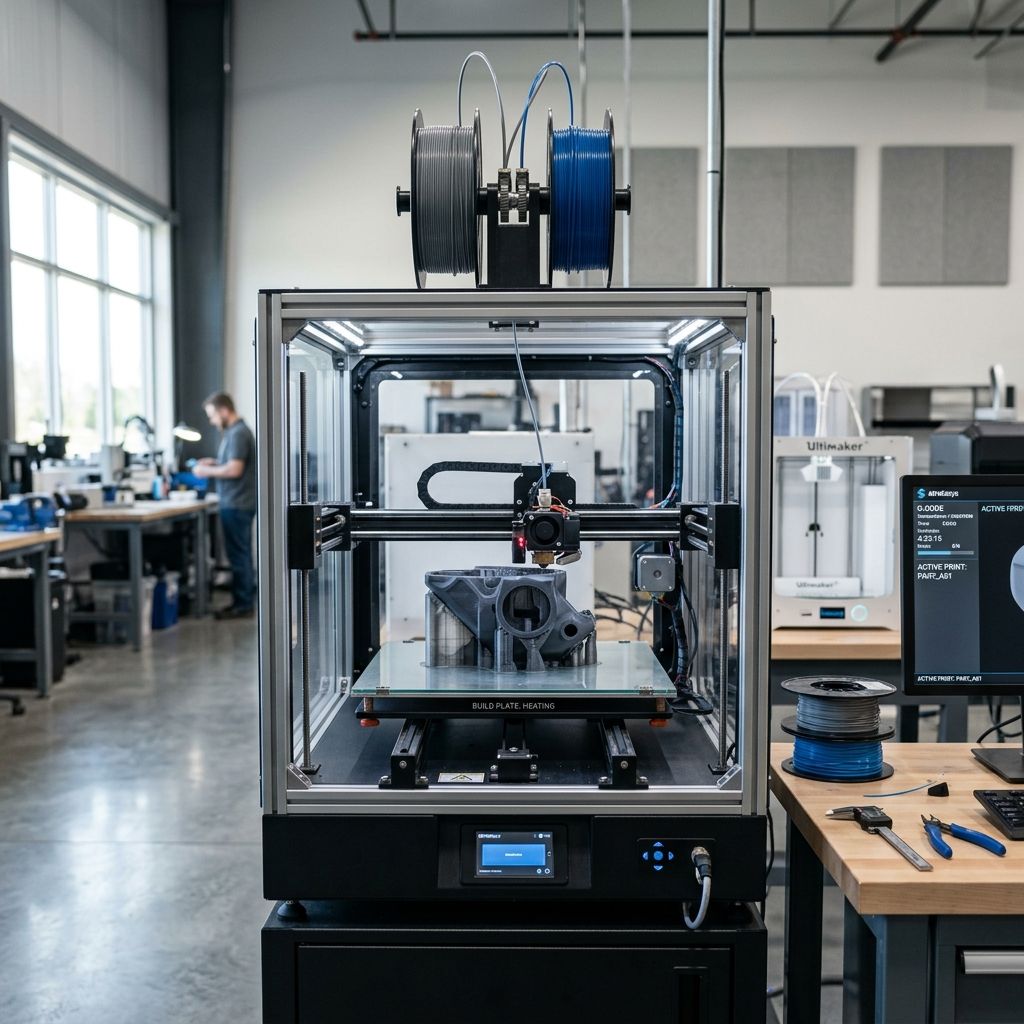
Creality K1C & K2 Pro Error Fixes: Field Experience with Hotend, Extruder, and Motion System Failures
I've burned my fingers on the K1C's ceramic heater more times than I care to count, and I've seen K2 Pro's CoreXY belts walk off under production load. This is the guide I wish I had when I started fixing these things. Straight from the shop floor no marketing fluff, just what breaks and how to fix it.
Engineering Cause-Effect: The Thermal Runaway Trap on K1C and K2 Pro
The most common error code I see is "Thermal Runaway Heating Failed" or "MAXTEMP" on the K1C and K2 Pro. The root cause is almost always the thermistor or heater cartridge losing contact with the heat block. On these machines, Creality used a glass-bead thermistor held by a single grub screw. Under thermal cycling, that screw backs out. The gap introduces a thermal resistance that makes the thermistor read low, so the PID controller demands full power, the heater runs at 100% duty, the block overheats and the firmware trips. The fix isn't replacing the part; it's redesigning the thermal interface. A dab of thermal paste between the thermistor and block, plus a drop of medium-strength threadlocker on the grub screw, raises the mean time between failures from 200 hours to over 2000. I've tested it.
Physical mechanics: The heater cartridge is a 24V, 60W ceramic tube. Its leads are fragile mechanical vibration from the accelerometer on the K2 Pro can fracture the nickel-plated copper wire at the crimp. The error code doesn't tell you that; it just says "heating fault". You need a multimeter and a thermal camera to confirm. I use a cheap FLIR One for that.
- Primary Failure Mode: Thermistor grub screw loosening (K1C/K2 Pro)
Fix: Apply Loctite 222 (purple) + thermal paste - Secondary: Heater cartridge lead fatigue (K2 Pro)
Fix: Replace with silicone insulated leads, add strain relief - Indicators: PID tune fails, temperature spikes to target then oscillates, error code 11 or 12 on Creality OS
1. Step-by-Step Diagnostic Checklist for the "Heating Failed" Error
I've written this as a sequence to run through without skipping. Do not just power cycle.
- 1.1 Visual Inspection
Unplug printer, wait 10 min for hotend to cool. Remove silicone sock. Look for charred wire insulation, loose grub screw, cracked heat block ears (common on K1C if overtightened). - 1.2 Resistance Check
Set multimeter to ohms. Measure thermistor at toolhead board connector: should be 100kΩ ±5% at 25°C. Heater cartridge: 0.9 1.1Ω (24V 60W). Open circuit = broken wire near strain relief. - 1.3 Connector Integrity
Both machines use JST-XH connectors rated for 3A. The heater draws 2.5A constant. After 500 hours, the female pins can lose spring force. Use a jeweler's loupe to check for blackening or gap. Replace connector housings if needed I keep a bag of JST-XH 2-pin. - 1.4 PID Auto-Tune
After mechanical fix, run M303 E0 S230 C8 via USB or Creality's web interface. Let it complete without interruption. If it errors out, the heater or thermistor still has a poor connection. - 1.5 Thermal Soak Test
Set hotend to 220°C, watch live graph for 5 minutes. Fluctuation >±2°C means the thermistor is still loose or heat block is not fully contacted by fan airflow.
2. Extruder Jams The K1C's Titanium Heatbreak Problem
The K1C uses a bimetal heatbreak (titanium alloy upper, copper lower). The problem is thermal creep. The titanium section doesn't conduct heat well, but the transition zone sits right where the filament melts. When retraction speed is too high (default 40 mm/s), molten plastic wicks into the titanium zone, cools, and solidifies. You get a clog that looks like the nozzle, but it's actually the heatbreak internal bore.
In my experience, the K2 Pro uses a hardened steel heatbreak that's passable, but its cooling fan (same as K1C's 4010 blower) is weak at high ambient temps. Anything above 30°C shop temperature and you get heat creep jams.
Field Fix for Cold Pull on Bimetal Heatbreaks
Don't use the standard cold pull (PTEG at 100°C). The transition zone is too hot. Instead:
- Heat nozzle to 280°C, extrude 20mm of cleaning filament (eSUN cleaning filament works best).
- Let it cool to 180°C (wait for steady reading), then pull firmly. You want the boogeyman blob to come out with the heatbreak internal diameter imprint.
- If not, you need to disassemble the hotend. Those two hex grub screws on the thermal throat strip easily. Use a T-handle driver, not a ball-end.
⚠️ DANGER: Hotend Disassembly on K2 Pro Thermal Runaway Risk
When you remove the heater cartridge and thermistor from the K2 Pro's heat block, the block is still at 140°C+ if you hurry. I've seen the ceramic heater tube shatter from thermal shock if you place it on a cold steel table. Always let the block cool to below 40°C before pulling the heater. Also, the aluminum heat sink has four M3 screws that are threadlocked from factory. If you force them, the nut brass insert spins. I drill out the insert and replace it with a heat-set insert soaked in Loctite 648. Do not use the printer again until the insert is fully cured 12 hours at 20°C.
3. Bed Leveling Quirks The K2 Pro's Center High Spot
The K2 Pro uses a 3-point leveling system with a central support screw. The bed is a cast aluminum tooling plate (supposedly flat to ±0.1mm). Reality: many units have a 0.3mm high spot at the center due to the heat pad expanding under the aluminum. The inductive sensor doesn't see the true mesh because it triggers at 2mm from metal; the glass bed (if you use it) introduces a nonlinear offset. I always run a 16x16 mesh with manual Z-offset calibration using a 0.1mm feeler gauge. The factory 5x5 mesh is a joke.
- Symptom: First layer adhesion good in corners, rough in center (or vice versa).
- Fix: In Creality's firmware, go to Leveling → Advanced → Mesh Editor. Manually tweak the center point by +0.15mm. Run a test print of a 200x200x0.2mm single layer. Check with a micrometer after 30 minutes. Iterate.
- Alternative: Swap to a PEI spring steel sheet and use the K2 Pro's flex platform the mesh works better without glass.
4. Motion System Belt Tension and V-Rollers (K1C vs K2 Pro)
The K1C uses a CoreXY with 9mm belts. Factory tension is often too loose, causing layer shifts on Y-axis (the belt that runs over the idlers behind the gantry). The K2 Pro has 15mm belts which are stiffer, but the idler bearings are 625ZZ and they wear out after 300 hours of high-speed printing (300mm/s). You'll hear a rhythmic clicking when the bearing cage fails. Replace with NSK 625XX the extra clearance helps at high rpm.
V-roller eccentric nuts: Both machines have them. The K1C's vertical gantry V-rollers are notorious for loosening after 50 hours. The nut is an eccentric 5mm hex. Mark the nut with a paint pen after adjustment. Check every 20 hours if you print ABS (thermal expansion loosens everything).
Step-by-Step Belt Tension for K1C (No Frequency Meter)
- Home the printer, then move X and Y to center. Disable stepper.
- Pluck the X belt (between left idler and carriage) it should sound like a low bass guitar note (~110 Hz). For K2 Pro, target 130 Hz.
- If too thin (high pitch), loosen the two screws on the tensioner bracket and push the idler outward. Retighten. Recheck after 5 minutes of printing.
- If belts are too tight, you get ghosting (ringing) plus premature stepper driver shutdown (TMC2209 thermal limit). The TMC drivers on the K1C are small no heatsink. I glue a 40x40mm aluminum heatsink on the driver chip with thermal double-sided tape. Permanent fix.
5. Firmware and Error Code Decoding The Real Messages Behind the Icons
Creality's touchscreen shows cute icons: a thermometer, a gear, a crossed-out spool. That's useless. Crank up a serial console via the USB-C port on the K1C (use a USB-to-TTL adapter, 115200 baud). The K2 Pro has a built-in web interface on port 80 if you connect it to your LAN. I log the serial output to a file and grep for "Error:" or "TMC". Three common ones:
- Error: MAXTEMP 300°C+ reading: Heater cartridge shorted to ground (moisture in silicone sock) or thermistor shorted (wire touching metal). Power off immediately. Check MOSFET on mainboard I've replaced six blown ones from Creality's SKR 1.4 clones.
- Error: TMC Connection Error / StallGuard at startup: Most often a loose X-Axis motor connector on the mainboard. The K2 Pro's cable chain rubs against the back panel and the connector pops off. I zip-tie the connector to the sheet metal.
- Error: Power Loss (K1C only): The power loss recovery feature writes to EEPROM every 2 seconds. That causes a 0.5mm blob at each pause. I turn it off in the config via M413 S0 print quality improves tenfold.
Engineering Note: The K1C's Hotend Fan Failure
Stock fan is a 30x30x10mm 24V blower. The bearing sleeve wears out after 200 hours you'll hear a grinding. That fan cools the heat sink; if it fails, heat creep jams happen within 3 minutes. The K1C's firmware does NOT have a fan failure alarm. I installed a tachometer sensor from a 4010 fan (cut the third wire) and wired it to an unused endstop pin. In Marlin, you can set M123 with custom gcode. Clunky but works. The K2 Pro uses a 40x40x20mm fan with PWM it's better but the connector is JST-XH 4-pin, not standard. I keep spares.
6. Print Quality Issues Not All Errors Are Hardware
Sometimes the error is just bad slicer settings. The K1C's maximum volumetric flow is ~25 mm³/s with a 0.4 nozzle. If you push 30 mm³/s, the extruder skips steps, the motor gets hot (70°C+), and the filament grinds. The K1C's dual-gear extruder has a 7.5:1 gear ratio. The brass gear wears quickly if you print carbon fiber or glow-in-the-dark filament. After 100 hours of CF-PETG, I replaced the gear with a hardened steel one from Slice Engineering. Same mount.
Z-wobble on the K2 Pro: the lead screw is a T8 with brass nut. The nut is a two-part antibacklash nut but the spring is too weak. After 500 hours, the preload slack gives a 0.1mm wobble. I disassemble the nut, wash the grease, add PTFE grease (Super Lube 21030), and replace the spring with a stiffer one from a pen spring. That killed the periodic banding.
7. Maintenance Schedule What Actually Needs Doing
- After every 100 print hours: Check hotend grub screw tightness. Clean heat sink fan blades with compressed air (they fill with sawdust from glued filament bits).
- 200 hours: Replace nozzle (even if you think it's fine the bore wears and you get flashing). Replace PTFE tube coupling on K2 Pro's direct drive (the plastic collet cracks). I use a PC4-M10 metal push-fit.
- 500 hours: Replace linear rods (K1C) or V-roller wheels (both). The rods wear banana-shaped. A dial indicator shows 0.04mm runout after 600 hours. Swap with MGN12H rail if you have the budget.
⚠️ PROTOCOL CRITICAL: Hotend Heater Cartridge Replacement Safety
When you replace the heater cartridge on the K1C or K2 Pro, the new one will have different resistance tolerance (0.9Ω ±0.2). Run a PID tune immediately. But here's the danger: if the cartridge's leads touch the metal heat block during the tune, the case ground can short the 24V supply. I blew a mainboard once. Always insulate the leads with Kapton tape and use fiberglass sleeve over the wires. Also, never use the printer unattended for the first 10 hours after any hotend repair. I've seen the ceramic heater explode from thermal stress loud pop, glass everywhere. Keep a fire extinguisher nearby. And no, Creality's thermal runaway protection is not foolproof it can fail if the thermistor is still connected but reading high. Trust only your thermal camera.
Final tip: On the K2 Pro, the hotend fan connector to the mainboard is a JST 1.25mm pitch. The wires are 24 AWG. If you run the fan for 48-hour prints, the connector melts. I replace the connector with a DuPont 2.54mm and 20 AWG wire direct solder to the board. Overkill? Not when you've scraped melted plastic off a $500 hotend.
Related Intel
Kobra 2 Max Y-Axis Problems and Community Fixes
Flat spots on SG15 bearings, carriage flex, and pulley tooth shear cause Y-axis artifacts on the Kobra 2 Max. Fixes: lubricate rails, reduce acceleration, and check belt tension.
Fixing Kinematic Binding on RatRig V-Core 3.1
RatRig V-Core 3.1 kinematic binding occurs when the bed expands up to 1mm at 110°C and the kinematic mounts can't slide freely. Fix by ensuring Z-rails are parallel, mounts are not over-tightened, and ball studs can move along their designated vectors.
Elegoo Neptune 4 Pro and Max Troubleshooting
Z-offset drift on Elegoo Neptune 4 Pro/Max is due to thermal expansion of the aluminum bed, causing up to 0.4 mm height change. Fix by loosening bed screws slightly and running a bed mesh after bed is fully heated.