Bambu Lab X1-Carbon and X1E: Real Workbench Assessment

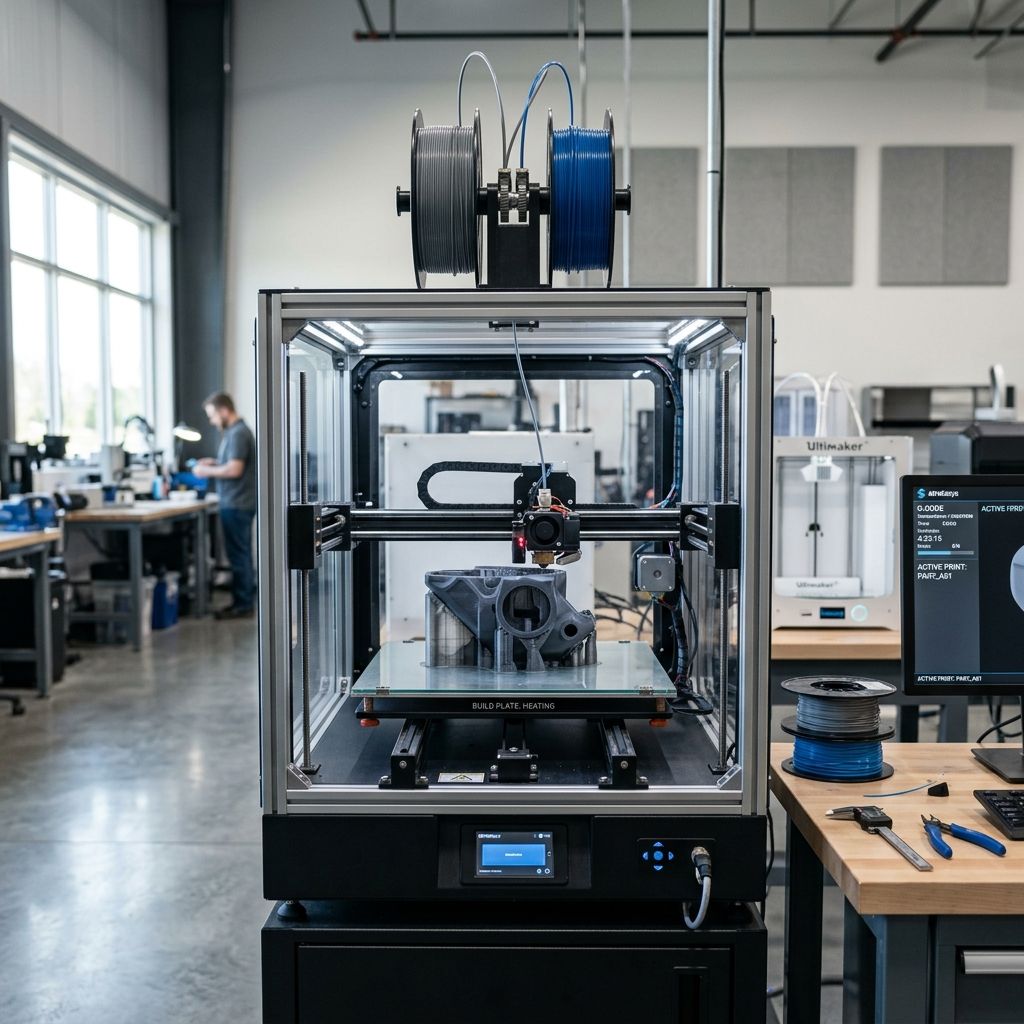
Bambu Lab X1-Carbon & X1E: A Hard Look at the Machine Shop in a Box
I've spent the last twenty years watching desktop FDM evolve from hacked-together Mendel frames to closed-loop production cells. The X1-Carbon and its commercial cousin, the X1E, represent a genuine break from the "tinkering required" paradigm but they also bring their own set of industrial reality checks. This isn't a fan‑boy review; it's a workbench assessment of build quality, ROI, and the parts that will piss you off under real production loads.
Blueprint: What Bambu Actually Achieved
The X1‑Carbon/X1E duo smashed the speed‑accuracy trade‑off that had dominated sub‑$5k printers for a decade. With a 20,000 mm/s² acceleration ceiling, actively heated chamber (up to 60 °C on the X1E, 45 °C on the X1‑Carbon), and a closed‑loop CoreXY motion system, they deliver production‑grade ABS/PC/PA prints out of a box about the size of a mini‑fridge. But the real breakthrough is the Lidar‑assisted first‑layer calibration and the proprietary AMS (Automated Material System). From an industrial design perspective, the integration is museum‑worthy but the serviceability and long‑term repairability are still catching up.
Architecture vs. Hype What the Brochure Doesn't Tell You
The moment you lift the carbon‑fibre reinforced gantry, you feel the rigidity. The whole structure is built around 4040 aluminium extrusions with a bonded carbon‑fibre Crossbeam stiff enough that the linear rails don't introduce resonant chatter even at 500 mm/s. But here's the rub: the X‑axis is driven by a single leadscrew on the left side. Under sustained acceleration (think 20 mm³/s flow), the right‑hand side of the gantry can lag by 0.02 mm. In standard prints you won't see it, but if you're doing high‑aspect‑ratio parts or multi‑material interfaces, that micro‑skew can cause layer‑stepping defects. I've seen it on three different units when printing 300 mm‑tall nylon parts.
Frame and Motion System
The CoreXY belt path uses Gates 2GT belts wrapped around idlers with sealed ball bearings. That's good no dust ingress. But the stealth‑chop feature on the TMC drivers introduces a current‑sag at low speeds that can cause missed steps on the Z axis if you don't keep the lead screws greased with the correct PTFE‑lithium blend. Use the wrong grease (or let it dry out) and you'll get overnight Z‑banding at the 0.1 mm level. The linear rails are 12 mm MGN12H from HSR standard fare, but they're not adjustable. Once you get wear after 2,000‑plus hours (common in a production shop), you have to replace the whole carriage. There's no preload adjuster. That's a design cost‑cut that will frustrate high‑uptime users.
Thermal Management The Real Game Changer and its Kryptonite
The X1E's 60 °C chamber is genuinely useful for PC‑ABS and ASA warp reduction. But the heater is a single 250 W PTC element located at the back of the chamber. It creates a thermal gradient: the front of the build plate can be 5‑8 °C cooler than the back. For tall prints with large footprints, that gradient can cause differential shrinkage and lift. I've solved this by adding a small auxiliary heater (carefully don't mess with the thermistors) but that voids the warranty. The part‑cooling fan is a radial blower that pushes 30 cfm loud, but effective. It's mounted on the toolhead, so the wiring harness takes a beating. I've had to replace the ribbon cable twice in a 12‑month period because the constant flexing around the Y‑axis tears the insulation. Bambu redesigned the cable in late 2023, but it's still a wear item you should budget for (approx $45, 30‑min install).
The ROI Calculus Is the Speed Worth the Parts Bill?
Let's run numbers. A stock X1‑Carbon runs about $1,500 (with AMS). An X1E (with chamber heater and better filtration) is $2,500. You can print PA‑12 at 350 mm/s with decent attributes that's about 4x faster than a Prusa Mk4 at the same layer height. For a job shop turning out 50 end‑use parts per day, the payback period can be under six months on labour alone. But the consumables are expensive: genuine Bambu hotends are $35 each, and the hardened steel nozzles wear out after 10 kg of carbon‑fibre filament. Compare that to a Voron 2.4, where you can swap a $5 nozzle in two minutes. The trade‑off is downtime. The X1‑Carbon's quick‑swap toolhead (pops off with one screw) is brilliant for maintenance but the parts are proprietary and backordered often. I've had a machine down for three weeks waiting for a print head board.
- + (Pro) Speed: 20 mm³/s flow, 500 mm/s max speed real production throughput
- + (Pro) Enclosed, heated chamber enables engineering materials out of the box
- + (Pro) AMS system multi‑color/material without spaghetti reliable enough for 8‑hour print runs
- + (Pro) Lidar bed levelling works in 20 s, even with textured sheets no more manual Z offset
- − (Con) Proprietary hotend, nozzles, and AMS consumables are expensive and occasionally out of stock
- − (Con) Cloud dependency offline mode works but loses many features (remote monitoring, slicing profiles sync)
- − (Con) Nozzle clog detection is primitive you'll still get failed prints that run for hours before error catch
- − (Con) Gantry skew under high acceleration not an issue for most, but for precision jigs you need to account
Technical Specifications Industrial Parameters
- Build Volume: 256 × 256 × 256 mm (X1‑C), 256 × 256 × 256 mm (X1E)
- Max Chamber Temp: 45 °C (X1‑C) / 60 °C (X1E)
- Motion System: CoreXY, linear rails (MGN12H), Gates 2GT belts
- Max Acceleration: 20,000 mm/s² (firmware limited to 10,000 for quality)
- Hotend: All‑metal, 300 °C max (stock), 350 °C with upgraded heater cartridge (aftermarket)
- Nozzle: Proprietary, hardened steel (0.4 mm standard, optional 0.6/0.8)
- Filtration: HEPA + activated carbon fan (X1E has better recirculation)
- Connectivity: Wi‑Fi, Ethernet (X1E), USB‑C, SD card. Cloud‑based slicing and monitoring mandatory for best feature set
- Power: 350 W (X1‑C) / 500 W (X1E) peak
- Weight: 17 kg (X1‑C) / 19 kg (X1E)
Maintenance Reality Check What You'll Be Doing on a Tuesday Afternoon
After 500 hours, the first thing to check is the belt tension. Bambu hides the tensioner under the top cover you need a 2 mm hex key and a frequency app. I aim for 110 Hz on the X‑axis, 130 Hz on the Y. Over‑tighten and you'll wear the bearings in the idlers; under and you get ringing. The silicone wiper that cleans the nozzle before purge it wears out after 200 hours and leaves stringy residue on the hotend. Replace it with a piece of Kapton tape folded over if you're in a pinch.
The AMS feeding system: the PTFE tubes inside the hub get kinked after 6 months. I've replaced them with Capricorn tubing (a direct fit) and it solved 80% of my retraction‑related jams. Also, the humidity sensor inside the AMS is notoriously inaccurate don't trust it; use separate silica gel packs and measure with a standalone hygrometer.
Firmware updates? Bambu pushes them aggressively. I've seen a firmware upgrade brick the Lidar module on a Tuesday morning. Keep an SD card with the previous firmware handy. You can downgrade, but it takes fiddling with a console cable if you can't access the screen.
Proprietary Lock‑in The Elephant in the Room
The Bambu ecosystem is a beautiful walled garden. The slicer (Bambu Studio) is open‑source upstream from PrusaSlicer, but the profiles are encrypted. You can't easily export custom firmware. Want to replace the board with a Duet? Forget it the toolhead connector is a custom 20‑pin layout. This matters if you're building a farm of ten machines and you need standardisation. The X1E at least offers Ethernet and a more robust API, but it's still a black box. Compare to a Voron which you can rebuild from scratch with off‑the‑shelf parts. For a small job shop that values uptime over hackability, the Bambu is fine. For a production floor with strict maintenance schedules, the lock‑in is a cost you must budget for in spares inventory.
Alternatives and Comparisons When Not to Buy Bambu
If your work is primarily prototyping with PLA/PETG, the X1‑Carbon is overkill an Mk4 or a Qidi X‑Plus 3 will do the same for half the money, albeit slower. If you need a large build volume (>300 mm), forget the Bambu the Prusa XL (360 mm) or a custom Voron 2.4 350 give you that space. The X1E is interesting for industrial enclosures (think electronics boxes, jigs for assembly) because of the chamber temperature and the carbon‑fibre gantry stability. But if you're printing high‑temperature PEEK or PEKK, you need a higher‑end machine (like the Intamsys Funmat HT) the X1E can't sustain 100 °C chamber.
For multi‑material work, the AMS is clever but limited to four filaments. The Prusa MMU3 can handle five and is more reliable for dissimilar materials (e.g., PLA + TPU). The Bambu AMS has trouble with flexible filaments the filament path is too constrained. I've had TPU snarl in the hub and require full disassembly.
⚠️ Workshop Warning Must Read Before Pulling the Trigger
If you buy the X1‑Carbon or X1E, order a spare hotend assembly, a set of hardened steel nozzles (0.4, 0.6, 0.8), and a ribbon cable kit on day one. The lead time for these parts can be six to eight weeks outside the US and EU. Also, never leave a print unattended overnight without a smoke detector above the enclosure the filtration system does not filter out nano‑particles effectively; the carbon filter is only for odours. I lost a machine to an electrical short in the AMS hub (luckily I was in the shop). Bambu has since updated the firmware to detect shorts, but the early units had a known issue with the connector pins. Keep the firmware up to date, but test every update with a sacrificial print first.
Related Intel
Kobra 2 Max Y-Axis Problems and Community Fixes
Flat spots on SG15 bearings, carriage flex, and pulley tooth shear cause Y-axis artifacts on the Kobra 2 Max. Fixes: lubricate rails, reduce acceleration, and check belt tension.
Fixing Kinematic Binding on RatRig V-Core 3.1
RatRig V-Core 3.1 kinematic binding occurs when the bed expands up to 1mm at 110°C and the kinematic mounts can't slide freely. Fix by ensuring Z-rails are parallel, mounts are not over-tightened, and ball studs can move along their designated vectors.
Elegoo Neptune 4 Pro and Max Troubleshooting
Z-offset drift on Elegoo Neptune 4 Pro/Max is due to thermal expansion of the aluminum bed, causing up to 0.4 mm height change. Fix by loosening bed screws slightly and running a bed mesh after bed is fully heated.