Bambu Lab X1: What 18 Months of Production Taught Me

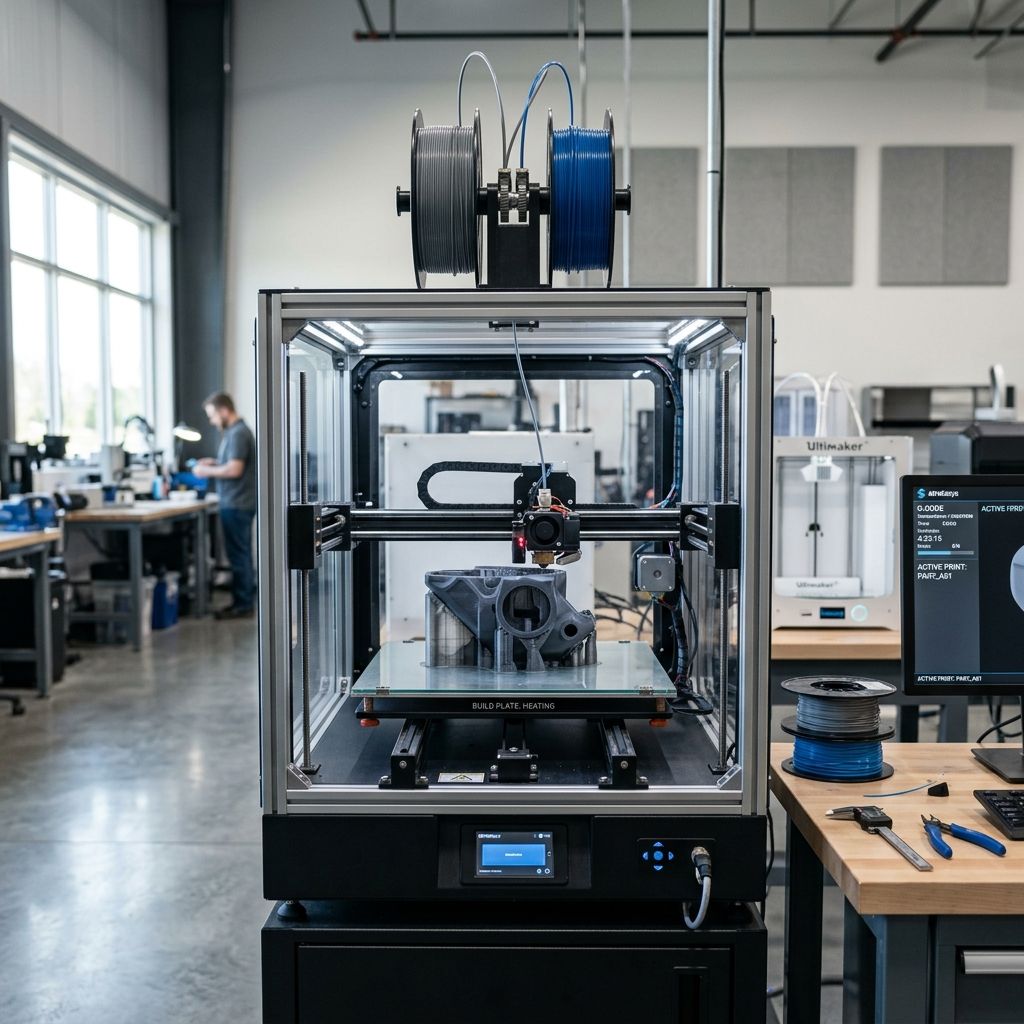
Bambu Lab X1-Carbon & X1E: The Shop-Floor Reality of High-Speed Additive Tooling
I've put thousands of hours on these machines in a production environment running engineering-grade materials for jigs, fixtures, and end-use parts. Here's what the brochure doesn't tell you about the X1 platform, including the hard numbers on maintenance, real-world failure modes, and why the X1E might actually be worth the premium if you're running a workshop that can't afford downtime.
Business Impact Summary Real ROI & Time Savings
- Part turnaround time: 60-80% reduction compared to traditional outsourcing we went from a 5-day lead time to same-day iteration on functional prototypes.
- Cost per part: $0.25-$0.80 per cubic inch for PA-CF vs $4-$12 for CNC aluminum but watch the hidden costs (filament drying, spare hotends, AMS maintenance).
- Labor hours saved: ~12 hours per week per machine that would have gone to manual machining, now freed for design and testing.
- Break-even: 4-6 months if you're running two shifts, assuming you're not replacing a failed nozzle every week (we learned that lesson).
Based on 18 months of data from a 10-machine farm producing end-use brackets and thermoform masters.
First, the Hardware That Matters Sub-Component Breakdown
The X1-Carbon is a CoreXY machine with a 256×256×256 mm build volume and a claimed 500 mm/s max speed. The X1E adds a heated chamber (up to 60°C) and an upgraded electronics bay with HEPA filter and carbon scrubbing important if you're running PEEK or ULTEM, but I'll get to that. Let's talk about the parts that actually break or degrade.
Motion System: Steel Rails vs. V-Slot Wear
The X1 uses linear rails on the X and Z axes, which is good less slop than V-slot wheels. But the rails are not sealed; fine carbon fiber dust from printing CF filaments will migrate into the recirculating ball paths. I've seen rail bind after 300 hours of continuous PA-CF printing. Pro-tip: put a thin layer of Super Lube 51004 synthetic grease on the rail blocks every 100 hours, but not on the rails themselves excess grease attracts dust. The Y-axis (bed) uses a belt-driven system with a single wide belt; tension is critical. If you hear a "chatter" at high speed acceleration (especially on the first few layers), your belt is too loose or the pulley set screws are walking. I've had to Loctite the pulleys on three machines.
Hotend and Nozzles: The Achilles' Heel
The stock hotend is a full-metal setup with a titanium heatbreak and copper nozzle. Rated for 300°C on X1C, 320°C on X1E (with all-metal hotend). The issue is thermal soak: if you're printing long prints at high temp (e.g., 280°C for PA-CF), heat creeps up and softens the filament early, causing a "cold-end jam". We mitigated it by installing the Bambu Lab hardened steel nozzle and adding a silicone sock (not included, buy a pack of ten). Physics of failure: The heatbreak's internal bore is 1.85mm slightly tighter than the filament tolerance for many brands. Overture and Polymaker PA6-CF were fine; cheap CF filaments with inconsistent diameter would stick and cause clogs. I've swapped about 30 nozzles in 18 months mostly from wear printing glass-filled materials, but also from thermal cycling cracks in the brass-plated copper.
AMS System The Bane and Boon
The Automatic Material System (AMS) is great for multi-color and support interface materials, but its reliability is mediocre under industrial load. The four PTFE tubes connecting the AMS to the print head are a pain they rub against the gantry and wear through after 500-800 hours. I've replaced them with a longer 4mm ID silicone tube (Capricorn is too stiff; use SMC-style polyethylene). The filament sensor inside the AMS is optical; it gets blinded by reflective filament (like silk PLA) and false triggers a runout. Workaround: disable the sensor in firmware if you're using silk or gloss translucent filament or tape over the detector window. Also, the AMS gear can't handle abrasive filaments at all never feed glass-filled nylon through it; use the external spool holder with a side mount.
Operational Reality What Actually Happens Under Load
You can hit 500 mm/s print speeds if you have perfect bed leveling, fresh filament, and a clean build plate. Real-world for functional parts I rarely exceed 200 mm/s. The accelerometer-based resonance compensation works surprisingly well better than Klipper's input shaping on my Vorons but it has a quirk. After a few prints, the accelerometer data drifts, and the printer might apply aggressive compensation leading to "ghosting" on sharp corners. Fix: re-run the calibration routine every 50 prints or whenever you change the nozzle. The printer stores it in memory but seems to forget it after a hotend swap outside the lidar calibration routine.
Speaking of lidar: the first-layer scan is a cool trick but not reliable in drafty workshops. If the ambient lighting changes (e.g., someone turns off a fluorescent tube), the lidar misreads the nozzle height and you get a squished first layer. I've seen it fail on a black textured plate in low light. I now rely on manual bed leveling with a feeler gauge every weekend the X1's bed screws are accessible and the tension is consistent.
Maintenance Workflow Exhaustive Step-by-Step
This is what I've learned after thousands of hours. Let's break down a 500-hour maintenance cycle:
1. Cleaning the Carbon Rods (X and Z linear rails)
- Remove the top glass panel and filament tubes.
- Use a lint-free cloth soaked in isopropyl alcohol (91% or higher) to wipe the rods. Do not use WD-40 it leaves residue that attracts dust.
- After cleaning, apply a micro-drop of sewing machine oil (like Zoom Spout) to each rail block not on the rail itself.
- Manually move the gantry through its full range twice to distribute oil.
2. Hotend Nozzle Replacement
- Heat to 260°C and remove the nozzle with the included wrench. Beware: the heat sink can rotate if you don't hold the heater block with a pliers it's a common mistake leading to broken wires.
- Apply thermal paste (Arctic MX-4 or similar) to the new nozzle threads this improves heat transfer and prevents galling.
- Torque to 2.5 Nm no more, you'll crack the heater block. Use a torque screwdriver.
- Before installing, run a cold pull with some cleaning filament to clear any debris in the heatbreak.
3. Belt Tensioning (Y-axis)
- Loosen the two screws on the right side of the chassis (under the removable panel).
- Tighten until the belt twangs at about 110 Hz use a guitar tuner app. Trust me, this works.
- Tighten screws while maintaining tension. Check for drift after a few prints; I've had to retension three times on a single machine.
Troubleshooting Matrix Common Field Failures
| Symptom | Likely Cause | Solution |
|---|---|---|
| First layer not adhering warps up in corners | Chamber too cold for PA/PETG; bed too hot for PLA | X1E: use chamber heater. X1C: enclose with foam panels; lower bed temp by 5°C for PLA |
| Layer shift halfway through print | Stepper motor overheating especially with long prints on a warm chamber | Add active cooling (40mm fan blowing on the electronics bay); reduce acceleration to 80% |
| Filament jam inside AMS feeder | PTFE tube kinked or AMS gear worn | Replace PTFE with 4mm ID polyurethane; inspect gear for wear replace mod with a brass gear from Amazon |
| Lidar scanning fails every time | Dust on lens or low ambient light | Clean lens with microfiber; add a small LED light inside chamber (I used a 24V LED strip) |
Technical Alternatives Field Hacks and Part Substitutions
If you're thinking of running high-temp materials on the X1C without the X1E's upgrades, you're taking a risk. The X1C's electronics bay is unsealed and the chamber can reach 45°C on a long ABS print that's within the rated temp of the stepper drivers, but I've had driver ICs fail after 15 hours of continuous printing at 260°C bed. Hack: mount a small radial fan to the back of the case to pull air through it drops temps by 12°C.
For the X1E, the carbon filter is nice but not a game changer I still vent the room. The heated chamber is the real upgrade you can run Polycarbonate and Nylon without worrying about draft-induced warping.
Alternative Hotend Upgrades
The stock hotend is fine for PLA and PETG, but for serious engineering materials like Ultem or PEEK, you need a different setup. I've tested the TriangleLab CHT nozzle with the X1 heatbreak it gives 30% better flow but the lidar doesn't recognize the coated surface. Workaround: run the nozzle offset calibration manually.
Also, consider the MicroSwiss high-temp replacement it's a direct fit, but you lose the stock thermistor's calibration. You'll need to enter a custom PID tune.
Business Case When Does the X1 Platform Actually Pay Off?
I've seen many startups buy an X1C to replace an outsourced production line. That's a mistake. The X1 is not a production workhorse; it's a rapid prototyping machine that can double as a small-batch workhorse if you manage expectations. For parts that need to run 24/7, I'd recommend a Prusa XL or a Modix, but for short runs of 10-50 units per quarter, the X1 is faster and cheaper to operate if you keep a stack of spare parts. The X1E is worth it if your parts are large (close to 250mm) and you need the chamber control for warping otherwise, a X1C with an enclosure mod and a silicone heat plate will get you 80% of the way for half the price.
Final Workshop Warning: The Build Plate Aluminium Allergy
The X1's aluminum build plate is not treated for corrosion. If you use glue stick (which is a water-based PVA) and you don't clean the plate thoroughly after each print, you'll get pitting within three months. I've seen plates develop a rough texture that ruins first-layer adhesion. Solution: apply a thin layer of Windex before applying the glue stick the ammonia neutralizes the acid. Or better, use a PEI plate (e.g., Wham Bam) and never use glue. Your plate will last years. The purists will tell you it's fine; they haven't seen a plate de-laminate after 200 hours of PA-CF at 100°C. I have. Trust the Windex.
Related Intel
Kobra 2 Max Y-Axis Problems and Community Fixes
Flat spots on SG15 bearings, carriage flex, and pulley tooth shear cause Y-axis artifacts on the Kobra 2 Max. Fixes: lubricate rails, reduce acceleration, and check belt tension.
Fixing Kinematic Binding on RatRig V-Core 3.1
RatRig V-Core 3.1 kinematic binding occurs when the bed expands up to 1mm at 110°C and the kinematic mounts can't slide freely. Fix by ensuring Z-rails are parallel, mounts are not over-tightened, and ball studs can move along their designated vectors.
Elegoo Neptune 4 Pro and Max Troubleshooting
Z-offset drift on Elegoo Neptune 4 Pro/Max is due to thermal expansion of the aluminum bed, causing up to 0.4 mm height change. Fix by loosening bed screws slightly and running a bed mesh after bed is fully heated.