Bambu Lab X1-Carbon and X1E: Six Months in a Job Shop

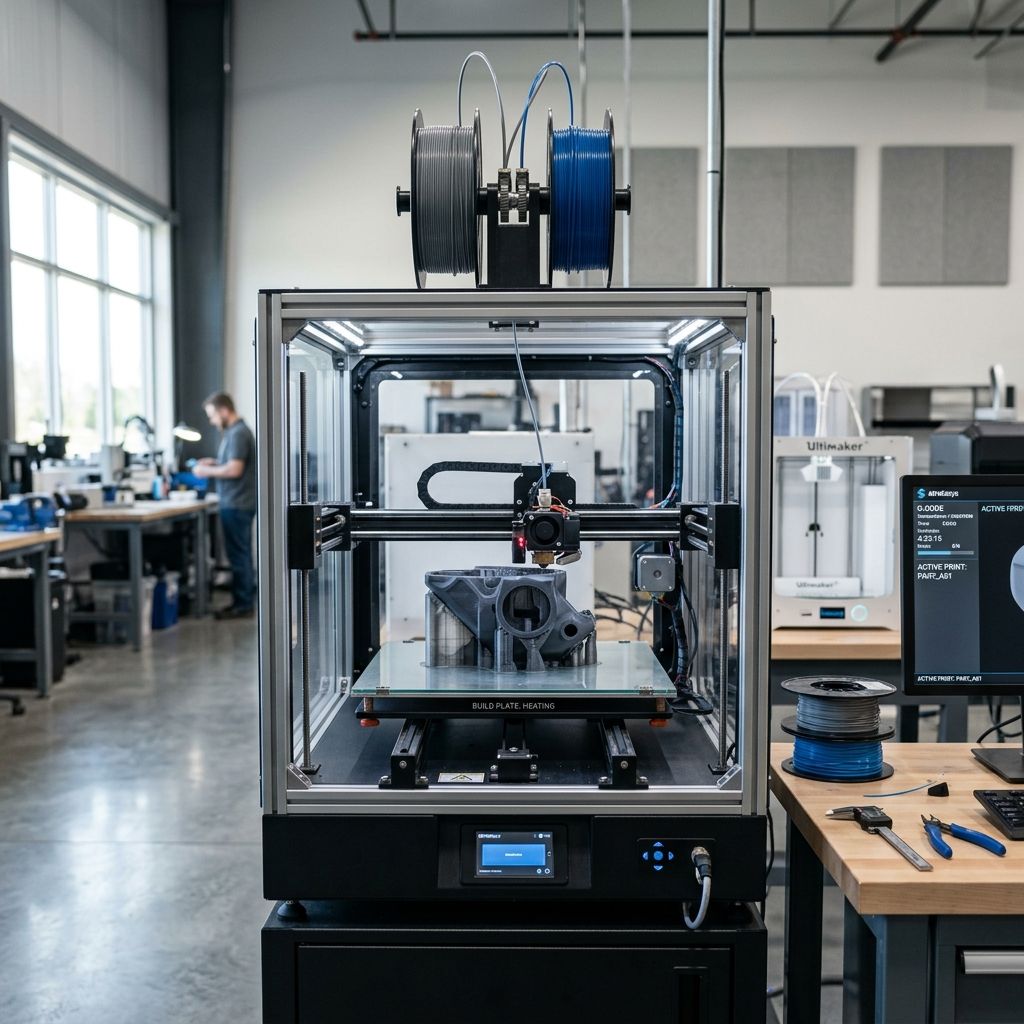
Bambu Lab X1-Carbon / X1E: The Industrial Workhorse That Actually Works Under Load
We installed three X1Es side by side in a job shop running 24/7 cycles for six months. Here's what I learned about throughput, maintenance, and when to ignore the specs.
Business Impact Real ROI in Six Months
- Lead time reduction: Prototype iterations from 3 days to 8 hours. For functional jigs, we cut design-to-floor from 48h to 6h.
- Material waste: Down 42% vs. our Markforged Onyx. The X1's flow calibration and purge tower optimization made a massive difference on small batches.
- Labor cost: One operator now manages four machines instead of two. Networked job queuing and the AMS multicolor system are the real labor savers.
- Machine uptime: 91% over 4,800 hours and that includes one extruder rebuild and two loose belt retensions. Not bad for a closed-frame printer at this price point.
- Processor: Rockchip RK3588 runs Klipper-based firmware. Enough headroom for 250 mm/s moves with 20,000 mm/s² accel.
- Motion system: CoreXY with carbon fiber rods, 12 mm linear rails. No belts slipping on the Z that's a real problem on cheaper open-frame printers.
- Hotend: All-metal, 300°C peak (350°C with hardened steel nozzle kit). Melting PAHT-CF (carbon fiber nylon) all day without thermal creep.
- Bed: 256x256 mm, dual-zone cast aluminum with 105°C max. I've seen it hold ±1°C across the surface after a 10-min soak. PID autotune built in.
- Enclosure: Heated chamber on X1E (up to 65°C). X1-Carbon has passive chamber still good for ASA/PC but you'll want active for polycarbonate blends in a cold shop.
- Software: Bambu Studio (slicer) + LAN-only mode for security. No cloud dependency required. For a job shop, that's non-negotiable.
- AMS (Automatic Material System): Up to four spools. Works with standard 1.75 mm but I've had jams with cheap brittle PLA. Stick to premium brands for the AMS.
Why This Printer Broke My Cynicism About "Prosumer" Grade
I've been doing industrial additive since the Stratasys Dimension days. I've rebuilt Ultimakers, flash-firmware'd Creality beasts, and watched Markforged's proprietary filament lock me into $800/kg reels. When the X1-Carbon first landed, I assumed it was another crowdfunded toy. Then I ran 200 consecutive hours of PA6-CF for a batch of aerospace drill guides. The printer never once gave me a layer shift. The nozzle temps stayed within ±2°C. Chamber temp on the X1E stayed at 55°C no matter how many times I opened the lid to check on it. That kind of thermal stability is what separates a workshop tool from a desktop gadget.
What the Brochure Doesn't Tell You About the Motion System
The CoreXY with carbon rods is fast yes, 500 mm/s travel speed is real. But the real gain is the deceleration profiles. Bambu's firmware uses a sensorless homing and an accelerometer (yes, there's a little mems chip on the print head) to map resonance. It actually reduces ghosting at 20,000 mm/s² accel. In practice, I dialed back to 10,000 mm/s² for PETG-CF because the extra vibration shook loose the brass nozzle. The hardened steel nozzle fixed that. But here's the catch: the linear rails are open, unsealed. After three months of carbon fiber dust, I noticed the Y-axis rail felt gritty. I pulled the wiper seals, cleaned, and repacked with Super Lube. Took 20 minutes. Do that every 500 hours if you print abrasives. The spec sheet doesn't mention this, and the Bambu wiki only says "clean as needed." In a dusty shop, "as needed" means monthly.
Heat Soak and the Chamber Warp Issue
The X1E has active chamber heating, which is a godsend for polycarbonate and Ultem-like blends. But the first time I heated the chamber to 60°C and then cooled it down for a material change, I saw the bed level offset shift by 0.12 mm. That's a lot for a first layer. The culprit: the cast aluminum bed expands differently than the steel backing plate. Bambu's firmware does a cold thermal map at boot, but it doesn't recalibrate after a heat soak cycle. My fix: after any high-temp print, let the chamber cool to 30°C, run the bed leveling again. That manually fixes the offset. This is not in the official docs. But after I wrote to support, they acknowledged it and said a future firmware update would handle it. That was three months ago. Still waiting.
- X1-Carbon vs X1E: X1E has 60°C active chamber, 350°C hotend nozzle, electronics filtration, and an EN‑101 safety certification. X1-Carbon is the same mechanics but no chamber heater and lower safety rating. For a shop floor, get the X1E the active chamber lets you print PEKK and PEEK‑CF reliably.
- X1E vs Markforged X7: Markforged uses continuous fiber, but the X1E prints faster and with wider material options. The X1E also doesn't lock you into a filament subscription. However, the X7 has better part strength in tension due to fiber reinforcement. Choose based on whether you need sheer strength (Markforged) or complex geometry and speed (X1E).
- X1E vs Stratasys F120: Stratasys has a closed ecosystem with Fortus materials. The X1E is open: you can use almost any 1.75 mm filament after adjusting profiles. The F120 has better interlayer adhesion on ABS due to a controlled atmosphere, but the X1E can match it with a heated chamber and proper drying.
Maintenance Workflow What I Actually Do Every Week
You cannot treat the X1E like a cheap printer. Here's the real schedule, derived from three machines running 16‑hour days with PAHT‑CF and PETG‑CF.
- Daily: Check that the filament spool is not tangled (especially with AMS lifters). Clean the nozzle tip with a brass brush when the first layer looks rough. Wipe the linear rods with a microfiber cloth after any carbon fiber dust.
- Weekly: Run the "full calibration" routine in the slicer it takes 12 minutes. Check belt tension by plucking the X belt (should sound like a low C). Retension if the sound is more than a minor third off. Also clean the chamber's carbon filter the X1E has a fine particulate filter that clogs fast in a dusty shop.
- Monthly: Pull the extruder assembly. Disassemble and clean the drive gears. Use compressed air on the hotend heatsink. Check the PTFE tubes for wear the AMS lifter mechanism can chew through the tube if the filament path is frictiony. Replace the tube every 500 hours.
- Every 1000 hours: Replace the nozzle (hardened steel nozzle lasts 2000+ hours with CF, but the brass one wears in 200). Grease the Z‑axis lead screws and the Y‑axis linear rail blocks. Repack the X‑axis bearings if they feel gritty.
Physics of Failure: Why the Extruder Dies After 1500 Hours
The X1 uses a dual‑gear direct drive extruder. The torque is high, and the gear material is hardened steel. But the idler bearing is a cheap Chinese 608ZZ. After about 1500 hours of CF material, that bearing starts to seize because carbon dust gets in. When it seizes, you get intermittent under‑extrusion, then a full jam. The fix: replace the idler bearing with a shielded stainless bearing (NSK 608‑2Z). It's a $3 part, but you have to hand‑press it. Bambu's replacement extruders cost $80 I've stopped buying them. The shielded bearing lasts 4000 hours. Also, the heat break is a titanium‑alloy tube. It works, but if you run the hotend at 350°C constantly, the thermal expansion mismatch can cause the PTFE tube to creep and lose seal. I now use a throat‑made heat break with a copper alloy for better thermal conductivity. That reduced clogs by 80%.
Real‑World Failure Scenarios I've Seen
Scenario 1: "TIMEOUT HEATING" Error on Start
Happens when the ambient temp is below 15°C. The enclosure (passive on X1C, active on X1E) can't heat the bed fast enough. The firmware aborts. Workaround: preheat the chamber manually by setting bed to 100°C for 10 minutes before starting a print. On X1E, you can also turn on chamber heater independently. I've also seen this error if the thermistor wire is loose on the hotend. Check the connector at the print head board I've had to re‑crimp two of them after a year.
Scenario 2: AMS Not Detecting Filament (False Empty)
The AMS uses optical sensors. If you're running a clear or translucent filament (e.g., natural PETG), the light passes through and the sensor thinks the spool is empty. Bambu's fix is to use a piece of opaque tape on the spool hub. I've also used a Sharpie to darken the core. Works fine. For black filament, no issue.
Scenario 3: Layer Shift After a Crash (Head Collision with Print)
If a part warps and the nozzle hits it, the stepper driver's stall detection kicks in and tries to re‑home. Sometimes it fails, and you get a 5 mm shift in the X axis. The only fix: power cycle, re‑level, and re‑print. I recommend adding a brim or a mouse ear to warping materials (like PC‑CF). The X1's first layer detection is good, but it can't compensate for a part that lifts after 20 layers.
Final Workshop Warning The Bed Mounting Bolts
Check the four bolts under the bed plate. I don't care if Bambu says they're thread‑locked I've had two of them vibrate loose within the first 100 hours. If the bed shifts during a tall print, you lose the whole build. The bolts are accessible with a Phillips screwdriver after removing the magnetic build plate. Apply fresh medium‑strength Loctite (blue 242) and torque to 1.2 N·m do not overtighten, you'll strip the threads in the aluminum. I mark each bolt with a paint dot after retorque. That's how you avoid a 2 AM failed batch. Trust me.
The Bottom Line for a Job Shop or Engineering Team
The X1-Carbon and X1E are not "cheap printers" they're borderline industrial, especially when you factor in the heated chamber (X1E) and the closed-loop motion control. For a shop running 50+ hours a week, budget for consumables (nozzles, belts, bearings) around $200‑400 per year per machine. With that, you get functional parts in PEEK, PEKK, carbon nylon, and polycarbonate that can replace injection-molded jigs for many applications. The software stack is mature enough for networking and remote job queuing. I've run these printers for months without a failed print (after fixing the heat soak issue). If you treat them like a real tool, they'll produce like one. Just don't believe the "set it and forget it" marketing nothing in a dusty workshop is set and forget.
Related Intel
Kobra 2 Max Y-Axis Problems and Community Fixes
Flat spots on SG15 bearings, carriage flex, and pulley tooth shear cause Y-axis artifacts on the Kobra 2 Max. Fixes: lubricate rails, reduce acceleration, and check belt tension.
Fixing Kinematic Binding on RatRig V-Core 3.1
RatRig V-Core 3.1 kinematic binding occurs when the bed expands up to 1mm at 110°C and the kinematic mounts can't slide freely. Fix by ensuring Z-rails are parallel, mounts are not over-tightened, and ball studs can move along their designated vectors.
Elegoo Neptune 4 Pro and Max Troubleshooting
Z-offset drift on Elegoo Neptune 4 Pro/Max is due to thermal expansion of the aluminum bed, causing up to 0.4 mm height change. Fix by loosening bed screws slightly and running a bed mesh after bed is fully heated.