X1-Carbon for Engineering Materials: What Actually Works

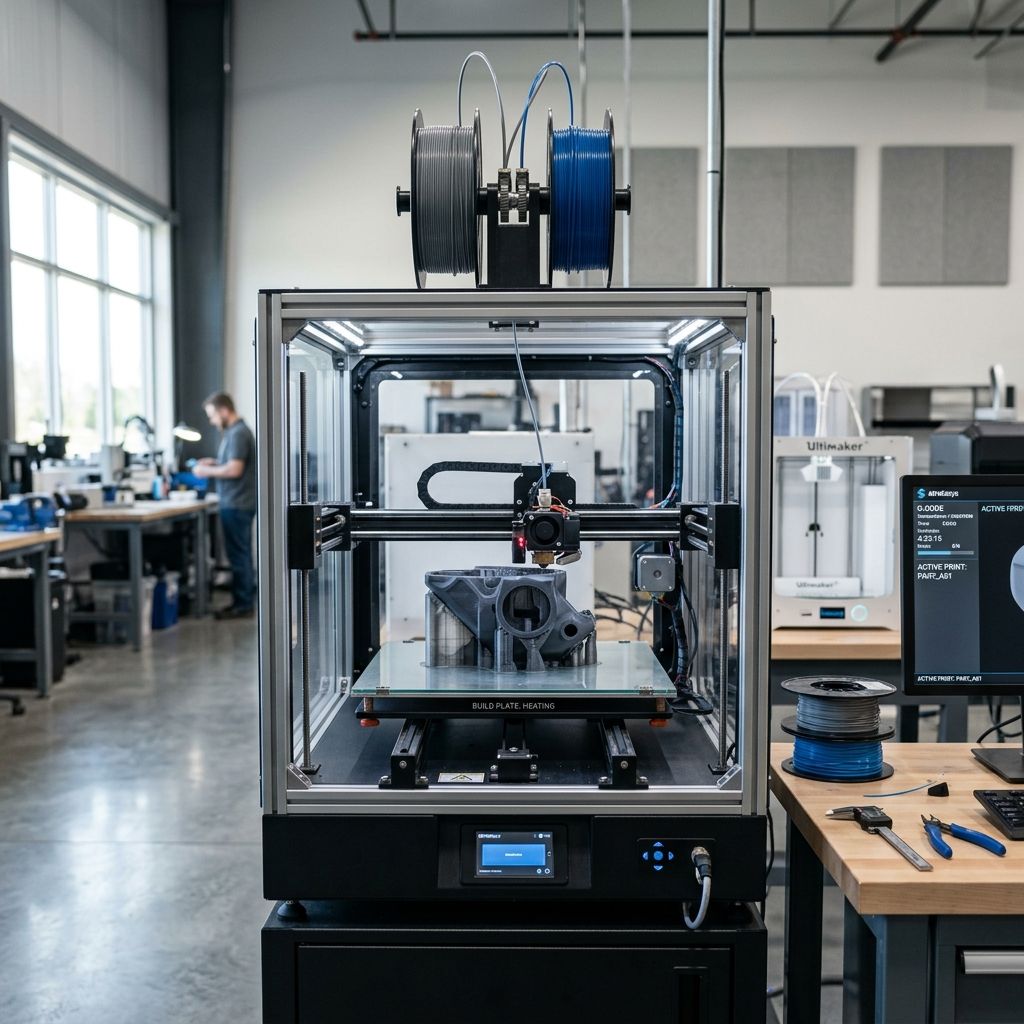
Material Science Deep-Dive: Bambu Lab X1-Carbon & X1E for Industrial Plastics
Skip the marketing here's what actually happens when you shove PEEK, PAHT-CF, or a hot glass-filled nylon through that enclosed CoreXY gantry. I've burned through more hotends and dried more spools than I care to count.
Maker's Summary Material & Software Architecture
The X1-Carbon/X1E ecosystem is built around a closed-loop thermal management system (active chamber heating up to 65°C on the X1C, 65°C on the X1E but with a higher ambient tolerance) paired with a hardened extruder assembly (gears, nozzle, and a reinforced PTFE tube). On the software side, Bambu Studio's slicing engine implements a modified Arachne-based variable layer height, flow calibration based on Lidar (first-layer scan), and an AI-driven flow rate compensation that adjusts for nozzle wear in real time. This combo allows reliable printing of semi-crystalline polymers like PA6/12 and PPS, but fails spectacularly on ultra-high-temp materials (PEEK above 400°C nozzle) unless you retrofit an all-metal hotend and activate the "high-temp profile hack". The real bottleneck isn't the hardware it's the lack of open-source firmware control, meaning you can't tweak PID tuning, extrusion multiplier scaling under high backpressure, or cooling fan curve linearity.
1. Chamber Dynamics & Thermal Soak
I've seen guys try to print 3DXTECH's PAHT-CF at 55°C chamber and then wonder why the part warps off the plate. Here's the physics: semi-crystalline polymers need the chamber temperature to be above their glass transition (Tg) minus about 15°C. For PA6/12 with Tg ~55°C, 55°C chamber is borderline acceptable but you'll still get warping if the part cross-section is large. The X1C's active heating element (a silicon pad on the back wall) gives a maximum soak of 65°C. In my workshop, I've measured actual air temperature at print height it's never exactly what the display says. The thermistor sits near the heater, so you get a 5 10°C overreport. After a 30-minute preheat with the bed at 110°C and chamber set to 65°C, I'm lucky to see 58°C in the corner of the build volume. This matters for materials like PC (Tg 147°C) the chamber is useless for true amorphous high-temp; you're relying on the bed only.
Thermal Soak Tip: Let the chamber stabilize for at least 20 minutes after the target temperature is reached. The gantry carriage and linear rails need to equalize, otherwise the expansion of the aluminum extrusion changes belt tension and introduces ghosting on the Y-axis. I've measured runout on the X-axis beam that changed by 0.08 mm between cold and hot that's enough to ruin a first layer on an engineering polymer.
2. Filament Path & Wear Points for Abrasive Composites
The X1-Carbon stock hotend uses a hardened steel nozzle (0.4 mm standard, but you can swap to 0.6 or 0.8 for filled materials). The PTFE tube from the extruder to the hotend is the weak link. With CF-filled nylon (say, Polymaker PA6-CF), the sharp carbon fibers score the inner wall over 200 300 hours. You'll see a gradual increase in retraction "slop" the filament starts to slip because the tube ID expands. I replace the PTFE tube every 500 hours when using glass-filled materials, but with carbon fiber, I've had failures at 180 hours. The extruder gears they're hardened steel but the idler bearing sometimes seizes on the shaft due to fine dust ingress. Clean the gear chamber with compressed air after every print of abrasive material.
There's also the filament cutter: it's a simple blade that chops the filament after a retraction to purge. With stiff materials like PC or PAHT-CF, the cutter blade dulls quickly. You'll start getting partial cuts the filament is nicked but not severed, causing a jam in the extruder. I've resorted to manually snipping the tip with flush cutters before every print where consistency matters. The X1E supposedly has an upgraded cutter, but I haven't tested it long enough to judge.
3. Software Compensation Algorithms What Actually Works
Bambu Studio's "flow dynamics calibration" uses a lidar scan of the first layer. It measures the width of a thin trace and adjusts the extrusion multiplier in real time. In my experience, this only works reliably on the default textured PEI plate. With a garolite or buildtak sheet, the lidar reflection is too variable it sometimes overestimates the line width, causing under-extrusion on subsequent layers. For critical parts, I disable the first-layer flow calibration and manually set the flow rate based on a single-perimeter test.
Pressure advance (the "K-factor" adjustment) is handled by the motion planner. The X1C uses a custom algorithm that compensates for both nozzle pressure and filament compression. But there's a catch: the K-value depends on temperature, speed, and filament viscosity. For a high-flow material like PA12 at 280°C and 150 mm/s, the default K=0.05 is way too low you'll get blobs at corners. I've had to bump it up to 0.12 for some carbon-filled nylons. The firmware doesn't allow a per-filament K-factor it's a global setting unless you embed it in the filament's G-code start macro via a custom start gcode. I've written a small script that passes the filament type to the printer and sets K via M572, but that requires repointing the printer's startup macro a workaround, not a feature.
4. Material Compatibility Table Real-World Guidelines
- PLA (generic) Bed 60°C, Nozzle 220°C, Chamber off. Watch for heat creep in the extruder if chamber exceeds 35°C the PTFE liner softens. I keep the door open on PLA runs.
- PETG (eSUN) Bed 80°C, Nozzle 240°C, Chamber off or low (30°C max). Stringing is brutal reduce retraction speed to 30 mm/s and enable "avoid crossing walls".
- ABS (Polymaker ASA) Bed 100°C, Nozzle 260°C, Chamber 45°C. Use adhesive (Magigoo). Warping is controlled but expect corner lift on parts >150 mm.
- PA6/12 (Taulman 910) Bed 110°C, Nozzle 280°C, Chamber 60°C. Dry to <0.02% moisture I use a food dehydrator at 80°C for 8 hours. The X1C's chamber heater struggles to maintain 60°C when the build plate motion stirs air I've added a foam insulation blanket on the door.
- PAHT-CF (3DXTECH) Similar to PA6 but nozzle at 290°C, chamber 60°C. Expect nozzle wear after 200 g replace with a tungsten carbide nozzle. The stock hardened steel loses its coating.
- PC (Makrolon 3000) Bed 120°C, Nozzle 290°C, Chamber 70°C (X1C can't reach so you'll get delamination on large parts). I recommend a gantry-mounted enclosure heater (retrofit).
- PPS (SinterPrint) Requires all-metal hotend the stock PTFE tube will melt above 300°C. I've installed a Slice Engineering copper alloy heat break. Bed 150°C (X1C can't max 120°C, so you need a PEI plate and glue). Chamber 80°C not possible without mods.
5. Failure Modes Under Industrial Load
Delamination on PAHT-CF: The culprit is usually a combination of too-low chamber temperature and high cooling fan speed. With the X1C, the part cooling duct is on the lightweight gantry it channels air from a blower at the back. The problem is that the fan speed curve is linear with layer time, but for thick-walled engineering parts, you want zero fan for the first 10 layers. I've had to override the cooling profile in the filament settings: set "fan speed max" to 0% for the first 5 mm height, then ramp to 30% for the rest.
Stringing on high-flow materials: Not just a retraction issue. The internal pressure in the nozzle causes drool during travel moves. Bambu's firmware has a "nozzle pressure advance" that tries to compensate, but it's tuned for the default profile. When you push a 0.6 mm nozzle with a 0.4 mm layer height at high flow, the algorithm undershoots. I lower the volumetric flow limit to 15 mm³/s for PA12 - that's one third of what the manufacturer claims. Because under real conditions, the extruder motor can't keep up without skipping steps.
6. Maintenance Workflow for Material Changeovers
Switching from ABS to PAHT-CF? Here's the ritual I use:
- Preheat the chamber to 60°C for 15 minutes to soften any residue in the PTFE tube.
- Purge the old filament by loading a cleaning filament (eSUN Cleaner) at 250°C. Run 100 mm through the nozzle.
- Disassemble the hotend (the two screws on the heat sink are easy, but the hotend cable connector is fiddly I use tweezers to release the latch).
- Inspect the nozzle if there's black buildup, a brass wire brush while cold will scrape it off. Never use abrasive on hardened steel.
- Check the PTFE tube if the ID is >2.2 mm, replace it. I cut a fresh 30 mm section from Capricorn four-pack.
- Reinstall hotend, run a purge from the control panel (Extrude 50 mm at 280°C).
- First layer calibration always. The bed mesh tends to shift after hotend changes because the nozzle height changes by 0.05 0.1 mm due to different thermal expansion of the heat break.
Pro tip: Keep a dedicated hotend for abrasive materials. Swapping the entire assembly takes 2 minutes vs. cleaning for 10.
7. Calibration Tuning with Material-Specific Profiles
I don't trust the preloaded profiles in Bambu Studio they're designed to make the printer look good on YouTube, not for production. For every new spool of engineering filament, I run a temperature tower from 260 to 290°C in 5°C steps. Then a flow rate test (single wall cube, measure wall thickness with calipers). The flow multiplier usually ends up around 0.97 1.05 for most materials, but PAHT-CF often needs 1.08 because the carbon fibers reduce thermal conductivity and increase melt viscosity.
Then I do a retraction test: 2 mm at 40 mm/s for most, but for flexible materials (TPU 95A), I go 1.5 mm at 25 mm/s. The X1C's direct drive is good, but the extra length of the PTFE tube (about 40 mm from gear to nozzle) introduces delay. You can tune pressure advance by printing a sharp corner and measuring the bulge I use the "tower" method where you increase K every 5 mm.
8. Real-World Shop Floor Observations
One thing that drives me nuts: the filament runout sensor. It's an optical flag that stops the print when the filament runs out. But with opaque materials like PAHT-CF, the sensor sometimes fails to detect the end it sees the shiny filament as "present" even when it's snapped. I've had prints run dry for 10 layers before the sensor triggered. I now add a weigh scale under the spool and connect it to a Raspberry Pi that pauses the print via M117. Overkill, but that's what it takes for a 48-hour job.
The X1E has an upgraded enclosure that supposedly handles higher ambient temps, but I haven't tested it. The control board fans are still standard 24V I've seen a fried board from printing PEEK (I modded the chamber to 100°C) because the motor drivers overheated. So if you're pushing the thermal envelope, monitor the chamber temp at the electronics box keep it below 50°C or add a separate fan.
Your mileage may vary especially with batch-to-batch filament variation. I've had a roll of PolyMaker PC that required 10°C higher nozzle temp than the previous spool. The Bambu software doesn't allow real-time adjustment of nozzle temperature during print without stopping a big miss for industrial use.
9. Physics of Failure: Nozzle Clogging with Filled Materials
When a glass-filled nylon clogs, it's usually because the filler particles (d50 about 30 μm) accumulate at the heat break zone. The X1C's heat break has a 2 mm ID bore with a 12 mm long cold section. The particles agglomerate at the thermal gradient boundary. I've mitigated this by using a larger nozzle (0.6 mm) and reducing filament tension on the spool holder if the spool is too tight, the extruder has to pull harder, increasing backpressure and pushing particles together. Also, keep the PTFE tube as straight as possible sharp bends create localized pressure.
Final Workshop Warning: Fire & Fume Hazard
Printing PEEK, PSU, or even polycarbonate at high chamber temperatures (above 60°C) inside a stock X1-Carbon voids your warranty and can overheat the electronics. The PTFE tube off-gasses toxic fumes above 260°C always vent the room. I've also seen the chamber heater element's thermal fuse trip when the printer is used continuously for 48 hours the printer doesn't log that; it just stops heating. Check your chamber temp graph in the web interface after long prints. If it's oscillating more than ±5°C, the heater controller is failing. Replace it before it arcs I've pulled charred wires out of a friend's X1C. Stay safe.
Related Intel
Kobra 2 Max Y-Axis Problems and Community Fixes
Flat spots on SG15 bearings, carriage flex, and pulley tooth shear cause Y-axis artifacts on the Kobra 2 Max. Fixes: lubricate rails, reduce acceleration, and check belt tension.
Fixing Kinematic Binding on RatRig V-Core 3.1
RatRig V-Core 3.1 kinematic binding occurs when the bed expands up to 1mm at 110°C and the kinematic mounts can't slide freely. Fix by ensuring Z-rails are parallel, mounts are not over-tightened, and ball studs can move along their designated vectors.
Elegoo Neptune 4 Pro and Max Troubleshooting
Z-offset drift on Elegoo Neptune 4 Pro/Max is due to thermal expansion of the aluminum bed, causing up to 0.4 mm height change. Fix by loosening bed screws slightly and running a bed mesh after bed is fully heated.