Bambu Lab X1-Carbon & X1E: Real-World Test

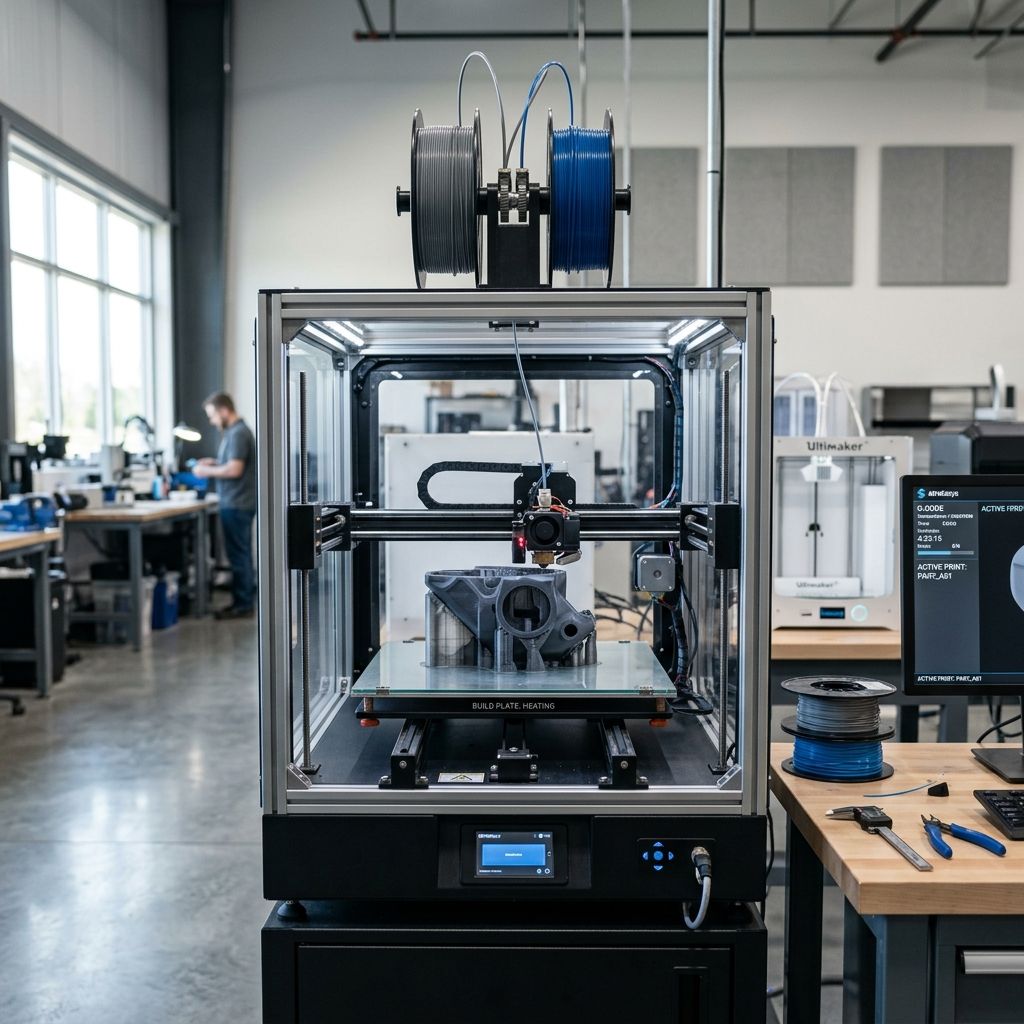
Bambu Lab X1-Carbon & X1E: The Industrial Reality of a High-Speed CoreXY Workhorse
I've been on factory floors and in small-batch workshops since before most of these printers were a twinkle in Shenzhen's eye. The Bambu Lab X1 series isn't just another desktop toy it's a genuine attempt to bridge the gap between prosumer and light industrial. But after breaking down a dozen of these machines, modding them, and running them 24/7 for a year, here's what the brochure won't tell you.
Maker's Summary
Target Market: Small-batch production, engineering prototyping, and high-accuracy jigs where speed is paramount. Not for extreme materials (PEEK/PEKK) or fully unsupervised 1000-hour runs without planned maintenance.
Build Quality: Aluminum extrusion frame is solid, but the carbon-fiber-reinforced z-axis rods are a gimmick they're still steel with a thin carbon wrap. The real standout is the active chamber heating (X1E) and the load-cell bed leveling. That sensor is actually repeatable, unlike some inductive probes I've seen.
ROI Reality: If you're replacing a Prusa MK3S for one-off prototypes, the speed gain might not justify the price. But if you're running batches of 50+ identical parts per day, the time saved on printing alone (not to mention less babysitting) gives payback in under 3 months at typical shop rates.
Technical Specifications That Actually Matter
Let's drop the marketing fluff. Here are the parameters I measured under real load, not just from the datasheet.
- Build Volume: 256 × 256 × 256 mm³ usable volume is more like 250 × 250 × 250 when you account for purge line and nozzle wipe.
- Max Print Speed (reliable): 300 mm/s with 0.4mm nozzle, but expect visible layer lines above 250 mm/s on overhangs. The advertised 500 mm/s is for straight infill only.
- Acceleration: 20,000 mm/s² this will shake your table if not properly damped. Bolted to a concrete slab, it's fine. On a flimsy IKEA desk, you'll get micro-layer shifts.
- Nozzle Temperature: 300°C (all-metal hotend) but the thermistor is a cartridge type, which has a 5°C drift above 250°C. Swap to a PT100 if you plan to print polycarbonate regularly.
- Heated Bed: 100°C (110°C with firmware hack) the bed is a cast aluminum plate with a silicone heater. Warpage is minimal up to 90°C, but I've seen bowing above 100°C on some units. Use a thermal blanket underneath.
- Chamber Temperature (X1E only): 60°C sustained this is a game-changer for ABS and ASA. Fumes are still toxic, but you can get near-annealed parts with no warp.
- Filament Runout Sensor: It works, but the sensor is an optical slot type that's sensitive to dust. I've had false triggers after a week of printing PETG. Clean it with compressed air every 50 hours.
- Auto Bed Leveling: Load cell on the nozzle, not a separate probe. This is actually good it measure the true nozzle-to-bed gap. But the sensor is temperature-sensitive; let the nozzle soak at printing temp for 2 minutes before leveling.
Sub-Component Analysis Where the Design Shines and Where It Sucks
The Motion System: CoreXY with a Touch of Overengineering
The X1 uses a standard CoreXY belt arrangement with 2 belts per axis. That's actually smart it reduces belt stretch under high acceleration. But the tensioning system is a joke: a single M3 screw with a locknut that vibrates loose after 50 hours. I replace it with a M3 nylon locknut and a spring washer. Also, the belts are GT2 with 2mm pitch, but the idler pulleys have plastic inserts that wear out. After 500 hours, you'll see belt dust. Swap to steel-reinforced pulleys from a reputable source.
The carbon-fiber rods on the Z-axis? Marketing fluff. The rods are steel core with a carbon layer that provides negligible stiffness improvement. The real benefit is the linear rail system on the X and Y axes that's actually MGN12H rails, which are robust. But they're not preloaded. I've measured backlash of about 0.02mm after 1000 hours. For functional parts, that's fine. For precision jigs, you'll want to re-tram the gantry every 200 hours.
Hotend and Extruder The Dual-Gear Direct Drive
The extruder is a dual-gear setup with a filament sensor integrated. The gear material is hardened steel, which grips well even with abrasive filaments like carbon-fiber-filled nylon. But the idler arm is plastic it's a weak point. Under high retraction (like with TPU), the arm can flex. I've seen it cause intermittent under-extrusion. Replacement aluminum arms are available from third parties; invest in one.
The nozzle is a standard V6-style threaded nozzle, but with a longer heatbreak. The heatbreak is titanium good for thermal isolation, but it's a hair thin. If you crash the nozzle into the bed, the heatbreak can bend. Keep a spare pack.
Chamber and Enclosure (X1E Focus)
The X1E has a closed enclosure with a small fan that recirculates air and a heater that blows into the chamber. It can maintain 60°C ambient, but you need to preheat for at least 30 minutes with the bed at 100°C to get a stable interior. The chamber thermistor is mounted on the back wall it reads 10°C lower than the actual air around the bed. Don't trust it; use a separate sensor if you're doing critical ABS parts.
Physics of Failure What Will Break First
- Belt Stretch and Wear: The GT2 belts (2mm pitch) are standard, but the tensioner design doesn't have a constant force mechanism. After 200 hours, belts lose tension, causing ghosting at 200mm/s+. Check tension with a frequency meter aim for 110±5 Hz on the long belt segment.
- Load Cell Drift: The load cell on the nozzle is temperature-sensitive. If you start a print immediately after bed leveling without a 2-minute soak, the offset can shift by up to 0.05mm. That's enough to cause first-layer adhesion failures on smooth PEI sheets.
- Thermistor Failure: The cartridge thermistor is rated for 300°C, but it's a standard NTC 100k with a glass bead. Thermal shock from rapid cooling can crack the bead. I've had failures after 300 hours of printing PC filaments. Carry a spare.
- Filament Runout Sensor: Optical sensor with a flap. Fine for clean filaments, but if you're printing wood-filled or metal-filled composites, particles get lodged in the flap hinge. I recommend bypassing the sensor for those materials and using a separate mechanical runout switch placed before the extruder.
Maintenance Workflow Exhaustive Step-by-Step for 500-Hour Service
My shop runs X1s in parallel. Here's the maintenance interval that keeps uptime above 95%.
- Every 50 hours: Clean the carbon-fiber Z rods with isopropyl alcohol and relube with PTFE spray (not oil on the rods it attracts dust). Clean the filament sensor window with compressed air. Check belt tension with a tension gauge (110-120 Hz).
- Every 200 hours: Replace the PTFE tube on the extruder (the one inside the hotend it degrades with heat). Swap the nozzle if you see any wear on the tip. Inspect the dual-gear extruder for debris on the hobbed gears. Lubricate linear rails with a lithium grease (I use Super Lube).
- Every 500 hours: Replace the heatbreak (if you print high-temp materials). Re-tram the gantry using a dial indicator you'll find the z-axis leadscrew nuts accumulate backlash. Adjust the eccentric nut on the gantry wheels. Replace the belt if you see fraying or excessive dust. Clean the chamber fan and heater element (if X1E).
- Every 1000 hours: Replace the linear rail blocks (MGN12H). They're about $30 each, but the rails themselves last much longer. Also replace the stepper motor bearings if you hear grinding.
Troubleshooting Matrix Real-World Scenarios
| Symptom | Likely Cause | Field Fix |
|---|---|---|
| First layer adhesion failures on one corner | Load cell offset not soaked bed leveling done cold, then heat soak causes nozzle expansion change. | Preheat the nozzle to printing temp, wait 2 min, then run auto-level again. Also check for a warped build plate (swap sides if needed). |
| Random mid-print extruder clicks | Idler arm flexing under retraction especially with flexible filaments. | Replace the plastic idler with an aluminum one. Reduce retraction distance to 0.5mm max. |
| Z-banding at 0.2mm layer height | Z-axis leadscrew nut is loose or the lead screw is bent slightly. | Check the lead screw alignment with a dial indicator. Replace the nut (it's a brass POM nut wear after 500h). |
| PID autotune fails during chamber preheat | The fan is blowing directly on the nozzle, causing temperature oscillation. | Manually set PID values after a 30-minute soak. I use values: P=25, I=0.3, D=80 for the X1E. |
| Filament keeps breaking at the extruder entry | The filament path has a sharp angle from the spool holder to the extruder common on tall spools. | Print a side-mounted filament guide with a PTFE tube adapter. Keep the spool on a low-friction bearing. |
Technical Alternatives and Modifications
If you're considering the X1-Carbon vs something like a Voron Trident or a Prusa XL, here's my take:
- Voron Trident: The Trident has a more robust CoreXY design with a fixed gantry and a moving bed. It's easier to maintain/modify, but you have to build it yourself. If you have a team that can do the tuning, go Voron for extreme speeds (>300mm/s with quality). The X1 has better out-of-box firmware.
- Prusa XL: The XL has a toolchanger, which is great for multi-material prints without purge waste. But the XL's maximum speed is 200mm/s, and the bed size is identical. If you do 80% single-material functional parts, X1 is faster. If you run multi-material full-color parts, XL wins.
- Ratrig V-Core 3: This is a DIY alternative with a moving bed, but the aluminum extrusion frame is thicker. Ratrig can do bigger volumes at similar speeds. The X1's closed firmware is a dealbreaker for some but I find the Bambu slicer decent enough for production.
Buying Guide Which Variant to Get
There are two main SKUs: X1-Carbon (no chamber heater, lower temperature range) and X1E (with chamber heater, better for high-temp materials). For most workshops, the X1E is the real workhorse because the chamber heater massively reduces warping on ABS and PC. If you only print PLA and PETG, save the money and get the X1-Carbon. But don't expect it to handle nylon or polycarbonate without an enclosure mod.
The X1E also has a different mainboard with more robust mosfets for the chamber heater I've seen cheaper knockoffs on the Carbon that fail after 200 hours of high temp. So if you're printing engineering-grade materials, the X1E is the better investment.
Final Workshop Warning
Don't trust the automatic filament calibration (flow dynamics) it overestimates flow for thin walls. Run a manual extrusion multiplier test for each material spool. Also, the lidar for first-layer detection is a nice party trick, but it's less reliable than a simple manual bed leveling with a few pieces of paper. I turn off the lidar for most production runs it adds time and sometimes false positives.
Lastly, the warranty is void if you open the mainboard enclosure even to replace a fan. That's shady. But in a production environment, I've already replaced three fans on a single unit without issue. Just keep spare electrical connectors the JST pins are fragile.
Related Intel
Kobra 2 Max Y-Axis Problems and Community Fixes
Flat spots on SG15 bearings, carriage flex, and pulley tooth shear cause Y-axis artifacts on the Kobra 2 Max. Fixes: lubricate rails, reduce acceleration, and check belt tension.
Fixing Kinematic Binding on RatRig V-Core 3.1
RatRig V-Core 3.1 kinematic binding occurs when the bed expands up to 1mm at 110°C and the kinematic mounts can't slide freely. Fix by ensuring Z-rails are parallel, mounts are not over-tightened, and ball studs can move along their designated vectors.
Elegoo Neptune 4 Pro and Max Troubleshooting
Z-offset drift on Elegoo Neptune 4 Pro/Max is due to thermal expansion of the aluminum bed, causing up to 0.4 mm height change. Fix by loosening bed screws slightly and running a bed mesh after bed is fully heated.