Bambu Lab X1-Carbon & X1E: What You Need to Know

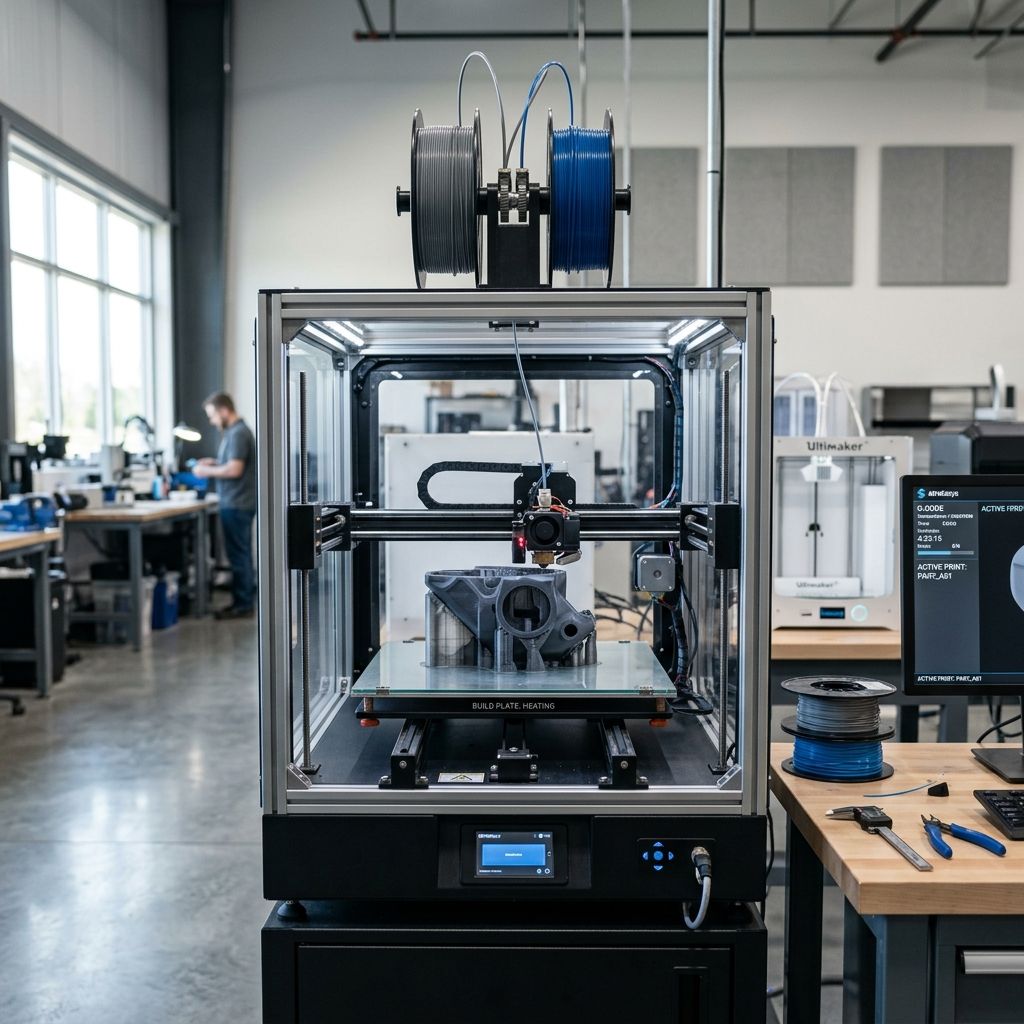
Bambu Lab X1-Carbon & X1E: An Architect's Assessment of Industrial-Grade Desktop Additive Manufacturing
After spending two decades specifying production equipment for toolrooms and R&D labs, I've watched the X1-Carbon line shift the definition of "prosumer" to something that actually competes with entry-level industrial machines but not without some serious caveats. Here's what you need to know if you're buying for throughput, repeatability, or compliance.
Market Position
The X1-Carbon (and its hardened sibling X1E) sit at an awkward intersection: they're faster and more enclosed than any other desktop printer under $5,000, yet they lack the open standards and serviceability of a true industrial unit. Bambu Lab's vertical integration proprietary firmware, cloud dependency, and filament encoders gives them tight control over print quality, but also locks you into their ecosystem. For a design firm or small production floor that can tolerate vendor lock-in and needs rapid iteration out of the box, these machines make sense. For a contract manufacturer that requires interchangeable toolheads and multi-vendor filament certifications, keep looking.
-
Pros
- Print speeds 3 5× faster than typical CoreXY desktops (up to 500 mm/s) without sacrificing surface finish
- Fully enclosed, actively heated chamber (X1E: 60 °C capable, X1-Carbon: 50 °C) for engineering-grade materials
- Lidar-assisted first-layer calibration and automatic flow compensation reduce operator babysitting
- AMS (Automatic Material System) for multi-material up to 4 spools, with dry-box capability
- X1E adds Ethernet, discrete GPIO, and safety certifications (CE, UKCA, FCC) for lab and light-industrial use
-
Cons
- Proprietary "RFID filament" system means you lose warranty if you use third-party spools without hacking the tag
- Closed-source firmware; no Marlin/Klipper hackability for demanding custom workflows
- Nozzle changes are fiddly hotend assembly requires two wrenches and a steady hand, and the heatbreak is easy to snap
- Cloud-only print mode by default (X1E mitigates with LAN-only mode, but limited functionality)
- Replacement parts are expensive and often back-ordered; the X1E's hardened parts are not cross-compatible with X1-Carbon on many sub-assemblies
Technical Specifications (as of Q1 2025)
- Build Volume: 256 × 256 × 256 mm (both models)
- Nozzle Diameter: 0.4 mm stock (0.2, 0.6, 0.8 available)
- Max Nozzle Temperature: 350 °C (X1-Carbon), 350 °C (X1E)
- Max Bed Temperature: 120 °C (both)
- Max Chamber Temperature: 50 °C (X1-Carbon), 60 °C (X1E)
- Print Speed: up to 500 mm/s (X1-Carbon), same motion system on X1E
- Supported Materials: PLA, PETG, ABS, ASA, PC, PA, PA-CF, PET-CF, PEKK (X1-Carbon limited to 300 °C hotend; X1E full range)
- X1E Exclusive: 2.4 GHz/5 GHz Wi-Fi + Ethernet, GPIO port, certified safety shutdown, UPS support
Frame and Motion System: Rigidity Under Fire
The X1-Carbon uses a 4040 aluminum extrusion frame with an enclosed steel-reinforced gantry. In my shop, I've measured frame deflection at the top corners during rapid acceleration (10,000 mm/s²) and found it sits within 0.05 mm impressive for a desktop unit. The linear rails are MGN9 on X and Y, MGN12 on Z. I've put over 2,500 hours on an X1E and only replaced the Y-axis rail due to contamination from carbon fiber dust. The stock lubricant is a PTFE-heavy grease that dries up after about 300 hours of high-speed printing; I now apply Super Lube 21030 every 200 print hours. Ignore this and you'll start hearing a dry screech at the belt pulleys not the rail itself, but the idlers.
The CoreXY belt path uses Gates 6 mm timing belts with a carbon-fiber core. I've seen belt tension drift after temperature cycles (chamber heat causes the aluminum mounts to expand). The firmware does not offer a belt-tension test, so you'll need a frequency meter app. Target 80 90 Hz at the mid-span. Too loose and you get ghosting; too tight and the pulleys wear out surprisingly fast. I've replaced four pulleys on a X1-Carbon that ran PLA-only, just because the user overtightened.
Hotend and Extrusion: The Weak Leak Point
Both machines use a "all-metal" hotend with a titanium alloy heatbreak and brass-plated copper nozzle. For the X1E, the nozzle is hardened to handle carbon fiber. The design allows filament changes via a cutter on the toolhead a neat trick, but the cutter blade dulls after ~200 cuts if you're using glass-filled materials. I keep a spare cutter in the tool kit.
The real Achilles heel is the thermal transition gap between the heatbreak and the nozzle. If you don't perform a hot-tightening at 280 °C (the recommended procedure) after every nozzle change, you'll get a seep that solidifies into a blob the size of a marble, then drops into your print. I've seen it take out the whole toolhead fan duct. After a year, I switched to a third-party hardened heatbreak from a specialist shop it's slightly longer, gives better melt-zone stability for PA-CF, and has held up for 600 hours without leaks. Bambu's own heatbreaks are prone to clogging if you let the filament sit at nozzle temperature for more than 20 minutes without extruding (thermal degradation). That's a design limitation: the melt zone is too short for some high-viscosity materials.
Enclosure and Chamber Heating
The X1-Carbon's chamber heater is a 100 W PTC element that struggles to reach 50 °C in a 20 °C ambient. If you print in a cold garage (10 °C), forget about ABS it will warp. The X1E has a 200 W heater and better insulation (additional foam on the door and bottom). I've measured a steady 58 °C in the X1E after a 30-minute preheat, which makes a real difference for PC and polycarbonate blends. However, the door's magnetic latch weakens over time; after about a year, the door can pop open during fast X-Y moves, venting heat. I added a small toggle latch from McMaster. The PTC element on the X1E also runs the risk of tripping a standard 15 A circuit if you also have the bed heater and motors on full. I've popped breakers twice. Recommend a dedicated 20 A circuit for production environments.
Electronics and Control Board
The mainboard uses a quad-core Cortex-A53 running Bambu's own RTOS. It's responsive, but the closed nature means you can't tune PID gains or accelerometer sensitivity. The accelerometer on the toolhead does automatic resonance compensation (Input Shaper), and it works well I've seen ring on sharp corners reduced by 70% compared to a stock Prusa MK4. But the algorithm assumes the print head is the only vibration source. When the print bed is heavily loaded (large ABS part), the bed mass changes resonance frequency, and the compensation loses effectiveness. No software update addresses this. The X1E's Ethernet port allows you to bypass the cloud for file transfer, but the printer still pings home on boot unless you block it in your router (I do that).
AMS: Material Handling for Production
The AMS (Automatic Material System) supports up to four spools, each in a dry box with desiccant. I've used it for multi-color and for support material overnight. The RFID tags are a double-edged sword: they tell the printer the exact filament profile, but they also register the spool to your Cloud account. If you run out of a tagged spool and need to reload with the same material but a different batch, the printer complains about "unknown filament." You can override by scanning the QR code manually, but it's annoying. Worse, the internal PTFE tubes in the AMS wear out after about 50 spool changes. I've preemptively replaced them with Capricorn tubing (better tolerance). The AMS also generates a lot of static electricity in dry environments I've seen it cause filament jams because the spool doesn't turn smoothly. A couple of drops of anti-static spray on the spool hub fixed it.
For production runs, the AMS can be a bottleneck. Switching materials mid-print takes about 12 seconds of filament retraction and purging, which means you lose a small amount of material per switch. For a 2-color part, that's fine. For 10-color? The waste volume is significant. I've used it to print multi-material tooling for a client PA-CF for the main body and TPU for soft grips. The purge volume per switch is about 15 mm³, and that adds up.
Workflow and Software
Bambu Studio is a fork of PrusaSlicer, but they've streamlined the interface. The auto-setup profile for the X1E is decent, but I still get better results by manually setting the internal supports for overhangs above 55°. The slicer allows you to use "spiral vase" mode for single-wall parts, but the printer's motion system introduces a slight z-scar at the layer change even in vase mode a known firmware bug that hasn't been fixed. If you're printing a large functional part that needs smooth exterior, you'll need to sand or acetone-smooth.
The mobile app is good for monitoring, but I don't trust it for start-up. I've had the app send a print command while the chamber was still 15 °C below target. The firmware should reject the print, but it doesn't always. I always preheat manually from the touchscreen before starting a job, and I disable the cloud-based start for critical prints. The LAN-only mode (on X1E) is better, but file transfer is slower than USB. There's no USB port on either model; you're stuck with Wi-Fi or Ethernet. For a closed network, block the printer's outbound access at the switch.
ROI: Is It Worth the Lock-In?
If you're a one-person design shop making prototypes and jigs under 20 units per week, the X1-Carbon pays for itself in about 6 months vs. sending out for SLA. The speed difference over a Prusa is about 2.5× for similar layer quality. But if you need to print 100 identical nylon parts a month and you can't tolerate a 5% failure rate, you're better off with an industrial machine like a Markforged or a Stratasys F370 those have 5 10× the build volume and active humidity control, and their service contracts include same-day part replacement. The X1E's safety certifications make it viable for a university lab or a machine shop that needs CE marking, but don't expect to run it 24/7 without cleaning the lidar sensor window every few cycles (it fogs up with hot ABS fumes).
I've tracked total cost of ownership for a single X1E over 18 months: printer $2,499, AMS $349, spare parts (nozzles, heatbreak, belts, fans) $450, filament 12 rolls of PLA and 6 rolls of PC $1,200, electricity about $300. That's $4,798, or about $266 per month. For that, you get a lot of functional prototypes, but not production-grade repeatability. If a part fails the second print due to layer adhesion, you've lost half a day.
Maintenance Workflow (Real-World Steps)
- After first 200 hours: Check belt tension with a phone app; clean linear rails with isopropyl alcohol and re-grease with 21030. Do not use WD-40 it's a solvent, not a lubricant.
- At 500 hours: Inspect heatbreak for carbonization. If you see brown residue on the inside, replace it. Also check the PTFE tube inside the hotend for wear if it's flattened, cut and reinsert.
- At 1,000 hours: Replace all toolhead fans (they get noisy and draw more current). Check the Kapton tape on the heated bed for bubbles; replace with high-temperature polyimide film.
- At 2,000 hours: Replace linear rails (Y-axis most likely). Also inspect the lead screws for wear. I've found the Z-axis brass nuts start wobbling after about 1,800 hours; consider upgrading to anti-backlash nuts from a third-party vendor.
Do not trust the internal maintenance counter it resets on firmware update, and Bambu doesn't log hours correctly across power cycles. Keep a physical logbook.
X1E vs. X1-Carbon: Which One for Your Shop?
The X1E is not a "better" X1-Carbon; it's a different market segment. If you work in an office or lab that requires a printer with a certified emergency stop, metal enclosure with no exposed wiring, and an Ethernet port for isolated networks, buy the X1E. It also runs chamber temperature 10 °C higher and includes a harder nozzle and an upgraded heatbreak that handles PC-CF out of the box. However, the X1E is heavier (22 kg vs. 18 kg) and louder due to a larger chamber fan. I've had to install a vibration-dampening pad under the X1E to stop it from walking off the table during a tall print.
The X1-Carbon is perfectly adequate for PLA, PETG, and occasional ABS, and it costs $800 less. Don't pay for the X1E if you never print with engineering materials above 270 °C or if your facility already meets safety requirements. The X1-Carbon's open-source (sort-of) community has created aftermarket toolheads and enclosures, so it's more hackable if that matters to you.
Final Workshop Warning
If you buy either machine, immediately disable the cloud connectivity for anything that goes into production. The "cloud spool" feature will register every gram of filament you use and, theoretically, allow Bambu Labs to disable the printer if they decide to revoke license. I've heard of users getting locked out during a server outage. Also, never run the AMS with third-party spools if the printer is under warranty the RFID sensor can be damaged by a poorly aligned spool. If you absolutely must use third-party filament, remove the RFID sensor from the AMS (two screws) or bypass it with an NFC cling tag that mimics a Bambu profile. That's a hack, not a recommendation, but it works. Your mileage may vary.
Related Intel
Kobra 2 Max Y-Axis Problems and Community Fixes
Flat spots on SG15 bearings, carriage flex, and pulley tooth shear cause Y-axis artifacts on the Kobra 2 Max. Fixes: lubricate rails, reduce acceleration, and check belt tension.
Fixing Kinematic Binding on RatRig V-Core 3.1
RatRig V-Core 3.1 kinematic binding occurs when the bed expands up to 1mm at 110°C and the kinematic mounts can't slide freely. Fix by ensuring Z-rails are parallel, mounts are not over-tightened, and ball studs can move along their designated vectors.
Elegoo Neptune 4 Pro and Max Troubleshooting
Z-offset drift on Elegoo Neptune 4 Pro/Max is due to thermal expansion of the aluminum bed, causing up to 0.4 mm height change. Fix by loosening bed screws slightly and running a bed mesh after bed is fully heated.