Bambu Lab X1-Carbon Production Reality Check

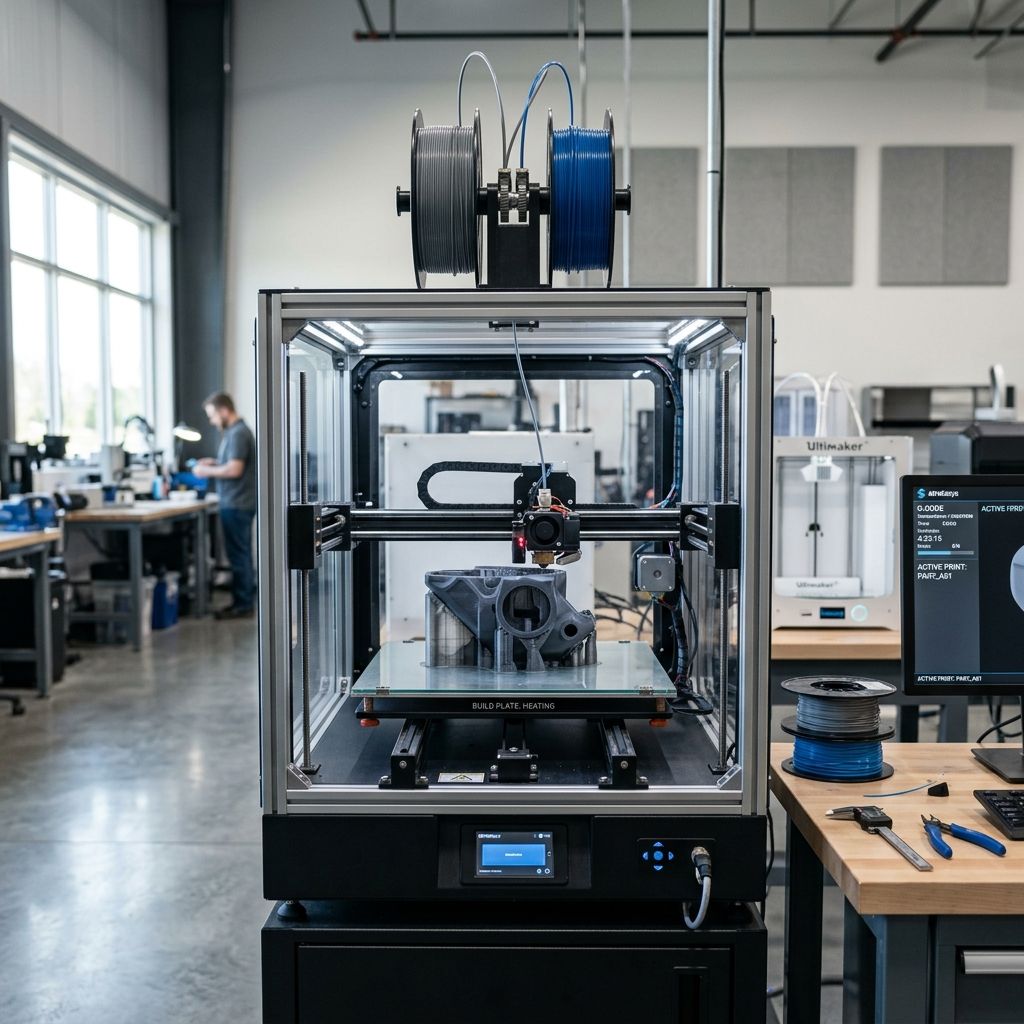
Bambu Lab X1-Carbon/E: The Contract Manufacturer's Reality Check
I've got three X1-Carbons running right now as I type this. Two are spitting out PETG-CF jigs for a local aerospace job, and the third just shit itself because someone loaded wet PPA into the AMS. That's the reality of running these machines in a professional capacity. It's not a magic box. It's a high-speed, high-maintenance tool that either pays for itself in the first production batch or becomes an expensive paperweight if you ignore the physics.
Business Impact: The 1-Batch ROI Threshold
Here's the number that matters. A typical CNC shop outsourcing nylon brackets pays $12-$18 per part plus setup and shipping. A batch of 100 brackets runs $1,500+. Running that same batch on an X1-Carbon? Raw filament cost for PA12-CF is about $60. Electricity, maintenance amortization, and labor for unloading add another $50. Total in-house: ~$110.
The single X1-Carbon pays for itself in one production batch. But here's the caveat the marketing material doesn't show you: our scrap rate for engineering materials across three machines averages 8% due to warping, bed adhesion failure, or heat creep jams. That scrap cost is an operational tax you must budget for.
Time Savings from Prototype to Production: From finalized STL to unsupervised multi-part production run is under 30 minutes of human labor. The rest is machine time. If you're evaluating time-to-market for a new product bracket or tool, the X1E collapses the iteration cycle to just a few hours.
- Machine ROI: 1-2 production batches (Engineering materials)
- Labor Time: <30 min human touch per job start
- Scrap Budget: Factor 8-12% for high-temp materials
- Outsourcing vs. In-house: 10x cost reduction per part
Validating the Investment: Throughput vs. Tinkering
The X1C is fast. Stock flow rates hit 25-30 mm³/s without much complaint. But raw speed is useless if the machine can't hold tolerance over a 200-part production run. In my workshop, we define throughput as "good parts per hour", not "benchies per hour." The CoreXY kinematics are stiff, but the real money is in the automation features. The automated bed leveling and flow calibration get the first layer consistent enough that we regularly hit +/- 0.1mm dimensional accuracy on production jigs without manual intervention.
Where the business case gets murky is volume. If you need 10,000 parts in a month, you buy a dozen these machines, not one. They scale horizontally. We've got three. For runs over 500 units in a single material, the AMS becomes a liability due to buffer friction. We bypass it and feed from a heated dry box directly. The X1C is a production cell designed for low-to-mid volume, high-mix manufacturing. That's its sweet spot.
CoreXY Kinematics & The Carbon Chassis: Tolerances Under Load
The carbon fiber reinforced rods and the aluminum extrusion frame form a stiff gantry. But "stiff" is relative. Under rapid acceleration (20,000 mm/s²+), the frame exhibits measurable vibration that transfers to the part. The stock machine feet amplify this. First thing we did was swap them for solid silicone vibration damping pads. The X1E offers a slightly better chassis seal and a more robust chamber heater, but the kinematics are identical. The linear rods are case-hardened steel, and they will wear. Expect measurable "slop" in the Y-axis carriage after 2,000 hours of heavy use if you don't maintain the wipers.
- X/Y Resolution: 0.01mm (Theoretical), 0.05mm (Practical workshop tolerance)
- Max Flow Rate: 32 mm³/s (PLA), 20 mm³/s (PC/PA)
- Chamber Temp (X1C): 60°C ambient (takes 30 min to stabilize)
- Chamber Temp (X1E): 90°C ambient (better for PPA/PPS, but needs a thermal soak)
- Build Surface: Textured PEI plate (works great for PLA/PETG, borderline for Nylon without adhesive)
When the Brochure Lies: Heat Creep, Clogs, and AMS Woes
This is the section that'll save you a Saturday. The X1C hotend is a workhorse, but it has a fatal design flaw for production: the PTFE tube inside the heat break. It's a consumable. In a high-temp environment (chamber at 50°C+), that PTFE tube degrades. It softens, deforms, and eventually causes a clog that mimics a nozzle jam. We replace them every 500 hours as standard maintenance. Stop using the scrap stock one the day you buy the machine. Upgrade to a genuine Capricorn PTFE tube immediately.
The AMS is a separate physics problem. It relies on a friction buffer that is incredibly sensitive to spool geometry. In a production environment, you will fight the AMS more than the printer. For 99% of our single-material production runs, we feed from a rear-mounted spool holder with a low-friction PTFE guide. The AMS sits idle. It's great for multi-color prototypes or small batches of PVA supports, but it's not a production-grade material handling system.
Workshop Discovery: The Lidar's Blind Spot
The lidar scanner is a clever piece of engineering, but it has a dirty secret: it struggles with translucent, glass-filled, or very dark materials. It will fail to calibrate flow rate for natural PEEK or translucent PETG. We disable the lidar flow calibration for engineering materials and rely on manually tuned Orca Slicer profiles. The laser scanning is also thrown off by dusty chamber environments. Keep the lidar lens clean if you want it to work.
From CAD to Production Batch: A Controlled Workflow
Here's our actual production workflow. It's built for repeatability, not tinkering.
Stage 1: Slicer Profile Validation. We use Orca Slicer exclusively. Bambu Studio is fine for prototyping, but Orca gives us granular control over pressure advance and flow dynamics. Each material gets a profile derived from the generic base, but tuned with a 30-minute test print that measures overhang score and max volumetric flow.
Stage 2: Queue Management. We don't use the Bambu cloud for production. Too much latency and risk of network dropouts. We run the machines in LAN mode. Files are sliced, transferred via the Bambu Studio API or manually via SD card. This is non-negotiable for security and reliability in a shop environment.
Stage 3: Pre-Flight Check. Check the build plate adhesion. Is it clean? Re-wipe with IPA. Check the nozzle. Is there a blob? Heat up and purge. Check the filament path. Is it dry? If printing PC or Nylon, it goes from a 70°C dry box directly into the machine.
Stage 4: Start and Supervise. Start the print. Watch the first layer via the camera. If the first layer is good, you can walk away. If it's not, stop it, adjust the Z-offset or clean the plate.
Stage 5: Post-Processing. Parts are removed, support material is broken off. We use a deburring tool for sharp edges.
- Software Stack: Orca Slicer (Tuning), Bambu Studio (Firmware updates), LAN Mode (Production)
- Camera System: 720p with time-lapse. Good enough for failure detection, terrible for cinematography.
- Material Tracking: RFID tags are convenient but lock you into Bambu filament. We use our own QR code system for third-party spools.
The 500-Hour Maintenance Cycle: A Field Procedure
This is the procedure I've developed after 3,000+ hours across three machines. It prevents 90% of failures. Do it religiously.
Step 1: Frame and Rods. Remove the top glass and the front door. Home the toolhead. Unplug the machine. Clean the carbon rods with a microfiber cloth dampened with 99% isopropyl alcohol. Do NOT use oil on the carbon rods. The wipers are there to remove dust, not to lubricate. The steel rails for the Y-axis get a dab of Super Lube 21030.
Step 2: Lead Screws. The Z-axis lead screws collect dust. Clean them with a toothbrush and apply a light coat of PTFE grease. I use Super Lube 92003. Crank the Z-axis up and down to distribute it evenly. Excess grease will attract more dust. A little goes a long way.
Step 3: Belts. Check the belt tension. They should resonate with a low twang, not a buzz. If they're loose, tighten the adjusters on the back of the gantry. Loose belts cause layer shifts.
Step 4: Hotend. Remove the nozzle. Check for wear. If it's a hardened nozzle and you've printed abrasives, replace it every 1,000 hours. Check the heat break PTFE tube. Replace it if it looks deformed. Re-torque the nozzle into the heat block. It needs to be tight. I use a torque wrench set to 2.5 Nm, but if you don't have one, tighten it by hand and then give it an extra 1/8 turn with the open-end wrench. A loose nozzle leaks.
Step 5: Fans. The chamber fan and control board fans collect dust. Blow them out with compressed air. A clogged control board fan will cause a thermal shutdown mid-print.
First-Day Fails vs. Long-Term Fatigue
Scenario 1: Layer Shift Mid-Print. Cause: Loose belt or an obstruction on the linear rod. Fix: Check belt tension and alignment. Check the Y-axis carbon rod for a flat spot. If the rod is worn, replace it. This is a 2-hour job.
Scenario 2: Inconsistent Extrusion on Overhangs. Cause: Heat creep. The filament is softening too early in the heat break. Fix: Reduce the retraction distance (under 2mm for the direct drive). Lower the chamber temperature. Increase the part cooling fan speed.
Scenario 3: The Blob of Death. This happens when a print detaches from the bed and sticks to the nozzle. The printer keeps extruding, and you get a massive plastic wad that destroys the hotend wires. Fix: Never start a print with a dirty build plate. Watch the first layer. If you see a blob forming, stop the print immediately. Heating the hotend to 250°C and letting the blob drip off sometimes saves it. Sometimes you need a new hotend assembly. Keep spares on hand.
Scenario 4: Camera Feed Drops. The USB camera connection can be flaky. Fix: Re-seat the ribbon cable inside the electronics bay. Update the firmware. If it persists, replace the camera module. It's a standard off-the-shelf USB camera.
- Lead Time for Spares: Nozzles (2 days), Hotend assembly (1 week), Mainboard (2 weeks, depending on stock)
- Common Consumables: Build plates ($40), PTFE tubes ($5/m), Wipers ($10/pack)
- Critical Spare: Keep a complete hotend assembly + thermistor in your parts drawer.
X1C/E vs. The Old Guard: Voron, Prusa XL, and the Chinese Industrial Beds
I've run Vorons. I've run Prusas. They have different strengths. The Voron 2.4 is a tinkerer's machine. When it's tuned, it's capable of similar speeds to the X1C. But it takes 40 hours to build and 100+ hours to tune to a production level. The X1C wins on time-to-value. The Prusa XL is built like a tank. The tool changer is genuinely superior to the AMS for engineering materials. But the XL costs $4,000 and prints slower. The X1C wins on cost and speed for most common production materials.
The Chinese industrial beds (e.g., Creality CR-30 belt printer, FLSUN V400) are cheaper but lack the automated calibration that makes the X1C viable for unattended production. We tested an X1C against a modified Voron 2.4 for a 500-part PETG run. The X1C completed the run in 38 hours with 5 failures. The Voron completed it in 52 hours with 12 failures. The Voron was quieter. The X1C was faster and more reliable.
The X1E Difference: The X1E adds a more effective chamber heater, a better filtration system, and an unlocked mainboard. For production shops running PPA, PPS, or PEEK, the X1E is the minimum viable option. The X1C cannot reliably run PEEK because it lacks the chamber temperature control. Do not buy an X1C if you need to print super-high-temp materials. Buy the X1E.
The True Cost of a Spool: Engineering Filaments in the AMS
Bambu's branded filaments are good, but they're priced at a premium. The AMS works best with Bambu's spools because the RFID tag ensures the printer knows the material profile. However, in a production environment, manually entering material profiles for third-party filament costs a few seconds of labor but saves 30-40% on material cost. We use Polymaker PA6-CF and PETG-CF almost exclusively in production. We respool them onto Bambu spools to use the AMS, but for long runs, we bypass the AMS entirely and feed from a dry box.
The AMS is an enclosed dry box. It maintains a low humidity, but it does not actively dry filament. If you open the AMS lid to load new spools, humidity gets in. For hygroscopic materials like Nylon and PVA, a passive dry box is not enough. You must pre-dry spools in an active dryer (e.g., Sunlu S4 or a dedicated food dehydrator) for 8+ hours before printing. We've lost entire production runs to stringing and bubbling because someone left the AMS lid cracked overnight.
Final Workshop Warning: The Thermal Soak is Mandatory
Don't buy the X1E expecting a 'push-button factory' for high-temp materials without upgrading your ventilation and drying protocol. The chamber heater is powerful enough, but it takes 30-45 minutes for the entire gantry and build plate to reach thermal equilibrium. If you start a PEEK print on a cold chamber, the base will warp. We had a $400 plate of PEEK delaminate because we rushed the soak. Heat the chamber to 80°C, let it sit for 30 minutes, then start the print. Ignore the machine's readiness indicator. It lies.
Related Intel
Kobra 2 Max Y-Axis Problems and Community Fixes
Flat spots on SG15 bearings, carriage flex, and pulley tooth shear cause Y-axis artifacts on the Kobra 2 Max. Fixes: lubricate rails, reduce acceleration, and check belt tension.
Fixing Kinematic Binding on RatRig V-Core 3.1
RatRig V-Core 3.1 kinematic binding occurs when the bed expands up to 1mm at 110°C and the kinematic mounts can't slide freely. Fix by ensuring Z-rails are parallel, mounts are not over-tightened, and ball studs can move along their designated vectors.
Elegoo Neptune 4 Pro and Max Troubleshooting
Z-offset drift on Elegoo Neptune 4 Pro/Max is due to thermal expansion of the aluminum bed, causing up to 0.4 mm height change. Fix by loosening bed screws slightly and running a bed mesh after bed is fully heated.