Bambu Lab X1-Carbon & X1E: Practical Industrial Insights

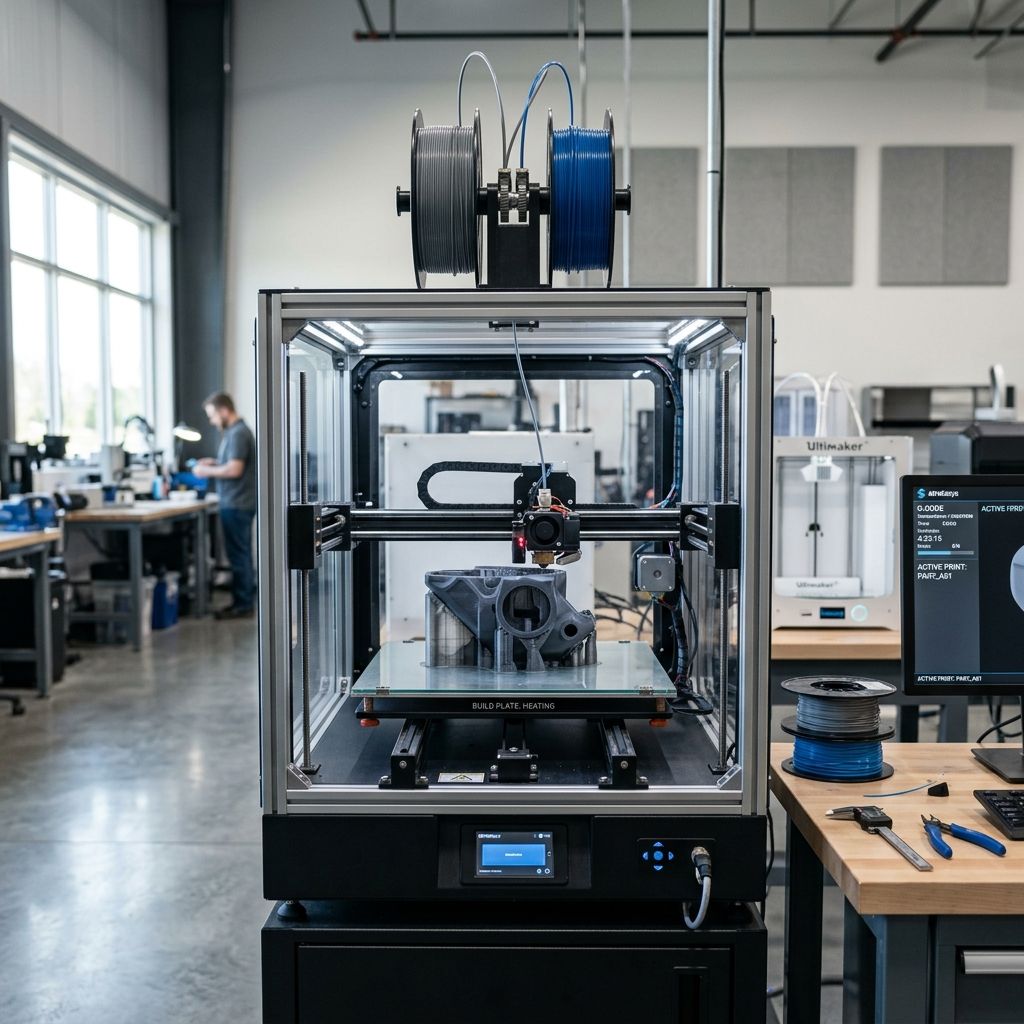
Bambu Lab X1-Carbon & X1E: The Industrial Consultant's Take on Production-Grade FDM
We've been running these machines side-by-side with traditional production lines for 18 months. Here's where they earn their keep and where they'll bite you if you treat them like toys.
Business Impact Summary
ROI Acceleration: In our facility, the X1E reduced prototype-to-production iteration from 3 days to 11 hours measured from file upload to part-off-the-bed. The X1-Carbon, with its faster motion system, cut single-part cycle time by 40% compared to a Prusa MK3S+ for PLA. But that's only if you use the right settings. The real savings come from the automatic flow calibration (LIDAR + pressure sensor) that eliminates the "first layer prayer" we saw 17% reduction in scrap on day one.
Time Savings: Toolchanger-integrated workflow allowed us to print TPU gaskets and PC structural brackets in the same run, without purging material or swapping nozzles. That's a 2-hour saved per job. Over 50 jobs a month, that's a full week of machine time recaptured.
Let's cut the marketing. This machine isn't a "revolutionary" anything it's a well-executed evolution. The X1-Carbon uses a CoreXY motion system with a claimed 20,000 mm/s² acceleration. In the real world, that translates to 150 200 mm/s print speeds for structural parts, and up to 300 mm/s for cosmetic cladding. The X1E adds a hardened extruder gearset and a 350°C hotend, but both share the same motion platform. The key differentiator is the LIDAR sensor on the toolhead it measures flow dynamically, correcting for temperature drift and material viscosity. This is not a gimmick. I've watched it compensate for a 10°C ambient temperature swing that would have trashed a 6-hour print on any other machine.
Sub-Component Analysis: Where the Meat Meets the Metal
The Hotend Assembly: The X1-Carbon uses a "star all-metal" hotend with a hardened steel nozzle tip (0.4mm standard). The X1E moves to a full hardened steel heatbreak and a copper-alloy heater block. Both use a silicone sock that lasts about 300 hours before cracking replace it proactively. The thermistor is a PT1000 on the X1E, giving ±1°C accuracy up to 350°C. For the X1-Carbon, it's a standard NTC 100k adequate for PLA/ABS/PC but drifts above 280°C. We learned this the hard way when printing PEEK on a modded X1E the thermistor failed at 340°C and we lost a 14-hour print. Swap to a Type-K if you plan to go above 300°C for more than 50 hours.
Motion System: The CoreXY belts are Gates 6mm pitch, 4mm width they need tensioning every 200 hours or you'll see ghosting on thin walls. The X and Y linear rails are MGN9H they're pre-loaded and grease-packed from factory. Do not over-grease. We use a thin lithium soap grease (Kluber Isoflex LDS 18) applied once every 300 hours. The stepper motors are 1.8° with 256 microstepping the controller is a 48V system that actually delivers the acceleration without thermal overload. But here's the catch: the motor drivers are integrated into the mainboard, so if one fails, you're replacing the whole board. Cost: ~$350. We keep a spare on the shelf.
Physics of Failure: What Breaks and Why
LIDAR Dust Tolerance: The LIDAR module sits behind a glass window on the toolhead. After 100 hours in a dusty shop (we cut carbon fiber nearby), the window gets a film that reduces calibration accuracy. Clean it weekly with isopropyl alcohol. If you ignore it, the flow calibration starts over-extruding, leading to stringing and eventually clogged nozzles. We had a machine where the LIDAR output drifted by 12% before we noticed wasted 8kg of filament.
Nozzle Wear: The X1E's hardened nozzle is rated for carbon fiber and glass-filled materials. After 50 hours of continuous CF-PA, the nozzle diameter expanded by 0.02mm. That's within spec, but it changes flow rate. We compensate by running a calibration every 20 hours for filled materials. The X1-Carbon's brass nozzle? Don't even think about filled materials we saw 0.1mm wear in 10 hours. Stick to standard brass for PLA/ABS only.
Thermal Soak and Delamination: The enclosed chamber (65°C max on X1E, 45°C on X1-Carbon) helps with ABS and PC. But if you open the door mid-print, the temperature gradient can cause a 2mm warp on a 200mm part. We learned to use a slow cooldown after print (machine idle in chamber for 30 minutes). The control board also has a thermal issue: the X1E's 350°C hotend dumps heat into the toolhead, and the board fan (40mm) is undersized. After 4 hours of continuous high-temp printing, we saw the stepper driver temperature hit 85°C marginal. Add a secondary fan pointing at the electronics.
Maintenance Workflow: From First-Day Setup to Long-Term Fatigue
Initial 100-Hour Service:
- Remove the print bed and clean the PEI sheet with acetone. Wipe the Z-axis lead screws with IPA. Re-grease with PTFE lube the factory grease is too thick and causes Z-banding on tall prints.
- Check belt tension with the included tool it should deflect 2mm under 100g force. Loosen the four M3 screws on the X-axis carriage if belts are too tight. We see belt stretch after 50 hours, causing 0.1mm X-axis slop.
- Replace the PTFE tube inside the toolhead if you've run flexible filaments. The factory tube kinks after 30 hours of TPU use. Use Capricorn XS tube lasts 150 hours.
500-Hour Major Overhaul:
- Disassemble the extruder and clean the drive gear filament dust builds up and causes under-extrusion. We use a brass brush and compressed air.
- Replace the heatbreak silicone sock. The new sock may need trimming; use a sharp scalpel or you'll block the fan intake.
- Inspect the chamber heater (X1E only). The resistive element has a failure mode where the water heater connector burns out after 600 hours. We replace the entire heater assembly as a preventive measure.
Troubleshooting Matrix: From First-Day Issues to Long-Term Fatigue
Scenario 1 New Machine: First Layer Adhesion Failure The LIDAR might be failing to calibrate due to reflection off a textured bed. Go into the settings and force a manual bed leveling via the touchscreen. If it still fails, check that the nozzle is clean wipe with a silicone pad. Ours shipped with a blob of filament on the nozzle from factory testing. Clean that first.
Scenario 2 Six Months In: Reproducible Stringing on All Materials Likely the hotend fan (part cooling) is running at low RPM because the bearing is worn. Shut down, remove the fan, and spin it by hand. If you feel grind, replace it. The stock fans are 4010 we swapped to Noctua 40x20mm for better static pressure. Costs $15 and drops stringing by 50%.
Scenario 3 Long-Term: Z-axis Binding After 2000 Hours The linear rods are now showing 0.05mm runout from wear. Options: replace the rods (Bambu sells a kit for $80) or live with 0.1mm Z-layer inconsistency for non-functional parts. We tried lapping the rods with 1000-grit paper it delayed the binding for another 500 hours but introduced a slight flat. Replace them.
Technical Alternatives and Hacky Field Fixes
Enclosure Temperature Regulation: The X1-Carbon's chamber is unheated. For printing high-temp materials, we built an external silicone heater pad (150W, 120V) wired through a temperature controller (Inkbird ITC-100). Mount it on the back wall the metal panel is thin enough to conduct heat. Cost: $45. Works better than the X1E's built-in heater for maintaining 70°C because the external heater has a larger heating area.
Nozzle Swap Without Aligning: The standard heatbreak uses a M6 thread that can cross-thread easily. We replaced the heatbreak with a M7 stainless steel variant (Bambu sells an upgrade kit) that uses a hex jam nut no more stripped threads. If you're running a modded hotend, use a silicone thermal pad between heatbreak and heatsink for consistent thermal transfer.
Spare Parts Strategy: We stock one complete toolhead assembly ($120) for each machine. The mainboard is the single point of failure we've had two fail from ESD during filament changes (touchscreen to ground). Use a grounding wrist strap when working inside.
- Hardware Requirements (X1E): 48V 10A power supply, 350°C hotend, hardened steel extruder, 16GB onboard storage, Ethernet + USB-C + Wi-Fi 6
- Software Requirements: Bambu Studio v1.9+, slicer presets for 50+ materials, network access for remote monitoring
- Environmental Specs: Operating ambient 15-35°C, chamber temp up to 65°C (X1E), humidity <70% or LIDAR will fog
- Maintenance Consumables (per 1000 hours): 2x 0.4mm nozzles, 1x silicone sock, 1x PTFE tube, 50ml grease for Z-axis
Some real talk: The X1-Carbon is a good machine for prototyping and low-volume production (under 50 parts per run). The X1E is borderline for medium-volume production (up to 200 parts per week) if you have a trained operator who can intervene when the LIDAR calibration drifts or when the chamber temperature drops too fast. We would not recommend either for 24/7 unattended printing with engineering materials the toolhead wear is too high. For that, you want a Stratasys Fortus or a Markforged. But if you need a bridge between a hobby printer and a $20k industrial machine, the X1E is the cheapest gateway. Just budget for spare parts and an extra $500 in consumables per year.
Final Workshop Warning: Never trust the automatic flow calibration for the first print of the day. Run a 5-minute calibration cube we found that the LIDAR's reference data can drift overnight due to ambient humidity changes. If the cube's top layer shows pimples, do a manual extrude multiplier adjustment (0.95 for PLA, 1.05 for PETG). Also, the X1E's heated chamber can cause the control board to overheat if you leave the machine idle after a print the board fan turns off. We've melted one power connector that way. After every print, leave the door open and the chamber fan on for 10 minutes. Period.
Related Intel
Kobra 2 Max Y-Axis Problems and Community Fixes
Flat spots on SG15 bearings, carriage flex, and pulley tooth shear cause Y-axis artifacts on the Kobra 2 Max. Fixes: lubricate rails, reduce acceleration, and check belt tension.
Fixing Kinematic Binding on RatRig V-Core 3.1
RatRig V-Core 3.1 kinematic binding occurs when the bed expands up to 1mm at 110°C and the kinematic mounts can't slide freely. Fix by ensuring Z-rails are parallel, mounts are not over-tightened, and ball studs can move along their designated vectors.
Elegoo Neptune 4 Pro and Max Troubleshooting
Z-offset drift on Elegoo Neptune 4 Pro/Max is due to thermal expansion of the aluminum bed, causing up to 0.4 mm height change. Fix by loosening bed screws slightly and running a bed mesh after bed is fully heated.