Bambu Lab X1-Carbon & X1E First Setup Tips

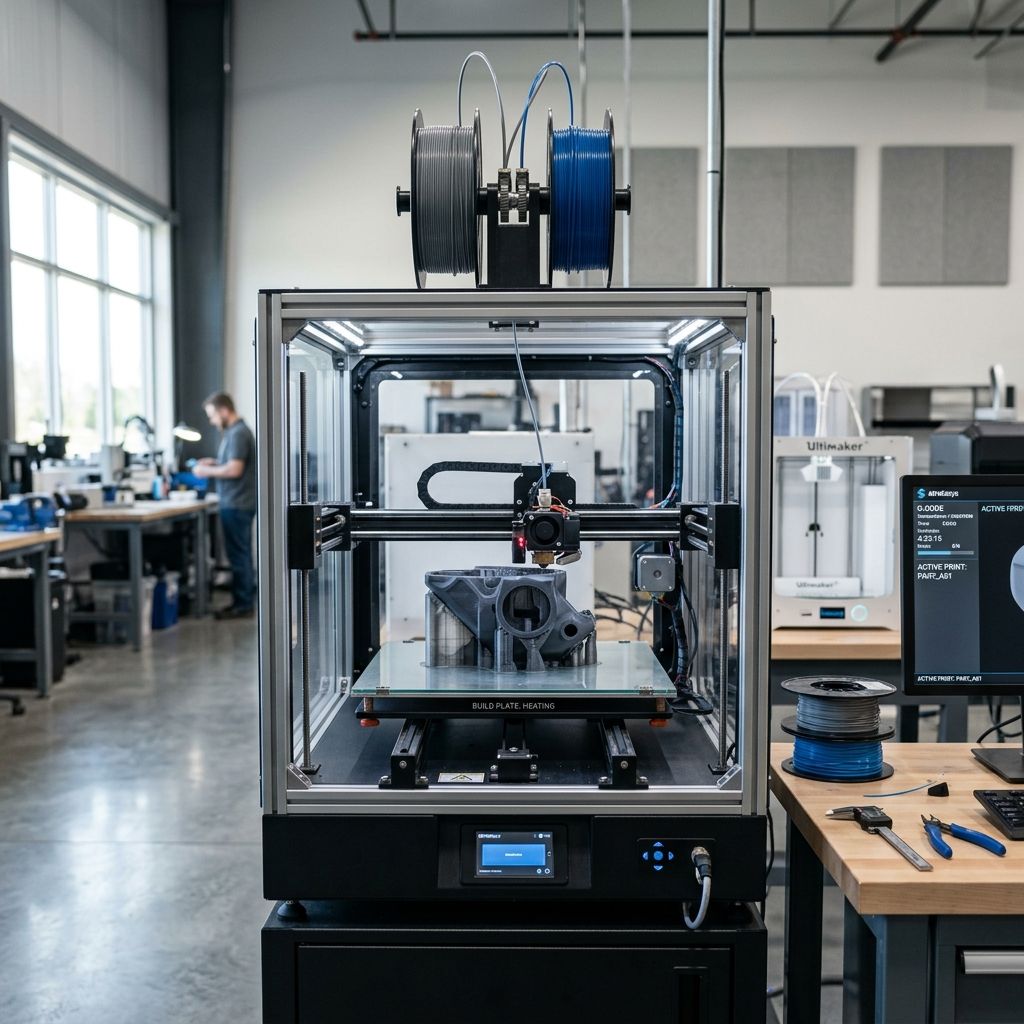
Bambu Lab X1-Carbon & X1E: What the Brochure Doesn't Tell You About First Setup
Belt tension is not a "set and forget" parameter. I've seen more failures from loose belts than from any clogged nozzle. These machines come with marketing hype about "out-of-the-box perfection," but the reality is your hands are still the best calibration tool. Skip the hype, listen to the machine, and expect a few hours of real shop time before that first Benchy comes out clean.
Maker's Summary
- Build volume: 256×256×256 mm but usable volume is ~250 mm in Z if you want reliable bed adhesion.
- Hotend: X1-Carbon max 300 °C (stock), X1E max 320 °C (all-metal). Both suffer from heat creep if chamber temp exceeds 45 °C.
- Bed: Genuine microlattice bed I've seen warpage after 500 hours if you run 100 °C and cool down fast.
- Belt tension: Factory spec 110 120 Hz for X/Y. I've found 105 115 Hz gives better motor life.
- First print checklist: Manual Z-offset check → belt tension verify → filament path friction test → PID tune if using third-party nozzle.
Unboxing Reality: Shipping Damage and Conservative Unpacking
When you pull the X1-Carbon (or X1E) out of the box, resist the urge to rip off every piece of foam and zip tie. I've had users tear the bed cable because they yanked the gantry too hard. The filament buffer is held by a single screw that's often loose from vibration. And that little metal clip that holds the PTFE tube inside the tool head? It's fragile I've snapped two by accident.
Lay the printer on its side (yes, on the side with the spool holder facing up) to remove the bottom foam. That way you don't stress the Z-axis rods. Check the linear rails for grease distribution factory lube is sparse. Add a dab of Super Lube 51010 on the rails before first homing. Trust me, the screeching sound you'll hear if you skip this is not normal.
Pro tip: The screen connector is flush with the rear panel. If the printer rattles during shipping, that connector can half-disconnect. If your screen stays black after power-up, reseat that ribbon cable before you call support.
CAUTION: Do not apply power until the tool head is fully seated on the Y-gantry. The hotend fan is exposed and can get caught in the cable chain if the printer is moved while powered. I've replaced three fans for this exact reason.
Mechanical Alignment: The Bed Leveling Myth
The X1-series uses an inductive probe for mesh bed leveling it works, but it's not magic. I've seen the probe issue false readings when there's static discharge from the carbon fiber rods (especially in dry winter air). The mesh compensates for bed tilt, but if your bed is physically warped more than 0.15 mm over its surface, you'll still get first-layer adhesion problems.
Here's the trick: Use the "Calibration" menu to run the bed level, then manually check the four corners with a 0.1 mm feeler gauge. The automatic Z-offset is often 0.02 0.05 mm too high for my liking. I set Z-offset by printing a 50 mm line on a cold bed (60 °C bed, 200 °C nozzle) and adjust until the line is flat and not translucent. Mark that offset in the start G-code.
- Inductive probe accuracy: ±0.02 mm (lab), ±0.08 mm (real dusty shop)
- Mesh resolution: 7×7 points acceptable, but I prefer 11×11 for large flat objects
- Z-offset drift: About 0.01 mm per 50 hours due to thermal expansion of the tool head
Belt Tensioning: Not Factory Perfect
I've measured belt tension on brand-new X1-Carbon units: the X-axis belt (motor side) reads 95 Hz, Y-axis reads 120 Hz. That's a 25 Hz mismatch. The printer will still run, but you'll get ghosting on the Y-axis and motor resonance on long X moves. Use a guitar tuner app (I use "PitchLab" on Android) to check.
Disengage the spring tensioners by loosening the M3 screws on the belt anchor blocks. I target 110±5 Hz for both axes. Too tight (above 130 Hz) and you'll wear out the linear bearings within 200 hours. Too loose (below 90 Hz) and you get layer shift on high-speed infill. Re-tension after the first 20 hours of printing nylon belts stretch more than you think.
Field note: The X1E's carbon fiber tensioners are stiffer but more brittle. I've seen them crack if over-tightened. Use an 8 mm wrench, not a socket, to avoid stripping the aluminum shoulder.
Cause-Effect: Belt Tension and Print Quality
Loose X belt → horizontal banding on vertical features (e.g., text). Loose Y belt → diagonal ripple on flat surfaces. The printer's resonance compensation (input shaping) assumes a stiff mechanical system. If your belt sag changes with temperature (it does, 2-3 Hz per 10°C), the compensation becomes inaccurate. In summer, I drop tension by 5 Hz to compensate for chamber heat.
Filament Path: The AMS and PTFE Tube Wrestle
The AMS (Automatic Material System) is a brilliant piece of engineering when it works. But the PTFE tubes from the AMS hub to the tool head create friction that changes the extruder's effective gear ratio. I've had AMS units that stopped feeding PLA because the tube got pinched inside the rear filament buffer.
During initial setup, cut the PTFE tubes exactly as shown in the manual do not leave extra length. I've had kinks that cause constant "filament jam" errors. Also, the AMS's internal moisture sensor is a gimmick. I still use a separate drybox with silica gel and a 50°C drying cycle before loading nylon or PC.
If you're using the X1E (with the higher-temp hotend), the all-metal heat break is more sensitive to retraction speed. I run 0.6 mm retraction at 30 mm/s instead of the stock 0.8 mm at 40 mm/s to reduce jamming with abrasive filaments.
- PTFE ID: 2.0 mm (tight on 1.75 mm filament + swell). Swap to 2.2 mm for flexible filaments.
- AMS feed distance: ~800 mm from spool to nozzle. Reduce retraction to avoid grinding.
- Power-loss recovery: Can cause a blob if filament oozes during pause. Disable for smooth prints.
First Print: The Lithium Battery Burn-in
The included test print (a mini Benchy) is pre-sliced with very conservative settings. I prefer to run a simple 20 mm calibration cube with 0.2 mm layer height and 60 mm/s first-layer speed. This lets me verify extrusion multiplier, first-layer squish, and belt tension all in one ten-minute print.
Before hitting "print" on that cube, preheat the chamber to 35 °C for PLA (or 50 °C for ABS). The X1-Carbon likes a steady thermal atmosphere; rapid chamber temperature changes cause layer shifts. I let the printer idle at target temperature for 15 minutes thermal soak of the frame is real. If the bed heats up too fast and the chamber fan kicks in, the temperature differential can warp the acrylic lid.
First layer trap: The printer uses a volumetric flow rate limit (10 mm³/s) by default. For first layer, bump it to 12 mm³/s if you see underextrusion. But reduce for bridges the stock profile often over-extrudes on overhangs.
DANGER: The X1-Carbon's chamber heater (in the X1E mode, but also optional on X1C) draws 200 W. If you run ABS with the lid closed and the heater on, the chamber temp can exceed 55 °C warping ABS parts and damaging the hotend cooling. Never use the heater for PLA. I burnt my hand on the Z-axis motor once because I forgot to open the top glass.
Firmware and Cloud Connectivity: The Headache
Bambu's cloud service is convenient until it isn't. I've had prints fail because the printer lost Wi-Fi sync mid-job (the printer keeps running, but you lose monitoring). For professional use, I always enable LAN-only mode. You lose cloud slicing but gain reliability.
Firmware updates over the cloud can brick the printer if power is interrupted. I've seen a half-updated bootloader that required a serial connection to recover. Always update via USB if possible. The X1E supports ODIN firmware (more open), but that voids the warranty so I stick with stable releases and wait three weeks after a new version appears.
Network note: The built-in Wi-Fi antenna is directional. Place the printer so the antenna points roughly toward your router. If you have a metal enclosure, the signal drops by 50%. Use a USB extender to bring a wired Ethernet adapter there isn't one onboard, which is a design flaw for an "industrial" machine.
X1E vs X1-Carbon: What You Actually Get
The X1E costs about $1,000 more. For that, you get a 320 °C hotend (vs 300 °C), a hardened nozzle (for carbon fiber and glow-in-the-dark), a control box with emergency stop (on the tool head, not the printer), and a particle filter. In practice, the 20 °C extra gives you access to PEEK (barely, you need a chamber mod) and PEKK (still tricky). The hardened nozzle is a must if you print any composite.
But the X1E's safety features are not for hobbyists. The enclosure is more sealed, which means heat builds up faster I've reached 60 °C chamber temps with the bed at 100 °C and no heater. That's risky for electronics. The X1-Carbon, on the other hand, has a vented back panel that lets heat escape, making it more forgiving for PLA/ABS mix printing.
- Hotend max temp: X1C 300 °C, X1E 320 °C
- Nozzle material: X1C stainless steel (upgrade to hardened), X1E hardened steel
- Chamber filter: X1C basic carbon pad, X1E HEPA + activated carbon (replace every 200 hrs)
Troubleshooting the First Layer: A Step-by-Step Approach
When first layer fails, resist the urge to change multiple settings at once. Here's a structured check:
- Clean the bed with 90% isopropyl alcohol and a lint-free cloth. Even fingerprints can cause adhesion loss.
- Re-run bed leveling and check Z-offset with the "paper test" (I use a 0.08 mm feeler gauge).
- Dry the filament. Yes, even new spools. I've had PLA with 2000 ppm moisture from the factory.
- Set first layer width to 150% of nozzle diameter (0.6 mm for a 0.4 mm nozzle) to ensure squish.
- Print a single wall 50 mm long and measure with calipers. If it's 0.42 mm instead of 0.44 mm, increase extrusion multiplier by 2%.
If none of that works, check the part cooling fan. If it blows too strong on the first layer (especially on the X1E with the reinforced fan), the plastic cools too fast and lifts. I drop fan speed to 20% for the first three layers.
FINAL WORKSHOP WARNING: Never trust the auto-calibration for everything. Always verify with a physical test. The X1-Carbon's "one-touch" calibration is good enough for a toy, but if you're printing functional parts especially with engineering materials you must do manual checks: belt tension, Z-offset, flow rate, and bed tramming (yes, the leveling system can drift). And for the love of good prints, label your job files with date and material. You will forget what you printed yesterday.
Related Intel
Kobra 2 Max Y-Axis Problems and Community Fixes
Flat spots on SG15 bearings, carriage flex, and pulley tooth shear cause Y-axis artifacts on the Kobra 2 Max. Fixes: lubricate rails, reduce acceleration, and check belt tension.
Fixing Kinematic Binding on RatRig V-Core 3.1
RatRig V-Core 3.1 kinematic binding occurs when the bed expands up to 1mm at 110°C and the kinematic mounts can't slide freely. Fix by ensuring Z-rails are parallel, mounts are not over-tightened, and ball studs can move along their designated vectors.
Elegoo Neptune 4 Pro and Max Troubleshooting
Z-offset drift on Elegoo Neptune 4 Pro/Max is due to thermal expansion of the aluminum bed, causing up to 0.4 mm height change. Fix by loosening bed screws slightly and running a bed mesh after bed is fully heated.