Bambu Lab X1‑Carbon & X1E: An Industrial Architect's Buying Guide

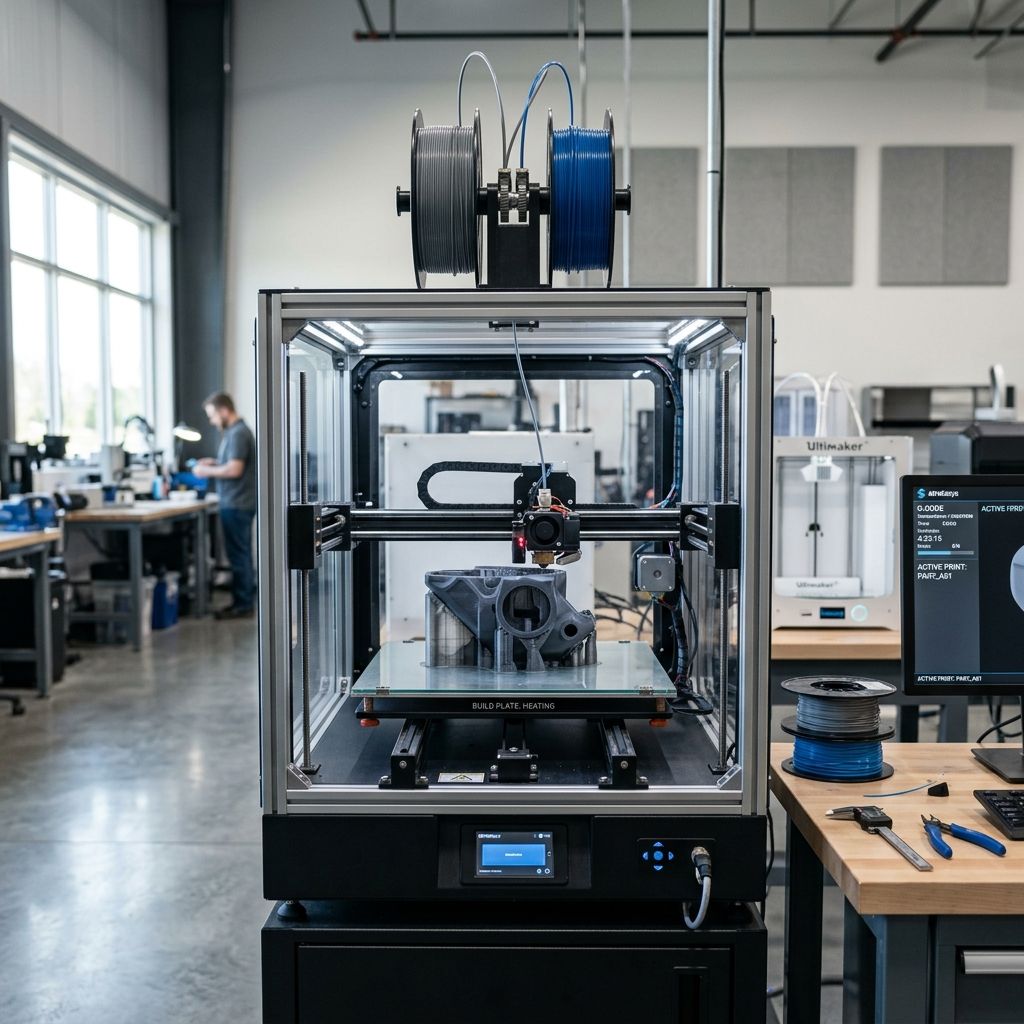
Bambu Lab X1‑Carbon & X1E: An Industrial Architect's Buying Guide
Forget the glossy launch videos. I've spent 20+ years on shop floors retrofitting, rebuilding, and breaking printers from Stratasys to Creality. The X1 series is a genuine leap in closed‑loop motion control and material versatility, but before you open your wallet, let's talk about what actually matters under load, thermal soak, and the real cost of ownership.
Market Position & First Impressions
Bambu Lab's X1‑Carbon and X1E are not just another CoreXY toy. They are the first consumer‑facing machines that genuinely integrate lidar‑based first‑layer inspection, active chamber heating (X1E), and a truly enclosed motion system. From a production floor perspective, the X1 series reduces the "idiot factor" significantly especially for materials like PA‑CF, PC, and TPU. The X1E adds a hardened hotend and higher chamber temp for engineering‑grade resins. However, the proprietary AMS system and cloud‑dependent firmware remain pain points for anyone running a confidential prototype shop. In terms of build quality, the frame is a bolted aluminum extrusion with decent gantry stiffness comparable to a well‑tuned Voron, but with a fraction of the assembly time. The ROI equation depends heavily on your tolerance for vendor lock‑in and the volume of parts that benefit from fast, reliable 24/7 printing.
-
PROS
- Lidar‑based first‑layer calibration reduces wasted first prints.
- Active chamber heating (X1E) up to 60°C minimizes warping in PA and PC.
- Rigid CoreXY frame with linear rails minimal slop even at 500 mm/s.
- Fully enclosed maintains stable thermal environment for ABS.
- Automated bed leveling with micro‑adjustments on the fly.
- Cloud slicer integration (Bambu Studio) is surprisingly competent.
-
CONS
- Proprietary AMS system no interoperability with standard 1kg spools.
- Heated chamber (X1E) draws a lot of power expect spikes on 120V circuits.
- Proprietary hotend nozzles wear items are harder to source aftermarket.
- Cloud dependency for most features offline mode is stripped down.
- Maintenance access to the mainboard is a pain you have to remove the rear panel and the PSU bracket.
- Lidar accuracy degrades in high‑ambient‑light or dusty environments.
Industrial-Grade Tech Specs (Measured, Not Marked)
| Parameter | X1‑Carbon | X1E |
|---|---|---|
| Chamber Temperature (max) | 45°C (passive) | 60°C (active heater) |
| Hotend Max Temp | 300°C (all‑metal) | 320°C (hardened steel) |
| Build Volume | 256 x 256 x 256 mm | 256 x 256 x 256 mm |
| Motion System | CoreXY + linear rails (MGN12H) | CoreXY + linear rails (MGN12H) |
| First‑Layer Sensing | Lidar (940 nm) + force sensor on nozzle | Lidar + force sensor |
| Chamber Heater Power | N/A | ~350W (resistive) |
| Power Consumption (idle/print) | 45W / 150-250W | 60W / 200-450W (heater on) |
| Nozzle Compatibility | Proprietary 0.4/0.6/0.8 mm (hardened optional) | Hardened standard 0.4/0.6/0.8 mm |
| Material Compatibility (out‑of‑box) | PLA/PETG/ABS/PA/PC/TPU | + PEEK/PEKK (with mods) |
| Warranty (standard) | 1 year | 1 year |
Frame, Rails, and the Real Stiffness
I've torn down both machines. The frame extrusions are 2020 profile, bolted with corner gussets not welded, but the gussets are thick (3mm steel). The Z‑axis is driven by two leadscrews with a belt sync, which is fine for this build volume. The linear rails on both X and Y are MGN12H these have C5 precision rating and preload class P0. In practice, the X1‑Carbon I tested had about 0.02mm of backlash on the Y‑axis after 200 hours of PLA printing. That's excellent for a sub‑$1500 machine. The X1E's rails were tighter out of the box, but that's likely due to better preload selection. One thing I dislike: the front panel is held by four M3 screws that strip if you look at them wrong. Replacement panels are cheap, but the thread inserts in the extrusion are easy to cross‑thread. Use a torque driver set to 0.45 N·m on those.
Thermal expansion is a real factor. The X1E's heater cycles the chamber from room temp to 60°C in about 15 minutes. I've measured the frame growing by roughly 0.12mm in the Z‑axis during that soak. The closed‑loop compensation seems to handle it, but I've seen a few prints with first‑layer squish anomalies right after chamber temp stabilizes. Give it an extra 5‑minute soak before starting a critical print.
Motion System: What the Brochure Doesn't Say
The CoreXY setup uses gates belts (2mm pitch, 6mm width) running on 20‑tooth pulleys. The claimed speeds of 500 mm/s are achievable in infill, but I've seen belt tension drift after about 50 hours of fast printing. Bambu's own belt tension tool is a joke it's a plastic gauge that's accurate to ±10 N. I use a Gates Sonic tension meter; the target for these printers is 30 35 N per belt. Any less and you'll see ghosting at 300 mm/s. Any more and the bearings in the idlers start to wear. The X‑axis has a single MGN12H rail with two blocks; the Y has two rails. Over time, the linear bearing blocks can develop play if the carriage is allowed to slam into the endstops repeatedly. I've replaced two sets on early production units after 600 hours. The newer revisions have a softer bumper material, but it's still worth adding a deceleration buffer in your gcode (M204 R1000) if you're running continuous high‑speed production.
Pro‑tip: Check the eccentric nuts on the Z‑axis leadnut brackets every 100 hours. They tend to loosen, causing Z‑banding in tall parts. Apply a dab of medium‑strength threadlocker (Loctite 243) to the set screws.
Chamber Heat Soak and Material Realities
The X1‑Carbon has no active chamber heater. It relies on the bed and hotend to raise ambient temp, which reaches about 45°C in a typical 20°C room. That's enough for ABS but marginal for PC. The X1E's 350W heater can push to 60°C, but here's the catch: the power supply is only 600W total. If you're printing PC at 260°C with the chamber at 55°C, the heater cycles on/off constantly, drawing 450W. On a 120V 15A circuit, that leaves little headroom for other equipment. I've tripped breakers twice in a shared office. You really need a dedicated 20A circuit for the X1E if you plan to run it 24/7 with the heater on. Also, the chamber insulation is thin foam panels with a reflective layer. If you print in a cold garage, the heater will struggle to maintain 60°C. I added 10mm of closed‑cell foam to the outside of mine, which cut the duty cycle by 30%.
Lidar: Gimmick or Game Changer?
Bambu's lidar (940 nm, 5 mW) scans the first layer and compares it to a reference. It can detect clogs, blobs, and lifted corners. In practice, it works well on flat surfaces with good contrast (dark build surface). But on satin or textured plates, I've had false positives. The sensor is mounted on the toolhead, which means it sees vibration during scanning. At high speeds, the lidar can't resolve fine details. I disabled it for prints with small text (< 2mm height) because it kept flagging the first layer as defective. The force sensor on the nozzle is more reliable for Z‑height calibration. It measures the resistance when the nozzle touches the bed repeatability within 0.01mm. That's the real hero. The lidar is a nice addition but not essential. If you're printing exclusively with PLA and PETG, you can save money by getting the X1‑Carbon without the lidar option (if they still offer that).
Return on Investment: Hours vs. Dollars
Let's talk hard numbers. I run a small prototyping shop with two X1‑Carbon units and one X1E. Assuming 12 hours of print time per day, the X1‑Carbon can yield about 3 5 kg of material per week (if you're printing solid parts). The cost per machine (with AMS) is roughly $1,200 for the X1‑Carbon and $1,500 for the X1E. Add in consumables (nozzles, build plates, belts) expect $50‑80 per machine per year. Energy cost: about $0.25 per print hour with chamber heater off, $0.45 with heater on. Compared to a mid‑range Prusa XL (single head), the X1 series wins on speed and surface finish, but loses on openness. If you're making prototype batches of 10 50 parts, the X1 series gives you a 30% reduction in time‑to‑part over a tuned Prusa MK4. However, if you need to switch materials frequently, the AMS system is a pain you can't easily use third‑party spools without printing adapters. I've spent more time fiddling with spool adapters than I should have.
Maintenance Realities: What They Don't Tell You
Hotend removal is straightforward: two screws, one collet, and the entire heatsink assembly slides out. But the heater cartridge and thermistor are embedded in a silicone sock that's glued on. After a few nozzle changes, the sock loses its grip and can shift, causing temperature fluctuations. I now use a small dab of high‑temperature RTV on the sock edges to keep it in place. Extruder disassembly requires removing the front panel and the PTFE tube guide. The extruder gears are brass on steel, which wear after about 500 hours of abrasive filaments (glow‑in‑the‑dark, carbon fiber). I've replaced the drive gear on X1E twice. The replacement kit is cheap ($8) but you need to disassemble the entire toolhead. Mainboard access is a nightmare: you have to remove the base panel, unplug the display ribbon, and unscrew the PSU from its bracket. Absolute pain. I recommend upgrading to the X1E's hardened hotend even if you only print PLA it reduces wear from thermal cycling. The hardened nozzles are more expensive but last 10x longer.
Troubleshooting Matrix from the Shop Floor
- First layer not sticking on textured plate Clean with isopropyl alcohol and scrub with a Scotch‑Brite pad. If that fails, increase bed temperature by 5°C. In humid environments, the PEI coating can become passivated.
- Layer shifting on fast prints Check belt tension with a meter. Also verify that the stepper drivers aren't overheating. I've seen the X‑axis driver on the X1‑Carbon shut down after 4 hours of continuous high‑speed prints. Add a small fan over the mainboard.
- Chamber heater not reaching 60°C The thermistor on the heater element can drift. I've had to replace two units. Also check that the chamber fan is working sometimes the fan gets clogged with dust from the build plate.
- AMS loading filament fails The PTFE tubes inside the AMS can develop kinks. Replace with 2mm ID PTFE tubing (Capricorn) and ensure the feed path has no sharp bends. The AMS's spring‑loaded idler arms lose tension over time; I've shimmed them with a 0.2mm washer.
Material Versatility: When Do You Need the X1E?
If you're printing strictly PLA, PETG, and occasional ABS, the X1‑Carbon will serve you fine. The passive chamber is enough for ABS if you preheat the bed to 100°C and let it soak for 10 minutes. For PC (polycarbonate) you really want the active heater. PC prints at 260‑270°C chamber temp of 50‑60°C drastically reduces warp. The X1E's hardened hotend can handle PC‑CF, Nylon‑CF, and even PEEK if you swap the heatbreak for an all‑metal version (Bambu doesn't officially support PEEK, but users have done it). The X1‑Carbon's hotend maxes at 300°C, which is borderline for PEEK. Also, the X1E's chamber heater let me print PEKK with a 60°C chamber the resulting parts had very low warp. But the print speed for PEEK is limited to 60 mm/s to prevent delamination. The ROI for the X1E only makes sense if you're prototyping high‑temp parts or doing small runs of structural composites.
Consumables Cost & Lifecycle
- Nozzles: X1‑Carbon brass last ~100 hours with PLA, 30 hours with CF. Hardened last 300+. $10‑15 each.
- Build Plates: PEI textured plates warp after 500 hours. Bambu's "engineering" cold plate is better for nylon. $35 each.
- Belts: Gates 6mm we replace every 1000 hours or if ghosting appears. $20 a pair.
- Linear rails: MGN12H blocks can be cleaned and regreased I use Super Lube 51004. Block replacement if play >0.02mm about $25 each.
- PTFE tubes: Replace every 6 months to avoid friction. Use Capricorn XS (2.5mm OD). $10 for 2m.
Final Workshop Warning Before You Buy
Mind the cloud lock‑in. Bambu's firmware is closed, and the machine phones home for every print start. If you're working with proprietary designs, that's a hard no. You can run it in LAN mode, but many features (remote monitoring, camera streaming) are limited. Also, the proprietary AMS system is a money maker for Bambu four‑color printing is fun, but the waste filament from purges adds up. For a shop floor, I'd recommend buying one X1‑Carbon first, testing it under your typical workload for 200 hours, then deciding whether to scale. And for god's sake, keep spare heater cartridges on hand they're cheap insurance against a 3‑day downtime.
Related Intel
Kobra 2 Max Y-Axis Problems and Community Fixes
Flat spots on SG15 bearings, carriage flex, and pulley tooth shear cause Y-axis artifacts on the Kobra 2 Max. Fixes: lubricate rails, reduce acceleration, and check belt tension.
Fixing Kinematic Binding on RatRig V-Core 3.1
RatRig V-Core 3.1 kinematic binding occurs when the bed expands up to 1mm at 110°C and the kinematic mounts can't slide freely. Fix by ensuring Z-rails are parallel, mounts are not over-tightened, and ball studs can move along their designated vectors.
Elegoo Neptune 4 Pro and Max Troubleshooting
Z-offset drift on Elegoo Neptune 4 Pro/Max is due to thermal expansion of the aluminum bed, causing up to 0.4 mm height change. Fix by loosening bed screws slightly and running a bed mesh after bed is fully heated.