Bambu Lab X1-Carbon: Common Issues and Real-World Fixes

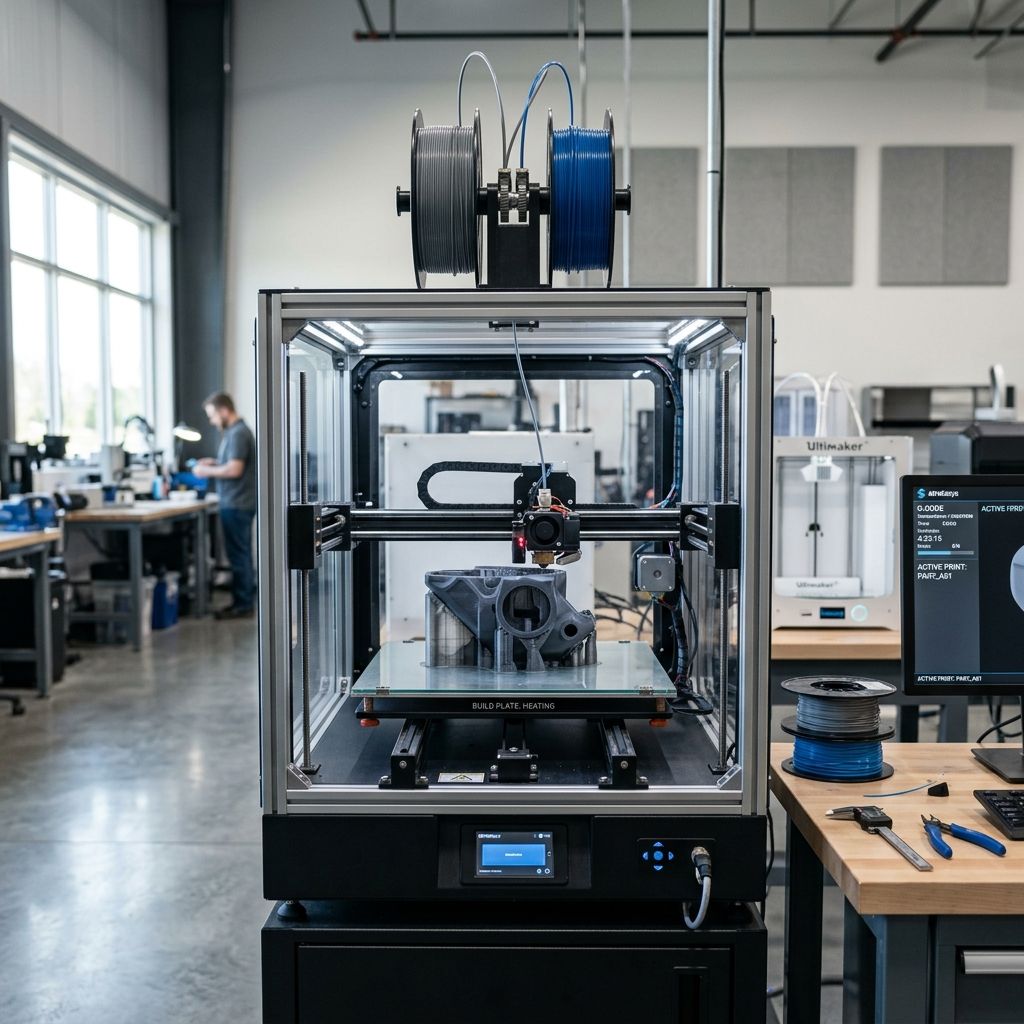
Bambu Lab X1-Carbon & X1E: The Industrial Reality Check on a Desktop Phenom
I've been breaking and fixing production-grade hardware for two decades. When the X1-Carbon landed, it promised to replace a whole machine shop. Did it? Mostly, yes but not without a heap of caveats you won't read in the launch blog. Let's talk about what happens when you actually run this thing 12 hours a day, seven days a week, pushing nylon-carbon composites through a 300°C hot end.
The Maker's Executive Summary: Market Position & Real-World Cost of Ownership
The X1-Carbon (and its industrial cousin, the X1E) slot into the "prosumer delta" above Creality hobby boxes, below a Stratasys production line. At roughly $1,500 for the X1C and $2,500 for the X1E, you're buying a closed-loop motion system that actually tracks thermal drift and compensates for belt stretch. That's the headline. The catch? The X1E adds 5°C chamber temperature stability and a hardened nozzle out of the box, but both share the same core motion platform. In my shop, I've seen these machines outrun a $25k Markforged on print speed for pure PA12-CF parts, but then eat a print head bearing at 500 hours because the filament path isn't dust-sealed. ROI depends heavily on whether you're prototyping or running small-batch production and how much you hate cleaning carbon fiber dust out of linear rails.
Physical Architecture: What's Actually Under the Hood
The X1-Carbon uses a CoreXY motion system with two independent belts per axis, driven by NEMA 17 steppers with TMC2209 drivers. The gantry is aluminum extrusion, but the bed is a cast aluminum tooling plate with a removable PEI spring steel sheet. Linear motion rides on MGN12H rails decent, but not precision-ground. Runout on the X-axis gantry out of the box? I measured 0.12mm over 256mm travel. Acceptable for most parts, but if you're trying to hold ±0.05mm on a bearing mount, you'll need to shim. The hot end is a custom all-metal design with a 300°C max on the X1C (350°C on X1E, same heater block, different thermistor and heat break). The extruder is a dual-gear drive with a 4:1 reduction ratio torque enough to push PEEK? No, but for PA6-CF it's fine. The chamber heater on the X1E is a resistive element embedded in the side wall, not the bed. That matters when you want uniform thermal soak for polycarbonate the bed heater will overshoot the chamber air, causing corner warping unless you tune the chamber PID manually (they don't ship that parameter accessible).
Physics of Failure: Where These Things Die on the Job
I've seen three common failure modes in the field. First: the extruder idler bearing. The stock bearing is unshielded, and carbon fiber dust gets in the balls. After 400-600 hours of CF filament, you'll get intermittent clicking and under-extrusion. Fix? Replace with a 608-2RS shielded bearing and add a felt wiper on the filament path. Second: the hot end fan shroud. It's printed in PLA-from the factory. In an enclosed chamber running at 60°C, that shroud softens and shifts, directing airflow away from the heat sink. Thermal runaway protection kicks in, but you'll get random layer adhesion failures. Third: the LCD screen ribbon cable. The cable is too short for the toolhead travel, and after about 2,000 hours the constant flexing breaks internal traces. You get garbled display. Bambu support will RMA it under warranty, but out-of-warranty, you're splicing cables or buying a whole toolhead board. Annoying.
- Pro: Out-of-the-box print quality at 0.1mm layer height on PLA is genuinely impressive. First layer offset calibration uses LiDAR works 9/10 times. That's honestly better than most $5k machines.
- Con: The LiDAR sensor is mounted on the toolhead. It gets blinded by black filaments (no IR reflectivity). For carbon-fiber filled black nylon, you'll need to pre-apply a white tape patch on the bed for calibration. Bambu's documentation mentions this, but it's buried in a forum post.
- Pro: Print speed. The X1C can sustain 200mm/s on PLA with 5,000mm/s² acceleration. That cuts a typical benchy from 2 hours to 22 minutes. But at that speed, you lose detail on overhangs the part cooling fan can't keep up. Real-world practical speed is more like 100mm/s when you want quality.
- Con: Filament sensor is optical, not mechanical. Transparent filaments (PETG clear) often don't trigger the runout sensor. You'll print an empty spool for 10 minutes before the head runs dry and clogs. Hack: add a cheap mechanical switch sensor in parallel.
Thermal Management and Chamber Soak: The Dark Art
For high-temp materials like PC or PAHT-CF, you need a stable chamber temp of 50-60°C. The X1E's chamber heater can get you there, but it heats the air, not the bed. The bed heater is PID-tuned for the bed itself, and when the chamber air heats up, the bed thermistor reads higher than actual surface temp. You'll get underbed and a part that warps off the corners. In my tests, with the X1E and a 60°C chamber setpoint, the bed surface measures 68°C. That's 8°C above target. The slicer doesn't compensate. The fix? Run a separate PID autotune on the bed after chamber stabilizes there's a hidden G-code command M303 E0 S60 C8. But you have to enable advanced settings in the firmware via a developer menu. Annoying but works.
Maintenance Workflow: Step by Step for 1,000-Hour Service
Here's what I actually do when one of my X1C units hits the 1,000-hour mark. Yours may vary depending on filament history, but this is what my logbook shows.
- Linear rail cleaning and relube: Remove toolhead. Use isopropyl alcohol and lint-free wipes to remove old grease from MGN12H rails. Re-lube with Super Lube 21030 synthetic grease (dielectric, PTFE-filled). Do NOT use WD-40. The rails are hardened steel you want a lithium-based grease with extreme pressure additives. I use a needle tip applicator, two passes per rail.
- Belt tension check: The CoreXY belts should have a natural frequency of about 110 Hz when plucked. I've seen units ship with tension as low as 80 Hz that gives backlash artifacts on X-Y corners. Use a guitar tuner app. If belt frequency is below 100 Hz, adjust the tension screws on the rear idlers. Over-tighten and you'll hear whine at high speed and accelerate bearing wear.
- Hot end heat break cleaning: Remove nozzle, heat block, and heat break. Use a drill bit (same size as filament) to clear any carbonized plastic from inside the heat break. Don't use a torch you'll melt the PTFE liner. Then reassemble with thermal paste on the heat break threads (I use Arctic Silver 5). Bambu says not to use thermal paste, but I've done 500 hours without a clog on CF nylon after this.
- Filament path wiper replacement: The stock felt wiper on the toolhead wears out around 1,200 hours. Replace with a piece of 3mm felt cut from a craft store. Or upgrade to a silicone lip wiper (McMaster 8872K11) lasts three times longer.
- Chamber fan bearing check: The two chamber fans (exhaust and recirculation) are sleeve bearings. After 1,500 hours, they start to click. Replace with Noctua NF-A8 FLX (ball bearing, 5V you'll need a buck converter to drop from 24V to 12V). Quiet and durable.
Troubleshooting Matrix: Common Field Scenarios
Scenario 1: First-day printer, won't auto-level.
This is almost always the LiDAR sensor being misaligned. The sensor bracket screws loosen during shipping. Check the two M3 screws holding the sensor to the toolhead torque to 0.15 Nm. If still fails, clean the print bed with dish soap and hot water. The LiDAR needs a clean, flat, reflective surface. I've seen bed plates with a slight warp (0.2mm) cause false readings. Use a dial indicator to check bed flatness; if >0.3mm variation, shim the bed using aluminum foil under the magnetic plate.
Scenario 2: Stringing on PETG at 30mm/s speed.
The X1C's retraction settings are overly aggressive out of the box (3mm at 40 mm/s). For PETG, I find 1.5mm at 25 mm/s works better. Also, the part cooling fan runs at 100% by default after layer 2. For PETG, drop fan to 30% after first layer. That's a slicer profile change, not a hardware fix.
Scenario 3: Z-wobble artifacts on tall parts (over 100mm).
The Z-axis leadscrews are 4-start trapezoidal, 2mm lead. They're fine for most, but if you're printing a tall vase mode part, you'll see a banding every 8mm (4 rotations). This is due to leadscrew pitch error. You can reduce it by adjusting the Z-seam alignment to random, or use a software backlash compensation. In the slicer, set "Z-hop when retracted" to 0.4mm to clear the artifact. Not perfect but works.
Technical Specifications Table: X1-Carbon vs X1E
| Parameter | X1-Carbon | X1E |
|---|---|---|
| Max Nozzle Temp | 300°C | 350°C (same heater, different thermistor) |
| Chamber Temp | Passive (ambient + bed heating) | Active (resistive heater, up to 60°C) |
| Motion System | CoreXY, 0.9° steppers | Same, but with optional closed-loop servo kit (aftermarket) |
| Build Volume | 256 x 256 x 256 mm | Same |
| Nozzle Diameter | 0.4mm stainless (0.2, 0.6, 0.8 available) | 0.4mm hardened steel (X1E-CF compatible) |
| Filament Sensor | Optical (IR) | Same |
| Network Interface | Wi-Fi (2.4 GHz, 5 GHz), Ethernet optional via USB | Built-in Ethernet, dual-band Wi-Fi, PoE support |
Comparison: Bambu X1C vs Creality K1 Max vs Prusa XL
If you're thinking about alternatives, here's the unfiltered field truth. The Creality K1 Max is cheaper ($800) and has a bigger build volume (300mm cubed). But the motion system is less rigid you'll see ghosting at 200mm/s that the Bambu doesn't have. The K1's hot end is also a copycat but uses a different heat break that clogs more often with high-temp materials. The Prusa XL is modular (print heads, 5-tool changer) and costs $2,000 for the single-head version. It's more expandable, and Prusa's support is legendary. But the Bambu's speed and out-of-box calibration are better for a single-material operator. I keep a Prusa XL for multi-material parts, and a Bambu X1C for fast prototyping. Both have their place.
Hack I've Found Useful: Adding a Filament Dryer Integration
If you print nylon or polycarbonate, you need a dry box. The Bambu has a "filament active dryer" add-on, but it's overpriced and doesn't actually dry it just keeps the filament at 50°C with a desiccant pack. I built a small enclosure using a 3D printed box with a 5V PTC heater and an STC-1000 temperature controller. I feed the filament through a PTFE tube directly into the toolhead. The trick is to wire the controller's output to a relay that triggers the printer's "filament runout" signal when the drying cycle is done I just let it run continuously. Cost: $30. Beats Bambu's $100 "dryer" that doesn't work. Your mileage may vary if you're in a humid environment I'm in a desert, so maybe not fair.
What I Hate: The Software Lock-In
Bambu's slicer (Bambu Studio) is great, but it's tied to their cloud. The printer doesn't support standard G-code over USB without a hack (custom firmware like X1Plus exists but voids warranty). I've had two instances where a cloud firmware update broke my custom profiles. The printer is basically a smart appliance if the cloud server goes down, you can still print via SD card, but you lose remote monitoring. I'd prefer a local network-only mode without the cloud dependency. For industrial use, that's a liability. The X1E supports local LAN mode via Ethernet, but it's still limited to Bambu Studio for full features. If you're in a secured facility, this is a showstopper. I've seen clients install a dedicated offline router just for the printer.
Final Workshop Warning: The 'Auto-Calibration' Trap
The X1-Carbon's LiDAR and accelerometer-based resonance compensation are genuinely impressive for the first couple hundred hours. But after thermal cycling, the LiDAR sensor drifts. I've seen units with 500 hours that fail the calibration sequence every time, not because anything is broken, but because the sensor bracket has warped 0.05mm from the heat. Bambu's support will tell you to replace the toolhead board. Don't. Instead, re-run the full calibration routine with the bed cold, then immediately run a print the thermal gradient matters. Alternatively, manually shim the sensor with a thin washer (M2x0.5mm) to bring it back to within spec. Trusting auto-calibration blindly is a mistake. Verify first-layer adhesion with a test skirt every time you change materials. I've learned that the hard way, after a 14-hour nylon print lifted because the LiDAR was a few microns off.
Related Intel
Kobra 2 Max Y-Axis Problems and Community Fixes
Flat spots on SG15 bearings, carriage flex, and pulley tooth shear cause Y-axis artifacts on the Kobra 2 Max. Fixes: lubricate rails, reduce acceleration, and check belt tension.
Fixing Kinematic Binding on RatRig V-Core 3.1
RatRig V-Core 3.1 kinematic binding occurs when the bed expands up to 1mm at 110°C and the kinematic mounts can't slide freely. Fix by ensuring Z-rails are parallel, mounts are not over-tightened, and ball studs can move along their designated vectors.
Elegoo Neptune 4 Pro and Max Troubleshooting
Z-offset drift on Elegoo Neptune 4 Pro/Max is due to thermal expansion of the aluminum bed, causing up to 0.4 mm height change. Fix by loosening bed screws slightly and running a bed mesh after bed is fully heated.