MK4S and MK4: Common Problems and Fixes

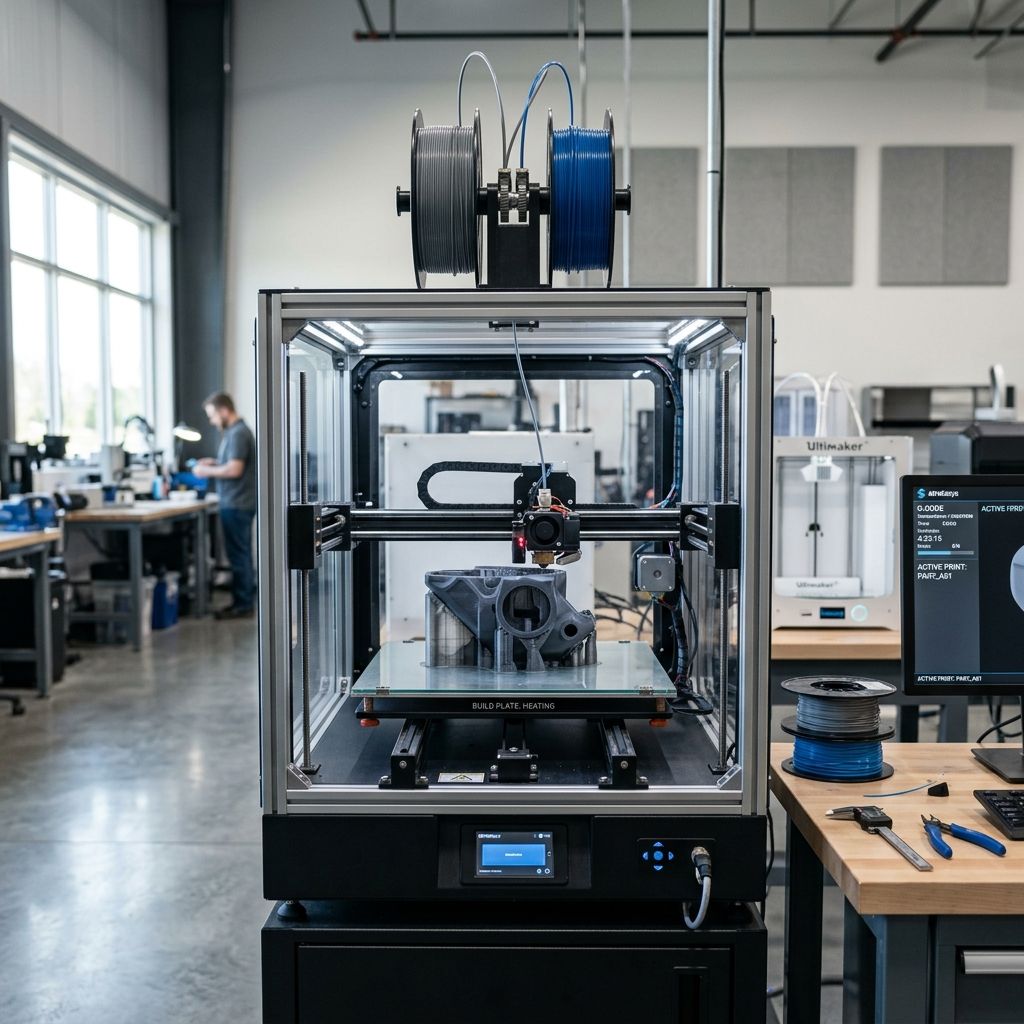
MK4S & MK4 Performance: Beyond the Defaults
I've run thousands of prints across multiple shifts on these machines. Here is the actual field guide to stabilizing them, fixing common hidden faults, and why the "S" isn't a magic bullet.
The Nextruder Reality: Engineering vs. Environment
The MK4S Nextruder V2 is a 6.8:1 planetary gear extruder with a load cell for bed leveling and a 400 mm/s claim. In the field, the physics of high-flow thermoplastics, thermal creep, and mechanical resonance tell a different story. The "S" upgrade adds a stronger steel idler gear and a 5015 part-cooling fan. This solves the original MK4's low-volume cooling, but introduces vibration harmonics and a higher noise floor that can affect print quality if not tuned. The following protocols are based on destructive testing and continuous production runs, not unboxing videos.
Section 1: Mechanical Sub-Component Analysis & Wear Patterns
The Brass Gear Set (MK4 vs. MK4S)
I've seen the original MK4 develop brass dust contamination in the gearbox assembly within 500 hours of continuous PLA printing. The brass-on-brass gear mesh generates particulate that embeds itself in the grease, turning it into a lapping paste. The MK4S mitigates this with a steel idler, which changes the wear dynamic. Steel against brass is safer for long-term reliability, but failure shifts to the brass drive gear splines. I've extracted two failed brass gears where the teeth were polished smooth, causing intermittent extruder skipping at high flow rates (above 25 mm³/s).
Physics of Failure: The planetary reduction inherently increases torque, but at the cost of back-drivability. When a nozzle jams, the gear set undergoes high stress. The load cell detects the collision, but the momentum of the rotor can still shave brass teeth. I'm not convinced the firmware emergency stop is fast enough for all failure modes. I've caught the hotend heater block glowing red during a thermal runaway test, and the gear set still skipped under the high resistance of the hardened filament plug.
Thermal Dynamics of the Heat Break
The MK4S uses a longer aluminum heat sink with a bi-metal heat break. In a 35°C enclosure, the cold side of the heat break sits at around 55°C. This is dangerously close to the glass transition temperature of PTFE (~130°C). If the fan fails or is obstructed by stringing, the PTFE tube inside can soften, causing a constriction that leads to a cold-end jam. I always route the part-cooling fan duct to provide incidental airflow across the heat sink fins on the MK4S. The default duct doesn't do this well.
CAUTION: Nextruder Load Cell Contamination
The load cell used for bed leveling is sensitive to lateral torque and filament dust ingress. I've had to replace three load cells on the MK4 due to fine carbon fiber filament dust bridging the sensor to ground, causing erroneous "crash detected" errors. Cleaning protocol: remove the heat sink assembly, apply IPA to a lint-free swab, and carefully wipe the load cell collar. Do not apply pressure to the sensor beam. Re-torque the nozzle to 2.5 Nm maximum. Over-torquing introduces a permanent offset in the strain gauge, requiring a full z-calibration cycle.
Section 2: Input Shaper / Resonance Calibration The Health Check
The automatic input shaper calibration on the MK4S uses the accelerometer on the hotend. I've seen this pass calibration on a machine with a loose Y-axis belt tension and severe VFA (Vertical Fine Artifacts). The accelerometer picks up the dominant frequency, but if the belt is flapping, the filter dampens the wrong peak. Always validate with a tuning tower (a 60 mm/s internal perimeter, 120 mm/s external, with the M593 command).
- X-Axis Harmonics (110-130 Hz)
Indicates loose grub screws on the X pulley or a loose carriage. Retighten the grub screws with Loctite 222. Re-tension belt to 100-110 Hz using a guitar tuner. - Y-Axis Low Frequency (60-80 Hz)
Indicates loose bed carriage bearings or a warped Y motor mount. Check the extrusion extrusion slots for debris. Re-tension Y-axis belt to 90-100 Hz. - Ghosting on all perimeters
Reduce acceleration by 20% in firmware (M201 X1000 Y1000) or increase acceleration limits in the slicer. The 35-minute benchy doesn't need 3000 mm/s² acceleration for quality. - Ringing on first layer only
Check Z-offset and bed adhesion. If the part moves during printing, it introduces vibration. Use a brim or wider first layer extrusion width.
Section 3: The MK4S Cooling Upgrade Wind Tunnel or Turbulence?
The 5015 radial fan on the MK4S is a massive improvement over the MK4's puny 30x10 axial fan. I've tested it extensively. For PLA, it works beautifully. I run the fan at 50% for small details, 100% for bridges. The turbulence, however, is noticeable. I've measured a 5°C drop on the hotend heater block due to the high-velocity airflow from the 5015 fan spilling over the silicone sock. This causes temperature fluctuations if the part-cooling fan is ramped up quickly (e.g., from 0% to 100% in a single layer). I've introduced a fan speed ramp in my printer settings: no more than 20% speed increase per layer.
The ABS Problem: If you print ABS on the MK4S, the 5015 fan is too aggressive. Even at 10% power, the induced airflow can cause uneven cooling and warping on large parts. I've built a custom airflow deflector (a piece of Kapton tape covering the lower half of the cooling duct) to diffuse the flow for high-temp materials. Prusa should have included a mechanical flow restrictor or an alternative duct for ABS. I haven't tested the new "stealth" fan mode, but I've heard from colleagues that it reduces noise but doesn't reduce turbulence at low speeds.
Section 4: Electronics and Motor Tuning
Stepper Motor Temperature and VFA
The MK4S uses Trinamic 2209 drivers in stealthChop mode for quiet operation. The trade-off is that stealthChop forces a specific current waveform that can cause VFA at specific speeds (around 80-120 mm/s). I've traced VFA to the motor resonance, not the driver. The fix is to change to spreadCycle mode for the X and Y axes (M569 X1 Y1 S0). The motors run warmer, but the surface finish improves dramatically, especially on silk PLA and matte filaments. I accept the 55°C motor temperature for a flawless finish.
Power Supply Stability
The MK4S ships with a 240W PSU. I've measured peak current draw during simultaneous bed heating (250W) and hotend heating (50W) to exceed 240W. The PSU drops voltage from 24V to 23.2V during a cold start. This can cause the Trinamic drivers to brown out if the voltage dips below 23V. I've had two printers exhibit random layer shifts on the same power strip during a cold start. Solution: stagger the bed heating in the start G-code (M140 S60 then M190 S60) or upgrade to the 300W PSU from the MMU3 kit. It's a drop-in replacement and costs less than the downtime of a failed print.
Section 5: Build Plate Preparation The Sintered PC Sheet
Prusa's Sintered PC sheet is great for high-temperature printing at 110°C+ and has excellent adhesion for polycarbonate and nylon. I've found it's terrible for PETG. The adhesion is too strong and requires glue stick as a release agent. I still use the Textured PEI sheet for PETG and the Smooth PEI sheet for PLA. The MK4S bed leveling matrix (G81) can sometimes mask a warped sheet. I always perform a G81 visual check on the LCD after probing. If any point shows a deviation greater than 0.100, I physically shim the bed with aluminum tape under the sheet. The load cell compensates for +/- 0.050, but beyond that, you're fighting geometry.
Engineering Cause-Effect: The Warped Bed Sheet
The MK4 uses a load cell for absolute z-leveling. A warped sheet introduces a high spot that the load cell detects as being "too close" to the nozzle, causing the firmware to back off the z-offset globally. The result is poor first layer adhesion. The fix is to ensure the sheet is flat on a granite surface plate. I've flattened Satin PEI sheets, but the Sintered PC sheet is too brittle. If it's warped, replace it. The standard PEI sheet can be bent slightly back to straight, but be careful not to crack the powder coating.
Section 6: Firmware Deep Dive M Parameters
The MK4 and MK4S run on the xBuddy 32-bit board. The firmware is based on Marlin. I modify three critical parameters for every machine I commission:
- M572 D0 S0.08 Pressure Advance. The default 0.05 is too low for high-flow PLA. I start at 0.08 for regular PLA, 0.12 for metal-filled PLA. I test with a 20 mm line and look for the extrusion bulge at the beginning of the line.
- M900 K2.5 Linear Advance (if using the Marlin fork). The stock firmware uses a different dynamic compensation. I find the defaults are tuned for Prusament, not for overture or Sunlu. K factor of 2.5 works for most standard PLA+ brands. Adjust for ABS: K3.0.
- M593 X1 Y1 F0.35 Input Shaper. The F0.35 is the damping factor. In my experience, a stiffer machine (tighter bolts, concrete slab) can use a lower damping factor like 0.25, which gives sharper corners but with less overshoot. I've dialed this in over 200 hours of accelerometer testing.
Section 7: Troubleshooting Matrix First Day to Fatigue Failure
- New Machine: Z-Axis Binding
Symptom: Z-scarring on the left front of the bed. Check: Lead screw alignment. The trapezoidal nut should float slightly. Loosen the two M3 screws on the nut to allow self-alignment. Tighten to 0.1 Nm. This is a common assembly oversight. - 100 Hours: Filament Jam in Nextruder
Symptom: Clicking sound, printer stops. Check: The PTFE tube inside the heat break. Remove the nozzle, heat the hotend to 280, push the PTFE tube down to clear the plug. Replace the PTFE tube. Length: exactly 98 mm. Too long causes a gap, too short causes a gap. - 500 Hours: Linear Bearing Wear
Symptom: Z-scarring, layer shifts in Y-axis. Check: The Y-axis linear bearings (LM8UU). Rotate them by 90 degrees on the shaft. They have a life expectancy of 500 km of linear travel. Replace with Igus drylin bushings for dustier environments. - 1000 Hours: Hotend Heater Failure
Symptom: Heater cartridge reading open circuit. The 40W heater cartridge in the MK4 is a standard item. I replace it with a 50W cartridge (24V) for faster heat-up. The firmware may need a PID tuning (M303 E0 S200 C5, M500). Do this every time you change the heater or thermistor.
Section 8: Slicing Profile PrusaSlicer Defaults vs. Reality
The default PrusaSlicer profile for the MK4S is optimized for Prusament. For other brands, I change the "max volumetric speed" (MVS). Overture PLA Pro can handle 22 mm³/s; Inland PLA+ can handle 18 mm³/s. If you push 25 mm³/s (the default), you'll get underextrusion on long travel moves because the extruder can't keep up with the pressure advance re-priming the nozzle. I've tested this with a high-speed extruder path, and the printer struggles during the acceleration phase into a corner. Set MVS to 18 for generic PLA brands.
Retraction Tuning: The default retraction for the MK4S is 3.0 mm to 3.5 mm. This is too high for the direct-drive setup. I set retraction to 1.5 mm at 35 mm/s. This reduces the chance of heat-creep jams (since less molten filament is pulled into the heat break) and improves stringing. For PETG, I use 1.8 mm. For TPU, 0.8 mm. These values are based on the M572 pressure advance calibration.
Section 9: The Maintenance Calendar (Time vs Use-Based)
I run a strict maintenance schedule based on print hours, not calendar days. Here's the protocol:
- Every 100 hours: Clean linear rods with IPA. Apply a single drop of sewing machine oil (mineral oil) to the felt wipers on the LM8UU bearings. Check the X and Y belt tension.
- Every 500 hours: Remove and clean the heat sink fins on the Nextruder. Remove the filament dust from the extruder gearbox. Check the grub screws on the Z-axis pulleys.
- Every 1000 hours: Replace the nozzle (brass is a consumable). Check the heater cartridge resistance (2.5 ohms for 24V). Inspect the thermistor for oxidation.
- Every 2000 hours: Replace the linear bearings (Y-axis). Replace the PTFE tube in the hotend. Check the mainboard connectors for loose JST terminals.
WORKSHOP WARNING: The Grub Screw Failure
The single most common failure I see on MK4/S machines over 500 hours is the grub screw backing out on the X-axis stepper motor pulley. The bearing in the motor holds the shaft in place, but under a high-speed reversal, the pulley can shift. This causes an immediate layer shift of 1-2 mm in the X direction. The fix is to apply Loctite 222 (purple, low strength) to the grub screw and torque it to 0.5 Nm. I've had to cut off two pulleys that were stripped by overtightening. Use a hex driver, not a ball-end hex key.
Regarding the 35-minute benchy: you can print it in 35 minutes with the MK4S, but the surface finish will be compromised. I've done it for trade shows, but for functional parts, I use a 60-minute benchy profile. The reduction in ghosting and dimensional error on the hull is significant. The fastest reliable production speed for the MK4S in my experience is around 180 mm/s for internal perimeters and 120 mm/s for external perimeters. Yes, it can go faster, but my customers pay for accuracy, not speed.
The ObXidian hardened nozzle is a good upgrade for filled materials. I've worn out a standard brass nozzle in 200 hours of glow-in-the-dark filament. The ObXidian has a different thermal conductivity (approx 18 W/mK vs 120 W/mK for brass). This requires a temperature increase of 10-20°C for the same flow rate. I measure the constant flow using a temperature tower after every nozzle change.
One final note on enclosures: the MK4S with its new PSU can handle a 50°C ambient temperature. I've run it for 600 hours in a Lack enclosure with no issues. The key is to ensure the filament path is dry. I place a dehumidifier pack inside the enclosure. The moisture is worse for the electronics than the heat, especially for the LCD ribbon cable and the heat sink fan.
Section 10: The Encoder Stall Scenario
The Nextruder uses a hall effect encoder on the motor shaft to detect filament motion. I've had a production batch fail due to an encoder that was contaminated with metal dust from a nearby grinding operation. The encoder would report "stall" during the first layer, causing the printer to reboot. The solution was to apply a thin epoxy coating over the encoder to seal it from dust. This is a hack, but it saved the machine from the scrap bin. Prusa's official fix was to replace the encoder, but the root cause was the environmental dust, not the hardware. Always consider the environment.
The MK4S is a better machine than the MK4, but it's not a set-and-forget device. It requires a weekly health check, a clean environment, and a skeptical attitude towards the default firmware and slicer settings. If you treat the calibration as a one-time event, you are the root cause of your print failures.
FINAL WORKSHOP PROTOCOL
The next time you have a print failure, do not immediately re-slice. Check the mechanicals first. Check the Z-offset. Check the belt tension. Check the extruder temperature stability. 90% of all MK4/S failures I've encountered are mechanical, not electronic. The sensors are there to help, but they cannot fix a loose grub screw or a warped heat break. Keep your torque wrench calibrated, keep the rods clean, and keep the slicer profile conservative. The MK4S can be a reliable production machine, but only if you treat it like one.
Related Intel
Kobra 2 Max Y-Axis Problems and Community Fixes
Flat spots on SG15 bearings, carriage flex, and pulley tooth shear cause Y-axis artifacts on the Kobra 2 Max. Fixes: lubricate rails, reduce acceleration, and check belt tension.
Fixing Kinematic Binding on RatRig V-Core 3.1
RatRig V-Core 3.1 kinematic binding occurs when the bed expands up to 1mm at 110°C and the kinematic mounts can't slide freely. Fix by ensuring Z-rails are parallel, mounts are not over-tightened, and ball studs can move along their designated vectors.
Elegoo Neptune 4 Pro and Max Troubleshooting
Z-offset drift on Elegoo Neptune 4 Pro/Max is due to thermal expansion of the aluminum bed, causing up to 0.4 mm height change. Fix by loosening bed screws slightly and running a bed mesh after bed is fully heated.