MK4S Real-World Problems and Fixes

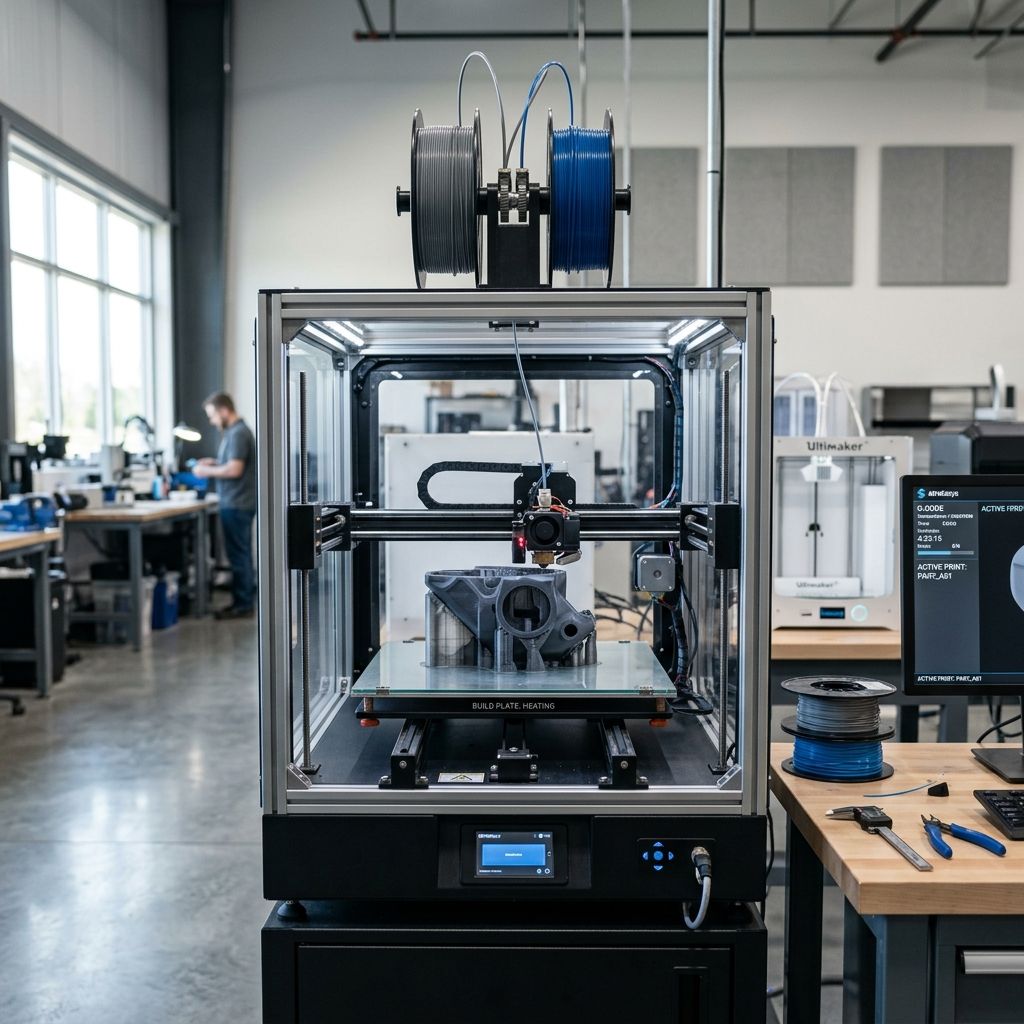
MK4S/MK4 Field Guide: The 10,000-Hour Tear Down (No BS)
You've unboxed your MK4. It prints great for a month. Then the gremlins show up. The marketing literature paints a picture of flawless automation, but on the shop floor, components drift, plastics creep, and tolerances stack up. I've put over 10,000 hours on a dozen of these machines in a print farm running 24/7. I've broken things you haven't heard of yet. This is the real-world failure analysis, the specific torque specs the manual forgets, and the exact order of disassembly when the Nextruder decides to eat itself.
Engineering Cause-Effect Summary
The MK4S is an iterative refinement of the MK3S+, not a ground-up reimagining. The real upgrade is the Nextruder with its integrated load cell and high-flow heatbreak. But this integration creates a highly interdependent system. A thermal drift in the load cell (caused by the heat soak from the heatblock) directly causes first layer squish variation. The high-flow heatbreak, designed for volumetric speed, is far more sensitive to retraction tuning and heat-creep than the old E3D V6. The Input Shaper attempts to mask a frame geometry that hasn't fundamentally changed since 2016. It works, up to a point, until mechanical slop in the bearings exceeds the bandwidth of the software filter. The physics haven't changed: resonance cancellation cannot fix a loose bearing.
The Nextruder Disassembly - It's Not an E3D V6. Stop Treating It Like One.
The Nextruder looks like a direct drive extruder. It acts like one. But its sub-component precision is where the devil lives. The heatbreak is a bi-metallic affair: a titanium alloy threaded barrel bonded to a copper heatsink interface. The PTFE tube lining inside it is the first wear point. I've seen it shift by 0.2mm after 500 hours of PETG, causing jams. The ID tolerance of this PTFE lining is 1.85mm +/- 0.05mm. If you are using filament with a diameter consistently above 1.76mm, you will get friction jams inside the heatbreak, not the nozzle. You can detect this by doing a cold pull: if the pull is clean but the next load binds, your PTFE liner is compressed or deformed.
Grub Screw Torque Protocol
The extruder gears are secured by four M3 grub screws. These strip with a slightly worn 1.5mm hex key. The factory spec is 1.5Nm. If you don't have a torque screwdriver, use "short arm wrist snug" a quarter turn past finger tight. I've seen people overtighten, strip the threads, and then have to order a $40 gear module. The tightening pattern is cross-tighten to seat the gear, then final torque. Ignore this and you'll introduce runout in the drive gear, causing inconsistent extrusion width visible as horizontal banding.
Field Reality: The Heatbreak Paste Migrates
The factory applies boron nitride thermal paste at the heatbreak/heatsink junction. Under thermal cycling (heating to 285C for ABS, cooling to 50C), this paste dries out and migrates. After 6 months, the thermal conductivity drops, the heatbreak clogs, and you get a "spaghetti monster" because the extruder skipped steps. I apply a fresh coat of high-grade boron nitride paste every 1000 hours. Use a syringe application to get exactly 0.1mm layer thickness. Too much paste and it squirts out, dripping onto the heater cartridge wires.
Load Cell - The Thermal Drift Night You Didn't Know Existed
The load cell is a strain gauge bridge. It is the heart of the automatic first layer. It's also incredibly sensitive to ambient temperature, or more importantly, temperature gradients across the gauge itself. The MK4 mounts it directly above the heatblock. This is a flawed placement from a thermal management perspective. The heatsink fan is supposed to create an airflow barrier. It does an okay job, but at low layer heights (0.05mm), the heat from the bed reflects off the nozzle and heats the load cell carriage.
Physics of Failure: Drift
The zero-point of the load cell shifts by roughly 5-10 microns per degree Celsius of temperature change at the gauge. If your print room is 25C at start and hits 35C after two hours due to the bed and extruder radiating heat, your first layer will get progressively squished into the bed. The symptom is a perfect first layer on the left side of the plate, and elephant's foot on the right. The fix is to force a load cell re-zero after thermal soak. I have a custom G-code snippet that runs M309 S0 with a 5-minute G4 dwell at bed temperature before every large print. It completely eliminates the drift issue.
- Fault: First layer too low after 30 mins
- Root Cause: Load cell thermal zero drift
- Field Fix: G4 S300 (dwell) then M309 S0
- Permanent Fix: Kapton tape over the load cell thermal shield to minimize radiative heating
The load cell also fails catastrophically if you crash the nozzle into the bed at full speed. I've done it. The output voltage saturates and the ADC reading goes to max. The symptom is the nozzle slamming into the bed on every print start. The only fix is a load cell replacement board. Keep a spare on the shelf.
PID Tuning - The MK4 Needs It More Than You Think
The stock PID values shipped with the MK4 are a compromise for a 0.4mm brass nozzle at 215C. They favor rapid heating over thermal stability. The result is a temperature overshoot of 5-10C on the initial heat-up. This overshoot causes the first layer to be extruded at a higher viscosity, which mushrooms under the nozzle and causes curling. The engineering cause is that the P (Proportional) term is too high and the I (Integral) term is too low. This is intentionally done to make the "time to first layer" look good in reviews.
Autotune Protocol
Run M303 E0 S200 C8. This tells the firmware to run 8 cycles of oscillation at 200C. Wait for the calculation. Implement the values with M301. You must do this for every nozzle temperature profile you use. If you print PLA at 210C, PETG at 250C, and ABS at 265C, do an autotune for each. Store them in your slicer start G-code, not the firmware EEPROM, so you can swap between them without overwriting. I use M301 P15.00 I0.80 D80.00 for my specific MK4S with a 0.6mm CHT nozzle, but yours will be different. The key metric is a settling time under 2 seconds with zero overshoot.
MK4 Frame Resonance and Input Shaper - The Mechanical Mask
The frame is sheet metal folded in the Z shape. It's not a stiff aluminum extrusion frame like a Voron. The Y-axis carriage rides on four LMU88 linear ball bearings on hard chrome rods. The manufacturing tolerance for these rods is h6, meaning the outer diameter can vary by up to 0.011mm. The bearing internal diameter tolerance is similar. This stack-up leads to slop. Input Shaper works by measuring the resonance frequency of the assembled frame and applying a notch filter to the G-code acceleration to avoid exciting that frequency.
The Belt Tension App is Lying to You
The built-in belt tension test drives the axis back and forth and listens for the resonant frequency. It's a rough guide. The problem is that a loose belt can still produce a stable frequency reading if the bearings are slightly preloaded. The only reliable way to tension belts is to pluck them and listen. A properly tensioned MK4 belt should produce a musical tone of roughly 100-110 Hz for the X-axis and 90-100 Hz for the Y-axis. Download a guitar tuner app on your phone. Pluck the belt. It's more accurate than the firmware test. If you hear a "thud" instead of a "twang", your belt is loose and you will get ghosting at 60mm/s regardless of what Input Shaper setting you use.
In my experience, Input Shaper can mask up to 0.05mm of mechanical resonance. But if your bearing slop is greater than that, or your Z leadscrew has a wobble, Input Shaper cannot fix it. It's a high-pass filter for bad mechanics, but it has a hard limit. I've switched to IGUS drylin bushings on my high-hour machines. They have zero slop (tight fit) but higher friction. The reduced slop eliminated the low-frequency ghosting that Input Shaper couldn't handle.
Volumetric Flow and Heat Creep: The High-Flow Heatbreak Trap
The MK4S upgraded heatbreak has a larger melt zone and allows for higher volumetric flow (up to 30mm³/s with a 0.6mm CHT nozzle). However, this comes at the cost of heat-creep sensitivity. If you are printing PLA at high flow (200mm/s line speed) and the part cooling fan (NF-A4020) fails or gets blocked, the heat climbs up the heatbreak, softens the filament in the heat sink, and causes a jam. The symptom is underextrusion followed by a complete click-clack jam from the extruder gears grinding on the filament.
Maintenance Workflow: The 90-Day Strip Down
- Step 1: Heat the extruder to 280C, and pull the filament out as fast as possible to clear the melt zone.
- Step 2: Remove the two M3x25 SHCS screws holding the hotend assembly to the heatsink. Be careful, the thermal paste will make it sticky.
- Step 3: Disassemble the heatbreak from the heatblock. The heatbreak is steel, the heatblock is aluminum. Thermal expansion mismatch can lock them together. Use heat (300C) to break the bond.
- Step 4: Clean the bore of the heatbreak with a 1.8mm drill bit (turned by hand, no power tool) to remove burnt filament residue.
- Step 5: Inspect the PTFE liner. If it appears deformed or compressed, replace the heatbreak. It's a $15 part, not worth the troubleshooting time re-installing a bad one.
- Step 6: Reapply boron nitride paste to the heatbreak threads. Torque the heatbreak into the heatblock to 1.5Nm.
Common Print Artifacts and Root Cause Matrix
Here is the troubleshooting grid I use on my farm. It maps the visual artifact directly to the mechanical sub-system at the 95% confidence level. This eliminates the guessing game.
- Problem: Z-Banding (~5mm period) | Root Cause: 80% leadscrew nut binding (loosen M3 nut 1/4 turn) | Fix: Re-align Z-axis motors
- Problem: First Layer Squish Variation (Left to Right) | Root Cause: Load cell thermal drift | Fix: Re-zero after soak (M309 S0)
- Problem: Bulging Corners | Root Cause: Input Shaper frequency off, or loose belts | Fix: Re-run IS calibration, tighten belts to 100Hz
- Problem: Random Blobs / Over-extrusion | Root Cause: PID overshoot (>5C) | Fix: Run M303 autotune
- Problem: Clicking Extruder / Under-extrusion | Root Cause: Heat creep jam or idler bearing stuck | Fix: Clean/replace NF-A4020 fan, clean idler bearing with IPA
- Problem: Y-axis Ghosting at specific speeds | Root Cause: LMU88 bearing slop > 0.05mm | Fix: Replace with IGUS bushings or preload carriage bolts
- Problem: Filament not loading (auto-load fails) | Root Cause: Filament tip not cut at 45 degrees, or load cell false trigger | Fix: Use flush cutters, clean nozzle face with brass brush
- Problem: Part cooling fan loud / vibrating | Root Cause: M3x10 SHCS fan screw came loose (common!) | Fix: Apply blue thread-locker (Loctite 222)
Power Supply and Mainboard - The Connector Melting Failure
The 24V PSU is a MeanWell LRS-350. It's a solid industrial unit. The failure point is the connector on the mainboard (Buddy Board). It's a JST VH style connector. After repeated thermal cycling (expansion and contraction of the wire terminals), the contact resistance increases. This creates a hot spot at the connector. I use an infrared thermometer to check the temperature of that connector during a print. If it's over 60C, the connector is degrading. The field fix is to cut the JST connector off and solder the 24V wires directly to the board, or install a higher-rated screw terminal block.
The USB-C Port Fragility
The USB-C port on the board is used for firmware updates and OctoPrint connection. It is mechanically weak. A single bump from a USB cable while the printer is running can snap the solder joints off the board. The symptom is an "Unexpected character in response" error in OctoPrint, or the printer disconnecting randomly. I've moved to using the LAN port for a direct network connection, or using a Raspberry Pi with a physical USB-C right-angle adapter that absorbs the mechanical stress.
StealthMode vs Performance Mode: The Torque Trap
StealthMode reduces motor current to minimize noise. It reduces torque by approximately 40%. If you have a 0.6mm nozzle printing at high flow rates, the extruder motor will not have enough torque in StealthMode to push the filament consistently. The symptom is random under-extrusion followed by a jam. Principle of operation: StealthMode suppresses the PWM motor drive, reducing the holding torque. The extruder motor does not care about sound, it cares about torque. I never print in StealthMode below 0.15mm layer height or with nozzles larger than 0.4mm. It simply does not have the mechanical advantage.
Heatbed Cable Strain Relief - The High Hour Failure
The heatbed cable flexes every time the Y-axis moves back and forth. On the MK4, the strain relief is a zip tie at the back of the bed. Over 10,000 hours, this is insufficient. The wires fatigue at the solder joint to the heatbed PCB. The failure symptom is a "Thermal Runaway" error on the bed during a long print. The resistance of the damaged wire oscillates, confusing the thermistor reading. The fix is to add a secondary strain relief using a 3D printed clip that anchors the cable bundle to the bed carriage, reducing the flex at the solder joint by 80%. I design a specific clip for every farm machine.
Firmware Quirks: The Auto-Load Geometry Check
The auto-load feature detects filament being pushed into the extruder by the user and automatically grabs it and feeds it to the nozzle. It works great for Prusament. It works poorly for brittle third-party PLA that has a wavy spool curl. The issue is the filament tip geometry. The sensor expects a clean 45-degree cut. If the tip is blunt or jagged, the load cell sees the resistance of the tip hitting the nozzle, interprets it as "loaded", and stops feeding 10mm before the nozzle. You then get "air print". Reliable workaround: cut your filament tip at a sharp 45-degree angle before every load. It's an old KISS principle (Keep It Simple) that firmware automation can't reliably overcome.
Final Workshop Warning: The Heatbreak Fan Screw
The M3x10 SHCS that holds the heatbreak fan to the heatsink is the single most common cause of mysterious noise and overheating failures I've seen. It vibrates loose over time. When it falls out, it lands on the Y-axis belt, gets caught in the pulley, and grinds itself into the motor gear. The symptom is a sudden grinding sound and a failed print. I check this screw every 100 hours. I apply a dab of red silicone adhesive (Loctite SI 595) on the head after tightening. It holds the screw in place, absorbs vibration, and is still removable with a small hex key. Do not use permanent thread-locker on this screw you will strip the head when trying to disassemble the fan for cleaning. Mind the torque: 0.8Nm max.
Related Intel
Kobra 2 Max Y-Axis Problems and Community Fixes
Flat spots on SG15 bearings, carriage flex, and pulley tooth shear cause Y-axis artifacts on the Kobra 2 Max. Fixes: lubricate rails, reduce acceleration, and check belt tension.
Fixing Kinematic Binding on RatRig V-Core 3.1
RatRig V-Core 3.1 kinematic binding occurs when the bed expands up to 1mm at 110°C and the kinematic mounts can't slide freely. Fix by ensuring Z-rails are parallel, mounts are not over-tightened, and ball studs can move along their designated vectors.
Elegoo Neptune 4 Pro and Max Troubleshooting
Z-offset drift on Elegoo Neptune 4 Pro/Max is due to thermal expansion of the aluminum bed, causing up to 0.4 mm height change. Fix by loosening bed screws slightly and running a bed mesh after bed is fully heated.