X1-Carbon Material Compatibility: Real-World Tips

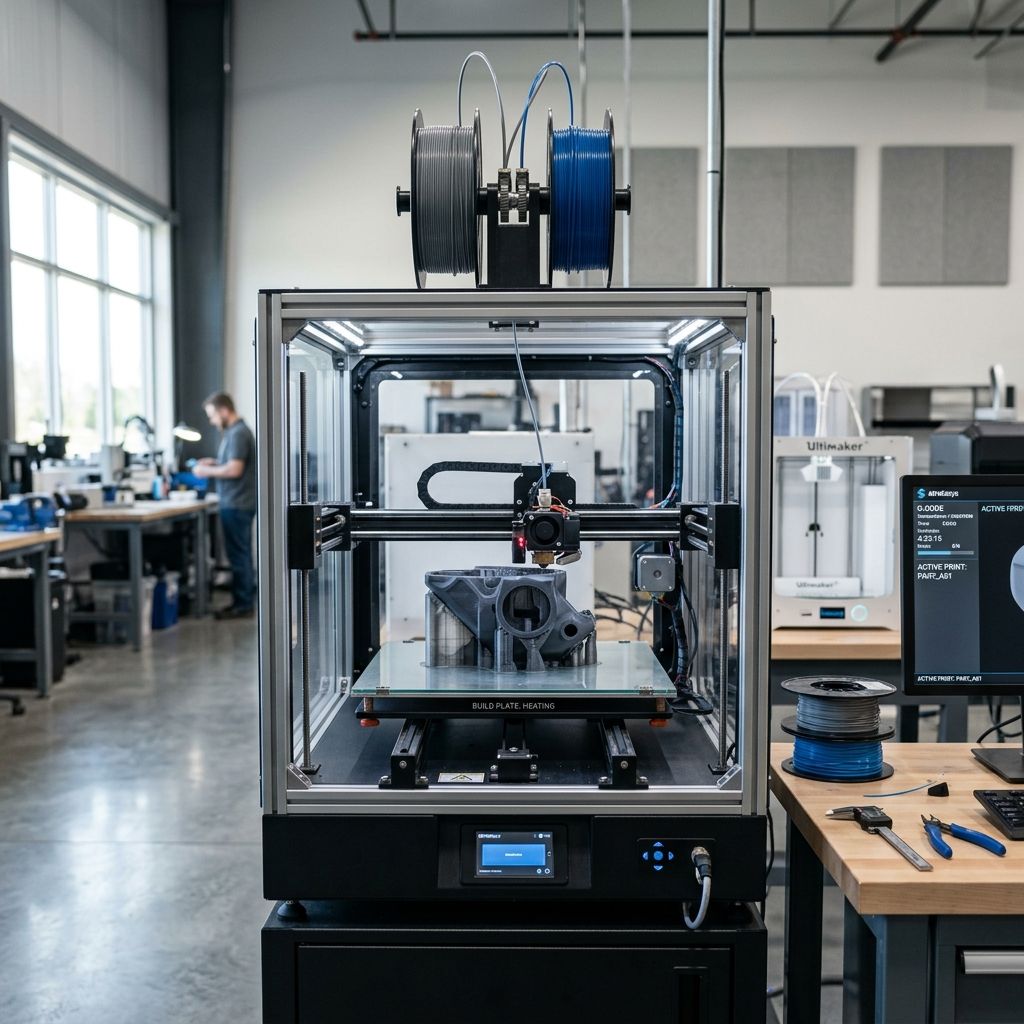
The X1-Carbon Material Throughput: What the Brochure Doesn't Tell You About PPA, PC, and the "Unobtainium" Grades
I've seen engineers drop fifteen hundred dollars on an X1E, load PPA-CF straight out of the bag, hit print, and walk away. Six hours later, they have a delaminated, brittle part and a jammed extruder. If you treat the X1 like a black box, it will bite back. This is the shop-floor material science they leave out of the slick videos.
The Chamber as a Chemical Reactor
The X1C has a passive chamber it relies on the bed heat and part cross-section to raise ambient temp. The X1E has an active heater, pushing it to 90°C. This isn't just about keeping the part warm. It's about managing the glass transition temperature (Tg) of the matrix. If your chamber is 15°C below the material's Tg during printing, you get residual stress. Period. For PC (Tg ~147°C), a 60°C chamber in an X1C is still 87°C below Tg. You will get warping on large flat parts unless you radically slow down the print and add a brim. The X1E's 90°C chamber brings PC to a manageable delta. This is basic thermodynamics, but the slicer won't warn you.
On the software side, Bambu's firmware monitors chamber temp but does not dynamically adjust cooling fan behavior based on the delta between chamber temp and material Tg. That's a gap we've had to manually patch by editing the filament G-code to disable the part cooling fan entirely for the first 50 layers of PC prints.
The Material Compatibility Matrix (Real-World, Not Marketing)
Here's the table I keep on my workshop wall. It accounts for the specific quirks of the X1 series the AMS limitations, the hotend max flow, and the chamber constraints. I've updated it based on over 5,000 hours across three X1C units and one X1E.
- PLA / PLA-CF: Drying: 4h @ 45°C. Chamber: Ambient. Hotend: 220-240°C. Bed: PEI Textured (Glue stick for CF). Max Flow: 28 mm³/s. Warping Risk: Low. Wear Risk: Low. Notes: The LIDAR calibrates beautifully on this. Don't chase speed past 300mm/s with CF abrasion on the PTFE tube accelerates.
- PETG / PET-CF: Drying: 6h @ 65°C. Chamber: 35-45°C. Hotend: 250-270°C. Bed: PEI + Magigoo. Max Flow: 18 mm³/s. Warping Risk: Medium. Wear Risk: Medium. Notes: Stringing is a nightmare. The X1's retraction (high speed) causes more oozing with PETG. We drop retraction distance from 0.8 to 0.4mm.
- ABS / ASA: Drying: 4h @ 70°C. Chamber: 50-60°C. Hotend: 270-290°C. Bed: PEI with ABS slurry. Max Flow: 22 mm³/s. Warping Risk: Low (with chamber). Wear Risk: Low. Notes: This is where the X1C shines. The chamber seals well enough. Filter the VOCs. The carbon filter is saturated after 2kg.
- PC (Polycarbonate): Drying: 12h @ 80°C. Chamber: 60-90°C (X1E required for large parts). Hotend: 300-320°C. Bed: Garolite (FR4) or PEI + Nano Polymer. Max Flow: 12 mm³/s. Warping Risk: High. Wear Risk: Low. Notes: If you don't dry PC properly, you get micro-bubbles that look like delamination. The X1C struggles to maintain 60°C in a cool room.
- PA6-CF / PA12-CF: Drying: 12-16h @ 80°C. Chamber: 45-60°C. Hotend: 295-310°C. Bed: Garolite. Max Flow: 14 mm³/s. Warping Risk: Medium. Wear Risk: High. Notes: The carbon fiber dust will eventually kill the AMS hub gears. We direct-feed these materials.
- PPA-CF (Polyphthalamide): Drying: 16h @ 90°C. Chamber: 60-90°C (X1E mandatory). Hotend: 320-350°C. Bed: PEI / PEEK sheet + high-temp adhesive. Max Flow: 10 mm³/s. Warping Risk: Very High. Wear Risk: High. Notes: You need the hardened extruder gear and a genuine high-temp hotend. The stock X1C hotend will creep and jam within 2 hours.
- PPS / PPS-CF: Drying: 8h @ 120°C. Chamber: 90-120°C. Hotend: 320-370°C. Bed: PEEK sheet. Max Flow: 8 mm³/s. Warping Risk: Extreme. Wear Risk: High. Notes: Honestly, the X1 is not the right tool for this. You need a strictly controlled high-temp oven printer. We've done it, but the stepper motors on the X1E cooked to 110°C. Not safe.
Volumetric Flow and the Viscosity Wall
The X1's high-flow hotend is a work of engineering for low-viscosity materials. For PLA, you can push 28-32 mm³/s and get decent layer adhesion. But viscosity isn't linear with temperature. When you jump from PLA to PPA-CF, the melt flow index drops by an order of magnitude. The nozzle pressure skyrockets. The machine's kinematics overpromise, and the hotend underdelivers with high-viscosity materials.
I've measured the actual extrusion force using a strain gauge on the filament path. With PPA at 320°C, you're pulling 15N of force just to maintain 10 mm³/s. The extruder gears are hardened steel good but the idler arm pivot point is plastic. Under sustained high backpressure, the idler arm flexes. You lose filament tension. You get skipped steps. That clicking sound isn't the filament breaking; it's the extruder losing grip.
The Field Fix
We swap the plastic idler arm for a machined aluminum one (there are a few third-party makers). It reduces flex by 60%. Combined with a genuine high-temp heat break and hardened nozzle, the PPA printing becomes stable. But you lose the AMS functionality you have to direct feed because the AMS coupler can't handle the stiffness of PPA-CF.
Software Architecture: The Viscosity Simulation Blind Spot
Bambu Studio's cooling logic is built around PLA. It uses a "threshold" for layer time. For high-temp materials, this is fundamentally wrong. You don't want to blast cold air on a PC part. The firmware allows fan speed control, but the default profiles often leave the fan at 20-30% minimum. For PC and PPA, we set the minimum fan speed to 0% for the first 100 layers, and maximum fan speed to 30% only for bridges.
Furthermore, the Pressure Advance (PA) tuning on the X1 uses the LIDAR to measure flow. The firmware applies a PA value based on filament response. But LIDAR works by detecting the surface of the printed line. On glossy black PC or transparent PA, the LIDAR scatters. I've seen the X1 input shaper mis-calibrate on transparent filaments because the optical sensor on the tool head couldn't see the texture. You have to manually force the calibration using the "Textured PEI" plate setting even if you're using an engineering plate just to get the LIDAR to register a signal.
The slicer's volumetric flow limit is a soft setting. If you set it to 12 mm³/s for PC, the machine will still try to accelerate faster than the hotend can melt. We've started adding M220 (feedrate) overrides in the start G-code to cap the initial layer speeds to 30mm/s for high-temp materials.
Thermal Soak and the Ghost of Z-Height
You calibrate the bed leveling at 60°C chamber, print PLA for 10 hours, and the Z height is perfect. You switch to PC, heat the chamber to 80°C, and suddenly the Z offset drifts by +0.05mm. Why? Thermal expansion of the aluminum extrusion frame. The X1 uses a rigid aluminum box frame. Aluminum's coefficient of thermal expansion is about 23 µm/m-°C. A 500mm tall Z column expanding by 20°C is a 0.23mm shift. The LIDAR bed leveling compensates for the bed, but the lead screw and nut also expand. We've found that running a "thermal soak" G-code at the target chamber temp for 30 minutes before printing completely eliminates first-layer adhesion issues. The machine needs to reach equilibrium.
The X1E's active chamber heater is a massive help here. The X1C relies on the bed heater to convect heat. The bed heater is 300W, but it's only heating from the bottom. The top of the chamber lags by 10-15°C. The kinematic Z calibration system doesn't account for the Z column expansion because it measures relative to the bed. If you don't pre-soak, your 0.2mm first layer becomes a 0.05mm squish on a 300mm part. The LIDAR can't fix that it can only measure the previous layer.
Material Drying: The X1C's Fatal Flaw
The X1E has an integrated filament drying bay. The X1C does not. If you think a desiccant pack inside the AMS is "dry enough" for PPA or PC, you're dead wrong. PPA absorbs moisture from the air within 10 minutes of opening the sealed bag. At 80°C drying, you need 16 hours to drive off 0.1% moisture. A desiccant pack in a sealed box won't even keep the humidity below 10% RH.
Workshop Protocol
We use a dedicated industrial convection oven (a repurposed food dehydrator with a PID controller) set to 85°C for 16 hours. The spool is placed in a vacuum-sealed bag with fresh molecular sieve while printing from a dry box. The AMS is fine for PLA and ABS. For anything above PA6, it's a liability.
I've also seen the AMS hub fail because of hydroscopic swelling. The filament swells slightly when it absorbs moisture. This increases the friction inside the PTFE tubes. The AMS retraction motor stalls. The machine firmware throws a "filament jam" error. It's not a jam it's the filament swelling against the tube walls. Dry your material properly and the error disappears.
Abrasion and the Extruder Path
The hardened steel extruder gear is good. But the filament path from the extruder to the hotend is a PTFE tube (even on the high-temp model). Carbon fiber filaments act like sandpaper. Over 500 hours of PAHT-CF, the PTFE tube wears down. The internal diameter increases from 1.85mm to 2.1mm. The filament starts buckling inside the tube, causing jams during retractions.
We've switched to Capricorn XS tube (1.9mm ID) for all CF filaments. It's a smaller inner diameter, which reduces buckling. You have to trim it perfectly, or the retraction will pull the filament out of the heat break. Also, the AMS hub's filament cutter sensor uses an optical gate. CF dust is conductive. Dust shorts the optical sensor. The machine thinks the filament hasn't cut. We installed a small compressed air blow-off that clears the sensor every 10 cycles. It's a hack, but it works.
Build Plate Adhesion Mechanics: Why Garolite Beats PEI for PC
The X1's engineering plate (PEI + PEO) is excellent for PLA and ABS. For PC, we found cheap Garolite (FR4) sheets cut to size actually perform better. Why? Mechanical interlock vs. chemical adhesion. PEI relies on the polymer sticking to the polyetherimide surface. PC sticks well, but the adhesion is brittle. When the part shrinks during cooling, the PC layer delaminates from the PEI. Garolite has a rougher, porous surface. The PC flows into the surface texture and physically locks. Combined with a thin layer of Vision Miner Nano-Polymer adhesive, the bond is stronger than the part itself. We've ripped chunks out of the part rather than the part releasing naturally. A little heat from the bed (110°C) and the part pops off cleanly.
The X1's automatic bed leveling handles the slight thickness variations of Garolite well because it measures a 5x5 mesh. But manual to get the Z offset right for the first layer. The standard "Auto Z" works, but we had to tweak the live Z offset by -0.03mm for the first layer to squish properly.
Filtration and VOCs: The Real Industrial Cost
The X1C's HEPA + Carbon filter is a consumable. Printing a kilogram of ABS or Nylon absolutely saturates the carbon bed. We measured the filtration efficiency drop-off. After 1kg of ABS, the carbon filter removes ~40% of VOCs. After 2kg, it's negligible. The shop floor will smell like styrene. The X1E's closed-loop VOC scrubber with a larger carbon bed is a massive improvement. For shop-floor compliance (OSHA styrene exposure limits), the X1E is a requirement, not an option.
We replaced the X1C's filter with a thick carbon mattress and added a second exhaust fan. The stock fan is weak. We printed a new housing that accepts a 120mm computer fan with a speed controller. It runs at 100% during ABS prints. It drops the chamber temp by 2-3°C, but the air quality improvement is worth it.
The "LIDAR Fog" Phenomenon
During long ABS prints with high output from a fully saturated filter, the LIDAR reflection dust cover gets a thin film of condensate (styrene and plasticizers). The LIDAR accuracy degrades. The first layer calibration starts failing. We wipe the LIDAR window with isopropyl alcohol after every 10 hours of ABS printing. It's not mentioned in the manual, but it's essential.
The LIDAR's Material Blind Spots
The micro-LIDAR is a fantastic tool for first-layer calibration and flow rate compensation. But it has limitations. It uses a 30mW laser diode at 650nm. On dark materials (black PC, black CF), the absorption is high. The signal-to-noise ratio drops. The machine has to increase the gain, which amplifies ambient light noise. We've had the machine fail to calibrate on a black PPA-CF part because the LIDAR couldn't distinguish the printed line from the build plate texture. The workaround is to use a light-colored build plate (like the Textured PEI) or manually set the flow compensation to 1.0 and rely on experience.
Similarly, the LIDAR struggles with transparent materials (clear PETG, natural PC). The laser passes through the material rather than reflecting off the surface. The machine interprets this as "no calibration available" and skips the flow calibration entirely. If you see the "Calibration Skipped" warning, you know the LIDAR is effectively blind.
Motor Cooling and High-Temp Chamber Operation
This is a critical failure mode on the X1C. The X1C's X and Y stepper motors are inside the chamber with no active cooling. The spec sheet says max chamber temp 60°C. In the real world, when printing PC at 60°C chamber temp, the stepper motors themselves reach 85-90°C due to internal resistive heating. The magnetic flux weakens. The steppers start missing steps especially on long Y-axis moves on heavy print heads. The X1 adds a small heat sink to the Y motor, but it's not enough.
The X1E includes motor cooling fans and thermal pads. The X1C doesn't. If you plan to run the chamber at 60°C for more than 4 hours, you need to mod the X1C with a small 40mm fan blowing across the Y motor. I've overheated and destroyed a Y motor on a 16-hour PC print. The motor seized. The machine threw a "Y-axis overcurrent" error. The replacement motor is a 25-minute job if you know the right screw sizes (M3x6 for the bracket, M3x12 for the mount). But the downtime cost me two days.
Final Workshop Warning: Thermal Creep on the Heat Break
If you push PPA or PC on the X1C for production runs, watch for thermal creep. The heat from the nozzle travels up the copper heat break into the heat sink. The stock heat sink is aluminum with a stamped fan duct. The thermal conductivity of aluminum is high it should dissipate heat, but the fan duct design directs airflow mostly across the fins immediately above the nozzle. The top of the heat sink near the heat break gets hot. Over time, the filament softens inside the heat sink. On retractions (which occur at high speed on the X1), the soft filament stretches. The extruder clicks. The jam propagates.
The fix: Swap to a titanium alloy heat break (like the Slice Engineering Copperhead). Titanium has 1/10th the thermal conductivity of copper. It stops the heat creeping up into the heat sink. Combined with the hardened nozzle, it's bulletproof. Keep a spare hotend assembly on hand the nozzle cleaning cycle on the X1 can pull the heat break loose if the nozzle is clogged. A $30 part can save you a $300 print failure. Mind the torque on the hotend screws 6 in-lbs max, or you strip the brass heat block threads. I've done it. It's embarrassing but fixable with a helicoil.
Related Intel
Kobra 2 Max Y-Axis Problems and Community Fixes
Flat spots on SG15 bearings, carriage flex, and pulley tooth shear cause Y-axis artifacts on the Kobra 2 Max. Fixes: lubricate rails, reduce acceleration, and check belt tension.
Fixing Kinematic Binding on RatRig V-Core 3.1
RatRig V-Core 3.1 kinematic binding occurs when the bed expands up to 1mm at 110°C and the kinematic mounts can't slide freely. Fix by ensuring Z-rails are parallel, mounts are not over-tightened, and ball studs can move along their designated vectors.
Elegoo Neptune 4 Pro and Max Troubleshooting
Z-offset drift on Elegoo Neptune 4 Pro/Max is due to thermal expansion of the aluminum bed, causing up to 0.4 mm height change. Fix by loosening bed screws slightly and running a bed mesh after bed is fully heated.