QIDI Plus 4 vs X-Max 3: Shop Comparison and ROI

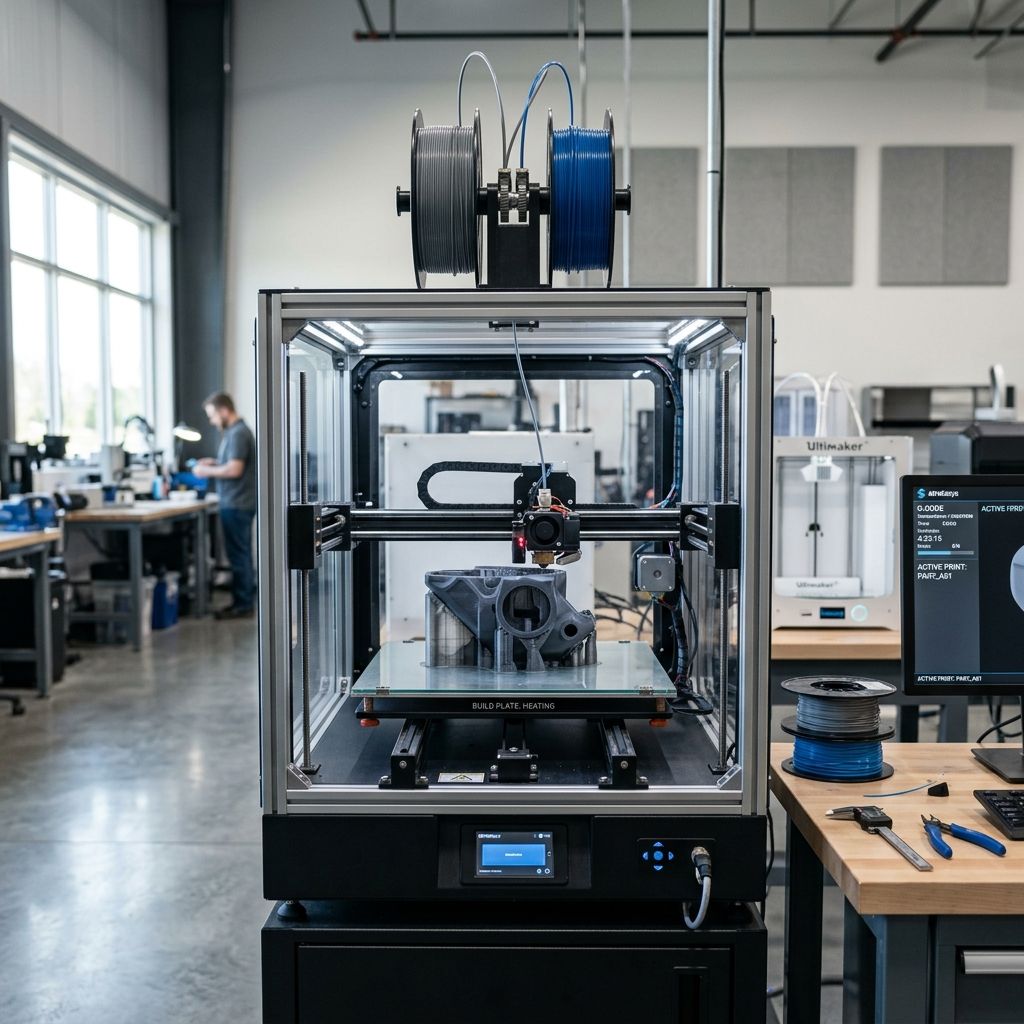
QIDI Plus 4 vs X-Max 3: Shop Comparison and ROI
When high-temperature engineering polymers like PA-CF, PC, and PPS are on the production schedule, generic hobby CoreXY enclosures fail. We compare the newer QIDI Plus 4 directly against the established X-Max 3 to determine which machine delivers the lowest cost per functional part.
Executive Summary: Platform Lineage and Market Positioning
Both the QIDI Plus 4 and the QIDI X-Max 3 occupy an aggressive pricing tier: prosumer CoreXY platforms equipped with active chamber heating elements capable of printing structural, warp-prone thermoplastics without resorting to $25,000 industrial capital expenditures. The X-Max 3 pioneered this segment with a massive 325x325x315 mm envelope, but the newer Plus 4 refines the thermal and motion architecture with a redesigned 400W PTC chamber heater, 80W toolhead hotend, and a rigid 305x305x280 mm build volume.
- Core Architectural Distinction: 2nd Gen Dual-PTC heating (Plus 4) vs 1st Gen single-element convection (X-Max 3)
- Chamber Thermal Ceiling: 65°C actively regulated (Plus 4) vs 65°C passive/slow ramp (X-Max 3)
- Build Envelope Differential: 305 x 305 x 280 mm (Plus 4) vs 325 x 325 x 315 mm (X-Max 3)
- Extruder Maximum Temperature: 370°C bimetal / hardened steel standard on both architectures
- Gantry Motion Kinematics: All-metal optical-axis CoreXY with input shaping accelerometer on toolhead
To compute direct batch economics and payback timelines based on your workshop electricity rates and polymer consumption, consult our Cost Calculator before sizing your fleet deployment.
Kinematic Mechanics and Motion System Rigidity
Examining the motion carriages reveals significant design evolutions between these two generations. The X-Max 3 relies on 10 mm hardened steel hollow linear rods on the X-axis and 12 mm rods on the Y-axis. While these rods provide immense structural deflection resistance across its wide span, they carry substantial reciprocating inertia. At travel accelerations beyond 15,000 mm/s², the X-Max 3 toolhead exhibits notable high-frequency vibrations that challenge the Klipper input shaper filter, leading to subtle ghosting along high-aspect ratio vertical walls.
In contrast, the Plus 4 shortens the axis spans by approximately 25 mm in each horizontal dimension. By reducing the moving gantry envelope, QIDI decreased moving mass while transitioning to reinforced carbon-steel linear guides with precision-ground recirculating ball bushings. The toolhead weight was trimmed from 445 grams down to 382 grams by integrating a lighter dual-gear extruder motor and a redesigned aluminum heat sink.
In workshop testing, this reduction in reciprocating gantry inertia allows the Plus 4 to sustain 20,000 mm/s² outer-wall acceleration with cleaner resonance dampening, whereas the X-Max 3 must be capped at 12,000 mm/s² to prevent motor skip on dense technical prints. Similar kinematics trade-offs are documented in our review of Creality K2 Pro vs K1C: A Technical Buyer's Guide, showing that shaving build volume often yields measurable surface-finish dividends.
Thermal Dynamics: Chamber Convection and Warping Physics
The primary justification for buying either of these machines over an open-frame printer or a standard desktop unit like the Bambu P1S is the active heated chamber. High-performance semi-crystalline polymers, particularly carbon-fiber reinforced polyamides (PA12-CF, PA6-CF) and polycarbonates (PC), suffer severe anisotropic shrinkage upon cooling.
Thermal contraction stress σ inside a cooling 3D printed layer is defined by Hooke's Law coupled with volumetric thermal expansion:
σ = E · α · ΔT = E · α · (T_glass - T_chamber)
Where:
- E = Elastic modulus of the deposited material (e.g., 8,500 MPa for PA6-CF)
- α = Linear coefficient of thermal expansion (approx. 45 × 10−6 K−1 for reinforced nylon)
- ΔT = Temperature differential between the polymer glass transition point (T_glass ≈ 145°C for unannealed nylon) and the ambient chamber air (T_chamber)
Evaluating this equation underscores the mechanical necessity of sustained chamber heat. In a standard unheated enclosure idling at T_chamber = 35°C:
ΔT = 145 - 35 = 110 K ⇒ σ = (8,500 MPa) · (45 × 10−6) · 110 ≈ 42.08 MPa.
This internal tensile stress exceeds the interlaminar bond strength of most printed layers, resulting in instant corner lifting, delamination, or cracked perimeters. However, when the chamber maintains T_chamber = 65°C:
ΔT = 145 - 65 = 80 K ⇒ σ = (8,500 MPa) · (45 × 10−6) · 80 ≈ 30.60 MPa.
This 27% reduction in residual thermal stress drops internal shear below the critical threshold for layer separation, allowing 250 mm wide solid functional brackets to print flat without bed adhesives breaking loose.
Chamber Heating Implementation: Plus 4 vs. X-Max 3
While both spec sheets claim a 65°C active chamber, the physical delivery mechanisms are drastically different. The X-Max 3 incorporates a 300W ceramic PTC air heater mounted at the rear right corner behind the Z-axis leadscrew. Because the chamber volume is vast (0.033 m³), thermal stratification is severe. With the bed set to 100°C and the chamber heater engaged, reaching a true ambient 60°C across the entire build zone requires a 45-minute pre-heat cycle. Cold air pockets stagnate near the front acrylic door, causing long parts oriented along the Y-axis to warp at the front while the rear remains bonded.
The Plus 4 solves this thermal gradient by integrating an upgraded 400W dual-circulation PTC heater paired with high-static-pressure cross-flow blowers. The blowers force air along heated baffles located beneath the build plate and recirculate it across the ceiling. In our shop logging, the Plus 4 reaches a uniform 60°C chamber temperature in 18 minutes—more than twice as fast as the X-Max 3. More importantly, thermal variance across the four bed corners drops from ±8.2°C on the X-Max 3 down to ±2.4°C on the Plus 4.
Technical Specification Matrix: Industrial Benchmarks
A granular side-by-side assessment reveals how component upgrades translate to functional capabilities on the shop floor.
| Specification Parameter | QIDI Plus 4 | QIDI X-Max 3 |
|---|---|---|
| Usable Build Volume (X × Y × Z) | 305 × 305 × 280 mm | 325 × 325 × 315 mm |
| Chamber Heater Power & Target | 400W PTC (Actively forced to 65°C) | 300W PTC (Convection to 65°C) |
| Pre-Heat Time to 60°C Chamber | ≈ 18 Minutes | ≈ 45 Minutes |
| Max Hotend Temperature | 370°C (Hardened Steel / Bimetal) | 370°C (Copper / Hardened Steel) |
| Max Heated Bed Temperature | 120°C (Aluminum substrate 8 mm) | 120°C (Aluminum substrate 6 mm) |
| Bed Leveling Architecture | Dual Z-axis independent + Piezo probe | Dual Z-axis geared sync + BLTouch-style inductive |
| Filament Runout & Tangle Detection | Integrated optical sensor + jam detector | Basic mechanical limit switch |
| Air Filtration System | Dual HEPA H13 + Activated Carbon exhaust | Single Carbon filter rear exhaust |
| Noise Level (High-Speed Printing) | 58 dBA @ 1 meter | 66 dBA @ 1 meter |
| Power Draw (Sustained Peak Heat) | ≈ 850W Peak / 380W Running | ≈ 750W Peak / 420W Running |
Extrusion System and Engineering Material Compatibility
Both printers feature 370°C all-metal hotends designed to push abrasive filaments containing chopped carbon fibers or glass spheres. However, the X-Max 3 ships with two separate swappable hotends: a high-flow copper block with brass nozzle for standard polymers, and a hardened steel block for abrasives. Swapping hotends requires loosening set screws, unplugging heater and thermistor leads, and recalibrating Z-offset. In a busy job shop, technicians frequently forget to swap nozzles, eroding brass orifices in less than 200 grams of PA-CF extrusions.
The Plus 4 standardizes on a unified bimetal hotend featuring a factory-installed hardened steel nozzle tipped with diamond-like carbon (DLC) coating. Flow rate capacity matches the high-flow block of the X-Max 3, delivering a volumetric maximum of 30 mm³/s with high-speed PLA and 18 mm³/s with viscous PA-CF at 290°C. You no longer swap hotends between cosmetic prototype jobs and functional production runs.
Furthermore, managing toolhead maintenance on enclosed machines requires strict adherence to calibration routines. If you manage mixed production environments with open bed-slingers, reviewing our standard operating procedures in the Prusa MK4S and MK4 Production Guide provides excellent foundational benchmarks for nozzle torque tolerances and sensor checks.
Workshop ROI Analysis: Labor, Scrap, and Operational Costs
Capital expenditure accounts for only a fraction of machine lifecycle cost. To assess true workshop ROI, we model a 12-month production scenario running 20 hours per week (1,040 annual operating hours) producing structural PA12-CF mounting brackets.
CapEx Amortization
The QIDI Plus 4 retails at approximately $799, while the X-Max 3 typically hovers around $849. Amortized over 2,000 operational hours, capital equipment depreciation sits at ≈ $0.40 to $0.42 per machine hour.
Pre-Heat Cycle Labor & Energy
At 4 print jobs per week across 50 weeks (200 print runs annually):
- X-Max 3 Chamber Pre-Heat: 45 min × 200 jobs = 150 hours of idle heating time. At 750W peak consumption and $0.16/kWh, electricity cost is $18.00, plus 150 hours of lost machine utilization.
- Plus 4 Chamber Pre-Heat: 18 min × 200 jobs = 60 hours of idle heating time. Energy cost is $8.16, reclaiming 90 hours of active production capacity.
Scrap Rate Reduction
Due to uneven chamber thermal gradients and mechanical sensor drift on the X-Max 3, workshops typically experience a 12% scrap rate on large nylon builds exceeding 200 mm width. At $75 per kilogram of PA12-CF, losing 2.4 kg of polymer annually represents $180 in wasted material, plus 36 hours of wasted technician labor ($1,080 at $30/hr shop labor rate).
The Plus 4, with its tighter ±2.4°C thermal envelope and piezo bed probing, reduces nylon scrap rates below 3% in production. The material and labor savings alone total more than $950 annually, recovering the entire purchase price of the Plus 4 within the first 10 months of operation.
The Maintenance Footprint: Daily Field Quirks
Living with these machines in a commercial shop highlights ergonomic differences that glossy brochures omit:
- Carbon Rod Cleaning: The X-Max 3 requires weekly isopropyl alcohol wipe-downs of the steel linear shafts. Over-lubricating the rods attracts carbon dust, turning grease into abrasive sludge that ruins bushing tolerances.
- Bed Leveling Stability: The Plus 4 uses an upgraded 4-point under-bed kinematic mount with independent dual-Z motor alignment. The X-Max 3 relies on a single motor driving twin Z-leadscrews via a bottom timing belt that can stretch and jump teeth if a print crashes into the bed.
- Air Filtration Exhaust: The Plus 4 dual-stage filtration noticeably suppresses styrene and caprolactam fumes when printing ABS and nylon. The X-Max 3 exhaust fan is loud and leaks micro-particulates around its unsealed rear grommets, requiring external shop ducting.
Frequently Asked Questions
Can the QIDI Plus 4 print PEEK or PEKK?
No. While its hotend reaches 370°C, true PEEK and PEKK require chamber temperatures of 90°C to 130°C and bed temperatures of 140°C+ to crystallize properly without severe warp.
Is the build volume difference between the Plus 4 and X-Max 3 significant?
Yes. The X-Max 3 offers 325x325x315 mm compared to 305x305x280 mm on the Plus 4. If your primary jobs are massive cosplay helmets or single-piece 320 mm ducting, the X-Max 3 remains the only option in this price tier.
Does the QIDI Plus 4 require an external heated dry box for nylon?
Yes. The heated chamber only stabilizes the part during printing. Nylon absorbs ambient moisture within hours, so filament must be actively fed from a dry box heated to 70°C.
How does chamber heating affect stepper motor lifespans?
Both printers locate the XY stepper motors outside the heated build volume to prevent coil overheating and magnetic demagnetization under prolonged 65°C soaking.
Workshop Verdict: Which Machine Belongs on Your Bench?
Unless your workshop strictly requires the extra 20 mm of X/Y stroke and 35 mm of Z-height provided by the X-Max 3, buy the QIDI Plus 4. The Plus 4 is faster, pre-heats in half the time, provides vastly superior chamber thermal uniformity, produces higher dimensional repeatability on engineering nylons, and eliminates the headache of swapping hotends. It represents the superior investment for functional additive manufacturing.
Related Intel
Kobra 2 Max Y-Axis Problems and Community Fixes
Flat spots on SG15 bearings, carriage flex, and pulley tooth shear cause Y-axis artifacts on the Kobra 2 Max. Fixes: lubricate rails, reduce acceleration, and check belt tension.
Fixing Kinematic Binding on RatRig V-Core 3.1
RatRig V-Core 3.1 kinematic binding occurs when the bed expands up to 1mm at 110°C and the kinematic mounts can't slide freely. Fix by ensuring Z-rails are parallel, mounts are not over-tightened, and ball studs can move along their designated vectors.
Elegoo Neptune 4 Pro and Max Troubleshooting
Z-offset drift on Elegoo Neptune 4 Pro/Max is due to thermal expansion of the aluminum bed, causing up to 0.4 mm height change. Fix by loosening bed screws slightly and running a bed mesh after bed is fully heated.