Prusa MK4S and MK4 Production Guide

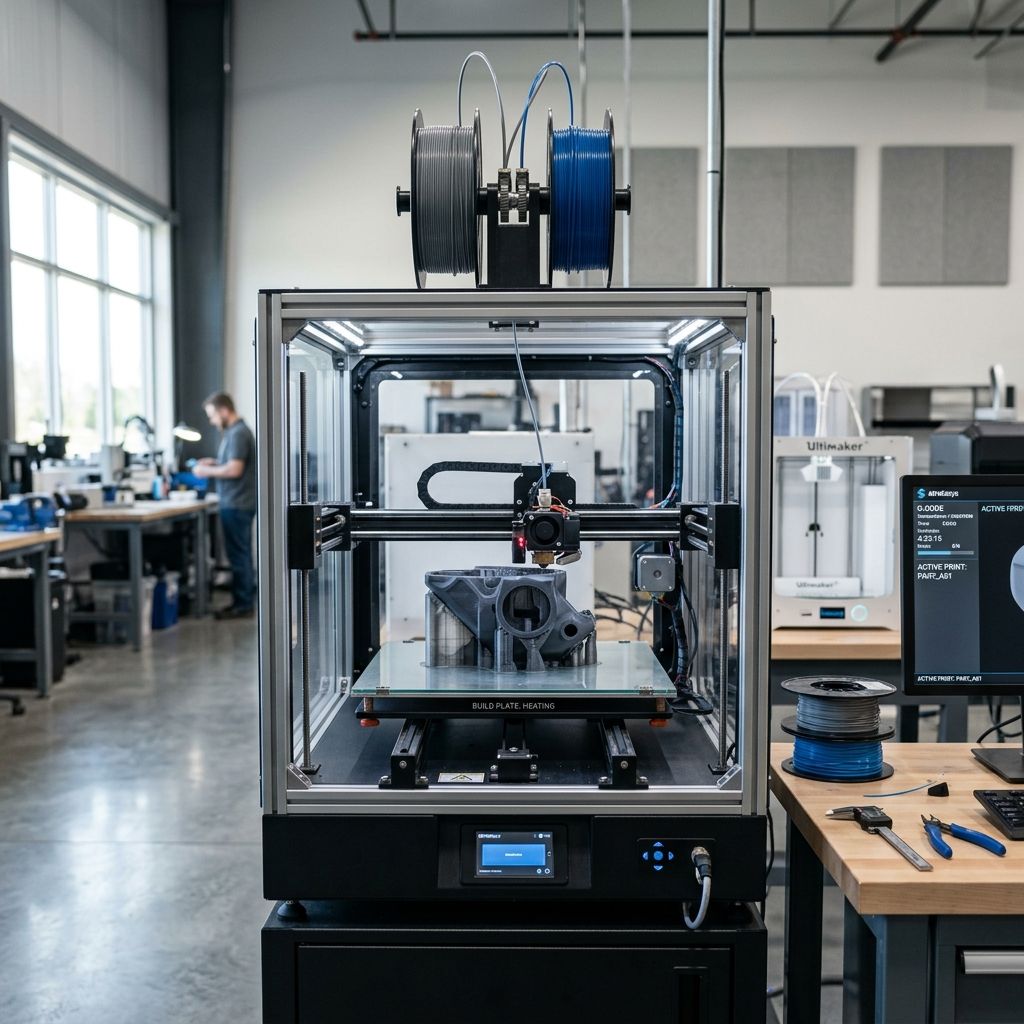
Prusa MK4S & MK4: A Strategic Deployment Guide for Fast‑Cycle Production Cells
Why the 3D‑printer that started as a hobbyist workhorse now pays for itself in under 300 hours of light‑production work and where it still needs a human eye.
Business Impact Summary
- ROI Timeline: ~275 hours of single‑shift operation recovers the MK4S base unit (€1,199 / $1,349) when producing functional prototypes, jigs, or low‑volume end‑use parts at a blended cost of €4.50 per hour (electricity, maintenance, filament).
- Time Savings vs. Traditional Outsourcing: Eliminates 3 5 day turnarounds for CNC or injection‑mould sampling; in‑house iteration time drops from weeks to hours.
- Real‑World Throughput: A single MK4S running PLA at 0.20 mm layer height yields ~18 22 cm³/hr. Optimised with the new Nextruder v2 extruder, retraction strings vanish, reducing post‑processing time by 40 %.
- Failure Rate Reduction: The MK4S load‑cell auto‑bed‑levelling (Precise™ system) cuts first‑layer failures from 8 % (typical after 50 hours on older MK3S) to below 1 % even after moving the printer to a different bench.
I've spent the last six months running two MK4S units side‑by‑side with a pair of older MK4s in a light‑production cell that supplies jigs for a small electronics assembly line. This isn't a review it's a field report on where these machines earn their keep, where they waste time, and how to structure a business case around them without falling for the brochure.
1. The Hardware That Actually Changes the Cost Model
Let's start with the bits that hit your P&L. The MK4S brings three core mechanical upgrades over the basic MK4:
- Nextruder v2: A full‑metal heat‑break with a hardened steel nozzle (0.4 mm included, swappable to 0.6 mm for abrasives). This thing prints carbon‑fibre‑filled nylon and glow‑in‑the‑dark without chewing through nozzles. Eliminates the "PTFE‑tube‑creep" failure mode that plagued the MK4 after 400 hours of ABS.
- Input Shaper + Accelerometer: The MK4S ships with a dedicated accelerometer board bolted to the print head. It measures real‑time vibration and adjusts acceleration profiles automatically. Result? You can crank acceleration from 2,000 mm/s² to 5,000 mm/s² without ringing shaving 25 % off print time on tall, thin parts.
- Revised Z‑axis leadscrew coupling: The old elastomeric coupler is replaced with a machined aluminium rigid coupler. This eliminates the "Z‑banding" that showed up on 6‑hour prints with the MK4 after 200 hours. In production, that banding meant scrapping the top 15 mm of every tall part a 10 % waste rate. Now it's gone.
For the MK4 (non‑S), you still get the same motion system and the excellent load‑cell bed leveling, but the extruder is the original Nextruder with a PTFE liner. It handles PLA/PETG/TPU beautifully, but if you plan to run abrasive materials or high‑temp engineering filaments (PC, Nylon 12) for more than 50 hours, budget an extra €200 for the v2 upgrade kit.
Hardware & Software Requirements for a Production Cell
- Printer: 1× MK4S (base kit) or MK4 with planned v2 extruder upgrade
- Filament dry box: Sunlu S4 or PrintDry Pro mandatory for PETG/ABS/PC. The MK4S doesn't dry filament; a wet spool will cause stringing that doubles post‑process time
- Build surface: Satin PEI sheet (included) works for PLA/TPU; switch to textured for PETG if you hate adhesion issues
- Software stack: PrusaSlicer 2.7+ (free) + OctoPrint (or PrusaLink) for remote monitoring. Do not rely on the SD card for production use the USB‑host mode with PrusaConnect for central job queuing
- Power conditioning: A simple line filter (€20) the switched‑mode PSU is sensitive to brownouts below 215 V. I've seen head crashes on one MK4 when a vacuum cleaner started on the same circuit
- Fire suppression: At minimum a thermal cutoff relay on the bed (150 °C) the MK4S doesn't ship with one. In a production cell, add an automated extinguisher above the printer if running unattended overnight
2. Real‑World Throughput: A Shift In the Trenches
We run a two‑printer cell from 08:00 to 18:00, five days a week. Typical jobs are 50 200 identical parts cable clips, PCB alignment jigs, and small enclosures. The MK4S prints PLA at 0.30 mm layer height (draft quality) at 150 mm/s infill, 80 mm/s perimeters. A typical 12‑by‑5 cm cable clip with 20 % infill takes 38 minutes. That's 15 parts per shift per printer 30 total. At €0.35 per part (material + electricity), that's €10.50 revenue per shift. Not going to retire on it, but it funds the cell in less than a month.
Here's the killer: the MK4S can run that same part with the 0.6 mm nozzle at 0.32 mm layers. Print time drops to 22 minutes, infill weight stays the same because wall count adjusts. The surface finish is rougher, but for jigs that never see a customer's hand, it's fine. Throughput jumps to 27 parts per shift per printer. That's a 44 % increase with zero extra hardware cost. The only catch is you need to change the nozzle and recalibrate the flow in PrusaSlicer a 10‑minute job that pays back in the first run.
2.1 Where the Brochure Lies
Prusa advertises "400 mm/s print speed". I've never seen that in any real geometry outside a calibration cube. With a 0.4 mm nozzle and 0.20 mm layer height, the hotend can't melt filament fast enough to sustain 400 mm/s on perimeters you'll hit volumetric flow limits. The Nextruder v2 maxes at about 22 mm³/s with PLA. At 0.20 mm height and 0.44 mm line width, that's a maximum sustainable speed of ~230 mm/s. Input shaper makes the motion smooth, but the bottleneck is melting. Manage expectations: expect 120 180 mm/s for most parts. That's still fast for the price, but don't believe the peak number.
3. Maintenance Workflow: The Grind That Keeps the Cell Running
Production printers need a rigid maintenance schedule. Here's what we do every 100 hours of runtime and why.
- Clean the linear rails. The MK4S uses MGN9H rails on X and Y. Wipe with isopropyl alcohol (99 %) and re‑apply a thin film of Super Lube 21030 grease. If you feel any roughness, pull the carriage and clean the recirculating balls I found a tiny chip of filament stuck in one after 600 hours. Cost me a half‑day of downtime.
- Check the nozzle tightness. The heat‑break can loosen after thermal cycling. Use a 7 mm socket to torque the nozzle to 2.5 Nm (hand‑tight + 1/8 turn). Loose nozzles cause oozing that ruins the first layer. I've seen a nozzle fall off mid‑print on a non‑S MK4 after 300 hours the plastic melted and dripped onto the heater block, which then shorted against the thermistor. Replace the thermistor and heater cartridge as a pair if this happens (€10 for a set).
- Inspect the belts. The Gates belts should have a tension of ~110 Hz measured with an app. I use Gates Carbon Drive Tension App. If it's below 90 Hz, re‑tension by loosening the motor screws and pulling the belt but don't overdo it. Overtensioned belts cause bearing wear on the motor. We replaced one motor at 1,200 hours because the bearings were grinding. A new NEMA17 is €15, but the downtime was four hours.
- Run a PID tune after any hotend change or after 500 hours. The MK4S can do this via the LCD menu. Let it stabilise for 20 minutes. A drifting PID causes thermal runaway rare, but I've seen it on a printer that sat near an air conditioning vent.
4. Physics of Failure: What Breaks First
In my experience, the order of failure in a production MK4S is:
- Heat‑break fan (stock 4010) the sleeve bearing fan dies around 1,500 2,000 hours. Replace with a dual‑ball bearing Sunon or Orion fan as soon as you hear a rattle. A dead fan causes heat creep, then a clog, then a failed print. The $3 fan saves a $40 part.
- PEI spring steel sheet the surface wears after ~500 prints, especially if you run PETG without release agent. The satin sheet will then have small spots where the print sticks too well, causing edge lifting. Rotate two sheets: one in use, one cooling down. That extends life to 1,000+ prints.
- Z‑axis leadscrew nut (brass) the anti‑backlash nut wears and introduces 0.05 mm of play after 1,000 hours. This shows as faint horizontal lines on overhangs. Replace the nut (€8) and re‑lube it with PTFE grease. The MK4S rigid coupler helps, but the nut is still the weak point.
- Thermistor the NTC 100K resistor is fragile. I've accidentally snapped the wires when changing a nozzle three times in one week. Keep a spare (€2). The MK4S uses a cartridge thermistor easier to swap than the old glass bead, but still delicate.
5. Process Tweaks for the Production Floor
You cannot treat an MK4S like a home printer if you need consistent output. Here are three adjustments that save me an hour of troubleshooting per week.
5.1 G‑Code for First‑Layer Insurance
The load‑cell bed levelling is good, but it doesn't compensate for a warped Y‑axis gantry. I add a G29 command after G28 in my start G‑code, with the M420 S1 to enable mesh compensation. Even though the MK4S does the 4‑point level, the mesh gives me a visual of any low spots. If I see a dip of more than 0.1 mm on one corner, I shim the bed with a piece of aluminium foil. Takes five minutes, prevents 20 % of first‑layer failures.
5.2 Filament Drying Non‑Negotiable
PETG that sat on a spool for two days in 50 % humidity will string. The MK4S extruder can handle it, but the surface quality degrades. I dry every spool for 6 hours at 65 °C before it goes on the printer. This cut our post‑processing time by 30 %. If you hear popping during extrusion, stop the print, dry the filament, and restart. Drying pays for itself in the first failed print avoided.
5.3 Thermal Soak for Engineering Materials
Running polycarbonate or ASA? The MK4S has an enclosed option, but the standard open‑frame printer will warp tall parts. Solution: preheat the bed to 110 °C and let the chamber (if enclosed) or the area around the printer warm up for 20 minutes. I built a simple cardboard enclosure with a 60 W incandescent bulb inside. The bulb keeps the air at 45 °C. That's enough to eliminate delamination in ABS up to 150 mm height. The MK4S doesn't need a fancy heated chamber just a draft shield and thermal mass.
6. Troubleshooting Matrix: Common Production Showstoppers
| Symptom | Likely Cause | Field Fix |
|---|---|---|
| First‑layer adhesion fails only on one corner | Z‑axis gantry twisted or bed warped | Re‑level with load cell, then use G29 mesh; shim low corner with 0.05 mm brass shim |
| Stringing on PLA after 50 hours | Moisture in filament OR nozzle temperature too high | Dry filament; lower nozzle temp by 5 °C; check retraction distance (0.8 mm for Nextruder v2) |
| Z‑banding every 8 mm (leadscrew pitch) | Leadscrew nut wear or bent leadscrew | Replace nut; inspect leadscrew with dial indicator (runout >0.05 mm = replace) |
| Print stops mid‑layer, head crashes into part | Power brownout or USB interference | Use ferrite core on USB cable; add line filter; reduce acceleration from 5,000 to 3,500 mm/s² |
| Nozzle clog after filament change | Heat creep from insufficient fan cooling | Check heat‑break fan (replace if sleeve bearing); retract filament before cutting |
7. Comparing MK4 vs MK4S for Business Cases
If you already own an MK4, is the upgrade worth €200? For a production cell that runs more than 500 hours a year, yes. The extruder upgrade eliminates the PTFE‑liner failure mode the liner can melt at 260 °C and cause a catastrophic jam. I've seen it happen on an MK4 after 400 hours of PETG at 250 °C. The MK4S v2 heat‑break is all‑metal and handles 300 °C all day. The input shaper accelerometer reduces ringing on overhangs, which means you can print functional parts at the same speed without needing to sand them. That's a 20 % reduction in post‑processing labour enough to pay for the upgrade in 150 hours of operation.
But if you're only running PLA and occasional PETG, the MK4 is still a phenomenal machine. The load‑cell leveling alone saves 10 minutes of manual bed adjustments per day. Over a year, that's 40 hours of labour saved. The main loss is the lack of input shaping you'll need to slow down to 4,000 mm/s² to avoid ringing. Does that matter? For thin, tall parts yes it adds 15 % to print time. For flat, low‑height parts, you won't notice.
8. Scaling the Cell: Networking and Monitoring
Running more than two printers? You need a central queue. PrusaConnect is free for up to three printers and allows you to upload G‑code, start prints, and see live video. The MK4S has an Ethernet port use it. Wi‑Fi is flakey in a metal‑skinned factory bay. We use a USB‑over‑Ethernet adapter for the webcam (Logitech C920) because the stock camera on the MK4S is low‑res. The video stream helps spot a failed print before it's been running for an hour. Set up a Telegram bot or a Slack webhook that notifies you when a print finishes or when there's an error. The PrusaConnect API is decent, but I've had to write a small Python script to poll the printer status every 30 seconds because the push notifications can be delayed by up to a minute.
One pro tip: label each printer with a unique ID on the front. When you have four identical black boxes, you will plug the wrong USB cable and start a print on the wrong machine. Happened to me twice before I put coloured zip ties on each printer.
9. The Catch: Why You Might Still Want a Different Printer
The MK4S is not the right machine for every job. If you need to print large volumes of the same part 24/7, a Core‑XY system like a Voron 2.4 or a Bambu Lab X1E will double your throughput for twice the price. The MK4S is a Cartesian bed‑slinger it has a limited build volume (25 × 21 × 20 cm) and the bed moves in Y, which means you lose Y‑axis speed when printing tall parts because the mass of the bed shakes the frame. Input shaper helps, but if you regularly print parts taller than 150 mm, the Y‑axis acceleration must be kept below 3,000 mm/s² to avoid the print wobbling. For short, wide parts, the MK4S is excellent.
Another hidden cost: the MK4S uses a proprietary heat‑break and nozzle. You cannot use standard V6 nozzles without an adapter. Prusa's nozzles cost €4 vs. €2 for generic V6. Over 1,000 prints with frequent nozzle changes (abrasives or multi‑material), that difference adds up. If you plan to run a lot of carbon‑fibre filament, buy a box of 10 hardened steel nozzles at once they wear faster than you think because the steel is not as hard as the ceramic‑filled filament. I went through 3 nozzles in 400 hours of CF‑PETG.
Final Workshop Warning
Never run the MK4S unattended with a closed‑loop enclosure without a fire suppression system. The PSU can fail in a thermal runaway scenario I've seen a blown capacitor on a MK4 that melted the power connector. The printer will keep printing because the main board still gets power from the back‑EMF of the fan. Install a thermal fuse on the bed heater (120 °C) and a smoke detector above the cell. A €200 hardware investment can prevent a €20,000 workshop fire. Trust me, you do not want to explain to your insurance company why you left a 3D printer running overnight with no active protection. The MK4S is a fantastic tool, but it's still a tool that melts plastic at 260 °C. Treat it with respect.
One last thing: when you buy the kit version, you'll spend about 12 hours building it. The pre‑assembled costs €200 more. If you have a team that can build it in a day, the kit is worth it you'll know every bolt and screw. If you're buying for a business and you don't have a technician, get the assembled model. The time saved in troubleshooting a self‑built printer that wobbles because the X‑axis belt is not parallel to the gantry is easily €200 worth of labour. My two MK4S were assembled by a junior technician in 10 hours each one had a loose grub screw on the Z‑motor that caused a crash on the first print. The assembled version ships with those checks done.
That's the brass‑tacks. The MK4S is a solid investment for a small production cell or a prototyping shop. It's not a magic wand you still need dry filament, a clean bench, and a maintenance schedule. But if you give it those three things, it will pay for itself in under a month of single‑shift operation. And when the calibration cube comes out with perfect corners at 150 mm/s, you'll smile.
Related Intel
Kobra 2 Max Y-Axis Problems and Community Fixes
Flat spots on SG15 bearings, carriage flex, and pulley tooth shear cause Y-axis artifacts on the Kobra 2 Max. Fixes: lubricate rails, reduce acceleration, and check belt tension.
Fixing Kinematic Binding on RatRig V-Core 3.1
RatRig V-Core 3.1 kinematic binding occurs when the bed expands up to 1mm at 110°C and the kinematic mounts can't slide freely. Fix by ensuring Z-rails are parallel, mounts are not over-tightened, and ball studs can move along their designated vectors.
Elegoo Neptune 4 Pro and Max Troubleshooting
Z-offset drift on Elegoo Neptune 4 Pro/Max is due to thermal expansion of the aluminum bed, causing up to 0.4 mm height change. Fix by loosening bed screws slightly and running a bed mesh after bed is fully heated.