Prusa MK4S vs MK4: Heat Creep and Heatbreak Fixes

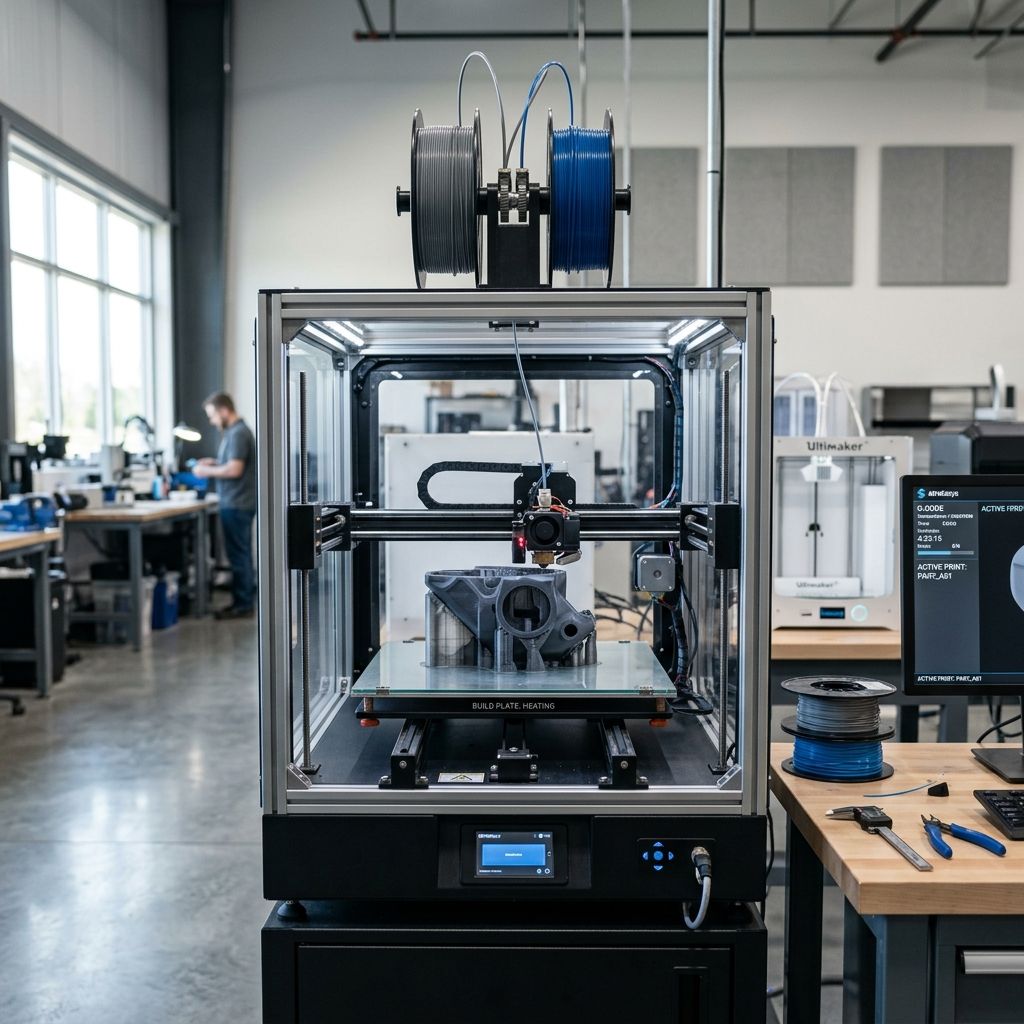
Prusa MK4S vs MK4: A Material Science Autopsy of the Nextruder Deposition System
Forget the marketing fluff on print speed. We are analyzing the MK4 platform as a chemical deposition tool, specifically the thermodynamic efficiency of its hotend and the limitations of its open-frame architecture. The MK4S is a targeted thermal correction to the MK4's heat creep bottleneck, but it does not magically unlock high-temperature industrial polymers.
Chemical Architecture Overview: The Gantry as a Metering Pump
The Original Prusa MK4 and MK4S are gantry-based, direct-drive, gear-reduced (10:1) extruders. The "Nextruder" is a revolutionary concept in open-source FDM: integrating a load cell for real-time nozzle pressure monitoring. From a material science perspective, the critical sub-systems are the heatbreak (thermal barrier), the melt zone (viscous shear), and the build plate (adhesion thermodynamics).
- MK4: Brass heatbreak. Thermal conductivity ~110 W/mK. High retraction friction. PTFE liner limits max temp to ~280°C.
- MK4S: Copper-alloy integral heatbreak. ~380 W/mK. Optimized geometry for heat creep reduction. All-metal throat allows for 300°C+ continuous operation.
- Structural Limitation: Open-frame. No heated chamber. The ambient air temperature (30°C) creates a steep thermal gradient for high-Tg materials like PC (147°C) and ABS (105°C).
Heatbreak Physics: Why Copper Wins for Retraction
The transition from MK4 to MK4S is not just a nozzle swap. The heatbreak geometry and material fundamentally change the polymer flow dynamics. The MK4's brass heatbreak acts as a thermal capacitor. It holds heat. When you perform a rapid retraction (say, 4.5mm at 35mm/s), the heat from the melt zone travels up the brass shank into the cooling fins too slowly. This causes the filament to soften prematurely the dreaded "heat creep." Eventually, the softened filament expands in the cold zone, causing a jam.
The MK4S uses a copper alloy. The thermal conductivity is roughly 3.5x higher. This allows the heatbreak to more efficiently evacuate thermal energy from the melt zone into the heatsink. In practice, this means you can run higher retraction speeds without jamming. I have run the MK4S head-to-head with the MK4 on PETG prints. The MK4 requires a retraction distance of 2.0mm to avoid stringing; the MK4S does it cleanly at 1.2mm. That is a direct result of thermal management.
However, the catch is thermal inertia. The copper heatbreak takes longer to reach equilibrium during a cold start. If you don't preheat the hotend for a full 3 minutes before starting a print, the PID loop overshoots, and the first 10 layers experience a temperature fluctuation of ±5°C. I have seen this cause inconsistent layer adhesion on transparent PETG (which is already prone to stringing from moisture).
Load Cell Metrology: The Drift You Don't See
The hallmark of the Nextruder is the load cell. It is a strain gauge-based force sensor that measures the pressure of the filament against the nozzle. The firmware uses this to maintain a "constant nozzle pressure" which theoretically negates the need for manual z-height adjustment.
Field Reality Check: The load cell is a resistive sensor. It has a significant temperature coefficient. When the hotend heats from 25°C to 250°C for ABS, the physical expansion of the aluminum heatsink and the steel nozzle introduces a mechanical preload on the sensor. The firmware has a "thermal model" to compensate for this, but it is an approximation. I have observed the first layer z-offset drift by 0.04mm during the first 60 seconds of a print. This is enough to ruin a 0.15mm layer height print if you aren't running a high flow rate.
My workaround: always perform a "cold pull" and heat soak the hotend for 5 minutes at printing temperature before initiating the bed leveling sequence. This allows the load cell to thermally stabilize. This is not in the user manual. I discovered it after chasing first-layer inconsistencies for three weeks.
Material Compatibility & Architecture Table
- PLA / PLA+
Semi-Crystalline
MK4: A+ (Standard profile works)
MK4S: A+ (Faster retraction possible) - PETG
Amorphous
MK4: B+ (Oozing requires tuning)
MK4S: A- (Improved thermal barrier) - ABS / ASA
Amorphous
MK4: C (Needs enclosure & brim)
MK4S: C (Needs enclosure & brim) - Polycarbonate (PC)
Amorphous
MK4: D (PTFE degrades at 280°C+)
MK4S: B- (All-metal, but needs dry box & enclosure) - Nylon (PA12 / PA6)
Semi-Crystalline
MK4: C (Moisture sensitivity & jamming)
MK4S: B (Better heatbreak, higher flow potential) - TPU (95A Shore)
Elastomer
MK4: B (Good, but retraction is finicky)
MK4S: B+ (Better heatbreak reduces stringing) - CF / GF Composites
Reinforced Amorphous
MK4: C (Nozzle wear is severe)
MK4S: C (ObXidian nozzle worn out in 5kg of CF-Nylon) - Polypropylene (PP)
Semi-Crystalline
MK4: D (Adhesion failure is common)
MK4S: D (Texture sheet required, same limitations)
The Open-Frame Thermal Gradient Problem
Here is the dirty secret of the MK4 platform for industrial materials: it is an open-frame machine. You cannot reliably print ABS, ASA, or Polycarbonate without an external enclosure. The ambient air currents cause uneven cooling, leading to warping and delamination at the layer line. The MK4S did nothing to address this. Prusa sells a "Prusa Enclosure" which is an acrylic box. It works, but it is a band-aid.
A true high-temperature material printer needs a heated chamber (60-80°C). The MK4S bed can hit 120°C, but the air above it is still 30°C ambient. That is a 90°C delta. Physics dictates that the part will cool from the top down, creating internal stresses. I have printed ABS parts on the MK4S in a 20°C room. The corners lifted by 2mm on a 200mm x 200mm print. The only fix was to print with a 10mm brim and a draft shield (a 1mm thick wall around the print). This increases print time by 40% and wastes filament. Do not buy the MK4S expecting to print engineering-grade materials out of the box without significant workflow modifications.
Nozzle Wear: Brass, Hardened Steel, and ObXidian
Let's talk about the nozzle. The MK4S ships stock with a brass nozzle. Brass is an excellent thermal conductor (110 W/mK) but it is mechanically soft. If you print glass fiber or carbon fiber filled materials, the brass nozzle will act as a sacrificial anode. I have seen the 0.4mm orifice widen to 0.6mm after 500g of Prusament PA11-CF. This changes the flow rate and ruins dimensional accuracy.
Prusa offers the "ObXidian" nozzle, which is a tungsten carbide alloy. It has inferior thermal conductivity to brass (18 W/mK vs 110 W/mK). This means you must increase your nozzle temperature by 10-15°C to achieve the same melt viscosity. The MK4S firmware has a specific profile for this, but if you install it manually without running a temperature tower, you will get underextrusion. I learned this the hard way. The ObXidian nozzle is also very brittle. If you crash it into the build plate at print speed, it will crack, not bend. Brass bends; ObXidian shatters. Keep spare nozzles.
Software Architecture: Input Shaper & Pressure Advance as Material Parameters
The MK4S firmware uses a predictive model for viscosity compensation. The "Pressure Advance" coefficient (K value) is material-specific. The stock values for Prusament PLA are spot-on. However, for generic PETG, I found the stock settings caused significant blobs on the seam because the viscosity of PETG is lower than PLA at equivalent temperatures. You must manually tune the K value.
Similarly, Input Shaper relies on accelerometer data. The resonance frequency of the frame changes with the mass of the spool. A full 1kg spool of Nylon (which is denser than PLA) shifts the resonance frequency by ~5 Hz. If you use the dynamic calibration, be aware that the computed shaper frequency will be inaccurate as the spool empties. This is a minor effect, but for high-quality surface finish, it matters.
Bed Adhesion Chemistry: The PEI Limit
The dual-sided PEI sheet is the gold standard for PLA and PETG. The adhesion mechanism is polar bonding between the PEI surface and the polymer. For PLA, this works because the ester groups in PLA form strong Van der Waals forces with the PEI. For PETG, the bond is so strong that it can actually rip the PEI coating off the spring steel if you let the part cool completely. I always flex the sheet immediately after the print finishes while it's still warm.
The problem is PP (polypropylene). PP has a waxy, non-polar surface. PEI does not bond to it at all. You must use a specialized textured sheet (like the "Satin" sheet) or apply a glue stick to create a mechanical bond. The MK4S's heated bed is excellent (120°C max, thermal uniformity of ±2°C across the surface), but it cannot overcome fundamental surface chemistry mismatches. If you need to print PP regularly, build a containment box and use a polypropylene sheet as the build surface.
Retraction Tuning: A Fluid Dynamics Problem
Stringing is not just a retraction distance issue; it is a viscosity issue. The MK4S's superior heatbreak allows for sharper thermal gradients. This means the filament transitions from a liquid (melt zone) to a solid (heatbreak) over a shorter distance. This reduces the amount of material that is drawn out during a travel move.
For flexibility, TPU is a nightmare for the Nextruder. The 10:1 gear reduction provides immense torque, but the pressure in the nozzle is low. If you use a standard retraction of 1.0mm, the flexible filament simply compresses in the gears. I have had to disable retraction entirely for TPU prints and rely on the "wipe" feature. The MK4S does not improve this over the MK4 because the extruder gears are identical.
Pro-Tip for PETG: Increase your travel speed to 250mm/s. The faster the nozzle moves, the less time the ooze has to accumulate. Combined with the MK4S heatbreak, this eliminated stringing on a 12-hour print that had been a constant issue on the MK4.
Field Workshop Warning: The Drying Dilemma and PTFE Degradation
I don't care what the brochure says about "smart filament sensors" or "enclosed filament paths." If you are printing Nylon, Polycarbonate, or even PETG in high humidity, you will get voids, bubbles, and layer delamination. The MK4/MK4S does not have an active drying chamber. You must build or buy a dry box.
I have seen brand-new rolls of Prusament PC sit in a warehouse for a week and pick up enough moisture to ruin a 12-hour print. The first sign is popping sounds from the hotend as the water turns to steam. The second sign is a rough surface finish. The third sign is a bowed print that cracks under pressure.
Furthermore, the MK4 uses a PTFE liner in the heatbreak. PTFE degrades at temperatures above 280°C. It releases toxic fumes. If you accidentally print Polycarbonate (which requires 290°C) on a stock MK4, you will permanently damage the hotend and possibly inhale hazardous gases. The MK4S is all-metal and safe up to 300°C+. Do not upgrade the MK4 to an all-metal heatbreak without also upgrading the firmware thermal model, or the load cell will give you faulty readings for the first 5 layers.
Gearbox Material Fatigue Under Load
The Nextruder uses a POM (polyoxymethylene) or similar plastic gear in its planetary gearbox. This is a conscious choice for noise reduction and production cost. However, POM has a fatigue limit. Under constant high-torque loads (printing PC at 0.20mm layer height, 250mm/s), the gear teeth can deform. I have seen the extruder skip steps not from motor torque failure, but from the gear teeth stripping on the plastic planetary stage.
This is a maintenance item. If you hear a clicking sound from the extruder that isn't the filament slipping, it's the gearbox. The MK4S upgrade does not change the gearbox materials. If you print a lot of high-temperature materials at high speeds, plan to replace the planetary gear assembly every 2,000 hours of operation. It is a consumable, not a lifetime component.
Thermal Runaway and Thermistor Placement
The MK4S uses a cartridge thermistor inserted into the copper heatblock. The thermal mass of the copper block is higher than the brass block on the MK4. This means the temperature is more stable under rapid extrusion (fewer oscillations), but it also means the response time to a thermal runaway is slower. Prusa firmware has software safeguards for this, but if the thermistor damages (a common failure from nozzle changes), the heater cartridge can overshoot to 400°C before the firmware detects the transient. I saw this happen on a friend's MK4S when a glob of PETG pulled the thermistor wire loose. The heatblock glowed red before it shutdown. Always check the thermistor crimp connection when replacing the nozzle.
Final practical tip: Keep your desiccant fresh. Silica gel has a limited capacity before it needs regenerating. Bake it at 120°C for 4 hours. If you are printing with Nylon, don't even look at the printer until you have a material dryer running for 6 hours beforehand. That is the real 'firmware' secret to avoiding stringing and layer adhesion failures on the MK4S.
Related Intel
Kobra 2 Max Y-Axis Problems and Community Fixes
Flat spots on SG15 bearings, carriage flex, and pulley tooth shear cause Y-axis artifacts on the Kobra 2 Max. Fixes: lubricate rails, reduce acceleration, and check belt tension.
Fixing Kinematic Binding on RatRig V-Core 3.1
RatRig V-Core 3.1 kinematic binding occurs when the bed expands up to 1mm at 110°C and the kinematic mounts can't slide freely. Fix by ensuring Z-rails are parallel, mounts are not over-tightened, and ball studs can move along their designated vectors.
Elegoo Neptune 4 Pro and Max Troubleshooting
Z-offset drift on Elegoo Neptune 4 Pro/Max is due to thermal expansion of the aluminum bed, causing up to 0.4 mm height change. Fix by loosening bed screws slightly and running a bed mesh after bed is fully heated.