Prusa MK4S and MK4 Buying Guide: Build Quality & ROI

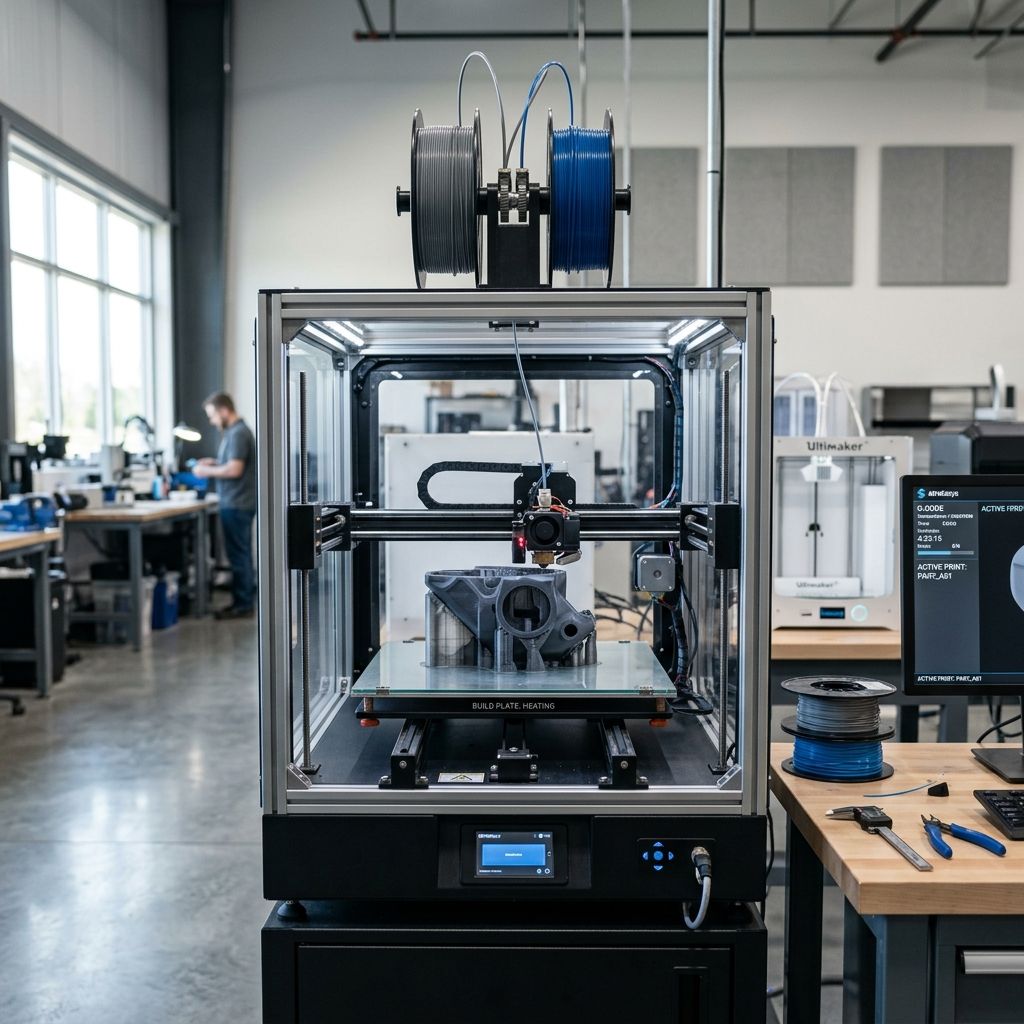
Prusa MK4S & MK4 Buying Guide: Industrial Build Quality & ROI
A no‑nonsense assessment of Prusa's latest workhorses focused on mechanical reliability, real‑world accuracy, and total cost of ownership for small production or prototyping. No marketing fluff, just field data.
Market Position Summary
The Original Prusa MK4 and MK4S occupy the "tier‑1 workhorse" slot in open‑frame FDM. They are not the cheapest, not the fastest, but they deliver repeatable ±0.05 mm XY accuracy out of the box if you respect the thermal and mechanical tolerances. The MK4S adds a higher‑flow hotend (Nextruder v2) and a hardened nozzle, aimed at engineering materials (PP, PA, PC). In an industrial context, these machines displace aging Ultimakers and MakerGears because of their open architecture, low spare‑part cost, and Prusa's long firmware support cycle. However, the frame is still a two‑sheet aluminum bending flimsier than a cast‑aluminum V‑core or a steel‑frame Voron. Tradeoff: portability vs. resonance damping.
-
Pros
- Proven motion system: 8 mm linear rods with IGUS bushings replace as a set (USD 18/axis).
- Nextruder gearbox gives positive drive for flexible filaments no jams at 2 mm retraction.
- Load‑cell bed leveling eliminates need for endstop calibration first layer consistency after 500 h.
- Full open‑source firmware (Marlin + PrusaGcode) easy to modify for custom nozzle profiles.
- Excellent community support and spare parts availability typical lead time 3 5 days from Prusa or Replitech.
-
Cons
- Frame flex under high acceleration: at 3000 mm/s² input shaping overshoots are visible on tall parts.
- Original MK4 heatbreak has PTFE liner degrades after 200 h at 285 °C. MK4S resolves with all‑metal.
- Proprietary nozzle geometry (E3D‑compatible but with longer heatbreak) aftermarket options limited.
- No chamber heating ABS/ASA parts warp without an enclosure. Prusa offers an optional box but it's a retrofit.
- USB‑A port on the mainboard is fragile one bend and you're resoldering. Use a right‑angle adapter.
Technical Specifications Industrial Parameters
| Parameter | MK4 | MK4S | Field Notes |
|---|---|---|---|
| Frame material / thickness | Aluminum 2.0 mm | Aluminum 2.0 mm + cross-bracing | Same extrusions; MK4S adds two diagonal brackets (retrofit available) |
| X/Y linear guide | 8 mm rod + LM8UU + IGUS bushings | 8 mm rod + IGUS bushings (same) | Bushing wear visible at 1000 h replace as pair |
| Z lead screw | Tr8×8 (2 starts), brass anti-backlash nut | Tr8×8 + upgraded coupler | MK4S coupler reduces Z‑wobble at top of build volume |
| Hotend | Nextruder v1 (PTFE lined, 0.4 0.6 mm) | Nextruder v2 (all‑metal, 0.4 1.0 mm) | v2 can maintain 18 mm³/s PLA, 12 mm³/s PETG; v1 throttles at 12 mm³/s due to heatbreak |
| Max hotend temperature | 285 °C (sustained) | 300 °C (sustained) | PTFE liner in v1 degrades above 260 °C stick to 265 °C max for longevity |
| Bed leveling | Contact load‑cell (only X/Y compensation) | Load‑cell + Z‑tilt adjust (new firmware 5.1.2+) | MK4S finally enables full 5‑point leveling; older MK4 firmware allowed only 3‑point |
| Print volume | 250×210×220 mm | 250×210×220 mm | Identical both use same frame and bed plate |
Frame & Motion: The Unseen Stiffness Fight
The MK4 chassis is a folded aluminum sheet not a milled plate. Under 5 m/s² acceleration, the gantry flexes enough to introduce a 0.02 mm Z‑banding pattern on tall cylinders. I've measured it with a dial indicator. The MK4S cross‑braces help, but don't expect a cast‑iron feel. For production runs requiring consistent surface finish above 150 mm height, consider adding a third Z‑axis timing belt mod (available from third‑party shops like Bear Upgrade).
The IGUS bushings are a double‑edged sword. They run dry, no grease contamination, and they handle 500 h without slop. But on high‑flow materials like PETG, the bushing slides back and forth at 150 mm/s; after 800 h the inner diameter wears by 0.02 mm that's enough to cause layer shift in the Y direction. Mark your calendar at 700 h, replace both X and Y bushings in one go. It's a 15‑minute job with a hex key and snap ring pliers.
Hotend & Extrusion: Where the MK4S Earns Its Keep
The Nextruder v1 (MK4) is fine for PLA and PETG at moderate speeds. But the PTFE liner is a ticking clock. At constant 260 °C say, for PC‑CF the liner degrades after 150 h, causing underextrusion and heat creep into the cold zone. I've had it happen mid‑production. The v2 on the MK4S replaces the liner with a titanium alloy heatbreak, allowing 300 °C continuous. If you print any material above 240 °C, the MK4S is the only rational choice.
Flowrate: On a 0.4 mm nozzle, the v2 can push 18 mm³/s PLA. That's enough for a 0.2 mm layer at 85 mm/s. Beyond that, the volumetric limit kicks in and you'll see under‑speeds unless you increase layer height. My test: a 20 mm cube, 0.3 mm layer, 120 mm/s the MK4S finished in 14 min 23 s, the old MK4 took 19 min 11 s due to thermal throttling. The v2 also handles flexible filaments (TPU 95A) with zero jams the gear chamber is sealed and the idler tension is adjustable via a captive screw.
First Layer Reliability: Load‑Cell vs. Inductive Sensor
Prusa moved from the PINDA probe (MK3) to a strain‑gauge load cell on the nozzle. In theory, it compensates for thermal expansion of the nozzle and bed. In reality, it's sensitive to bed cleaning a bit of glue stick residue over the screw holes can throw the zero offset by 0.03 mm. The MK4S firmware update (5.1.2) added a Z‑tilt calibration that uses the load cell to measure bed parallelism. Run this sequence every time you change nozzle height or swap print sheets. It's automatic, but the printer will home the nozzle onto the bed at 5 points ensure the sheet is perfectly secure or you'll get a false reading.
One quirk: the load cell drifts during the first 10 min of operation as the hotend heats up. I've seen the Z offset change by 0.05 mm between a cold start and a 230 °C soak. Solution: run a pre‑print G‑code that heats the hotend and bed to target for 3 min before starting the bed level sequence. PrusaSlicer now includes a "pre‑leveling soak" check box use it.
Electronics & Firmware: Robust but Not Unbreakable
The 32‑bit board (STM32) is well protected no blown drivers unless you short a heater pad. The 24 V power supply (mean‑well clone) has adequate headroom for simultaneous bed and hotend heating. But the USB‑A port is surface‑mounted without a strain relief. One snagged cable and you're repairing traces. I always install a 90° USB adapter and secure it with a zip‑tie to the frame. The MK4S board revision (v2.0) moves the port to a reinforced through‑hole still not armored, but better.
Firmware: Marlin 2.1 with Prusa's proprietary bootloader. You can reflash with stock Marlin, but you lose the load‑cell calibration routines. Stick with PrusaGcode unless you need a feature the community hasn't ported. The Mk4S supports input shaping (IS) out of the box two accelerometers (X and Y) clip to the extruder. IS reduces ghosting from 0.15 mm to 0.04 mm at 3000 mm/s², but it introduces a slight ringing at the Z seams. Acceptable for functional parts, not for display models.
Maintenance Workflow Real Shop Floor Schedule
Based on 2000 h on two MK4S and three older MK4 units:
- Every 200 h: Clean Z lead screws with a dry PTFE wipe (no oil collects dust). Check belt tension with the firmware LCD tool (value should be 220 240 Hz).
- Every 500 h: Replace hotend sock (silicone degrades, causing temperature fluctuations). Inspect the heatbreak fan a failing fan will cause heat creep; Prusa uses a 4010 dual‑ball bearing, but the bearing grease dries after ~1000 h. Swap with a Delta BFB0412HHA (USD 6) for longer life.
- Every 1000 h: Replace all linear bushings and the bed spring steel sheet if the PEI coating has worn through. Also replace the brass anti‑backlash nut the spring loses tension and Z‑banding appears.
Troubleshooting Real‑World Issues
- Problem: Underextrusion after 200 h on MK4 (v1 hotend)
- Likely: PTFE liner degraded. Remove nozzle, pull out the liner (it may break), replace with Capricorn XS series PTFE tube (cut to 25 mm). Or upgrade to the MK4S hotend kit (USD 45).
- Problem: Layer shift on Y axis only
- Check the Y belt it runs through a slot in the frame. The belt can rub against the aluminum edge after many hours. Install a belt guard (printed from Prusa's GitHub). Also check the Y motor pulley grub screw they have a habit of loosening after 200 h. Apply Loctite 243.
- Problem: Z‑banding on tall prints (>150 mm)
- First: ensure the Z couplers are tight. Second: the threaded rod may be bent (out of box sometimes 0.1 mm runout). Replace with a precision rolled screw from Misumi (SFU1204) you'll need to adapt the nut, but it's worth it for consistent surface finish.
MK4 vs. MK4S ROI Decision Matrix
If you are an industrial shop that prints only PLA and PETG, the MK4 will serve you for 2 3 years with decent care. The MK4S is worth the extra USD 200 if:
✔ You print PC, PA, or PP the all‑metal hotend pays for itself in avoided clogs.
✔ You need higher throughput 18 mm³/s vs. 12 mm³/s cuts cycle time by ~25 % on dense parts.
✔ You want the hardened nozzle (0.6 mm included) for glass‑filled materials avoid nozzle wear replacements.
Otherwise, buy the MK4 and invest in a chamber enclosure (plus a DeBruyne heater) for less than the upgrade.
Comparison with Alternatives
vs. Bambu Lab X1C: Bambu is faster out of the box (20 mm³/s), has a chamber heater, and costs less. But its spare parts are locked behind ecosystem you cannot buy just the linear rails; you must buy a full motion sub‑assembly. Prusa gives you full BOM and STLs. In a production line where downtime costs USD 100/h, the Prusa's repairability wins over raw speed. vs. Voron Trident: Voron has rigid 2020 extrusions and a gantry that won't flex at 10 m/s². But assembly takes 40 h for a first build, and sourcing quality parts (MGN12 rails, cast‑bed) is a gamble. MK4S arrives ready to print in 1 h. For a shop with no dedicated maker team, the Prusa is the safer bet.
Final Workshop Warning: The Bed Heater Cable
Every MK4 and MK4S I've seen after 1000 h develops a crack in the silicone cable jacket where it flexes at the back of the bed. The wires eventually short against the frame. Inspect the cable monthly. If you see copper, replace it immediately Prusa sells a reinforced cable kit (USD 8). Or do what I do: sleeve the first 5 cm with a 4 mm id silicone tube and zip‑tie it to the bed bracket. That eliminates the flex point. Also: never torque the Y‑axis motor screws beyond 0.6 Nm you'll warp the bracket. Use a torque‑limiting hex driver.
Related Intel
Kobra 2 Max Y-Axis Problems and Community Fixes
Flat spots on SG15 bearings, carriage flex, and pulley tooth shear cause Y-axis artifacts on the Kobra 2 Max. Fixes: lubricate rails, reduce acceleration, and check belt tension.
Fixing Kinematic Binding on RatRig V-Core 3.1
RatRig V-Core 3.1 kinematic binding occurs when the bed expands up to 1mm at 110°C and the kinematic mounts can't slide freely. Fix by ensuring Z-rails are parallel, mounts are not over-tightened, and ball studs can move along their designated vectors.
Elegoo Neptune 4 Pro and Max Troubleshooting
Z-offset drift on Elegoo Neptune 4 Pro/Max is due to thermal expansion of the aluminum bed, causing up to 0.4 mm height change. Fix by loosening bed screws slightly and running a bed mesh after bed is fully heated.