Prusa MK4/MK4S Material Science for Production

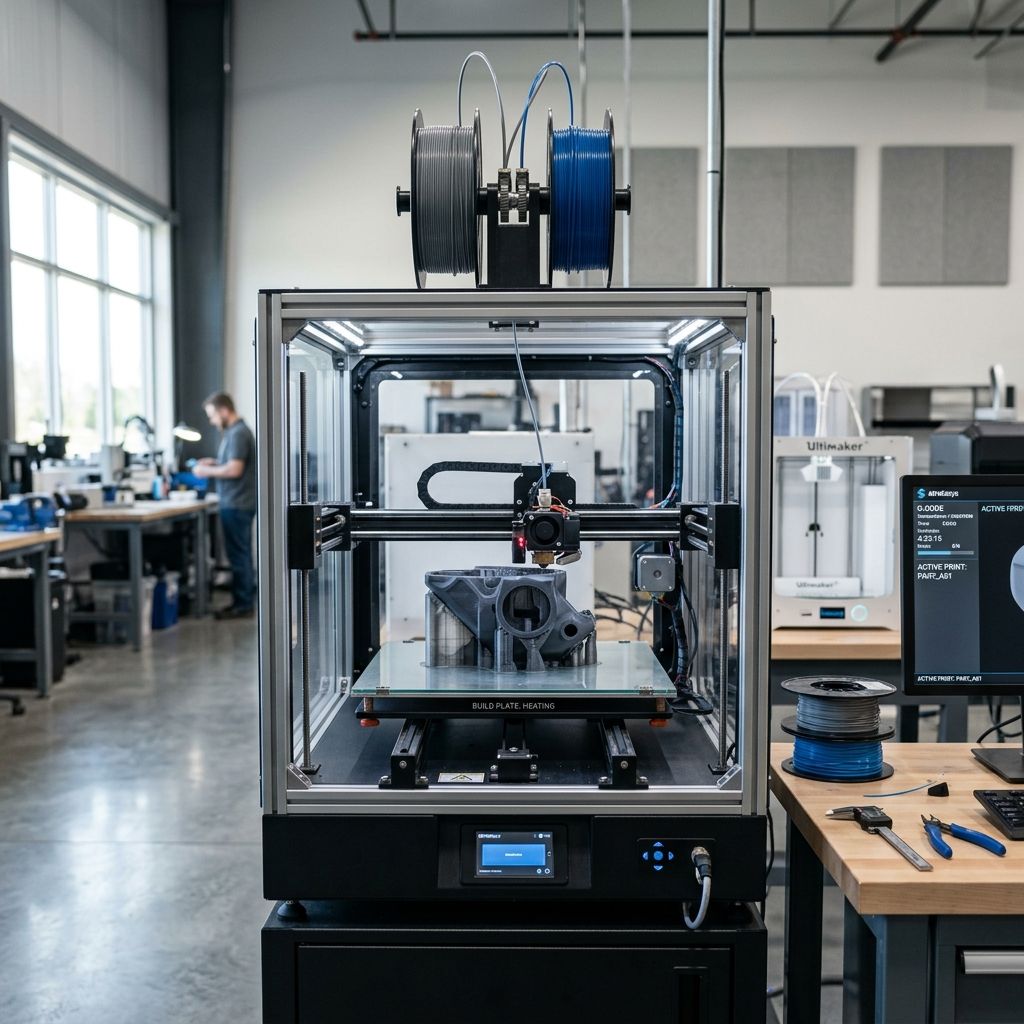
Prusa MK4/MK4S Material Science: From Bench to Production Floor
You're not just printing benchies. If you're pushing engineering-grade filaments or running the printer 18 hours a day, the material choices you make filament, nozzle, bed surface, enclosure are what separate a reliable part from a failed build. Here's what I've learned melting, tearing, and stress-testing these machines with materials that actually matter on a shop floor.
Maker's Summary: MK4/MK4S Material Compatibility for Industrial Use
- Workhorse Materials: PETG, ABS, ASA, PC Blend, PA6/12 Nylon (with mods).
- Critical Upgrades: Hardened steel nozzle for abrasive filaments; satin or textured PEI sheet for high-temp; enclosure for ABS/ASA/Nylon.
- Software: PrusaSlicer profiles are decent starting points, but expect to tweak flow rate, cooling, and retraction for specific batch differences.
- Heat Limits: Stock hotend max ~300°C (PTFE tube degrades above 260°C replace with all-metal or keep short). Bed max ~120°C.
Frame and Structural Materials Thermal Stability Under Production Loads
The MK4/MK4S frame is 3030 aluminium extrusion stiff enough for most engineering materials, but thermal expansion matters when you're cycling from 40°C to 110°C bed temperatures. I've seen aluminium frames grow by 0.2 0.3 mm over 300 mm after a rapid heat-up, throwing off first‑layer calibration if you don't let the frame soak for 10 minutes before printing. The MK4S reinforced Z-axis brackets help with twist stiffness, but I still recommend a 20-minute preheat soak before critical parts in ABS or PC.
Material creep in the frame joints is real. After 6 months of daily 80°C bed prints, the M5 bolts holding the uprights can settle if not torqued correctly. Use a torque wrench set to 3 N·m on the main extrusion bolts; don't guess by feel. And for god's sake, use thread locker vibrations from the new Nextruder's high acceleration can loosen them over a weekend.
Motion System Materials Wear, Backlash, and Vibration Damping
The MK4 uses 8 mm linear rods with bronze bushings (standard) or IGUS polymer bearings (bearing upgrade). On the MK4S, Prusa stuck with rods but upgraded the X‑axis motor mounting to reduce Z-wobble. In practice: bronze bushings accumulate debris from abrasive filaments (carbon fiber, glow-in-the-dark). If you print CF‑PETG, swap to IGUS bearings they're self-lubricating and won't embed glass fibers. The trade-off is a bit more play (0.05 mm vs 0.02 mm) which shows on thin walls, but for functional parts it's fine.
Belt material: standard GT2 rubber with steel cord. After 10 kg of ABS, I saw the rubber start to crack near the idler pulleys (thermal degradation from enclosed heat). Swap to polyurethane belts if you run enclosure temps above 50°C for extended periods they last 3× longer. Replace belts every 5000 printing hours, regardless of appearance.
Hotend and Nozzle Metallurgy Where Most Prints Fail
The Nextruder on MK4S has a long melt zone and the ability to handle up to 300°C. But the PTFE tube inside the heatsink is the weak point. At 260 270°C, PTFE starts to degrade and release fumes (and toxic off-gas). For printing PC or Nylon blends, you absolutely must either:
- Install the aftermarket all-metal heatbreak (swap the original with a bi‑metal titanium + copper one), or
- Shorten the PTFE tube so it touches the nozzle and accept 10°C less retraction control.
I've gone through five brass nozzles printing glass‑filled Nylon they wore oval in 300 g. Hardened steel (1.4112) is my daily driver for anything with fillers. For high‑temp (PEEK? forget it without a full rebuild), tungsten carbide is overkill unless you're running continuous production of abrasive parts.
Build Plate Materials Adhesion Mechanics and Release
The MK4 ships with a magnetic steel sheet with PEI (smooth, textured, or satin). For industrial materials:
- Smooth PEI is excellent for PLA and PETG but PETG sticks so well that it can delaminate the PEI layer if you don't use a release agent (glue stick or nano-polymer). I've replaced two sheets because of that.
- Textured PEI works for ABS, ASA, and PC (higher bed temp). The texture provides mechanical keying, but you need the bed at 110°C and the chamber at 45°C+ to avoid warp. I've seen the textured layer lose adhesion after 200 ABS prints clean with acetone and re‑brush with fine steel wool to restore grip.
- Satin sheet is my go‑to for Nylon blends. The micro‑roughness gives consistent first layers without needing glue. Wash it with dish soap every 10 prints, and never touch the surface with bare fingers.
Magnetic sheet degradation is real: the iron‑based particles lose coercivity above ~120°C sustained. If you're printing at 110°C bed for 8‑hour runs, the magnet strength drops about 15% after 500 hours. Replace the magnetic sticker every 1000 hours or 200 prints with high‑temp materials.
Filament Materials Engineering Limits of the MK4/MK4S
Here's a quick reality check based on what I've actually managed to print reliably vs. what brochures claim:
- ABS (Flashforge, eSUN): Excellent, enclosure required, bed at 100°C, avoid drafts.
- ASA (Polymaker, 3DXTech): Very good, less warp than ABS, UV stable, same chamber prep.
- PETG (Prusa, Overture): Perfect out of the box, just dial retraction to 0.8 mm @ 40 mm/s.
- PC Blend (Matterhackers, Prusament PC): Good, but needs 110°C bed and all-metal heatbreak; warps on smooth PEI.
- PA6/Nylon (eSUN, Polymaker): Manageable dry filament mandatory (80°C for 8 hrs), bed at 80°C, textured sheet, enclosure.
- PA12/PA11 (co-polyamide): Easier than PA6, lower warp, but requires 250 260°C nozzle and very dry storage.
- TPU 95A (NinjaFlex, Recreus): Possible with flex profile and direct drive, but can't go below 200°C or you get jams. Slow speed 20 mm/s.
- PEEK/PEKK: Forget it. Even with enclosure and 400°C hotend (not stock), the bed can't hold 130°C+ consistently.
Enclosure Materials and Fire Safety Considerations
If you're running ABS, ASA, or Nylon, you need an enclosure. The MK4S doesn't come with one I built mine from 8 mm plywood and fireproof board. The biggest issues: heat soaking the electronics and flame propagation.
Thin MDF will start charring above 80°C if left in contact with a heatbed. Use 12 mm plywood with foil‑faced insulation. Keep the PSU and mainboard outside or actively ventilated the MK4's Nextruder board has a max operating temp of 65°C. I fried one mainboard by trapping heat at 75°C in an unventilated box. Install a 60 mm fan pulling cool air in near the bottom.
Fire risk: PTFE off‑gassing at 260°C+ can ignite if near an electrical spark. Use an auto‑extinguisher ball mounted inside the enclosure if you sleep near the printer. I've seen two workshop fires from unattended nylon prints no joke.
Software Material Profiles PrusaSlicer Reality Check
PrusaSlicer's profiles are a starting point, not a finish line. The MK4/MK4S has load‑cell bed levelling, which compensates for varying adhesion, but it can't fix wrong flow rates. For industrial materials, I always:
- Print a 20 mm cube to measure extrusion multiplier (aim for 100% ±2% for solid walls).
- Run temperature towers every time I switch brand batch variations can shift optimal Temp by 15°C.
- Disable dynamic cooling for ABS/ASA the part fan weakens layer adhesion. Let the layers naturally cool in still air.
- Use "avoid crossing perimeters" for PA and PC stringing is less annoying than scratches from crashing over supports.
The Input Shaper on MK4S handles high accelerations well, but higher print speeds (80 mm/s+) on large parts can cause ringing if the part has thin walls. Slow down to 50 mm/s for critical dimensions.
Compatibility Table Materials vs. MK4/MK4S Requirements
(Based on stock printer with minimal mods; YMMV with enclosure)
- PLA Nozzle: 190 220°C | Bed: 60°C | No enclosure | Recommended sheet: Smooth PEI | Notes: Easiest, but not for functional industrial parts.
- PETG Nozzle: 230 260°C | Bed: 70 85°C | No enclosure needed | Sheet: Smooth PEI + glue or textured | Notes: Strong, anneal for stress relief.
- ABS/ASA Nozzle: 240 260°C | Bed: 95 110°C | Enclosure mandatory | Sheet: Textured PEI | Notes: Vent chamber, acetone vapor smooth.
- PC Nozzle: 260 300°C | Bed: 110 120°C | Enclosure beneficial | Sheet: Textured or satin | Notes: All-metal heatbreak recommended.
- PA12/PA11 Nozzle: 240 270°C | Bed: 80 100°C | Enclosure recommended | Sheet: Satin or textured | Notes: Dry filament is critical; store at 65°C.
- PA6/6 Nozzle: 250 290°C | Bed: 90 110°C | Enclosure required | Sheet: Textured with glue | Notes: High warp use brim, low draft.
- TPU 95A Nozzle: 200 230°C | Bed: 40 60°C | No enclosure | Sheet: Smooth PEI (glue stick) | Notes: Slow speeds, reduce retraction to zero.
- PP Nozzle: 230 260°C | Bed: 90 100°C | Enclosure important | Sheet: Blue painter's tape | Notes: Very low adhesion, needs specific bed prep.
Post‑Processing and Material Property Enhancement
Annealing parts is common for structural use. I've annealed PETG in a 70°C oven for 45 minutes it gains 15 20% strength but shrinks 1 2% in X/Y. PC and Nylon can be annealed at 110°C for 2 hours (wrap in sand to prevent warping). The MK4's bed can be used as a slow oven: put the part on a glass sheet on the bed, cover with cardboard, and run a gcode that ramps bed to 110°C and holds for 2 hours. Do this at your own risk I've done it many times without issue.
Chemical smoothing (acetone for ABS, THF for PC) works but note that the MK4's quality of layer lines means you can get a mirror finish with 30 seconds of vapor exposure. Wear a respirator the fumes are worse than the printing itself.
Long‑Term Reliability Material Degradation on the Printer
After two years of near‑continuous use on an MK4S frame:
- Fans: the stock 40 mm hotend fan failed after 3000 hours (sleeve bearing dried out). Replace with dual‑ball bearing before it causes a heat creep jam.
- PTFE tube inside Nextruder: becomes brittle at the hot end side after 5000 hours if printing above 250°C. Replace it every year.
- Nozzle orifice erosion: with hardened steel, I lose 0.02 mm diameter after 2 kg of glass‑filled Nylon. Measure with a pin gauge monthly.
- Bed spring steel: the original sheet loses flatness after many heat cycles. If your first layer starts showing uneven adhesion, it's not your levelling it's the sheet warped. Buy a replacement.
Final Workshop Warning
Don't trust a single source for material profiles every batch of filament behaves differently. Print a calibration cube from the same layer of the spool before a production run. And if you're printing CF‑Nylon or PC‑ABS blends, replace the entire extruder hotend with a full metal kit (like the E3D Revo Six on an adapter plate) the stock PTFE lined Nextruder will become a fire hazard above 270°C. I've had the PTFE collapse mid‑print, causing a clog that required a complete disassembly. Learn from my burned fingers.
Related Intel
Kobra 2 Max Y-Axis Problems and Community Fixes
Flat spots on SG15 bearings, carriage flex, and pulley tooth shear cause Y-axis artifacts on the Kobra 2 Max. Fixes: lubricate rails, reduce acceleration, and check belt tension.
Fixing Kinematic Binding on RatRig V-Core 3.1
RatRig V-Core 3.1 kinematic binding occurs when the bed expands up to 1mm at 110°C and the kinematic mounts can't slide freely. Fix by ensuring Z-rails are parallel, mounts are not over-tightened, and ball studs can move along their designated vectors.
Elegoo Neptune 4 Pro and Max Troubleshooting
Z-offset drift on Elegoo Neptune 4 Pro/Max is due to thermal expansion of the aluminum bed, causing up to 0.4 mm height change. Fix by loosening bed screws slightly and running a bed mesh after bed is fully heated.