Elegoo Centauri Carbon Workshop Troubleshooting Guide

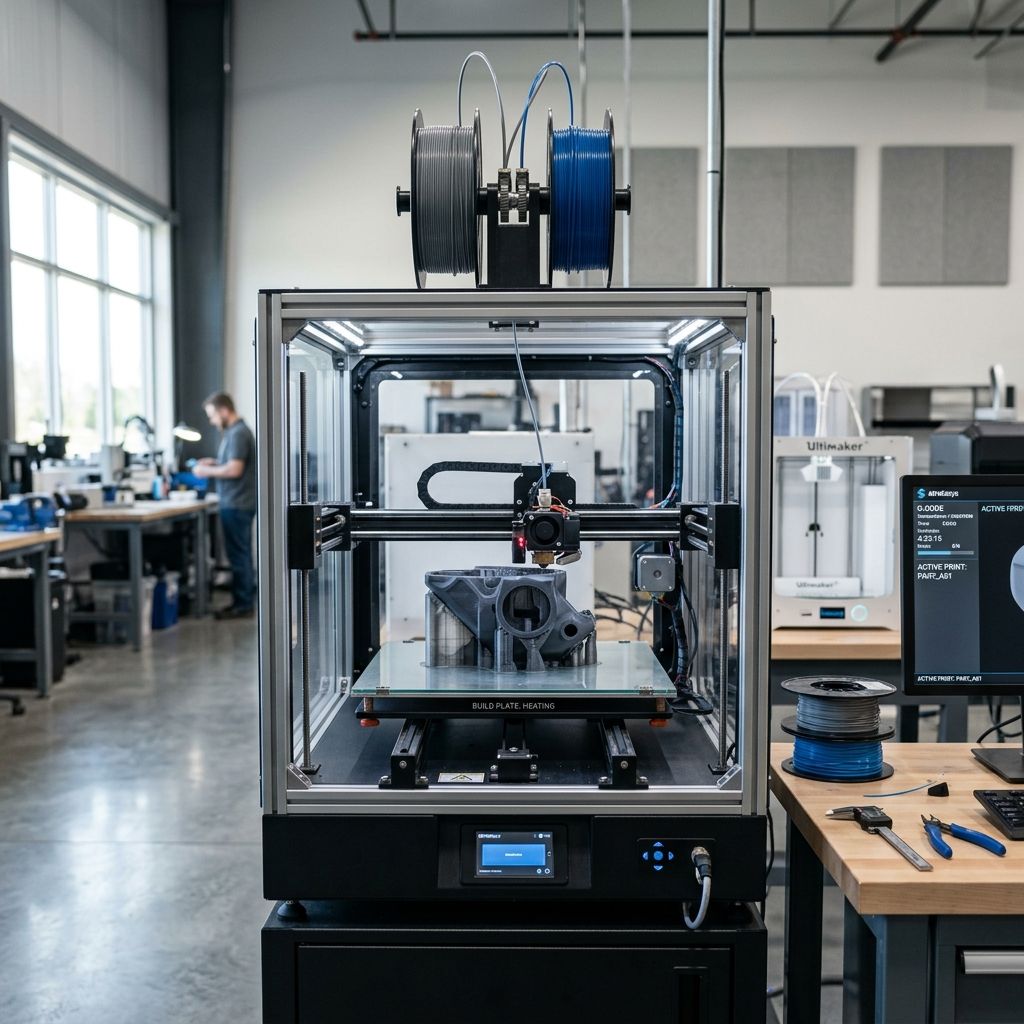
Elegoo Centauri Carbon Community Workshop Troubleshooting Guide
Field diagnosis and practical fixes for acoustic belt tensioning, accelerometer sensor drift, and dual-gear extruder wear on the Centauri Carbon.
Workshop Diagnostic Summary
The Elegoo Centauri Carbon brings enclosed high-speed CoreXY kinematics into high-throughput production environments. However, prolonged operation at accelerations exceeding 10,000 mm/s² exposes distinct wear patterns in belt path idlers, resonance sensor mounts, and extruder hobbing profiles. When troubleshooting surface artifacts or motion faults, reference our 3D Printer Troubleshooting tool to isolate mechanical backlash from resonance compensation errors.
Issue 1: CoreXY Belt Tension Asymmetry and Acoustic Frequency Calibration
On high-acceleration CoreXY gantries, uneven tension between the left (A) and right (B) timing belts causes the printhead carriage to twist obliquely during pure orthogonal axis moves. On the Centauri Carbon, users frequently report diagonal ghosting along 45-degree chamfers and ovality in cylindrical holes. Attempting to set tension by thumb depression is notoriously unreliable because belt stiffness masks tension differentials.
The shop-standard method relies on acoustic frequency measurement using a spectrum analyzer or smartphone microphone placed 5mm from the free belt span. Position the toolhead carriage at the front-right corner and measure the rear unsupported belt span $L = 0.160\text{ m}$. The fundamental transverse resonance frequency $f$ relates to static tension $T$ according to the classic string wave equation:
$$f = \frac{1}{2L} \sqrt{\frac{T}{\mu}}$$
Where $\mu$ is the linear mass density of the 6mm fiberglass-reinforced timing belt, nominally $0.0082\text{ kg/m}$. To achieve the manufacturer's target operating tension of $20.0\text{ N}$—which balances tooth skip resistance against stepper motor radial bearing fatigue—solve for the resonance target frequency:
$$f = \frac{1}{2 \cdot 0.160} \sqrt{\frac{20.0}{0.0082}} = 3.125 \cdot \sqrt{2439.02} = 3.125 \cdot 49.386 = 154.3\text{ Hz}$$
If Belt A vibrates at 135 Hz while Belt B vibrates at 165 Hz, the gantry operates with an 8.5 N differential force. Under a 12,000 mm/s² directional change, this imbalance induces transient carriage yaw. Similar belt balance procedures are essential across all enclosed platforms, as outlined in our field review of Creality K1C and K2 Pro Calibration Tips.
- Acoustic Target Span: 160 mm rear belt length with carriage locked at front-right boundary.
- Target Acoustic Frequency: 152 Hz to 156 Hz on both belts.
- Maximum Allowable Inter-Belt Delta: ±2.5 Hz (corresponds to less than 0.8 N tension variance).
- Tensioning Sequence: Loosen both rear idler clamp bolts; adjust tension screws incrementally; pluck three times per test.
- Maintenance Frequency: Check belt resonance every 150 print hours during the first 500 hours of machine runtime.
Issue 2: Input Shaper Accelerometer Drift and High-Frequency Ghosting
The Centauri Carbon utilizes an onboard ADXL345 accelerometer embedded within the printhead toolhead PCB for resonance testing. Community workshops encounter an insidious issue where automated input shaping runs report seemingly valid frequencies, yet prints continue to exhibit fine vertical ripples (VFAs) at speeds between 180 mm/s and 260 mm/s.
The root cause is mechanical decoupling of the sensor daughterboard. Under repetitive high-frequency vibration testing (sweeping from 10 Hz to 150 Hz), thermal cycling from the 300°C hotend relaxes the small M2 mounting screws holding the toolhead breakout board. This introduces parasitic resonance, distorting the measured transfer function.
The system's dynamic amplification factor $A(f)$ near natural resonance $f_n$ is expressed by the second-order mechanical response equation:
$$A(f) = \frac{1}{\sqrt{\left(1 - \left(\frac{f}{f_n}\right)^2\right)^2 + \left(2\zeta \frac{f}{f_n}\right)^2}}$$
Where $\zeta$ is the mechanical damping ratio (typically $0.05$ to $0.09$ on lightweight carbon-rod gantries). When the accelerometer PCB vibrates independently with low damping ($zeta < 0.02$), the algorithm detects an artificial secondary resonance spike at 78 Hz instead of the true frame peak at 54 Hz. Consequently, the firmware selects an overly aggressive filter like 3HUMP_EI or 2HUMP_EI. This filter damps broad frequency bands unnecessarily, rounding off crisp 90-degree corners while failing to suppress the true 54 Hz gantry ring.
- Inspection Step: Check M2 sensor bracket torque; re-tighten to 0.35 N·m using low-strength threadlocker.
- Vibration Testing Range: Limit manual frequency sweeps in Klipper to 15 Hz - 120 Hz to avoid board resonance.
- Recommended Filter: MZV or EI filter selection indicates clean mechanical rigidity without sensor lag.
- Target Acceleration Limit: 9,000 mm/s² on perimeter walls to maintain crisp feature definition.
- Comparison Reference: For high-speed direct-drive gantry comparison, inspect our analysis of Common Peopoly Magneto X Problems and Fixes.
Issue 3: Dual-Gear Extruder Misalignment, Tooth Wear, and TPU Grinding
The extruder on the Centauri Carbon employs dual hardened steel hobbed gears designed to feed abrasive composite filaments like carbon fiber nylon (PA-CF). However, processing softer filaments—such as 95A or 85A thermoplastic polyurethane (TPU)—frequently results in feeding stoppages, filament buckle jams inside the drive housing, and tooth packing.
Because hardened steel gears are cut with aggressive tooth rake angles to bite into rigid polymers, their sharp knurling cuts through soft elastomers rather than advancing them. Furthermore, axial play in the driven secondary idler gear shaft allows the teeth to mesh off-center by up to 0.15mm. Under resistance, this sideways gear tilt forces flexible filament into the clearance gap between the hobbed wheel and the PTFE guide funnel.
If your shop produces functional gaskets or vibration dampeners, consult our guide on Printing Production-Ready Flexible Parts with Vexi-Flexx70 to calibrate feeding speed limits and avoid drive stall jams.
| Filament Type | Drive Spring Tension | Max Volumetric Speed | Retraction Distance | Extrusion Temp |
|---|---|---|---|---|
| PLA-CF / PETG-CF | Tight (3 full turns) | 22 mm³/s | 0.6 mm | 225°C - 245°C |
| Standard PLA / PETG | Medium (2 full turns) | 20 mm³/s | 0.8 mm | 210°C - 235°C |
| Engineering PA6-CF | Tight (3.5 full turns) | 24 mm³/s | 0.7 mm | 280°C - 295°C |
| TPU 95A (Medium Soft) | Loose (0.5 turns) | 6 mm³/s | 1.2 mm | 220°C - 230°C |
| TPU 85A (Ultra Flexible) | Minimum (Flush screw) | 3.5 mm³/s | 0.0 mm (No Retract) | 225°C - 235°C |
Extruder Teardown and Hobbed Gear Alignment Protocol
To eliminate gear axial tilt and prevent premature wear from abrasive particulate buildup, follow this step-by-step workshop overhaul sequence whenever filament slippage or tooth grinding occurs:
- Step 1: Disconnect the toolhead ribbon cable and remove the two rear extruder mounting M3 socket screws.
- Step 2: Separate the front extruder casing and clean the hobbed gear grooves with a brass wire brush and isopropyl alcohol to clear embedded polymer flakes.
- Step 3: Inspect the driven gear needle bearings for radial play; replace the 3x6x2.5mm miniature bearing if shaft wobble exceeds 0.03mm.
- Step 4: Check gear tooth meshing alignment under 5x magnification; ensure the drive teeth center groove aligns with the filament guide bore within 0.05mm.
- Step 5: Apply high-pressure synthetic grease (NLGI Grade 2) strictly to the gear drive spur teeth; do not contaminate the filament hobbing profile.
- Step 6: Reassemble the housing and verify that the idler arm pivots smoothly without binding throughout its spring compression range.
Chamber Thermal Dissipation and Passive Venting Protocols
The enclosed chamber of the Centauri Carbon maintains ambient temperatures between 45°C and 55°C when printing high-temperature polymers with a 100°C bed. However, when users switch back to PLA without opening the top lid or unlatching the front glass door, heat soak into the aluminum toolhead bracket softens PLA filament above the heatsink cold break, leading to catastrophic extruder blockages.
The heat dissipation rate $Q_{loss}$ from the cold block to the chamber air depends on the temperature difference between the heatsink fins $T_{sink}$ and the chamber air $T_{amb}$:
$$Q_{loss} = h_c \cdot A \cdot (T_{sink} - T_{amb})$$
When the chamber reaches 50°C, the thermal delta $(T_{sink} - T_{amb})$ collapses by over 60% compared to open-air operation. The axial 3010 fan can no longer maintain the heatsink bore below 45°C. For continuous PLA printing, propping the top lid open by at least 30mm or removing the top acrylic pane is an mandatory operational protocol.
Frequently Asked Questions
Why does my Elegoo Centauri Carbon show vertical ghosting after automated calibration?
Automated input shaping produces flawed filter selections if the toolhead accelerometer PCB mounting screws have loosened under vibration, generating false resonance readings.
What acoustic frequency should I tune the Centauri Carbon CoreXY belts to?
Tune both belts to resonate at 154 Hz across an unsupported 160mm span measured at the rear gantry, keeping the difference between belts under 2.5 Hz.
How do I prevent the extruder gears from stripping flexible TPU filament?
Back off the idler tension adjustment screw so the spring is barely engaged, reduce printing volumetric speed to below 6 mm³/s, and turn off retractions for TPU softer than 90A.
Why does PLA constantly jam inside the extruder on long print jobs?
Chamber air temperatures exceeding 40°C collapse the heatsink thermal gradient and cause heat creep; keep the top lid propped open when printing materials with glass transition temperatures below 65°C.
Workshop Safety and Hotend Maintenance Protocol
Always disconnect electrical mains power before performing mechanical maintenance on the CoreXY gantry or toolhead electronics. Never service the hotend heater block or thermistor cartridge while the toolhead is powered, as accidental tool contact with the ceramic heater leads can short the 24V supply rail directly to the MCU input, destroying the motherboard processor. Use heat-resistant aramid gloves when clearing nozzle jams at 250°C and ensure adequate workshop exhaust ventilation when purging technical filaments.
Related Intel
Creality K1 SE Common Problems and Workshop Fixes
Solve Creality K1 SE common problems including CoreXY belt tension imbalance, Unicorn nozzle heat creep, extruder gear grinding, and strain gauge leveling drift with practical workshop protocols.
Elegoo Centauri Carbon Wear Parts Replacement Guide
Industrial maintenance guide for the Elegoo Centauri Carbon: precise replacement intervals, torque specs, and teardown steps for hardened nozzles, drive gears, and CoreXY belts.
QIDI Plus 4 vs X-Max 3: Shop Comparison and ROI
The QIDI Plus 4 introduces a dual-heater 65°C chamber and 305x305x280mm volume, whereas the older X-Max 3 delivers a larger 325x325x315mm envelope but suffers from slower chamber ramp rates and bulkier gantry mass.