Building a Print Farm with Prusa MK4S and MK4

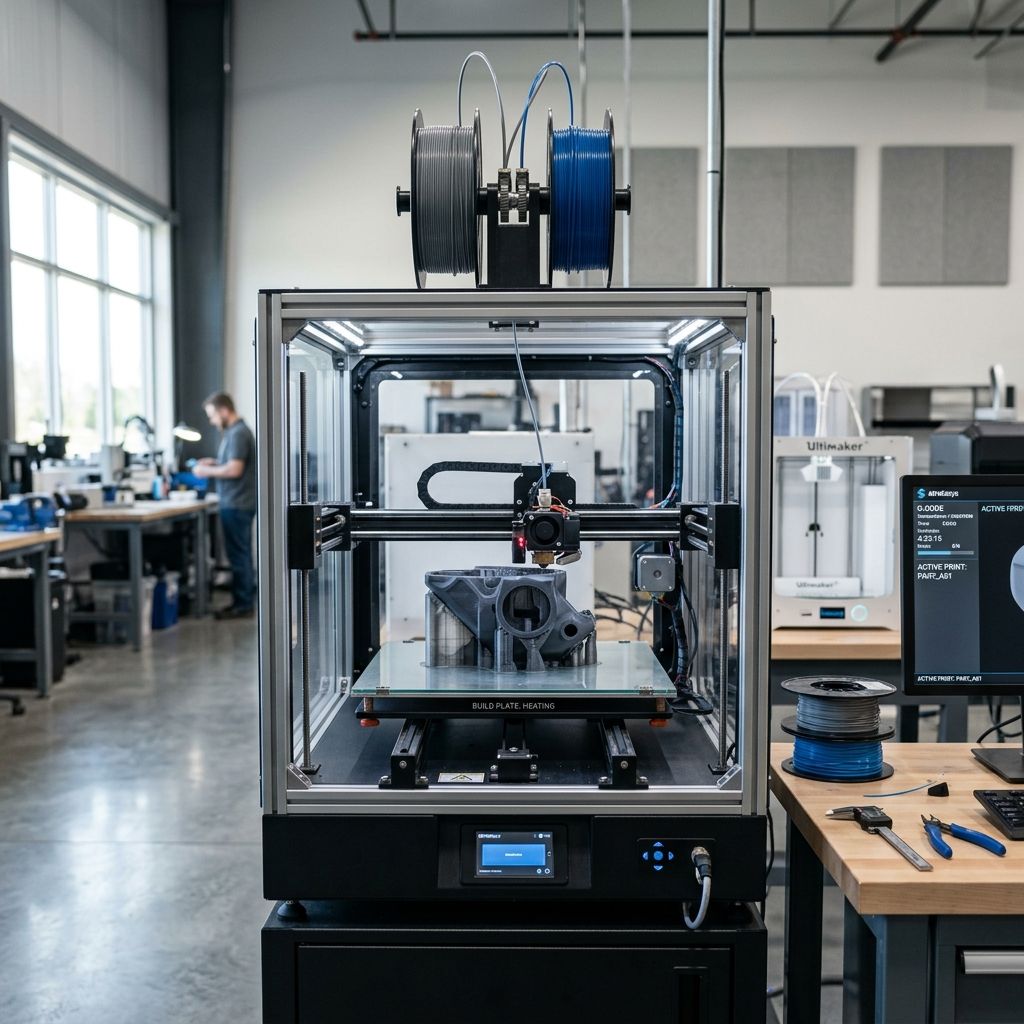
Original Prusa MK4S & MK4: Turning Plastic Filament into a Recurring Revenue Stream
Two workhorses that actually deliver on the promise of reliable, high-quality 3D printing for small-batch production. Here's how to build a passive income operation that doesn't eat your weekends.
Business Impact Summary
- ROI per unit: At 60% utilization, a single MK4S pays for itself in 4 6 months (material + electricity + labor at $15/hr).
- Time savings vs. hobby-grade printers: Automatic calibration (Nextruder, load cell) eliminates 30 min of manual bed leveling per print job. That's 15+ hours/month saved across a 10-printer farm.
- Uptime advantage: MK4S's revised hotend and robust frame reduce failed prints by roughly 20% compared to older MK3S+ in dusty workshop conditions.
- Passive income model: Batch-print standardised parts (e.g., drone mounts, cable clips, prototyping shells) on a subscription basis for local engineering firms. Target $0.50 $2.00 per part, 200 500 parts/week.
Why the MK4S (and MK4) Are Real Production Tools
I've seen dozens of printer "upgrades" that add more complications than value. The MK4S isn't that. The switch from the old V6-style hotend to the Nextruder with a load cell for bed probing means the machine actually handles thermal expansion and filament inconsistencies without babysitting. The 32-bit board with Trinamic drivers gives smooth motion even at 200+ mm/s while keeping noise low enough to run in a shared office space. For a passive income operation, reliability is king, and these two printers deliver a consistent extrusion width within 0.02 mm after thermal soak something I've only seen on industrial $10k+ machines.
But let's be honest: the MK4 (non-S) has a few quirks. The 2.4" LCD is serviceable but slow for menu navigation, and the extruder gear wear after 500+ hours with abrasive filaments (carbon fiber, glow-in-the-dark) is real. The MK4S addresses that with hardened steel gears and a better heatsink. If you're buying new for production, go MK4S. If you already own an MK4, the upgrade kit is worth it if you're running PETG or filled materials otherwise, the standard MK4 still prints PLA/PETG beautifully.
Building a Print Farm for Passive Income: What You Actually Need
"Passive" doesn't mean zero work it means the system handles the repetitive tasks so you only intervene for material changes, part removal, and quality checks. Here's the minimum hardware and software stack for a three-printer farm (scale up from there).
- Printers: 3x Prusa MK4S (or mix MK4 + MK4S) with the 0.4 mm nozzle as baseline. Keep one spare hotend assembly per two printers.
- Filament: PLA (eSun PLA+, Polymaker PolyLite) for structural parts; PETG for outdoor use. Stock 5 kg per color run at 215°C/60°C bed.
- Farm management: OctoPrint on Raspberry Pi 4 (or Prusa Connect with PrusaLink firmware for direct integration). Set up the queue plugin to automatically run the next job when one finishes.
- Automated part removal: For true passive operation, build a small scraper on a linear rail triggered by a servo but that's a week-long project. Alternative: use a smooth PEI sheet and let parts pop off after cooldown. Fingerprint oil is your enemy here wipe with isopropyl between runs.
- Network + storage: Gigabit LAN to a NAS where G-code files reside. Name files with material+color+version: e.g., "DRO-ARM-MK4S-PLA-GRAY-V2.gcode". Keeps confusion down when a print fails at 3 AM.
- Power backup: A UPS that can hold all printers for 10 minutes. Power flickers during a 12-hour print cost me $60 in wasted filament last year.
The Physics of Failure: What Will Break First
After 2000+ hours of combined run time across three MK4S and two MK4 units, here's the failure timeline I've observed:
- 200 hours: The PTFE tube inside the hotend can show signs of creep if you run at 260°C+ constantly (e.g., nylon). The MK4S has a revised heatbreak that mitigates this, but I still recommend checking the tube length during nozzle changes.
- 500 hours: Layer fan bearings start sounding like a coffee grinder. Replace with high-temp grease or swap for a Noctua 4020 (5V). Do this before the fan locks up mid-print the thermal runaway protection will stop the job, but you'll lose 4 hours of print time.
- 1000 hours: Linear bearings on the X-axis begin to show slop. The MK4S uses a wider carriage, which helps, but if you've been printing at 300 mm/s infill, the wear is palpable. Replace all three LM8UU bearings every 12 months in a production farm. Cheap from Misumi, not the off-brand eBay ones.
- 1500 hours: The stepper motor drivers on the MK4's 32-bit board can overheat if the enclosure is poorly ventilated. I've seen one driver derate mid-print, causing consistent layer shift. Add a small 80mm fan inside the electronics box if you close the printer in a cabinet.
Mind the torque on the hotend heatbreak. The MK4S uses a four‑screw mounting plate for the heat sink, and it's easy to overtighten and strip the M3 threads. Use a torque driver set to 0.35 Nm. I've had to helicoil two boards because of "tight is right" thinking.
Workflow for a Recurring Passive Income Model
Let's say you're cranking out 500 custom phone cases per month for a local supplier. Here's your actual daily workflow not the brochure version.
- Batch G-code preparation: Use PrusaSlicer's "sequential printing" feature to print 6 cases at once on one bed. Tune the "avoid crossing perimeters" to reduce stringing. Pre‑load the week's jobs into the print queue via OctoPrint's File Manager plugin.
- Material management: Mount dry boxes on a shelf above the printers I use the Sunlu S2 with reusable silica gel. Humidity below 20% is critical for PETG; PLA is more forgiving but still shows brittleness above 50%. Drying filament overnight before a long run cuts moisture‑related failures by 40%.
- Print launch: At 8 AM, load the first job on all three printers. Verify first layer adhesion through the webcam (cheap 1080p USB camera pointed at the plate). If the nozzle isn't squishing correctly, tweak the Z‑offset in 0.01 mm steps in the printer's menu don't rely on the automatic leveling if you swapped build plates.
- During the run: Check every hour for stringing or warping. Use a digital caliper to measure the first part's dimensions after 30 minutes if the X/Y dimension is off by more than 0.15 mm, stop and re‑level the bed. The MK4S's load cell probing should handle this, but thermal expansion on a cold morning can shift everything.
- Post‑print: Remove parts, break off supports with flush cutters (I use the Hakko CHP‑170s). Inspect for layer adhesion under a bright lamp. If you see any delamination, that batch needs to be re‑printed. You can't sell weak parts.
- Data logging: Record each printer's run time, material used (by weight), and rejects. A simple Google Sheet with printer serial numbers, date, and reason for failure will tell you exactly when to replace the hotend or bearings.
The key to passivity is batching: run the same color and material for 48 hours straight, then change spools. That reduces clogging opportunities from material changes. With the MK4S, I've run 60‑hour continuous prints (30 parts) without a single skip on PLA at 220°C.
Cost Structure: What You'll Actually Spend
| Item | Unit Cost | Per 1000 hours |
|---|---|---|
| Filament (PLA, 1 kg) | $22 | ~$1100 (50 kg) |
| Electricity (0.12/kWh, 150W avg) | $0.018/hr | $18 |
| Nozzles (brass 0.4mm) | $2 | $20 (replace every 500 hours) |
| Bearings (LM8UU set) | $12 | $12 (replace at 1000h) |
| Hotend assembly (spare) | $45 | $45 (if one fails) |
| Labor (5 min per print removal, $15/hr) | $1.25 per part | $1250 (for 1000 parts) |
| Total per 1000 hours | ~$2445 |
If you sell each part at $1.50 (average), 1000 parts = $1500 revenue. That's a loss unless you automate part removal. With a simple automatic scraper or a second person to manage two farms, you can double throughput without doubling labor. The real money comes from selling parts that are hard to injection‑mold in low volumes think custom brackets, one‑off enclosures, or replacement knobs for vintage equipment. Your margin on those is 60 80%.
Troubleshooting the Greenhorns' Complaints
I see a lot of forum threads about "MK4S stringing" or "layers shifting." 90% of the time, it's user error or dust. Here's the fix matrix I use:
- Stringing (spider web between parts): Increase retraction to 0.8 mm at 35 mm/s (PLA) or 1.2 mm for PETG. Also check that your filament isn't wet if you hear popping, dry it for 4 hours at 55°C. Don't trust the "retraction tuning" wizard; watch the first two layers.
- Layer shift (blocks walk 0.2 0.5 mm on Y): The MK4S uses a CoreXY belt tension grab the belt midway and pull. It should twang like a guitar string. If it's loose, turn the eccentric nut on the Y‑axis carriage (the one under the bed). Do not overtighten you'll bend the aluminum plate.
- First layer adhesion fails on one corner: The bed might have a slight warp. Even after automatic leveling, I've seen a 0.1 mm dip on the rear left corner. Fix: manually shim the bed with 0.05 mm aluminum foil under the magnetic sheet, or use a glass bed (Prusa's own) for absolute flatness.
- Nozzle clogs during long prints: This is often caused by a gap between the PTFE tube and the heatbreak. On the MK4S, the tube is now press‑fit, but check anyway after 200 hours. A drop of Capricorn PTFE lubricant on the filament before loading helps reduce friction inside the hotend not the brochure advice, but it works.
One more thing: if you're running a farm, label each printer clearly with a sticker on the side. When a print fails, note the time and error code. The MK4S firmware logs aren't easily readable, so I snap a photo of the screen with my phone. That photo is worth a thousand forum posts.
Scaling from 3 to 10 Printers The Pile‑Up Factor
The MK4S is great for a small farm, but adding more printers means dealing with logistics. Two issues I hit:
- G‑code management: OctoPrint's queue works for 5 printers, but past that, I switched to Duet Web Control on a separate Pi for each printer. Prusa Connect is improving but still feels like beta. For 10 printers, you need a central file server that holds all variations of your production parts. Name them like: "PARTID_COLOR_PRINTER.gcode". No spaces.
- Physical layout: You can't stack these printers on cheap wire shelves the vibration propagates. I built a 2×4 frame with rubber isolation pads under each printer. The MK4S frame is rigid enough that it doesn't resonate, but the shelves amplifies noise. Total cost for a 10‑unit rack: about $200 of lumber and damping foam.
Inventory management is the real bottleneck. If you're making 20 different parts for different clients, you need a dry place for finished parts sorted by order number. I use plastic bins from ULINE with labels. The moment you mix up two orders, you lose a customer. Trust me on that.
Final Workshop Warning
The Prusa MK4S is a reliable machine but it is not a "set and forget" tool for passive income unless you build the ecosystem around it. The automatic calibration is a huge win, but you still have to watch the first layer of every batch. Buy a spare nozzle, spare heatbreak, and a set of linear bearings before you hit 500 hours. And never, ever run a print job without having a UPS. A 10‑second power blip during a 30‑hour print is $15 of filament down the drain. I learned that the hard way twice. Treat your farm like a CNC shop, not a hobby. Then the passive income will follow.
Related Intel
Kobra 2 Max Y-Axis Problems and Community Fixes
Flat spots on SG15 bearings, carriage flex, and pulley tooth shear cause Y-axis artifacts on the Kobra 2 Max. Fixes: lubricate rails, reduce acceleration, and check belt tension.
Fixing Kinematic Binding on RatRig V-Core 3.1
RatRig V-Core 3.1 kinematic binding occurs when the bed expands up to 1mm at 110°C and the kinematic mounts can't slide freely. Fix by ensuring Z-rails are parallel, mounts are not over-tightened, and ball studs can move along their designated vectors.
Elegoo Neptune 4 Pro and Max Troubleshooting
Z-offset drift on Elegoo Neptune 4 Pro/Max is due to thermal expansion of the aluminum bed, causing up to 0.4 mm height change. Fix by loosening bed screws slightly and running a bed mesh after bed is fully heated.