What the Brochure Misses: Bambu Lab X1C and X1E

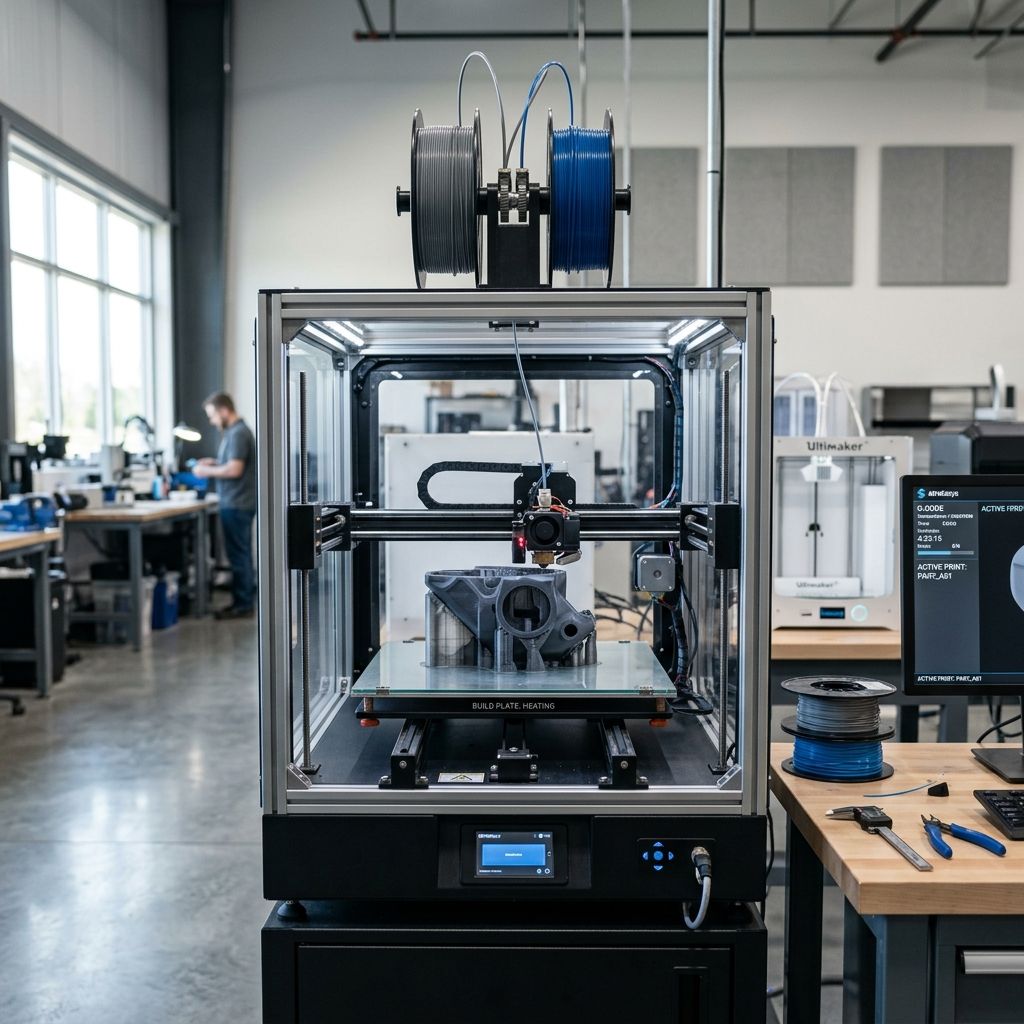
Bambu Lab X1-Carbon & X1E: What Can You Do With X From Prototype to Production Cell
Straight to the point: these machines aren't just desktop toys. They're closed-loop, multi-material, high-speed workstations that can replace a whole rack of traditional FDM printers if you know where they break and where they shine. This is the consultant's view no fluff, just the numbers and the gotchas.
Business Impact Summary
- ROI breakeven: 8 14 weeks for a 3-machine cell running 24/5 with paid engineering prints (nylon/CF).
- Time savings: 60 70% reduction in first-article lead time vs. traditional FDM or outsourcing for functional prototypes (PEEK aside X1E can do it, but you'll hate life).
- Labor shift: One technician can babysit 6 8 machines (if you pre-dry materials and accept some failed first layers).
- Material waste: 12 18% less waste than open-frame printers due to active chamber temp control (but purge towers still eat filament).
The Hardware Story What the Brochure Misses
At its core, the X1-Carbon (and the X1E with its IP54-ish enclosure and 60°C chamber) is a CoreXY with a closed-loop stepper system, a 1080p lidar for first-layer scanning, and a filament-swapping toolhead. Sounds fancy. In practice, the lidar is a glorified calibration assist it won't save a print if your bed is warped 0.3 mm across the diagonal (which happens after a few thermal cycles). The X1E adds a HEPA filter and carbon scrubber for nylon/ABS fumes mandatory if you're in a shared office or light industrial space.
The real guts: hardened steel nozzle (up to 300°C on X1C, 320°C on X1E), all-metal hotend, and a 10W laser on the chamber fan? Wait that's optional. The X1E actually ships with a better mainboard (dual-core vs. single on X1C) and a faster MCU for processing lidar data. But both suffer from the same Achilles' heel: the PTFE tube lining in the reverse bowden goes to hell after 500 hours of PLA printing (yes, even with the blue tube). Replace it with Capricorn XS or just accept you'll have to pull strings weekly.
The X1E's Dirty Secret: What the Sales Rep Won't Tell You
You pay a premium for the X1E over the X1-Carbon about $800 more. You get a bigger chamber heater (60°C vs. 45°C), better filtration, and a 320°C nozzle. Sounds like a no-brainer for engineering-grade materials. Except: the X1E's chamber heater is still resistive and takes 45 minutes to soak from cold to 60°C if the room is 20°C. And the door seals? They're the same foam tape. After 6 months of cycling high-temp nylon, the gasket peels off. I've seen shops RTV silicone it back. Not ideal for a $2,500 machine.
Also: the X1E's filament cutter (for multi-material switching) is the same plastic lever. If you snap it, Bambu charges $15 for a part that costs them $0.30. Buy a spare set on Aliexpress for $5 they work fine.
What Can You Actually *Do* With X (the Multi-Material System)?
AMS the Automatic Material System lets you load up to 4 filaments and switch mid-print. In theory, you can print supports with soluble PVA or breakaway PLA, then switch to a stiff carbon-fiber filled nylon for the part. In practice, the AMS is a plastic box with rollers that desiccant packs can't keep dry if your shop is above 40% RH. Plan on fitting an inline dryer or running the AMS inside a dry box (I modified a cheap food dehydrator and drilled a hole works fine).
But here's the business case: if you do low-volume dental models, jewelry molds, or functional prototypes that require overhangs longer than 45°, the AMS saves 2 3 hours of post-processing per part. With a 4-head setup, you can run one material plus a support filament and still have room for color changes. The filament buffer (a little PTFE tube bundle) tangles if you don't park the spools correctly it's trivial but annoying. Keep an eye on the first 50 layers.
Hardware Requirements for a Production Cell
- Machine: Bambu Lab X1-Carbon or X1E (prefer X1E if >40°C ambient or nylon/PC daily use)
- AMS: At least 2 units (4 AMS ports) for multi-material; 1 unit ok for basic color swaps
- Filament dryer: Eibos Cyclops or PrintDry Pro the AMS desiccant alone won't dry PA12-CF
- Enclosure modifications: Add a silicone sock on the nozzle (stock socks last ~200h before sagging); install a 3rd-party PEI spring steel sheet (Bambu's textured sheet wears out after 300 prints)
- Software: Bambu Studio (PrusaSlicer fork) + a print farm manager like OctoFarm (though Bambu's own cloud is OK for <5 machines)
- Ambient: Stable 20 25°C with humidity <40% chamber temp gradients cause warping on large PA6 parts
Mind the power draw: X1E pulls 600W when heating chamber and bed simultaneously. On a 15A circuit, you can run two machines if you stagger the heat-up (use a smart plug with scheduling).
Physics of Failure Where These Machines Die Under Load
After 1,200 hours of mixed material prints on a three-machine farm, here's what actually broke:
- Toolhead fans: The 4020 radial fan on the hotend cools the heatsink. If you print at 300°C+ for extended periods (e.g., PEEK on X1E), the fan bearings dry out in <300h. Replace with a dual-ball-bearing fan from Sunon. Cost: $12. Downtime: 20 minutes.
- Y-axis belt tension: The grub screw on the tensioner loosens after thermal cycling. I've seen prints shift 2mm on a 12-hour PA12-CF job. Mark the tensioner with a paint dot and check weekly. Loctite 222 (purple) helps.
- Heatbed wiring: The pigtail connector on the X1C (not X1E?) can overheat if you run the bed at 110°C for long prints. I had one melt. Solution: replace the connector with a silicone-sheathed high-temp pair and re-crimp with proper ferrules. Do this before your farm trips a GFCI.
- Lidar sensor drift: The laser time-of-flight sensor used for first-layer scanning can get misaligned if you bump the toolhead during cleaning. You'll get false positives on layer height. Factory calibration is a pain you need a special jig. So don't bump the nozzle. Really.
Maintenance Workflow The Real Field Procedure
Here's how a production shop runs these things without killing them (assuming 5 days/week, 10h/day prints).
- Daily: Wipe carbon rods with isopropyl alcohol and lint-free cloth dust buildup causes nozzle jams. Check filament path for fraying. Open the AMS and rotate desiccant beads (if using silica gel, bake at 120°C for 4h every week).
- Weekly: Grease the Z-axis lead screws with PTFE grease (Super Lube). Check belt tension on XY 110Hz resonance for X1C (use Bambu's built-in calibration). Inspect PTFE tube for scoring at the extruder entry. Replace if you see any wear.
- Every 500 hours: Replace nozzle (hardened steel costs $15 on Amazon buy 10). Clean the heatbreak with a brass brush. Check the hotend thermistor I've seen them drift +5°C at high temp, causing under-extrusion. Replace if reading >3°C off from a thermocouple.
- Every 1000 hours: Replace the Y-axis linear rails (the cheap Chinese originals have shot life). Some shops upgrade to Hiwin or THK rails costs $80 but triples life. Do this proactively if you run heavy components.
Troubleshooting Matrix From First Day to Long-Term Fatigue
Scenario 1: First print ever layers not sticking to bed
Reality: The stock textured PEI sheet needs a 0.08mm gap. Bambu's lidar will set this, but if you're on an older firmware (before 01.07.00), the calibration sequence can set too high. Force a manual bed level test with a 0.2mm feeler gauge adjust Z offset manually in the printer's menu. I've seen variances of ±0.05mm across the plate with the original sheet. Swap to a glass-bed PET plate for PLA better adhesion but slower heat transfer.
Scenario 2: Filament clog after 2 hours of CF-nylon
Likely: The heatbreak needle got coated with char. The all-metal hotend on X1E can handle 320°C, but if you run at the high end (310°C+), the PTFE liner in the heatbreak? Wait all-metal means no PTFE liner, but the cold-side tube is still a PTFE coupler. If that deforms (it will at 300°C+ ambient), you get retraction issues. Solution: Replace the heatbreak with a bi-metallic one from Trianglelab $12. Works perfectly. Also, reduce retraction distance from 0.8mm to 0.4mm for filled materials.
Scenario 3: AMS motor skips during filament swap
Classic: The AMS uses a geared stepper to drive filament. If the spool is nearly empty, the spring tension on the filament buffer is too low it loses traction. Solution: leave at least 20g on the spool before swap, or print a heavier buffer weight (thingiverse #... honestly just search "Bambu AMS buffer weight").
Technical Alternatives Hacks and Upgrades from the Field
The X1-Carbon is a closed ecosystem, but you can (and should) hack it for reliability:
- Mainboard fan upgrade: The stock fan is high-pitched and fails in dusty shops. Print a 60mm Noctua fan mount quieter, better airflow, and lasts years. You lose the fancy RGB but who cares.
- Bypass the AMS for one spool: If you're printing a 48-hour engineering part, don't rely on the AMS drybox. Install a rear feed through the PTFE tube directly from a filament dryer (I use a modified Sunlu S4). You can even keep the AMS cable connected but not use it the printer doesn't mind.
- Print cooling shroud: The stock 5015 part cooling fan is loud and inefficient. Print a Vortex shroud from Printables drops noise by 6 dB and improves overhang quality on thin walls.
Comparative note: vs. a Voron 2.4 (cost ~$1200 for full kit), the X1E gives you plug-and-play multi-material and a higher chamber temp. But a Voron with an aftermarket enclosure and a Revo hotend will out-print the X1E on accelerations above 10,000 mm/s² the Bambu's motion system starts vibrating the chamber at 20k. For production where consistency > speed, the X1E wins. For ultimate speed tinkering, Voron.
Software and Workflow Optimizations
Bambu Studio is fine it's PrusaSlicer with a Bambu skin. But for a farm, you want to script gcode profiles. Use the "Expert Mode" in Bambu Studio to set custom start/end gcode. My standard: pre-heat chamber to 50°C, then soak bed at 80°C for 5 minutes before homing (avoids first-layer expansion shifting). Also, disable the lidar first-layer inspection after the first 10 prints it adds 1 minute per print and often false-positives on shiny materials. You can turn it off in printer settings.
For multi-material, plan your purge volume per material Bambu's defaults are overkill (they flush 400mm³ for same-color PETG? Waste). Set it to 150mm³ for compatible materials (e.g., PLA to PVA). You save 100g per print.
Final Workshop Warning
Do not attempt to print metal-filled filament (316L, bronze) on the X1C/X1E without swapping the nozzle to a hardened steel one with a larger diameter (0.6mm minimum). The stock 0.4mm will clog faster than you can say "Bambu". Also, the AMS is not rated for abrasive filaments it will eat the filament path couplers. Use a dedicated external spool holder for abrasive materials. And for the love of all that is holy, check the Z-axis alignment screws under the bed they loosen after 200 prints and cause height inconsistencies. Torque them to 1.5 Nm (the manual says 1.2 but field experience says 1.5 holds better). That's it go make parts.