Bambu Lab X1C and X1E: Real Material Science Limits

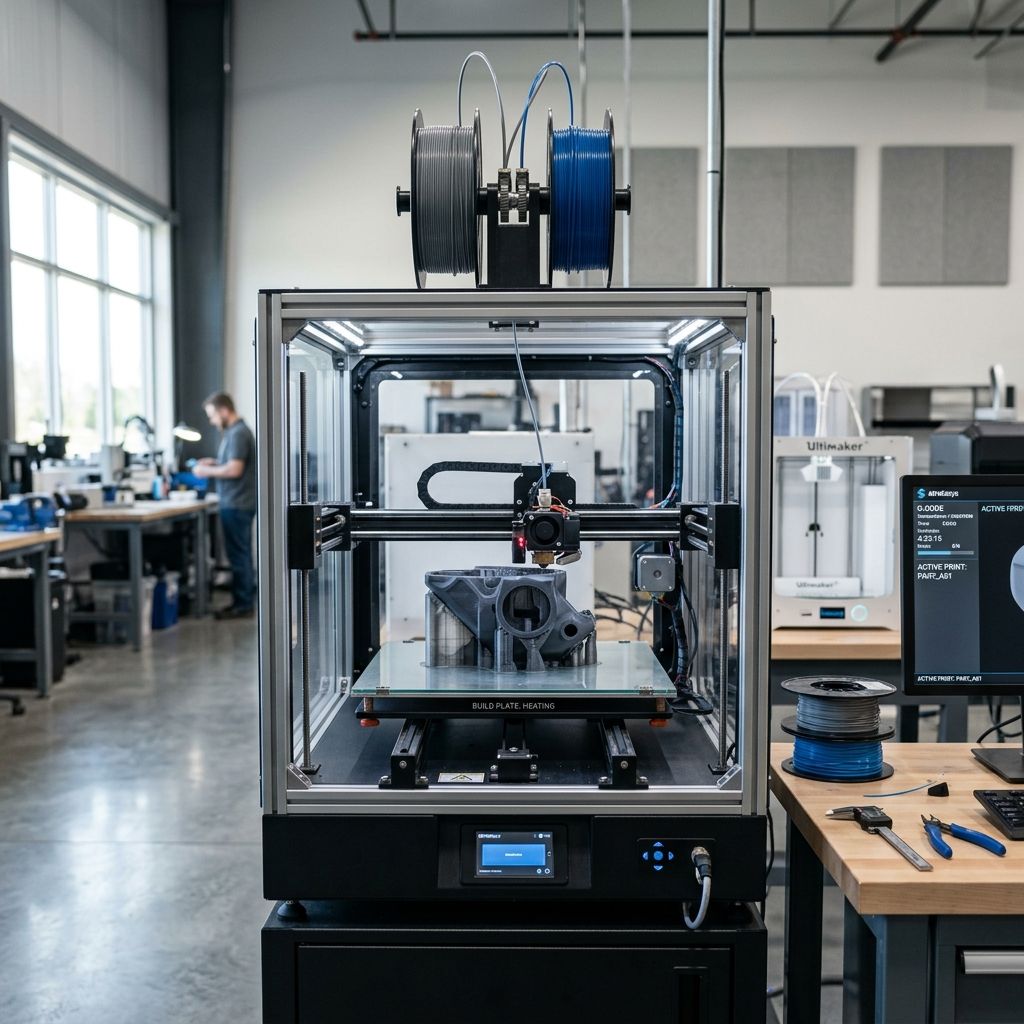
X1-Carbon and X1E in the Production Cell: The Real Material Science of Desktop Additive Manufacturing
Hard technical fact: The Bambu Lab X1 series shifted the prosumer paradigm by bundling a high-speed CoreXY motion system with a 300°C+ hotend and active chamber heating. But treating it like an industrial Fortus or a robotized Ender is a fast track to scrapped components and unnecessary downtime. I've seen shops try to run PEEK straight out of the box and blame the machine for delamination when the real culprit is the 65°C chamber ceiling. Let's talk about what happens when you push this platform to its material limits, and exactly where the software and hardware intersections break down.
Maker's Summary: The X1 Hardware-Software Stack as a Material Deposition Platform
Forget the marketing fluff about "multicolor prints." The X1C and X1E are essentially closed-loop, high-speed gantry systems with a fixed hotend architecture. The X1E solved the biggest bottleneck chamber temperature by offering a 75°C active heating element, mandatory for semi-crystalline polymers like PPS and Ultem 1010. The X1C relies on passive bed heat soak, which tops out around 55-60°C depending on ambient shop temperature. The controller is a custom closed-source board running a Linux derivative, communicating via MQTT. This is your biggest variable: the software stack is a black box, and the "Profile" is the only tuning interface you have.
- Max Hotend Temp: 320°C (allows PEEK/Ultem, but barely).
- Max Chamber Temp (X1C): ~60°C passive. X1E: 75°C active. Critical for annealing in-situ.
- Motion System: CoreXY with carbon rods. High rigidity, but sensitive to Z-binding if maintenance is skipped.
- Software Architecture: Fork of PrusaSlicer (Bambu Studio/Orca). G-code is post-processed. Requires cloud authentication by default (X1E has LAN mode).
The Thermodynamic Reality: Why Chamber Temperature is a Hard Ceiling, Not a Variable
Let's get the physics straight. Crystallization kinetics for high-performance thermoplastics like PEEK or PPA demand a chamber temperature above the glass transition temperature (Tg) to ensure even cooling and prevent warpage. PEEK has a Tg around 143°C. Your X1C chamber hits 60°C. That's a 80°C delta. You aren't annealing; you're managing a controlled quench. This means the part's outer layers cool faster than the core, inducing internal stress. The result? Delamination on tall Z-height parts and poor interlayer adhesion.
I've run dozens of Ultem 9085 parts on an X1E. The 75°C chamber is still insufficient for true stress relief, but it's enough to prevent catastrophic warpage off the build plate if you use a nano-polymer adhesive. The trick is thermal soak: pre-heat the chamber for 30 minutes after the bed reaches target. The hotend fan will cycle, and the chamber heater will oscillate. Wait for the thermistor to stabilize within ±2°C. Your first layer will thank you.
For the X1C running PAHT-CF (Carbon-filled Nylon), the passive soak works because PAHT's Tg is ~75°C. But the moment you switch to PPA (Tg ~100°C), you are relying on the hotend's local heat to keep the layer warm. This is where settings matter: slow down your volumetric flow so the hotend dwell time increases. I drop from 21 mm³/s to 9 mm³/s for PPA. Yes, it takes longer. No, the printer does not spontaneously combust. It produces a usable part.
Thermal Soak, Crystallization, and the "Ghost Anneal" Phenomenon
Here's a phenomenon the datasheets don't warn you about: post-print crystallization. If you print PEEK on an X1C and then place the part in a 120°C oven for annealing, the crystal structure reorganizes. The part shrinks. Not uniformly it shrinks along the Z-axis more than XY. I have seen parts deform by 2% on Z after a post-anneal. Your profile must account for this. Scale your Z accordingly. The X1E chamber can partially anneal thin-walled parts in-situ, but the thermal gradient is steep. Profile setting "Chamber Fan" must be set to 0 for any semi-crystalline polymer. Forced convection creates uneven cooling. Let the air stratify.
Sub-Component Analysis: The Hotend, Flow Path, and Wear Points
The X1 hotend assembly is a marvel of modularity and a source of mechanical frustration. The heater cartridge is ceramic, embedded in a silicon sock. It hits 320°C fast. The heat break is a bi-metal design (titanium for thermal break, steel for thread strength). In theory, this prevents heat creep. In practice, I have replaced three heat breaks on X1C units running continuous PAHT-CF because the carbon fibers abraded the internal bore over 500 hours. The physical failure mode is a "cold plug" filament jams at the heat break entrance because the thermal gradient shifts upwards as the PTFE tube degrades.
Hardware Truth: The nozzle is a hardened steel 0.4mm by default. It is adequate for glass fiber, marginal for carbon fiber (due to frictional wear), and poor for glow-in-the-dark (strontium aluminate is a ceramic abrasive). I swap to a 0.6mm ruby-tipped nozzle for any production run of filled materials. The larger bore reduces back pressure and the ruby tip handles abrasion without orifice geometry changes. The profile must be adjusted for the larger nozzle: reduce retraction distance (3mm -> 1.5mm) to prevent air gaps and blobs.
Volumetric Flow Limitations and the CHT Nozzle Debate
The CHT (Clog-Hardened-Titanium) nozzle is popular among speed-runners. For industrial materials, I advise against it. The CHT nozzle splits the filament flow internally, which works great for PLA/ABS to increase melt rate. For carbon-filled PPA? The splitter creates a dead zone where fibers accumulate, leading to intermittent clogging. I've timed it: every 15 hours of PPA-CF printing on a CHT nozzle, you get a partial clog. Stick to a single-bore hardened or ruby nozzle. The maximum volumetric flow on a standard X1E hotend with PEEK is around 12 mm³/s at 320°C. Push it to 14 mm³/s and you'll see underextrusion on sharp corners because the pressure advance can't compensate for the melt deficit.
The Software Stack: From G-Code to API Control (and Annoying Limitations)
The X1 series runs a custom Linux distribution on a dedicated MCU. The communication protocol is MQTT, which is actually incredibly useful for industrial monitoring. You can subscribe to the printer's status topics (temp, progress, errors) if you can navigate the encrypted handshake. The X1E specifically supports LAN-only mode, which bypasses the Bambu cloud. For ISO 27001 or AS9100D shops, this is non-negotiable. I have the X1E on a dedicated VLAN with a Node-RED instance that logs every print's thermal profile.
Here is the kicker: the firmware is closed source. You cannot modify acceleration curves or PID loops. The "Profile" is your only lever. The start G-code for the X1 is complex. It includes a "cleaning tower" (waste), a "purge line", a "Z-offset check", and a "LIDAR flow calibration." For production, I strip most of this. I disable LIDAR calibration on the third print of a batch. Once the flow is dialed, LIDAR just adds variance. I set enable_flow_calibration = False in the profile and manually set K (pressure advance) values.
Profile Engineering: Stripping the Factory Bloat for Production Stability
Let's walk through a production profile for PAHT-CF.
1. Start G-code: Keep the bed mesh (it helps), but remove the LIDAR calibration loop. Replace with a single purge line.
2. Cooling fans: Min 0%, Max 20% (layer time threshold of 30 seconds). Carbon nylon benefits from slight cooling on bridges, but full fan kills interlayer adhesion.
3. Pressure Advance: This is the most critical value. Orca Slicer has a built-in PA calibrator. Use it. PA for PAHT-CF on an X1E is typically 0.04 to 0.06. If you see blobs on corners, reduce PA. If you see gaps, increase PA.
4. Wall flow: I run 1.2 to 1.25 for filled materials. The volumetric error in the extrusion path due to fiber packing is real. The slicer's standard 1.0 flow will leave you with under-extruded walls that look like Swiss cheese under a microscope.
Troubleshooting Matrix: Real-World Failure Scenarios
I've categorized the most common production failures I've debugged on X1C and X1E units. These are not "first layer not sticking" issues; these are physics and wear failures.
- Scenario 1: Intermittent Clog on PPA-CF (X1C)
Symptoms: Print stops extruding after 4-5 hours. Cold pull shows a plug of carbon fibers at the heat break entrance.
Root Cause: Retraction is too high. Standard 3mm retraction pulls semi-molten filament back into the heat break, where fibers separate and compact.
Fix: Reduce retraction to 1.2mm. Increase travel speed to reduce stringing. Use a 0.6mm nozzle. - Scenario 2: First Layer "Ghosting" on X1E (Ultem 1010)
Symptoms: LIDAR detects first layer, but after 10 layers, the part detaches from the build plate.
Root Cause: The chamber heater cycles off after the first layer to avoid overheating the electronics bay. The bed temperature drops from 120°C to 110°C, causing the bottom layer to shrink faster.
Fix: In the profile, setchamber_temperature = 70(minimum for X1E) andbed_temperature = 125. Use a PEI sheet coated with 3Dlac. - Scenario 3: "HX" Error Code (Thermal Runaway) on X1C
Symptoms: Overnight print failed with HX code. Hotend temperature spiked by 20°C.
Root Cause: The silicon sock on the hotend degraded and lost contact with the heater cartridge. The PID controller overshot because the system mass changed.
Fix: Replace the hotend sock. This is a consumable. Inspect it every 200 hours. If it looks charred or loose, swap it. - Scenario 4: Z-Banding on Tall ASA Parts
Symptoms: Visual periodic lines on the surface every 2mm.
Root Cause: The Z-leadscrews are dry. The carbon rods are not lubricated, causing micro-stiction in the Z-axis. The lead screws are greased from factory, but the grease collects dust.
Fix: Clean the Z-leadscrews with isopropyl and apply Super Lube PTFE grease. Home Z and re-run bed mesh.
Material Compatibility Table: What Actually Works on X1C vs. X1E
| Material | Printer | Mods Required | Drying Required | Production Viability |
|---|---|---|---|---|
| PLA (Standard) | X1C/X1E | None | No | Excellent (Keep door open) |
| ABS/ASA | X1C/X1E | None | Yes (80°C for 12h) | Good (Chamber heater helps) |
| PAHT-CF (Nylon) | X1C/X1E | Hardened extruder gear, Ruby nozzle | Yes (90°C for 24h) | Excellent (X1E preferred for humidity control) |
| PPA (Polyphthalamide) | X1E Only | High-temp sheet, Adhesive | Yes (110°C for 48h) | Good (Volume flow limited to 10mm³/s) |
| PPS (Polyphenylene Sulfide) | X1E Only | Ruby nozzle, high-temp insulation | Yes (120°C for 24h) | Marginal (Chamber temp insufficient for complex parts) |
| PEEK (Polyether ether ketone) | Not Recommended | N/A | N/A | Fails due to chamber temp ceiling. Delamination observed. |
Takeaway: The X1E is a legitimate platform for PPA and advanced nylons. PEEK is a stretch too far. The physics of the 75°C chamber are a hard limit. You need a 120°C+ chamber for PEEK to be reliable. Accept this and move on.
The Maintenance Cycle for the Production User
If you are running this machine 8-12 hours a day, maintenance is not optional. It is a bill of materials.
Every 100 hours: Clean the carbon rods with isopropyl alcohol. Do not use acetone. I have seen the acetone degrade the coating on the shafts. Wipe the Z-leadscrews and apply a tiny drop of lithium grease. Check the nozzle for wear. If the orifice is no longer round, replace it.
Every 300 hours: Replace the PTFE tube inside the tool head. It degrades from heat. A degraded PTFE tube causes friction, leading to skipped extrusion steps. Check the hotend fan for dust buildup. The fan is small and high-speed; dust kills its bearings. Blow it out with compressed air (hold the fan blades to prevent over-spin).
Every 500 hours: Check the belt tension. The X1 has eccentric nuts for belt tensioning. A loose belt will cause VFA (Vertical Fine Artifacts). Use the built-in resonance compensation test; if the graph shows high amplitude at low frequencies, tension the belts. Replace the heat break. The thermal cycle degrades the bi-metal joint. I change the heat break every 500 hours on high-temp printers.
Technical Alternatives and Hacks: When You Must Fracture the Walled Garden
I have seen shops attempt to replace the X1 controller board with a Duet 3 or BTT Octopus. I do not recommend it. The mechanical integration (stepper drivers, wiring harness, proprietary encoder for the tool head) is a nightmare. You are better off buying a different printer if the X1 ecosystem is limiting you.
That said, there are three modifications I consider "production necessary" for the X1E:
- External Dry Box: The AMS is not a dry box. It leaks. Use a PrintDry Pro or a custom sealed container with a desiccant chamber. Feed PTFE tubing directly to the tool head. If your PPA filament has a moisture content above 500ppm, it will fail.
- Chamber Insulation Kit (X1C): Adding an external foil-faced foam panel to the X1C chamber can raise the passive soak temperature by 5-8°C. This is the difference between marginal and reliable for PAHT. Do not cover the electronics vent on the back.
- Orca Slicer Override: Use Orca Slicer instead of Bambu Studio. Orca is open-source and exposes the pressure advance, flow rate, and cooling parameters without the hidden Bambu magic. You can write custom "machine G-code" that does not include the cleaning tower, saving material and time.
Final Workshop Warning: The "Black Box" Problem and Supply Chain Risk
Mind the single-source dependencies. The X1 motherboard, hotend, and print head assembly are proprietary. If the MCU fails, you are not replacing a stepper driver; you are replacing an entire logic board that talks to a cloud server. I have seen a batch of X1C units fail after a firmware update that changed the max chamber temperature limit. Bambu rolled it back, but it caused a 24-hour production stoppage. If you are relying on this for a production line, buy a spare X1E and keep it offline. Treat the printer as a "black box" deposition system: maintain it rigorously, but never assume it is infinitely repairable. The profile is your only truly open interface. Master it, or the machine will master you.
Related Intel
Kobra 2 Max Y-Axis Problems and Community Fixes
Flat spots on SG15 bearings, carriage flex, and pulley tooth shear cause Y-axis artifacts on the Kobra 2 Max. Fixes: lubricate rails, reduce acceleration, and check belt tension.
Fixing Kinematic Binding on RatRig V-Core 3.1
RatRig V-Core 3.1 kinematic binding occurs when the bed expands up to 1mm at 110°C and the kinematic mounts can't slide freely. Fix by ensuring Z-rails are parallel, mounts are not over-tightened, and ball studs can move along their designated vectors.
Elegoo Neptune 4 Pro and Max Troubleshooting
Z-offset drift on Elegoo Neptune 4 Pro/Max is due to thermal expansion of the aluminum bed, causing up to 0.4 mm height change. Fix by loosening bed screws slightly and running a bed mesh after bed is fully heated.