Bambu Lab X1-Carbon & X1E: Industrial Buying Guide and Architectural Review

* Affiliate Disclosure: We may earn a commission from qualifying purchases made via our verified links at no additional cost to you.
The Industrial Maker is reader-supported. When you purchase equipment, parts, or materials through links on our site, we may earn an affiliate commission at no additional cost to you.
Bambu Lab X1-Carbon and X1E: Industrial Buying Guide & Engineering Evaluation
An architectural breakdown of active chamber thermodynamics, IEEE 802.1X enterprise network compliance, and production ROI for additive manufacturing cells.
Recommended Hardware: Bambu Lab X1-Carbon & X1E
Check current stock, official combo bundles, and certified accessories directly on Amazon:
View on Amazon • Check Live Price →Executive Market Position & Procurement Summary
The Bambu Lab X1-Carbon (X1C) disrupted rapid prototyping by establishing 500 mm/s high-acceleration CoreXY kinematics as an accessible baseline. However, regulated industrial aerospace, defense, and medical development sectors faced two non-negotiable hurdles: mandatory cloud connectivity and the absence of actively heated build chambers for structural polymers. The Bambu Lab X1E directly targets these institutional constraints. Use our Filament Drying Calculator to determine baseline moisture thresholds before processing high-temperature polyamides.
1. Chamber Thermodynamics: Active Convection Heating vs Passive Radiation
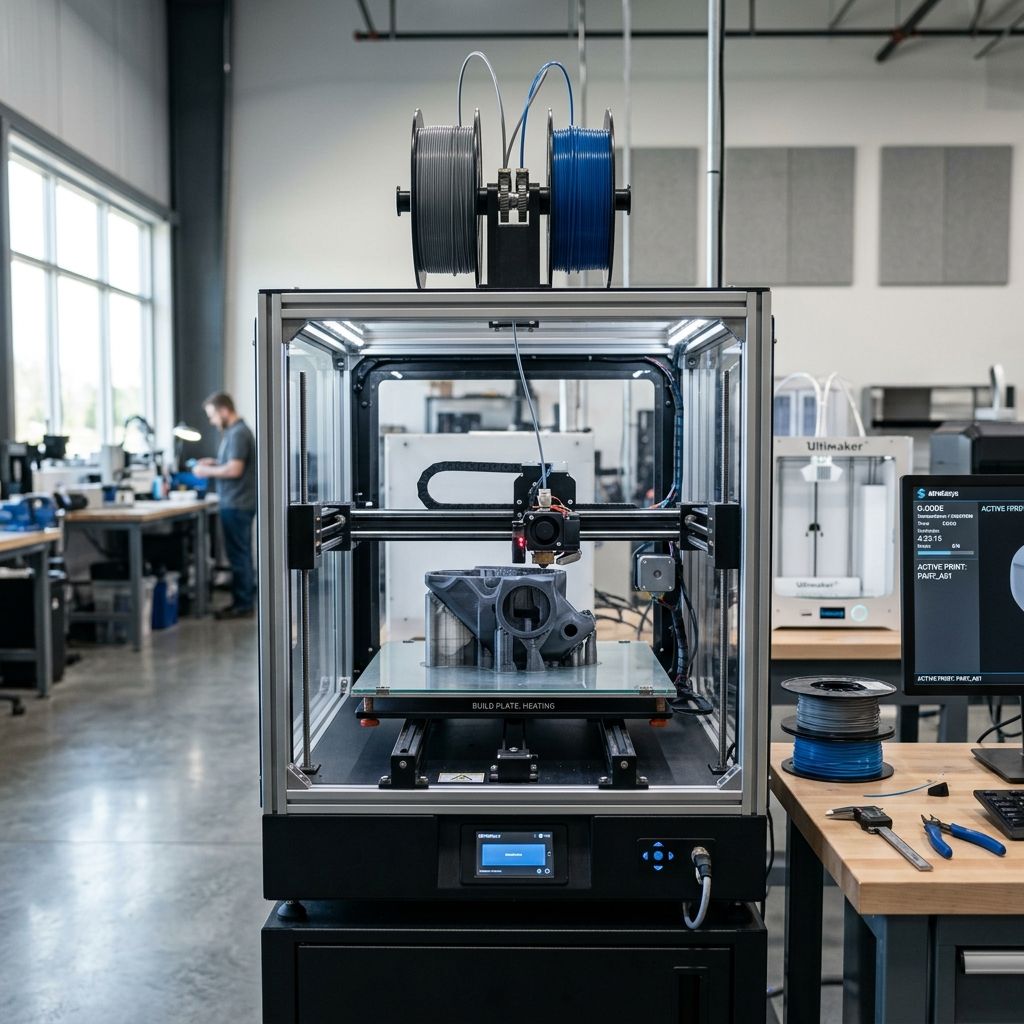
The most consequential engineering distinction between the X1-Carbon and the X1E is thermal chamber regulation. The X1-Carbon relies exclusively on passive radiation from its 110°C (or 120°C on 220V) heated bed. In typical ambient workshop conditions (21°C), the enclosed internal chamber stabilizes between 36°C and 48°C after a 45-minute heat soak. In contrast, the X1E integrates a dedicated 330W ceramic PTC auxiliary heater and circulating cross-flow fan capable of elevating and actively maintaining chamber air temperatures at up to 65°C.
When printing semi-crystalline engineering polymers such as carbon-fiber reinforced polyamides (PA6-CF, PA12-CF), polycarbonates (PC), and polyphthalamides (PPA), internal residual stress builds as extruded beads cool past the polymer's glass transition temperature Tg. The unconstrained thermal contraction stress σthermal across adjacent layer boundaries is defined by the thermo-mechanical relation:
σthermal = (E · α · ΔT) / (1 − ν)
Where:
- σthermal: Residual internal tensile stress generated within the printed boundary (MPa).
- E: Tensile modulus of elasticity of the cooled polymer (typically 6,500 to 8,500 MPa for PA12-CF).
- α: Linear coefficient of thermal expansion (CLTE), approximately 35 × 10-6 K-1 along the fiber orientation.
- ΔT: Thermal differential between the nozzle extrusion solidification threshold (~210°C) and the ambient chamber envelope Tchamber.
- ν: Poisson's ratio of the matrix material (~0.38 for dry polyamide).
Under X1-Carbon passive chamber conditions (Tchamber ≈ 42°C), ΔT equals 168 K, generating internal thermal stresses exceeding 16.5 MPa. This frequently induces edge curling, micro-cracking, and build plate detachment on parts with footprints exceeding 150mm. On the X1E with active 65°C chamber convection, ΔT drops to 145 K. Crucially, the elevated ambient temperature retards crystalline freeze-out, allowing polymer chains to relax and achieve isotropic interlayer weld strengths up to 28% higher than passively cooled equivalents.
2. Enterprise Network Compliance: Air-Gap Isolation and IEEE 802.1X
In secure industrial manufacturing facilities, intellectual property leakage and IoT botnet penetration are paramount concerns. The standard X1-Carbon operates primarily through Bambu Cloud services via 2.4 GHz Wi-Fi. While it offers a local "LAN Only" mode, it still requires initial cloud binding or firmware verification, and its wireless stack lacks support for enterprise RADIUS authentication protocols.
The X1E resolves these IT compliance roadblocks with physical and architectural hardware modifications:
- RJ45 Gigabit Ethernet Port: Dedicated 100/1000 Mbps hardwired Ethernet port integrated directly into the upper rear electronics bay, eliminating wireless RF interference in high-density machine halls.
- IEEE 802.1X Enterprise Authentication: Native support for WPA2-Enterprise and certificate-based network access control (EAP-TLS, PEAP), allowing direct deployment onto segregated corporate VLANs without pre-shared keys.
- Hardware Kill-Switches: Independent physical DIP switches located beneath an access panel allow security officers to physically sever both Wi-Fi and Ethernet communications, enabling true air-gapped classified operation.
- Pure Local Network Control: Complete machine operation, camera feed streaming, and firmware management conducted strictly through local LAN protocols without external internet handshakes.
Our companion technical analysis on Bambu Lab X1-Carbon vs X1E: What's Different? details the exact motherboard revisions and microcontroller bus architecture separating the two systems.
3. Industrial Specification Benchmark: X1-Carbon vs X1E
To evaluate the capital expenditure difference for manufacturing procurement teams, the following specification matrix contrasts both platforms across critical operational vectors:
| Engineering Specification | Bambu Lab X1-Carbon (AMS Combo) | Bambu Lab X1E |
|---|---|---|
| Target Market | Rapid Prototyping / Job Shops / Education | Regulated Enterprise / Defense / Industrial AM |
| Build Volume (W × D × H) | 256 × 256 × 256 mm | 256 × 256 × 256 mm |
| Max Hotend Temperature | 300°C (All-Metal Titanium/Steel) | 320°C (Heavy-Duty Ceramic Heater) |
| Chamber Temperature Control | Passive (Radiation from Bed, ~45°C Max) | Active Convection (330W PTC Heater, Up to 65°C) |
| Filtration System | Standard Activated Carbon Pellets | G3 Pre-Filter + H12 HEPA + Granular Coconut Carbon |
| Network Interfaces | Wi-Fi 802.11 b/g/n (2.4 GHz) | Ethernet RJ45 + Wi-Fi (802.1X Enterprise EAP/TLS) |
| Physical Network Cut-Off | Software Toggle Only | Physical Hardware DIP Kill-Switches |
| Filament Compatibility | PLA, PETG, TPU, ABS, ASA, PA, PC, PA-CF | Expanded: PPA-CF/GF, PPS, PPS-CF, PAHT-CF |
| Warranty & Support Tier | Standard Consumer/Commercial 1-Year | Enterprise SLA with Dedicated Channel Support |
4. Hotend and Filtration Architecture Upgrades
The X1E increases maximum nozzle operating temperature from 300°C to 320°C. While this 20°C increase appears modest on paper, it crosses a critical melt processing threshold for specialized engineering polymers. High-performance thermoplastic polymers like polyphenylene sulfide (PPS) and high-temperature polyamides (PPA) exhibit severe melt fracture and incomplete fiber wetting below 310°C. The additional thermal headroom ensures full liquefaction, reducing back-pressure on the hardened steel dual-drive extruder gears.
Furthermore, processing continuous fiber and styrene-based filaments produces hazardous volatile organic compounds (VOCs) and ultrafine particles (UFPs). As covered in our guide on X1-Carbon/X1E High-Temp Material Fixes, the X1E substitutes the basic carbon mesh pouch of the X1C with a multi-stage industrial cartridge incorporating a G3 particulate pre-filter, an H12-rated high-efficiency HEPA element, and an activated catalytic carbon bed, safely reducing styrene and caprolactam emissions inside unventilated office cubicles.
5. Architectural Pros and Cons: Engineering Assessment
Selecting between these two CoreXY production tools requires balancing immediate capital outlay against long-term maintenance overhead, material yield, and security compliance.
Bambu Lab X1-Carbon Assessment
- Pro: Capital Efficiency - Exceptional performance-to-price ratio (~$1,449 with AMS), allowing workshops to deploy multiple redundant nodes for the cost of a single enterprise workstation.
- Pro: Vast Community Ecosystem - Rapid firmware iteration, extensive open-source slicer profiles, and widespread aftermarket replacement part availability.
- Pro: Four-Spool Multi-Material Automation - Seamless multi-color or soluble support integration via the Automated Material System (AMS).
- Con: Thermal Enclosure Limitations - Inability to print large-envelope high-temperature polymers without localized warping and layer splits.
- Con: Cloud Infrastructure Vulnerability - Enterprise IT departments frequently refuse connection approval due to external AWS/Alibaba cloud telemetry.
Bambu Lab X1E Assessment
- Pro: Regulated Enterprise Compliance - Full air-gapped hardware disconnects and IEEE 802.1X support satisfy strict corporate security audits.
- Pro: Active 65°C Chamber Heating - Significantly improves isotropic mechanical properties and dimensional repeatability for engineering composites.
- Pro: Advanced Workplace Air Safety - HEPA H12 filtration prevents toxic aerosol and VOC buildup in enclosed design studios.
- Con: Substantial Price Premium - Positioned at approximately $2,499, representing a ~70% cost increase over the standard X1C package.
- Con: Enterprise Reseller Channel Lock - Purchasing and warranty servicing must be routed through authorized commercial distributors rather than direct online procurement.
6. Return on Investment (ROI) and Lifecycle Cost Formulation
To justify capital allocation for tooling, engineering management must compute the fully amortized machine hour cost Chour over a standard 3-year depreciation horizon (6,000 operational hours):
Chour = (Ccapex + Cmaintenance + Cenergy) / Htotal
Where:
- Ccapex: Initial machine and accessory acquisition cost ($1,449 for X1C vs $2,499 for X1E).
- Cmaintenance: Scheduled wear items (nozzles, PTFE tubes, carbon rods, HEPA filters): estimated at $450 for X1C vs $750 for X1E over 3 years.
- Cenergy: Electrical consumption: X1C draws ~160W average ($144 at $0.15/kWh), while X1E with 330W active heater active 40% of the time draws ~290W average ($261).
- Htotal: 6,000 operational production hours.
Amortized direct machine costs total $0.34/hr for the X1-Carbon versus $0.58/hr for the X1E. The critical commercial variable is scrap rate on engineering polymers. When printing a 350g PA-CF functional manifold costing $45 in raw filament, a single warp-induced print failure on an unheated X1C completely eliminates the hourly cost difference for over 180 operating hours. For facilities regularly manufacturing parts in carbon-reinforced nylons or polycarbonates, the X1E pays for its $1,050 price premium within the first 25 successful high-temperature build cycles.
7. Procurement Decision Protocol
Follow this checklist when finalizing capital expenditure approvals across engineering departments:
- Path A: Procure the X1-Carbon if your production mix consists primarily of PLA, PETG, TPU, and occasional medium-sized ABS/ASA parts, you operate in an unclassified open network environment, and your objective is maximum throughput per capital dollar.
- Path B: Procure the X1E if parts must be certified in PPA-CF, PPS, or thick-walled PA-CF, if corporate infosec mandates Ethernet or physical air-gaps, or if equipment must be operated in shared office spaces requiring HEPA filtration.
Frequently Asked Questions
Can the active chamber heater of the X1E be retrofitted onto an existing X1-Carbon?
No. The X1E features a re-engineered chassis, a higher-capacity internal power distribution board, heavy-duty wiring harnesses, and distinct mainboard firmware that prevents retrofitting the active 330W PTC heating assembly onto standard X1-Carbon units.
Does the Bambu Lab X1E support the AMS multi-filament feeder system?
Yes. The X1E fully supports up to four AMS units (16 colors/materials) via the standard 4-pin bus interface, allowing automated multi-material switching and dedicated soluble support interface extrusion.
Can the X1E print high-temperature PEEK or PEI (Ultem)?
No. While the X1E reaches 320°C at the hotend and 65°C in the chamber, true PEEK and PEI polymers demand minimum nozzle temperatures of 380–420°C and heated chambers exceeding 90–130°C to prevent crystallization cracking.
How does the noise level of the X1E compare to the X1-Carbon?
The X1E is slightly louder (~2 to 4 dB higher) during high-temperature printing due to the continuous operation of the internal chamber circulation fan and the high-static-pressure filtration blower.
Workshop Safety and Venting Notice
Even with the X1E's multi-stage H12 HEPA and activated carbon filtration system, continuous printing of polyamides, ABS, and composite resins at 300°C+ produces sub-micron particulates and VOCs. In enclosed job shops running multiple printers, always augment internal filters with dedicated workshop air exchange or ducted external exhaust extraction.