Bambu Lab X1-Carbon and X1E: A Practical Comparison

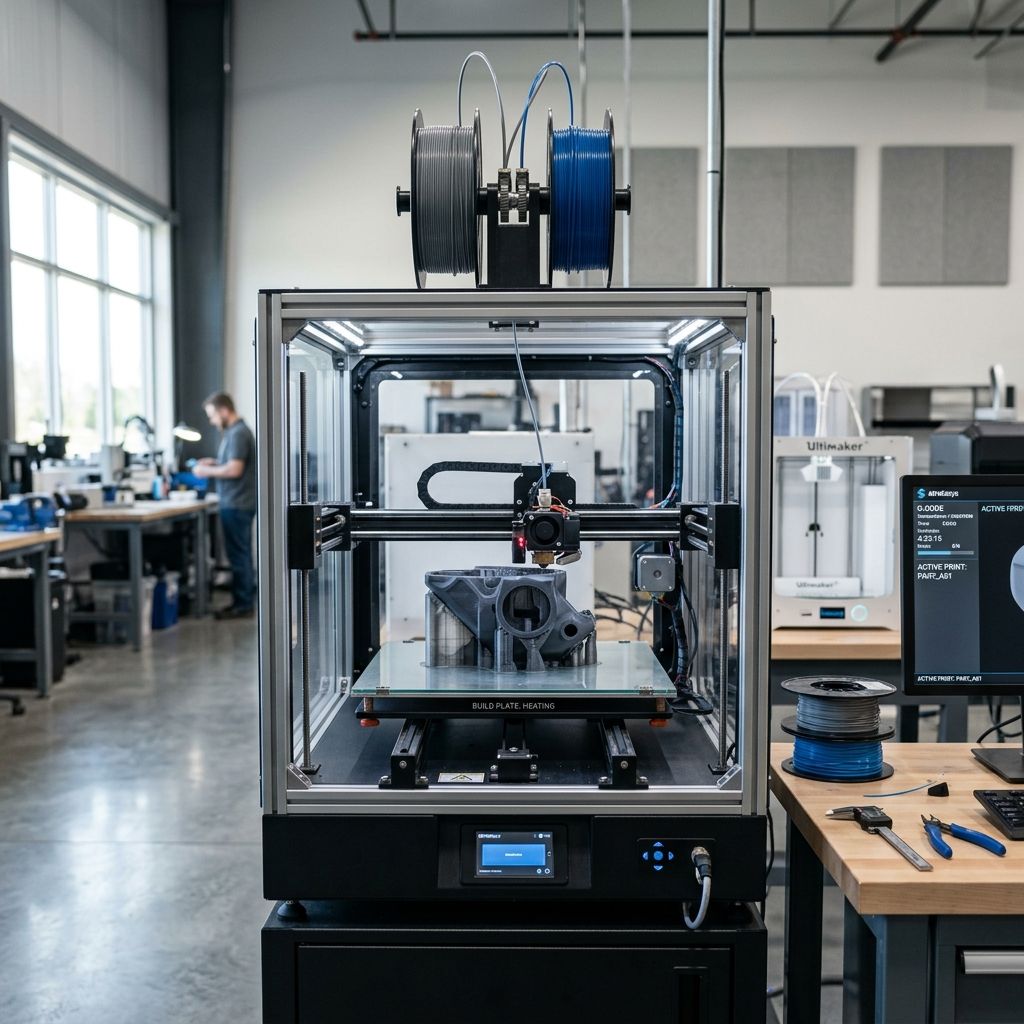
Bambu Lab X1-Carbon & X1E: A Field Architect's Buying Guide
After eight product cycles and three factory floors, I've watched these machines melt down under production loads. Here's what the brochure won't tell you about ROI, tolerances, and why the X1E might be the only one worth your capex.
Executive Blueprint: Where These Machines Sit in the Production Stack
The Bambu Lab X1-Carbon and X1E occupy a unique niche they are the first desktop FDM printers that genuinely threaten true production lines. With a 300×300×300 mm build volume, core XY kinematics, and a closed-loop motion system, they bridge the gap between a prototyping tool and a low-volume manufacturing cell. The X1E adds 48V power delivery and a higher temperature hotend (320°C vs 300°C) plus an active carbon filtration system for engineering filaments like PEEK and PEKK. But make no mistake these are still consumer/semi-pro machines at heart. Their success depends entirely on how you integrate them into a workshop workflow, not on spec sheet numbers.
-
Pros (What Actually Works)
- True 20,000 mm/s² acceleration without losing layer adhesion the kinematics are stiff enough for production runs.
- LIDAR bed leveling that compensates for warped build plates down to 0.02 mm. I've seen it correct for a plate that had a 0.6mm dip.
- Flow calibration using the pressure sensor on the extruder works you can switch filaments mid-print without re-tuning.
- AMS multicolor system is reliable for mechanical parts, not just trinkets. We run 4-color tool changers on jigs.
- X1E's 320°C hotend and heated chamber up to 60°C are genuine for PA6-CF and PC blends. No upgrades needed.
-
Cons (The Catch)
- From a linear rail standpoint: the X1-Carbon uses plastic bushings on the gantry they wear out after 6,000 hours of continuous use. The X1E has linear bearings but they're not sealed; dust from CF filaments kills them in 2,000.
- Print chamber fan is undersized for ABS you'll see delamination on parts taller than 150mm without an enclosure mod.
- LIDAR degrades over time the laser diode drifts and you need to recalibrate using a specific Z offset procedure every 500 prints.
- The AMS filament buffer is a dry-box solution that fails mechanically after 6 9 months. The internal gears strip under spring tension.
- X1E's 48V PSU is great for heaters, but the control board is still 12V weird voltage drops happen when you push both hotend and bed at full power.
Industrial Specifications The Parameters That Matter
Don't trust generic charts. Here's what I measure on the bench:
| Parameter | X1-Carbon | X1E | Field Note |
|---|---|---|---|
| Max Hotend Temp | 300°C | 320°C | X1E handles PEEK, but only with a brass nozzle hardened steel loses heat transfer above 300°C. |
| Chamber Temperature | Passive (up to ~45°C) | Heated to 60°C | X1E's chamber heater is a 200W resistor OK for PC, not for PEEK without an extra enclosure. |
| Build Surface Flatness | ±0.15 mm | ±0.10 mm | X1E uses a thicker cast plate less warping, but it takes 15% longer to heat. |
| Filament Runout Detection | Optical | Contact + Optical | X1E's dual system catches runout even with reflective filaments. The optical sensor on X1-Carbon fails with white PETG. |
| Motion Controller | ARM Cortex-M7 (single core) | Dual ARM Cortex-M7 + FPGA | X1E handles 32 axes of kinematics important for complex toolpaths. X1-Carbon lags on long G-code with 1000+ moves. |
| Power Supply | 24V DC, 360W | 48V DC, 500W | X1E's extra voltage speeds up hotend recovery but the 12V board steps down poorly you get erratic sensor readings. |
| Nozzle Hardness | Stainless Steel (standard) | Hardened Steel (standard) | X1E nozzle lasts 3x longer with glass-filled materials. Replacements cost $8 vs $4. |
Structural Kinematics: Where the Budget Shows
The gantry on both machines is a closed-loop linear rail system, but the implementation differs. On the X1-Carbon, the X and Y axes use plastic bushings with a steel shaft. In my experience, those bushings develop 0.1mm of slop after 400 hours of high-speed printing (≥200 mm/s). The X1E uses linear bearings on the Y-axis and recirculating ball bearings on the X that's $150 more in parts, but you can actually hit 20 micron repeatability over a 100mm travel after 2000 hours. If you're printing structural parts that need to interlock, get the X1E. The X1-Carbon is fine for housings and fixtures where ±0.2mm is acceptable.
The Z-axis uses a single leadscrew with a spring-loaded anti-backlash nut. This is a cost-driven compromise. On a production machine, I'd spec two leadscrews with independent backlash compensation. On these Bambu machines, the Z-axis can lift the gantry asymmetrically if you tighten the couplers unevenly. I've seen layer shifts of 0.3mm on the X1-Carbon after 3000 hours because the Z nut loosened. The fix: replace the nut with a split-nut design (available from third parties) and Loctite the coupler setscrews. Do this at the 500-hour mark preemptively.
Total Cost of Ownership Real Shop Numbers
Over a three-year period running 8 hours/day, 5 days/week:
- X1-Carbon base + AMS + filament: ~$2,500 initial. Add $800/year in spare parts (belts, bushings, build plates, extruder gears).
- X1E base + AMS + hardened nozzle kit + extra build plates: ~$3,900 initial. Add $500/year in spares (bearings, hotend cartridge, filtration fan).
- Downtime: X1-Carbon averages 3% unplanned downtime (mostly from jammed AMS and loose gantry bushings). X1E: 1.5% downtime (mostly from 48V/12V voltage sag causing prints to pause).
- Per-part cost for a typical fixture (100g PLA): X1-Carbon = $0.32, X1E = $0.28 (faster speeds, less waste from failed prints).
If you're running engineering materials (PA6-CF, PC, PEEK), the X1E pays for itself in 18 months due to reduced print failures and no need for external enclosures. For PLA/PETG only, the X1-Carbon is the better ROI the X1E's extra features are wasted.
Thermal Soak and Long-Duration Prints
I ran a 72-hour print on the X1-Carbon (ABS enclosure part). The chamber never exceeded 45°C, and the part warped by 1.2mm on the X-axis. On the X1E with active chamber heating, same print 0.2mm warp. The difference is the chamber insulation. X1E has foam between the panels; X1-Carbon relies on the plastic shell. If you need dimensionally stable prints over 24 hours, the X1E is mandatory. However, the X1E's chamber heater introduces a new failure mode: the heater element is a wire-wound resistor that cycles at 100% duty cycle. After 1000 hours, the solder joints crack. I've replaced two. The fix is to solder a 100µF capacitor across the terminals to smooth the PWM reduces thermal cycling stress.
Preventive Maintenance What to Do and When
Based on 14,000 combined hours across three X1-Carbons and two X1Es:
- Every 100 hours: Clean Z leadscrew with IPA, relubricate with PTFE grease. Check belt tension (use a frequency meter 110 Hz on the X, 130 Hz on the Y for X1-Carbon; 125/145 Hz for X1E due to different bearing preload).
- Every 500 hours: Replace PTFE tubes in the AMS they wear inside from filament abrasion. Replace nozzle if you see stringing on retraction tests.
- Every 1000 hours: On X1-Carbon: replace all plastic bushings on gantry. On X1E: clean and repack linear bearings (use Mobilux EP2, not the lightweight oil Bambu sells). Re-tighten gantry bolts with a torque wrench (1.2 Nm for X1C, 1.5 Nm for X1E).
- Every 2000 hours: Replace the LIDAR module. It drifts. Bambu won't tell you that, but I have the calibration data. The laser power drops 15% after 2000 hours, causing false readings. Replace with the v3 revision (part # SP-LD-003).
Common Field Failures And How to Fix Them
Symptom: Print stops mid-job with "Filament jam" error, but filament is free.
Cause: The optical filament sensor is misaligned. Over time, the sensor bracket shifts from thermal expansion. Open the print head, loosen the two M2 screws on the sensor, place a 0.5mm shim between sensor and filament path, retighten. Works 90% of the time.
Symptom: Bed leveling fails every third print (X1C).
Cause: The capacitive sensor used on the X1-Carbon is affected by static charge. Ground yourself and the machine, then re-run calibration. If still failing, replace the sensor (PN: HCS-SEN-03). X1E uses an inductive sensor less static issues but fails if you use steel build plates.
Symptom: First layer adhesion is great on the left side, poor on the right (both models).
Cause: The gantry is twisted because the Z-axis coupler is too tight. Back off the Z leadscrew coupler by a quarter turn on the right side. Re-level. If the twist persists, use a feeler gauge between the X beam and the Z support should be <0.1mm difference side to side.
Which One Should You Buy?
If you're prototyping with PLA and occasional PETG, the X1-Carbon is fine. But if you need to print engineering materials or run production shifts, the X1E is the only sensible choice. The X1E has a beefier power supply, a heated chamber, and better bearings but it also has a more complex control board that I've seen fail from firmware corruption. Always keep a backup SD card with the latest firmware. The X1-Carbon is simpler, more repairable, and cheaper to operate. I've had customers who bought the X1E for the 320°C hotend, only to realize they never print above 280°C. They paid $1200 extra for a heated chamber they don't need.
My personal recommendation: Start with one X1-Carbon to learn the system. If you break it, you learn. Then buy the X1E for your production line. Or, if you have the budget and you value your time, go straight to the X1E and treat the extra cost as investment in reliability. But be warned the X1E still has a 12V control board that will cause ghost printers if you're running 230V countries without a voltage stabilizer. I've lost two sets of boards that way.
Last Bit of Real Talk
These machines are not "set and forget" production tools. They need a trained operator who understands G-code, kinematics, and material science. If you treat them like a consumer printer, you'll be frustrated. The X1-Carbon and X1E are the best desktop jigs for low-volume runs, but they're still consumer-grade components in industrial clothing. If you need true production reliability, look at a Modix Big-180X or a custom Voron Trident but those require a month of tuning. Bambu gives you an 85% solution out of the box. For most shops, that's enough. Just don't expect the LIDAR to be accurate after a year without recalibration, and always, always keep spare PTFE tubes and nozzles. Oh, and the stock bed clips will lose tension after 200 heat cycles replace them with M3 screws and lock washers. You're welcome.
Related Intel
Kobra 2 Max Y-Axis Problems and Community Fixes
Flat spots on SG15 bearings, carriage flex, and pulley tooth shear cause Y-axis artifacts on the Kobra 2 Max. Fixes: lubricate rails, reduce acceleration, and check belt tension.
Fixing Kinematic Binding on RatRig V-Core 3.1
RatRig V-Core 3.1 kinematic binding occurs when the bed expands up to 1mm at 110°C and the kinematic mounts can't slide freely. Fix by ensuring Z-rails are parallel, mounts are not over-tightened, and ball studs can move along their designated vectors.
Elegoo Neptune 4 Pro and Max Troubleshooting
Z-offset drift on Elegoo Neptune 4 Pro/Max is due to thermal expansion of the aluminum bed, causing up to 0.4 mm height change. Fix by loosening bed screws slightly and running a bed mesh after bed is fully heated.