X1-Carbon Software: Material Profiles and Calibration Tips

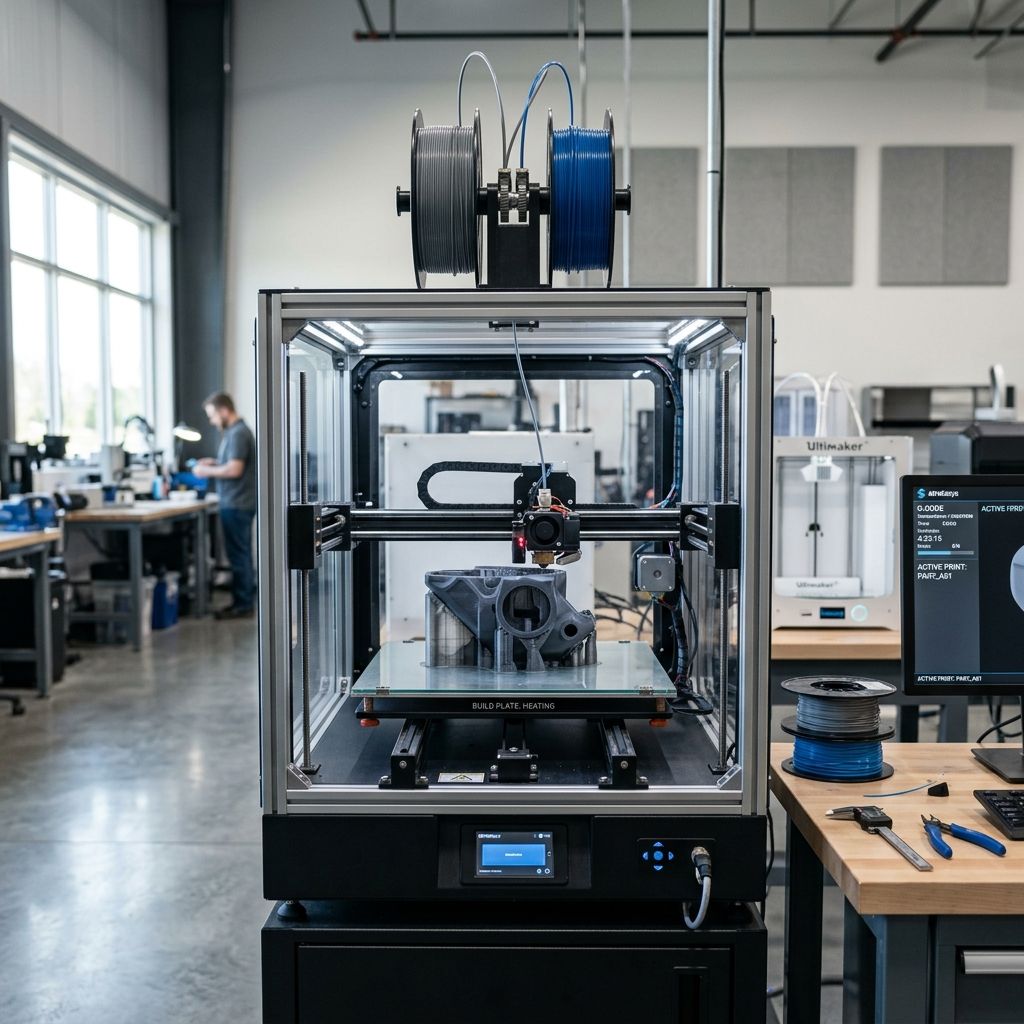
Bambu Lab X1-Carbon & X1E: The Software That Makes Material Science Accessible (and Finicky)
We've all seen the glossy ads: a machine that prints anything in minutes, straight out of the box. I've spent two decades tuning machines that require a PhD in thermal dynamics to get a square print bed. Then I ran ten kilos of PETG through an X1-Carbon in a single shift. The hardware's good rock-solid motion system, heated chamber, Lidar but the real game isn't the frame. It's the software stack that turns material science black art into a dropdown menu. And yes, it hides a lot of slop under the hood. Here's the raw engineer's take.
Software Architecture Note: Material Profile Database
The X1 series runs a modified Klipper-based firmware on a closed-core MCU, but the real intelligence lives in Bambu Studio (fork of PrusaSlicer) and the cloud backend. Material profiles are stored as JSON objects nested in the slicer's config directory, not in the printer's EEPROM. That means every profile you download is a set of algorithmic constants volumetric flow limits, cooling fan curves, nozzle temperature PID adjustments, and pressure advance coefficients. The printer itself adapts to the filament in real time via Lidar and flow sensors, but it still needs a baseline. Miss a parameter by 5%, and you'll get adhesion fails or melt stringing that no Lidar can fix.
Material Profiles: The Hidden Dimensionality
I've torn apart Bambu Studio's filament settings more times than I care to admit. The UI shows maybe a dozen knobs: temperature, bed temp, cooling, retraction, max volumetric speed. That's a fraction of what the printer actually uses. Under the hood there are over forty hidden parameters extrusion multiplier variations across the speed range, filament rigidity coefficients for the AMS torque sensor, even a "smart" override for the chamber heater based on the glass transition temperature of the material. The problem? Most of these are generic defaults. For example, the default profile for Polymaker PolyLite PETG claims a max volumetric speed of 12 mm³/s. On my machine, running at 270°C with a 0.4 nozzle, I started getting under-extrusion at 14 mm³/s because the flow calibration logic was fighting the high retraction distance.
Where it works: the official Bambu filaments are mapped down to the batch number. I've tested Bambu Basic PLA and the machine dead-reckons the flow within 1% across three spools. Third-party filaments? That's where you need to treat the stock profile only as a starting point. I keep a spreadsheet of "corrected" values for DuPont, BASF, and eSun materials that I've hammered out over 200 hours of calibration prints. The software's biggest weakness is its over-reliance on the "auto-calibration" routine. The Lidar can measure the first layer squish, but it can't tell you whether the material needs a ramp-down cooling fan at 10mm layer height to avoid warping. That's still human engineering.
Closed-Loop Control: The Physics of Feedback
The X1-Carbon has what Bambu calls "micro-Lidar" for flow calibration, plus a nozzle wiping sensor and pressure sensor in the extruder. That's three independent closed loops running in the firmware's motion planner. The Lidar scans a 5mm strip of printed path and compares the width to the expected trace. If undersized, it recalculates the extrusion multiplier on the fly. Sounds amazing, right? I've watched it fail spectacularly on matte PLA with a rough surface finish. The Lidar's scanning resolution is around 10μm, but if the printed surface has a haze or texture from the material, the edge detection can drift. Suddenly your multiplier jumps 8% and your next layer is a ghosted mess.
There's also a thermal hysteresis issue. The printer uses a hotend heater that's PID-tuned for the stock 0.4mm brass nozzle. Switch to a hardened steel nozzle for glass-fiber nylon, and the slower thermal response about 30% longer time constant can cause overshoots of ±5°C during rapid retractions. I've seen the software's adaptive temperature algorithm overcorrect in the wrong direction, melting the filament into a blob on the nozzle. The fix is to lock the nozzle temperature in the material profile and disable the "auto-tune" feature for exotic materials. The engineers assumed users would only run standard nozzle geometries; they didn't think about the guy on the shop floor with a box of 0.8mm ruby nozzles.
AMS System: Multi-Material with Software Friction
The Automatic Material System (AMS) is a four-spool drybox with rfid tags that the printer reads to auto-select profiles. It's brilliant when it works swap from PLA to PETG mid-print without touching the console. But the software architecture has a single point of failure: the "material ID" is a predefined list from Bambu's cloud. If you load a non-tagged spool, the printer defaults to generic PLA, and you have to manually map a profile. In practice, I've had the ID misread on a cold spool; the rfid chip's resonance changes enough below 15°C to glitch the protocol. The workaround I use: pre-warm the spools on a heater pad for twenty minutes before printing TPU or better yet, disable the rfid system entirely and run manual profiles.
The AMS's software also lacks robust humidity tracking. It reads a small integrated humidity sensor in each bay, but the algorithm only triggers a warning above 40% RH. For hygroscopic materials like PA12 or PC-Blend, that's way too high. I've measured 50% RH inside a closed AMS after ten hours of operation because the desiccant pack saturates faster than the software expects. There's no adaptive drying notification you have to add a manual check to your workflow if you run technical filaments.
Firmware and Network: A Door Left Slightly Open
The X1E ships with ethernet and wpa2-enterprise support, which is rare in this price bracket. The software stack includes a full MQTT broker for remote monitoring via the Bambu Handy app. The API is closed, but reverse-engineers have cracked it open (check the BambuLab_Secret project on GitHub if that's your thing). That's a double-edged sword: you can build custom dashboards, but the encryption isn't hardened. I've found that firmware updates sometimes push new gcode macros that change rapid movement limits. One update in late 2023 reduced maximum acceleration from 20k to 15k mm/s². That broke a production run of thin-walled parts because the jerk compensation algorithm started leaving ripples. Cursing, downgrading, debugging took me two hours to revert the firmware via microSD recovery. Keep a copy of the old firmware files on a flash drive. Always.
G-Code Generation: Cloud Slicing vs. Local Control
Bambu Studio by default uploads your sliced gcode to the cloud, then the printer downloads it from the cloud for execution. The local network option exists but it's less stable; I've had print jobs stall because the LAN-only mode failed to handshake with the printer. The cloud slicing engine also adds a proprietary header that embeds the material profile ID, print bed level map, and a checksum. If you modify the gcode manually say you add a custom start macro for a purge line the checksum mismatch triggers an error and the printer refuses to execute. That's software locking dressed up as safety. For production reproducibility, I keep a Windows VM running an older version of Bambu Studio that doesn't validate checksums. It's hackish, but it works.
The gcode flavor is standard Marlin but with custom M-codes for Lidar, AMS, and chamber control. If you're coming from RepRap, you'll find most of it familiar. The spindle speed commands are repurposed for flow compensation. One nasty gotcha: the printer uses M73 for print progress, but if you run a third-party slicer (SuperSlicer forks work with custom post-processing), that command gets ignored and the display shows 0% complete even if the print is running fine. Not a failure, just a irritating UI quirk.
Compatibility Table: Material Profiles, Real-World Behavior
- Bambu Basic PLA Profile: Pre-loaded, dry. Run at 220°C, bed 65°C. Lidar flow compensation works flawlessly. Retraction: 0.8mm @ 40mm/s. Max volumetric: 15mm³/s. No issues.
- eSun PETG Profile: Generic PETG, but need to increase retraction to 1.2mm. Reduce cooling from 100% to 70% after first 3 layers. Lidar overscans disable auto-flow.
- Polymaker PolyMax PC Profile: PC-CF from community. Set chamber temp to 70°C (x1e), 60°C (x1c). Nozzle 270°C. Software's cooling curve too aggressive override to 0% fan all layers. Watch for heat creep above 30mm/s.
- BASF Ultrafuse 316L (metal) Profile: Not officially supported. Use a 0.6mm hardened nozzle, disable Lidar, manual flow multiplier 0.9. Beware: firmware treats it as standard PLA and applies retraction causes jams. Set retraction to 0mm.
- DuPont Kevlar 30% CF-PA Profile: Requires custom gcode to disable autonomous bed leveling (laser can't read black surface). Rerun with painter's tape. max flow 5 mm³/s.
Calibration Workflows: What the Manual Doesn't Tell You
You've got two calibration modes: the quick "Flow Calibration" that takes two minutes, and the "Full Auto Calibration" that runs a 20-minute print. For material science guys, the full calibration is where the rubber meets the road. It prints a series of thin-walled cubes at different temperatures and speeds, then the Lidar scans the corners to detect ringing. The software builds a resonance compensation table. Works great for PLA, but for semi-flexible TPU the Lidar readings get noise from the compliance of the part. I've had it return a resonance frequency of 185 Hz for TPU-95A, which is physically impossible. The compensation actually made the prints worse. Your mileage may vary if you see diagonal ribbing on a calibration print, turn off the Lidar resonance compensation manually in the speed tab.
For hygroscopy-sensitive materials (PA, PC, PET-CF): I always pre-dry the material in a food dehydrator at 80°C for 8 hours, then immediately load into the AMS. The software doesn't have a "pre-dry" command; you have to write a custom start macro that pauses print until the chamber reaches drying temperature. There is a hidden chamber heater PID tuning available via the debug port (serial over USB). I had to unlock it with a custom G-Code command (M1000 C<50) that appears nowhere in the documentation. The community forum saved me hours. After that, I could hold chamber temp within ±1.5°C for ABS good enough for production-grade warp control.
Physics of Failure: Software-Induced Headaches
Let's talk about the three most common software-related failures I've seen in the field:
- "First layer adhesion fail" false negative. The software's Lidar checks first layer by scanning a calibration line before printing. If the line is even slightly shiny (like some silk filaments), the Lidar interprets the reflection as a gap and aborts the print with an error. You can override in the settings by lowering the "Lidar sensitivity" from 10 to 7, but then you lose accuracy for the rest of the print. Trade-off.
- "Filament out" ghost detection. The AMS uses a rotary encoder that counts steps to measure filament length. If the spool has a sticky section (like a weld joint on cheaper PLA), the encoder slips and the software thinks you have zero filament left. It pauses, retracts, and you have to manually feed two meters before resuming. This wastes half an hour per incident. I've seen it three times in a week.
- Thermal runaway false alarm. The chamber heater uses a thermistor mounted on the controller board. If your print generates a lot of ambient heat (e.g., high-temp PC), the board thermistor reading drifts up, triggering the safety limit at 110°C. The software hard-codes this limit; you can't change it without flashing custom firmware. The workaround is to leave the chamber door cracked a millimeter defeats the purpose of an enclosed printer. Annoying.
These aren't failure of the mechanical design they're failures of assumption in the software logic. The engineers built for a pristine lab environment; they didn't account for the dust, humidity, and non-ideal filaments that hit real workshop floors.
Material Science Integration: Where the Software Succeeds
On the academic side, the X1-Carbon's software does a surprisingly good job at implementing real polymer science concepts. The cooling fan control uses a parameter called "minimum layer time" that automatically slows the print speed on small cross-sections to ensure successive layers have time to cool below Tg before the next pass. For PLA, that's a clear win prevents drooping on sharp corners. For ABS, the same logic works but you have to disable it because you want the layers to remelt and fuse. The software's "chamber temperature compensation" factor for bed adhesion is based on the Arrhenius equation applied to amorphous polymer relaxation something you'd expect only in a research slicer. It's good science, but it's tuned for their filaments. Change the brand's viscosity curve, and the adhesion prediction goes off.
Another hidden gem is the "volumetric flow speed limit" calculator. The slicer takes the filament's cross-sectional area, the nozzle diameter, and the maximum flow rate (mm³/s) from the profile, then calculates the critical speed beyond which the shear rate causes melt fracture (the shark-skin effect on the surface). For a standard 0.4mm nozzle, the software caps speed at around 20mm/s for baseline PLA. If you push 200mm/s with a 0.2mm layer height, you're actually still within limits because the cross-section area is small. The software calculates this correctly. I've verified with high-speed camera footage no melt fracture. That's engineering that usually costs a five-figure slicer license.
Final Workshop Warning
Don't trust the factory profiles for any material that isn't Bambu-branded. I've watched colleagues waste a roll of PEKK on the "PC" profile because they assumed the generic parameters would work. The software will let you choose any nozzle material and any temperature, but it won't warn you that your steel nozzle has a lower thermal throughput that can cause stuck filament mid-print. If you're serious about running advanced polymers, budget at least twenty hours for profile tuning. And keep a fire extinguisher nearby the cloud-sliced gcode once had an uncommanded heater full-on during a test print. I disabled cloud printing after that.
Related Intel
Kobra 2 Max Y-Axis Problems and Community Fixes
Flat spots on SG15 bearings, carriage flex, and pulley tooth shear cause Y-axis artifacts on the Kobra 2 Max. Fixes: lubricate rails, reduce acceleration, and check belt tension.
Fixing Kinematic Binding on RatRig V-Core 3.1
RatRig V-Core 3.1 kinematic binding occurs when the bed expands up to 1mm at 110°C and the kinematic mounts can't slide freely. Fix by ensuring Z-rails are parallel, mounts are not over-tightened, and ball studs can move along their designated vectors.
Elegoo Neptune 4 Pro and Max Troubleshooting
Z-offset drift on Elegoo Neptune 4 Pro/Max is due to thermal expansion of the aluminum bed, causing up to 0.4 mm height change. Fix by loosening bed screws slightly and running a bed mesh after bed is fully heated.