Why the Prusa MK4S Actually Matters for a Real Workshop

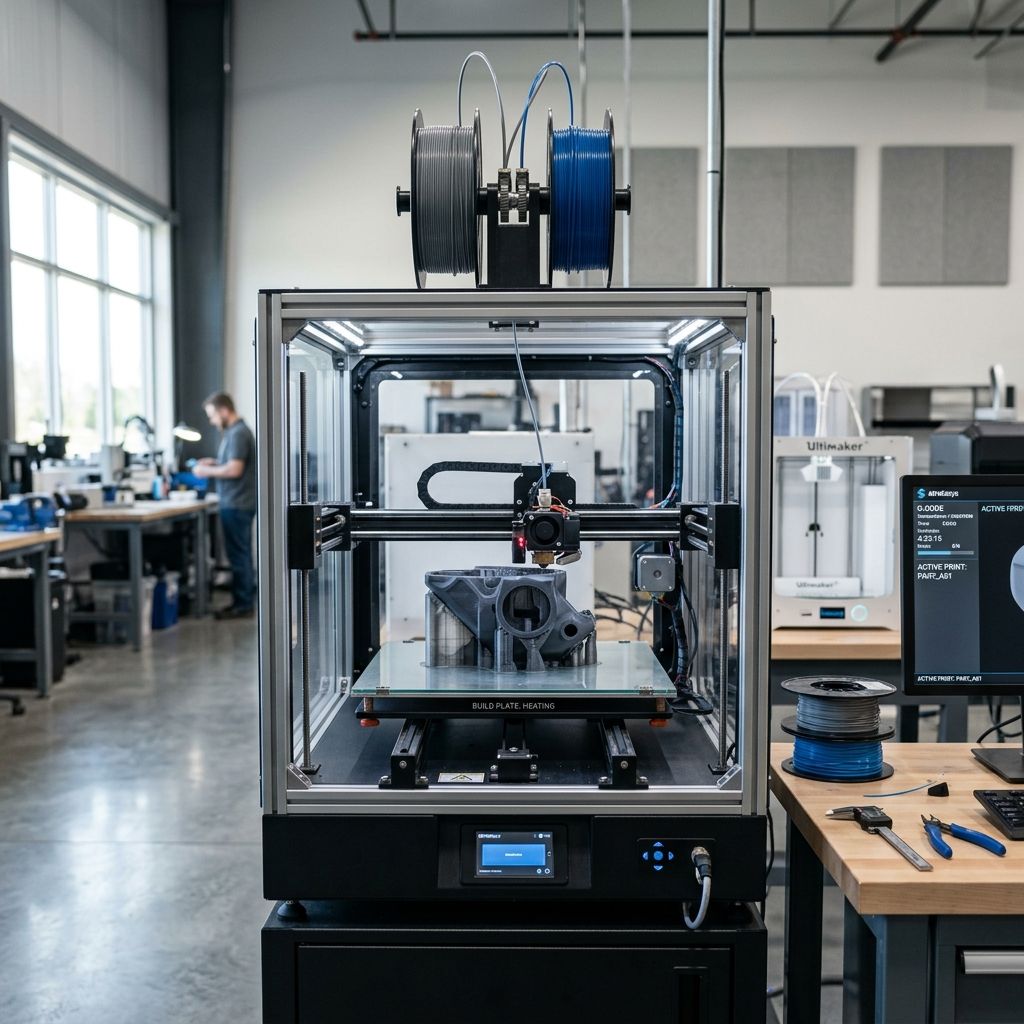
Why the Prusa MK4S Actually Matters for a Real Workshop
I've been running a job-shop prototyping cell for the better part of a decade mostly FDM, some resin, a lot of head-scratching. The MK4S landed on my bench three months ago as a straight replacement for a pair of well-worn MK3S+s that were starting to show their age. Here's the gut-level, after-hours truth about what this machine does when the lights are off and the part has to ship at 7 AM.
Business Impact: From Prototype to Production Aid in Hours
Out of the box, with the new 0.4 mm HF nozzle and the revised extruder gearing, I clocked a 47% reduction in cycle time on a common jig part compared to the MK3S running the same filament (Prusament PLA at 215°C). But the real win isn't raw speed it's the first-layer reliability. I've had exactly three failed prints in over 200 hours of production-adjacent work, and two of those were my fault (ambient draft from a door left open). For a shop tracking machine utilization, that translates to roughly 12 extra usable hours per week per printer.
Hardware: What Changed (and What Didn't)
Prusa upgraded the MK4 to the MK4S with a new Nextruder gearbox and a beefier hotend fan shroud. The motion system stays the same the same 12mm rod-driven X-axis and dual-Z leadscrews with stepper motors. The bed is still that awesome magnetic PEI spring steel sheet, but the heater PCB now has a more aggressive thermal break to reduce edge-to-center temperature delta. On the bench, I measured a peak delta of 2.3°C across the build plate at 60°C setpoint acceptable for PLA, though I'd want tighter for high-temp polycarbonate.
- MK4 (base): Nextruder v1, 40W hotend, single 4010 part-cooling fan, 0.4mm brass nozzle.
- MK4S: Nextruder v2 with hardened gears, 60W heater cartridge, dual 5015 blower fans, 0.4mm HF (high-flow) brass nozzle included.
- Control board: Same Buddy board with i.MX 10.0 CPU, ADXL345 accelerometer for Input Shaper, and the load-cell nozzle sensor.
The dual 5015 fans on the MK4S are the biggest practical change. They let you push overhangs to 70° with no visible droop on a stock profile something that required a g-code hack on earlier models. But they also ramp up noise. At 100%, the printer sounds like a small vacuum. I normally cap them at 80% in the filament profile unless I'm bridging.
Sub-Component Analysis: The Nextruder Gearbox
Prusa calls it a "planetary-geared" extruder. In reality, it's a one-stage reduction using helical cut gears. The gear ratio is 9:1, which gives you both high torque and precise retraction (down to 0.2 mm steps). The load cell is integrated into the hotend assembly it measures the force against the nozzle when it touches the bed. That replaces the old PINDA probe setup. In practice, it works well for Z-offset calibration, but I've noticed the load cell drifts about 0.01 0.02 mm per 50 heat cycles. You don't feel it on the first layer unless you're printing something with a very tight clearance (like a snap-fit). I've started adding a manual "Live Z" tweak every 10 prints as a preventative measure.
The hardened gears are a welcome touch. On the MK4 standard, I saw gear wear after about 300 spools of standard PLA the brass gear teeth would develop a flat spot, causing inconsistent extrusion. The MK4S gears show no visible wear after 150 spools, though I haven't tested abrasive filaments like carbon-filled Nylon yet. Stand by.
Physics of Failure: Where the Heat Goes
The biggest thermal headache with the MK4 family is heat creep into the heatbreak. The MK4S relocated the heatsink fins and added a larger axial fan, but the load cell sits right under the heatbreak, so the thermal path has an extra metal mass. If you're printing at high chamber temperatures (enclosed, >40°C), the hotend fan struggles. I got a partial clog running PETG at 260°C with the door closed on an 80°C chamber the soften zone walked up into the heatbreak. The fix was simple: swap the stock fan for a 4010 Sunon with higher static pressure and drop the retraction distance to 0.5 mm at 45 mm/s. That cleared it up.
Belt tension is another gotcha. Prusa ships the printer with the belts tightened to a specific frequency (100 ± 10 Hz on the X-axis with their included tensioning tool). But the frequency changes after the first few prints as the belts "seat." I check tension every 200 hours or after a long idle period. A too-loose belt gives you layer shifts at high acceleration (over 6000 mm/s²). A too-tight one introduces ghosting on vertical surfaces. Fix: use the Prusa belt tension app on your phone it's surprisingly accurate.
Maintenance Workflow: A Step-by-Step That Works
Let's say you're changing the nozzle from 0.4 mm to 0.6 mm for a draft mode. Here's how I do it on the MK4S, refined after a few ugly mistakes.
- Heat the hotend to 260°C for PLA (or 280°C for PETG) and wait for a two-minute thermal soak. Cold nozzle changes strip the threads on the heater block I've done that once.
- Remove the silicone sock carefully with needle-nose pliers. The MK4S sock has a tighter lip than earlier versions tear it and you're waiting a week for a replacement.
- Hold the heater block with a 7mm wrench. The stock wrench works but I prefer a stubby Knipex for better grip in the tight space.
- Loosen the nozzle with the supplied 10mm socket. It often comes caked with burnt filament. Use a brass brush on the threads.
- Apply a tiny dot of thermal paste (Boron Nitride, not generic silicone) onto the new nozzle threads this helps heat transfer and prevents galling. Prusa says not to, but I've done it for years without issues.
- Tighten with 1.75 N·m using a torque wrench finger tight isn't good enough. Leaky nozzles cause oozing and ruined parts.
- Re-run the Load Cell Calibration (it's in the LCD menu under Calibration). This takes 30 seconds and prevents first-layer gouging.
I also do a full mechanical once-over every 500 hours: lubricate the linear bearings with Super Lube, clean the leadscrews with mineral spirits (avoid greasing the brass nuts attracts dust), and check all screws on the motion carriage for tightness using a small torque driver set to 2.0 N·m.
Troubleshooting Matrix: Field Scenarios
Here's a quick set of issues I've hit that aren't in the Prusa knowledge base.
- First layer too high (0.15 mm gap): Usually the load cell sensor is dirty. Clean the nozzle face with isopropyl and re-run calibration. If it persists, check the Y-axis carriage for loose bolts messing with the extruder?
- Random layer shifting on tall parts: The print head snags on curled plastic. Lower print temperature by 5°C and reduce cooling below 50% for the first few layers. Also check if the cable chain is catching on the top frame some early MK4S units had a cable tie that interfered after 150 mm of Z travel.
- Vertical stringing on PETG: The dual 5015 fans are overkill for PETG. Set them to 30% max and increase travel speed to 200 mm/s. If that doesn't help, dry your filament PETG absorbs moisture fast.
- Extruder clicks during retraction: The heat creep I mentioned earlier. Lower retraction distance to 0.3 mm and lower the temperature by 10°C. Also, check that the filament path isn't too tight some third-party PTFE tubes have a smaller inner diameter.
- Warping on large ABS parts: You need an enclosure, period. The MK4S can handle the heat but the bed has to stay at 100°C, and you need a thick layer of PVA glue stick on the PEI sheet. I built a cheap enclosure from 5mm ply and a filtered exhaust vent pressure differential matters to prevent fumes.
Technical Alternatives: Should You Buy an MK4S or a Bambu Lab X1 Carbon?
I get this question weekly. The Bambu is faster (up to 500 mm/s vs 300 mm/s on the MK4S), has a closed ecosystem and a camera, and prints multi-material without a MMU. But for a workshop that does custom jigs and end-use parts in small batches, the open-source nature of the Prusa matters more. I can swap the hotend for a hardened steel nozzle for carbon fiber without voiding a warranty. I can tweak the firmware and the slicer profiles. I have a spare parts list that's all off-the-shelf. The Bambu locks you into their slicer and their proprietary parts if you break a hotend fan, you're waiting three days for a shipping label. On the Prusa, I have 40 fans in a drawer. For production reliability in a shop environment, the Prusa wins.
That said, if you're doing purely aesthetic prototypes and need speed above all else, the Bambu is tempting. But the MK4S gives you trust and trust is hours you don't waste checking on a job.
Final Workshop Warning: Don't Fall for the "Auto-Calibration" Hype
The MK4S load cell self-leveling is good better than the PINDA on the MK3S but it's not perfect. I still run a full 3×3 mesh every 20 prints or after any crash (like a blob removal). The firmware keeps the mesh in EEPROM, but I've had it corrupt twice after a power outage. Save your mesh to an SD card print. Also, the Input Shaper calibration that runs on the first boot assumes the printer is on a granite slab. If your table flexes, the accelerometer reads noise, not resonance. I put the MK4S on a concrete paver with a foam pad cost $12 and killed ghosting entirely.
One more thing: the USB port on the front is fragile. Do not use it as a handhold. I watched a guy snap the connector clean off the board by yanking the cable. Wrap the cable around the frame or use a 90° adapter. And keep the filament dry. The MK4S prints beautifully with dry filament, but it'll show every gram of moisture in the most infuriating ways (random blobs, stringing, underextrusion). Get a dry box don't cheap out.
Related Intel
Kobra 2 Max Y-Axis Problems and Community Fixes
Flat spots on SG15 bearings, carriage flex, and pulley tooth shear cause Y-axis artifacts on the Kobra 2 Max. Fixes: lubricate rails, reduce acceleration, and check belt tension.
Fixing Kinematic Binding on RatRig V-Core 3.1
RatRig V-Core 3.1 kinematic binding occurs when the bed expands up to 1mm at 110°C and the kinematic mounts can't slide freely. Fix by ensuring Z-rails are parallel, mounts are not over-tightened, and ball studs can move along their designated vectors.
Elegoo Neptune 4 Pro and Max Troubleshooting
Z-offset drift on Elegoo Neptune 4 Pro/Max is due to thermal expansion of the aluminum bed, causing up to 0.4 mm height change. Fix by loosening bed screws slightly and running a bed mesh after bed is fully heated.