Anycubic Photon Mono M7 Max and M5s Pro Review

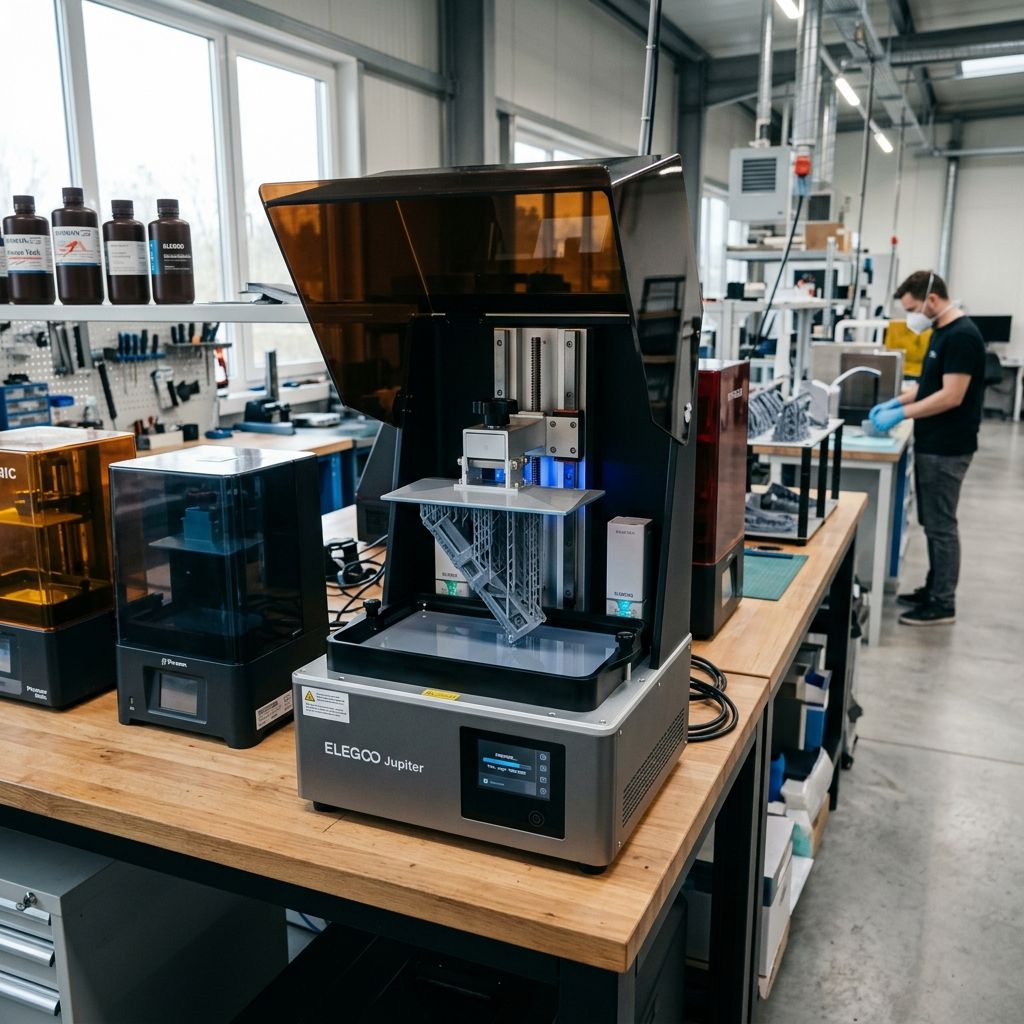
Anycubic Photon Mono M7 Max and M5s Pro: MSLA Architecture Review
An exhaustive shop-floor evaluation of 14K optical engines, ACF release membrane peel physics, high-torque Z-axis gantries, and automated resin handling in production environments.
Architectural Positioning & Production Benchmark
Large-format vat photopolymerization occupies a demanding space in rapid tooling and low-volume production. The Anycubic Photon Mono M7 Max and Photon M5s Pro represent an aggressive push into high-throughput desktop stereolithography, leveraging high-resolution masking LCDs, heated vats, and high-speed release films. However, deploying these units in a commercial prototyping cell requires looking past marketing claims of multi-centimeter-per-hour print speeds. Operating at large surface areas introduces extreme hydraulic suction forces, substantial exothermic polymerization heat, and Z-axis cantilever deflection. Calculate support cross-sections and peel anchors using our Supports Calculator before committing dense geometric solid volumes to these oversized vats.
Optical Engine Mechanics and Collimation Uniformity
The core of any masked stereolithography (MSLA) machine is the optical array positioned beneath the liquid crystal panel. In the Mono M7 Max and M5s Pro, Anycubic transitions away from older matrix LED clusters toward a high-intensity chip-on-board (COB) UV emitter paired with an array of precision Fresnel collimating lenses. Operating at the standard 405 nm peak wavelength, this assembly aims to project perpendicular rays across the entire exposure window.
In practice, beam collimation determines dimensional accuracy along vertical sidewalls. In our workshop radiometer testing, center-to-corner optical irradiance variance across the 14.7-liter vat footprint of the M7 Max measures between 8.2% and 11.5%. While acceptable for aesthetic prototypes, this light gradient creates an effective cure-depth differential of 12 to 18 microns between parts centered directly over the optical sweet spot and parts positioned along the perimeter. When exposing engineering resins—such as tough polyurethane-like acrylates or ceramic-filled composites—exposure times at the outer edges must be bumped by 0.3 to 0.5 seconds to avoid under-curing thin support tips.
Thermal management of the masking LCD panel remains a primary wear factor. Monochrome LCDs absorb roughly 8% to 12% of incident UV energy, converting radiant flux directly into heat. During continuous production shifts with exposure cycles running every 12 seconds, panel temperatures reach 46°C without auxiliary cooling. Elevated thermal soak accelerates liquid crystal degradation, causing pixel polarization breakdown that manifests as ghost curing and localized print bleed after approximately 1,200 to 1,500 continuous operating hours.
Z-Axis Gantry Rigidity and Ballscrew Mechanics
Scaling build volume to industrial envelopes amplifies cantilever moments on the vertical motion stage. The M7 Max features an oversized extruded dual-rail linear motion tower, whereas the M5s Pro utilizes twin MGN15-style profiled guide rails bolted to a reinforced aluminum backbone. Both architectures abandon cheap brass lead-screw nuts in favor of precision rolled ballscrews or anti-backlash loaded POM drive mechanisms driven by high-torque NEMA 17/23 hybrid stepping motors.
Under large-format vat suction, mechanical compliance in the Z-axis gantry causes microscopic layer shifting known as vat chatter. When a 200 mm wide cross-section separates from the release film, the upward force exerted by the motor is opposed by an equal downward suction force. In dial-indicator deflection measurements, the build plate bracket exhibits up to 0.08 mm of angular deflection at maximum extension when running at standard release velocities. This deflection causes variable layer compression across the initial 50 mm of Z travel unless lift acceleration curves are properly tuned.
- Optical Resolution: Mono M7 Max delivers 7K/14K optical masking across a 13.6-inch diagonal LCD; M5s Pro delivers 14K (13312 x 5120 pixels) with an XY pixel pitch of 16.8 x 24.8 microns.
- Peak Irradiance: 4.5 to 5.2 mW/cm² at 405 nm wavelength at vat bottom plane, with 92% rated collimation angle uniformity.
- Z-Axis Drive: Precision rolled ground ballscrew with dual MGN15 linear profiled rails; theoretical positional repeatability of ±0.005 mm along the vertical column.
- Release Film Interface: High-speed ACF (Advanced Composite Film) membrane; peel tension pre-calibrated to 320–350 Hz resonant frequency.
- Thermal Regulation: Integrated positive temperature coefficient (PTC) active chamber/vat heater rated at 150W, capable of maintaining resin bulk temperature at 28°C–32°C in ambient shop environments down to 10°C.
Release Film Mechanics: ACF vs FEP and PFA
The primary mechanical bottleneck in resin 3D printing has historically been the peel cycle. Standard Fluorinated Ethylene Propylene (FEP) and Perfluoroalkoxy (PFA) films require significant membrane elongation before the cured photopolymer layer shears away from the vat floor. This requires long Z-axis lift strokes (8 to 12 mm) and conservative lift speeds (60 to 90 mm/min) to prevent tearing fragile cross-sections.
Anycubic equips these fast machines with Advanced Composite Film (ACF). ACF incorporates an ultra-smooth composite fluoropolymer layer bonded to a stiffer core, drastically reducing surface friction and adhesion energy. The reduced elastic stretching allows the machine to achieve separation with a lift distance of just 3 to 5 mm, while ramping lift velocities up to 300 mm/min. However, ACF is not a magic bullet: its frosted structural texture introduces slight optical diffusion, reducing sharp corner fidelity on miniature engineering threads and fine dental margins.
Peel Separation Dynamics and Suction Physics
The separation of a freshly photopolymerized layer from the vat membrane represents an unsteady fluid-structure interaction dominated by Stefan adhesion and membrane tension. When the build platform moves upward, a low-pressure hydrodynamic zone forms in the thin liquid resin gap between the cured polymer and the release film.
According to classical Stefan lubrication theory, the peak adhesive suction force $F_{suction}$ required to separate two parallel rigid surfaces separated by a liquid film of dynamic viscosity $eta$ and initial gap thickness $h_0$ at separation velocity $v_z = rac{dh}{dt}$ is given by:
$$F_{suction} = rac{3 pi eta R^4}{2 h_0^3} cdot v_z$$
Where $R$ is the equivalent circular radius of the cured solid area. For non-circular rectangular geometries of area $A = L imes W$, this translates to an inverse cubic dependence on gap height:
$$F_{suction} approx rac{C cdot eta cdot A^2}{h_0^3} cdot v_z$$
Consider an industrial prototype printing on the M7 Max with a solid cross-sectional area $A = 150 ext{ cm}^2 = 0.015 ext{ m}^2$. Using an unheated standard ABS-like photopolymer resin at room temperature (20°C), viscosity is elevated at $eta approx 0.65 ext{ Pa}cdot ext{s}$. If the controller initiates a rapid separation velocity of $v_z = 4 ext{ mm/s}$ ($240 ext{ mm/min}$) before the elastic membrane begins to peel inward from the edges, the peak instantaneous suction force calculated across an unpeeled initial micro-gap ($h_0 approx 50 mu ext{m}$) would theoretically spike beyond 220 Newtons (equivalent to over 22 kg of dead hanging mass).
In actual operation, the release film deforms upward elastically into a shallow tent profile, transforming planar separation into a progressive peel boundary line moving at peel angle $ heta$:
$$F_{peel} = 2 cdot T_{film} cdot sin( heta) + w cdot Gamma_{adhesion}$$
Where $T_{film}$ is the membrane mounting tension, $w$ is the peel front width, and $Gamma_{adhesion}$ is the interfacial surface energy between the polymer resin network and the ACF surface ($approx 0.035 ext{ J/m}^2$). If the operator turns on the integrated 150W vat heater, heating the resin to 32°C, dynamic viscosity $eta$ drops precipitously from $0.65 ext{ Pa}cdot ext{s}$ down to $0.18 ext{ Pa}cdot ext{s}$. This thermal viscosity drop cuts hydraulic suction resistance by over 72%, directly reducing physical strain on the stepper motor, preventing support neck snapping, and eliminating micro-void cavitation.
Industrial Specifications & Architecture Comparison
Comparing the mechanical and operational parameters of the Anycubic Photon Mono M7 Max against the M5s Pro highlights distinct production envelopes:
| Operational Parameter | Photon Mono M7 Max | Photon M5s Pro | Workshop Implications |
|---|---|---|---|
| Build Envelope (X, Y, Z) | 298 x 164 x 300 mm (14.7 L) | 223 x 126 x 200 mm (5.6 L) | M7 Max supports full architectural assemblies without sectioning |
| Masking Resolution | 7K / 14K High-Aperture | 14K (13312 x 5120 px) | M5s Pro achieves superior XY edge resolution on micro-geometries |
| XY Pixel Pitch | 35 x 35 microns | 16.8 x 24.8 microns | M5s Pro produces undetectable stair-stepping on shallow angled faces |
| Vat Heating Mechanism | Integrated 150W circulating PTC heater | Separate air heater / vat wrap unit | M7 Max delivers rapid resin viscosity stabilization in cold shops |
| Auto-Leveling System | Mechanical floating spring-loaded plate | Strain-gauge force sensor leveling | M5s Pro requires zero manual knob calibration but can drift on thick vats |
| Resin Management | Automated peristaltic pump feeding system | Manual pour / auxiliary feeder bottle | M7 Max prevents mid-run dry vat failures on large volumetric prints |
| Membrane Tension Spec | 330–350 Hz audio tension metric | 320–340 Hz audio tension metric | Over-tensioning ACF causes pinhole tearing during heavy peel shocks |
Automated Resin Feeding & Fluid Dynamics
Volumetric consumption on a 14.7-liter build envelope is an operational challenge. Printing a single solid structural tooling jig can easily consume 1.8 kilograms of liquid resin in a twelve-hour run. Both the M7 Max and high-spec M5s Pro variants incorporate automated resin replenishment modules consisting of a peristaltic peristaltic tube pump, optical level float switches, and bottle feed attachments.
While peristaltic pumps isolate the liquid inside elastomeric tubing—eliminating rotating seals that seize when resin cures—they present maintenance challenges. Highly abrasive dental and ceramic-loaded resins cause micro-grooving on the internal silicone tube walls. After approximately 40 liters of throughput, tube fatigue causes micro-cracking, risking liquid photopolymer leakage into the interior gantry bay. Technicians must inspect peristaltic lines monthly and flush them with warm tripropylene glycol monomethyl ether (TPM) or isopropyl alcohol when swapping resin chemistries.
Software Slicing & Auto-Support Failures
Deploying large-format MSLA machines in a production setting demands cautious slicer parameter tuning. In proprietary slicers like Anycubic Photon Workshop, default auto-support profiles prioritize easy part removal rather than mechanical survival under severe peel suction. When slicing massive parts with high cross-sectional area, default 0.4 mm support contact points shear cleanly off the workpiece during the first 100 layers.
Technicians running professional production jobs typically migrate to Chitubox Pro or Lychee Slicer, locking in heavy support trunk diameters of at least 1.8 mm with 0.8 mm penetration tips. For a deeper understanding of slicing support failure modes, review our analysis on Three Chitubox Pro Auto-Support Failures and How to Fix Them. Setting appropriate rest times before exposure (minimum 2.0 to 3.5 seconds) is essential on high-viscosity materials to allow liquid resin to settle into an equilibrium plane before the optical engine flashes.
Workshop Safety, VOCs, and Post-Processing Cell Design
Operating desktop resin printers at this physical scale transforms an office space into a light industrial chemical zone. A full vat on the M7 Max holds upwards of 2.2 kilograms of hazardous liquid acrylate monomer. Volatile organic compound (VOC) emissions during active printing and heated degassing are substantial, releasing airborne methacrylates, photoinitiator breakdown products, and reactive diluents.
The integrated activated carbon filters provided with these machines capture localized odors but saturate rapidly—often within 60 to 80 operational hours. A production cell housing M7 Max or M5s Pro units must be paired with active ducted mechanical exhaust delivering at least 100 CFM per machine directly to the building exterior. Post-processing stations require dedicated wash tanks containing at least 20 liters of solvent and dual-wavelength UV curing chambers capable of uniform 360-degree exposure to prevent uneven curing warpage.
Preventive Maintenance Schedule and Field Checklist
To prevent costly resin vat spills and maintain sub-50-micron dimensional repeatability across thousands of hours, adhere to this shop-floor maintenance matrix:
- Daily Vat Sweep: Run an anodized aluminum silicone-tipped squeegee across the ACF vat bottom before every single print job to verify zero cured debris chunks are adhered to the membrane. A single cured fragment will puncture the ACF and crack the masking LCD on the next homing pass.
- Weekly Z-Axis Guide Rail Lube: Clean the twin MGN15 linear rails with a lint-free cloth and apply NLGI Grade 2 synthetic lithium-complex grease or ISO VG 68 slide-way oil. Never use thin WD-40 or volatile spray solvents on linear guide blocks.
- Monthly Ballscrew Backlash Check: Mount a dial indicator to the build bracket and apply 50 N of alternating axial load to verify axial play remains below 0.02 mm; retighten ball nut lock collars if movement is detected.
- Quarterly Optical Glass Inspection: Remove the vat and inspect the tempered glass LCD protective cover under angled raking light for resin haze, micro-scratches, or optical adhesive delamination. Clean exclusively with optical-grade lens wipes and pure anhydrous isopropyl alcohol.
Frequently Asked Questions
Can the Photon Mono M7 Max print directly at 0.01 mm layer height?
Yes, the ballscrew pitch and microstepping driver can resolve 10-micron vertical steps, but real-world optical cure penetration limits practical layer heights to 0.025 mm or higher on opaque engineering resins.
How long does an ACF vat release film last under continuous production?
Under continuous operation with proper rest-time delays and heated resin, an ACF membrane reliably endures roughly 40,000 to 60,000 peel cycles before surface micro-tearing and optical hazing mandate replacement.
Does the integrated vat heater eliminate the need for ambient room climate control?
The PTC heater keeps the liquid resin warm and lowers fluid viscosity inside the vat, but rapid ambient temperature fluctuations still cause thermal expansion and contraction in the aluminum Z-tower during multi-hour jobs.
Why do flat horizontal surfaces show layer stepping even at 14K resolution?
High pixel resolution only minimizes XY stair-stepping; horizontal and shallow angled surface contours are governed by the vertical Z layer thickness and resin meniscus curing shrinkage.
Related Intel
UniFormation GKTwo 12K Review and Comparison
The UniFormation GKTwo 12K combines a 29.7 µm 10.3-inch LCD with an integrated PTC vat heater and quick-release hardware, solving cold-resin failures in production workshops.
Common Elegoo Mars 5 and Mars 5 Ultra Issues
Learn how to fix common Elegoo Mars 5 and Mars 5 Ultra issues: tilt mechanism binding from resin contamination, force sensor leveling failures, and release film fatigue. Includes step-by-step rebuild workflows.
Phrozen Sonic Mighty & Mega 8K S Troubleshooting
Phrozen Sonic Mighty 8K and Mega 8K S common issues include Z-axis lead screw wear, build plate flex, and vat film delamination. Solutions: lubricate linear guides, verify rail parallelism, and replace brass anti-backlash nuts with POM.