Prusa MK4S Loadcell Drift Fix: Workshop Guide

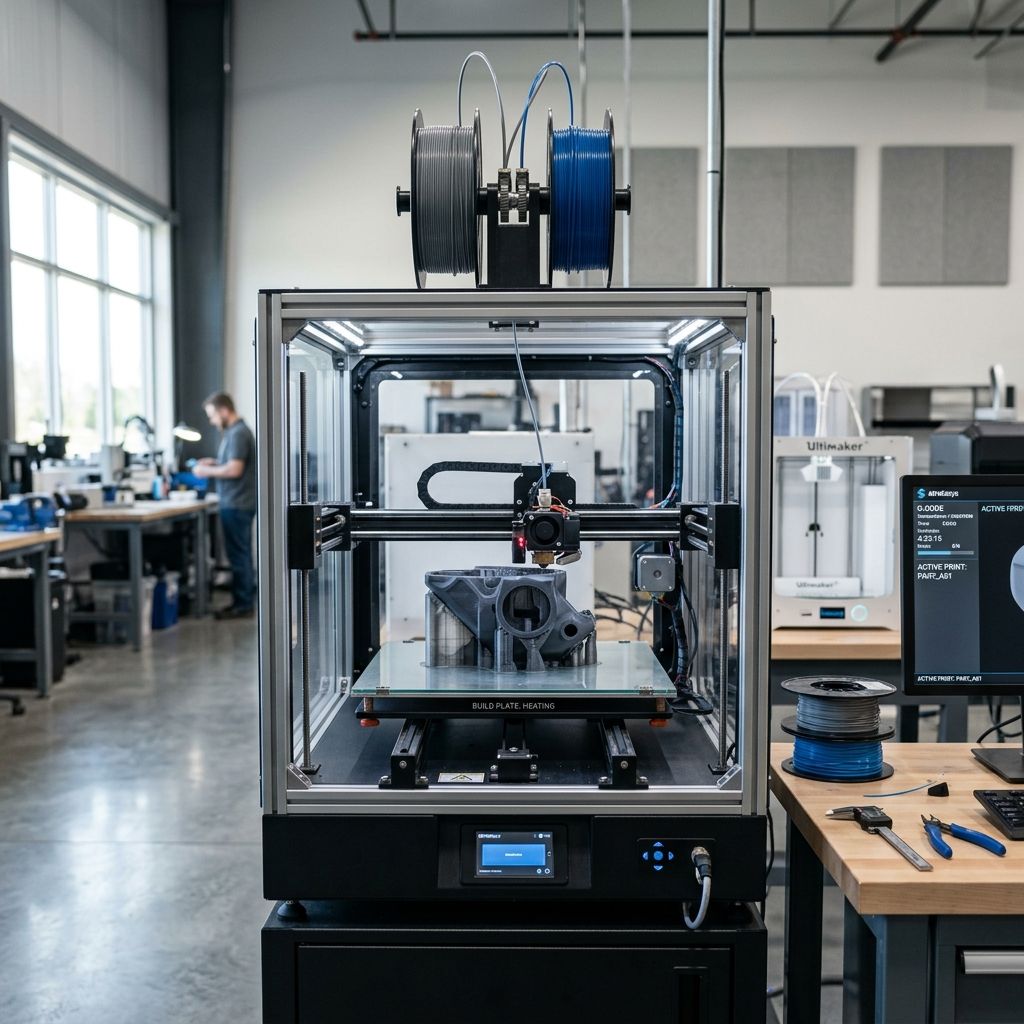
Prusa MK4S & MK4 Field Troubleshooting: Real-World Failures and Workshop Fixes
An unfiltered engineering tear-down of the Nextruder, loadcell drifts, structural resonance issues, and high-flow heat creep on the shop floor.
Executive Specifications & Diagnostics
Before throwing parts at a printer, you need to understand the structural limits of the platform. Prusa's marketing promises flawless out-of-the-box operation, but running these machines 24/7 in industrial or enclosed environments reveals distinct failure modes. Keep these core physical specifications in mind during diagnosis.
Need to run a complete system diagnostic on your printer? Use our 3d-printer-troubleshooting tool to isolate mechanical and electronic issues before tearing down the extruder assembly.
The Realities of the Nextruder on the Shop Floor
I have spent hundreds of hours keeping banks of MK4 and MK4S printers humming in demanding workshop environments. Under clean laboratory conditions, these machines are exceptionally reliable. However, once you introduce abrasive filaments, high ambient temperatures inside custom draft enclosures, and relentless duty cycles, the cracks begin to show.
The Nextruder is a massive evolutionary step over the older V6 and Revo setups, but its tight packaging and integrated loadcell system introduce a unique set of maintenance headaches. If you are running these machines for commercial fabrication, you cannot rely on automated routines to save you when mechanical drift sets in. You need to know exactly how to diagnose, disassemble, and rebuild these assemblies when they inevitably fail.
- Loadcell Sensitivity Range: 0.1g to 500g response window
- Planetary Gear Reduction: 10:1 ratio with hardened steel sun and planet gears
- Maximum Hotend Power: 40W heater cartridge (24V system)
- X/Y Axis Belt Spec: 6mm wide GT2, fiberglass-reinforced neoprene
- MK4S Cooling Fan Speed: Up to 10,000 RPM (high-static pressure radial)
- Nextruder Total Weight: ~340g (including stepper and cooling assembly)
Nightmare 1: The Nextruder Loadcell & Z-Axis Calibration Drifts
Prusa's automated first-layer calibration relies entirely on an integrated strain gauge loadcell built directly into the heatsink mount. By measuring the physical resistance when the nozzle touches the print surface, the printer calculates its Z-offset dynamically. This system eliminates the old Live-Z adjustment dance, but it introduces a complex mechanical path where any shifting, cable tension, or thermal stress translates directly into calibration errors.
The Physics of Loadcell Failure and Thermal Creep
The loadcell behaves as a sensitive cantilever beam. When the nozzle touches the print sheet, the upward force bends the beam slightly, which alters the electrical resistance of the strain gauge. However, the system cannot differentiate between the physical force of bed contact and structural forces exerted by stiff wires, thermal expansion, or plastic creep in the mounting components.
When operating inside a heated enclosure, the PETG parts of the Nextruder housing soften. At temperatures above 45°C, PETG begins to experience micro-creep under the constant tension of the assembly bolts. This relieves the structural pre-load on the heatsink mount, causing the loadcell to read "ghost" pressures or suffer from severe hysteresis. The result is a nozzle that either slams directly into the build plate (causing deep gouges in your PEI sheet) or triggers too early, leaving a massive gap that ruins first-layer adhesion.
To understand how thermal expansion directly impacts the Z-offset before the loadcell even triggers, we can calculate the linear expansion of the brass nozzle and copper heater block assembly:
$$\Delta L = \alpha \cdot L_0 \cdot \Delta T$$Where:
- $\Delta L$ = Change in length (mm)
- $\alpha$ = Coefficient of linear thermal expansion (for brass, this is approximately $19 \times 10^{-6} \text{ K}^{-1}$)
- $L_0$ = Original length of the heated assembly (~28 mm from the heatsink neck to the nozzle tip)
- $\Delta T$ = Temperature differential (from room temp of 20°C to 250°C print temp = 230 K)
Let's run the math:
$$\Delta L = (19 \times 10^{-6}) \cdot 28 \cdot 230 = 0.122 \text{ mm}$$An expansion of over 0.12 mm is more than half of a standard 0.2 mm layer height. If your loadcell is pre-loaded by stiff wires or a loose mount, it cannot resolve the contact point accurately enough to compensate for this thermal shift, leading to inconsistent first layers. If you are experiencing persistent first-layer drift, you should review our Prusa MK4 & MK4S Calibration: What You Need to Know guide to properly align the mechanical zero-points.
Field Recovery Workflow for Loadcell Drifts
If you are getting "Bed leveling failed" errors or inconsistent first layers, do not keep running the calibration test. Follow this physical alignment sequence to eliminate mechanical stress on the sensor:
- Unload Filament completely: Filament tension in the PTFE tube can pull the extruder upward, throwing off the strain gauge by several grams of force.
- Examine the Cable Harness: The main cable bundle exiting the rear of the Nextruder must have a gentle, sweeping loop. If the zip ties are pulled too tight or if the bundle is stiff, it will exert a rotational force on the extruder body. Snip the zip ties, relax the cables, and secure them with a loose hook-and-loop strap instead.
- Check the Hotend Mount Screws: Inspect the two thumbscrews securing the Nextruder nozzle/heater block. If they are unevenly torqued, they will twist the heatsink inside the loadcell pocket. Back them out completely, check for plastic debris in the collar, and hand-tighten them with equal torque.
- Loosen and Re-torque the Loadcell Bracket: Locate the three M3 screws that secure the loadcell to the main X-carriage plastic mount. Loosen them by half a turn, cycle the printer's power to allow the sensor to tare at zero physical load, and then torque them in a star pattern to exactly 0.8 Nm.
- Clean the Nozzle Tip: Any tiny, hardened blob of plastic on the nozzle tip will cushion the contact with the PEI sheet. The loadcell will register contact late, causing the nozzle to press too hard into the bed. Always brass-brush the nozzle at 220°C before running a calibration sequence.
Pro-Tip: Never print ASA, ABS, or Nylon on the MK4 or MK4S inside an unventilated enclosure using standard PETG extruder parts. Over time, the structural parts holding the loadcell will warp. If you must run high ambient chamber temperatures, reprint your Nextruder housing in PCCF (Polycarbonate Carbon Fiber) or PA12-CF.
Nightmare 2: Nextruder Heat Creep & High-Flow Nozzle Jamming
The MK4S upgrade introduced a high-flow nozzle system and modified fan shrouds to tackle fast printing speeds. However, the compact design of the Nextruder places the planetary gearbox and stepper motor extremely close to the melt zone. When printing high-temp materials or running PLA in hot environments, heat migrates upward along the heatbreak, softening the raw filament before it ever reaches the melt zone.
The Mechanics of Heat Creep in the 10:1 Planetary Gearbox
The Nextruder's stepper motor runs warm often reaching 60°C under continuous duty. Because the motor is directly coupled to the aluminum heatsink through the planetary gearbox plate, it acts as an active heat injector. The planetary gears (10:1 reduction) provide incredible pushing force, but they also generate friction. If your cooling fan is choked by dust or if you are running at high extrusion multipliers, the filament transitions from solid to semi-molten state inside the drive gears themselves.
Once PLA softens inside the planetary assembly, the hobbed drive gear bites into the soft plastic, flattening it out. The gears lose traction, fill with plastic shavings, and grind the filament to a halt. This issue is highly prevalent when using high-flow nozzles because the volumetric throughput demands more heat energy, which radiates upward when the printer slows down for complex geometry or outer perimeters.
For a deeper dive into the mechanical differences between these models and how they handle high-flow scenarios, check out our guide on MK4S and MK4: Common Problems and Fixes.
Thermal Dissipation Limits of the Nextruder Heatsink
To prevent heat creep, the rate of heat removal by the cooling fan must exceed the rate of heat conduction up the heatbreak. Under typical workshop conditions, this balance is governed by the thermal conductivity of the materials:
- Stainless Steel Heatbreak Conductivity: ~15 W/m·K
- Titanium Alloy (Ti-6Al-4V) Heatbreak Conductivity: ~6.7 W/m·K (highly recommended upgrade)
- Copper Heater Block Conductivity: ~400 W/m·K
If you run an enclosure ambient temp above 40°C, the delta-T between the heatsink cooling air and the heatsink itself drops significantly, reducing the heat-transfer rate. The transition zone shifts upward by up to 8mm, causing immediate jams with PLA and PETG.
Disassembly and Thermal Rebuilding of the Nextruder
When heat creep strikes and clogs the planetary drive, you cannot clear it with a simple cold pull. You have to open the drive assembly and perform a physical clearing of the planetary gears. Here is the field-tested procedure:
- Power down and isolate: Turn off the main power switch and unplug the machine. Let the hotend cool completely to room temperature.
- Remove the Fan Shroud: Swing open the print fan door. Remove the two M3 screws securing the hotend cooling fan to gain unrestricted access to the heatsink fins.
- Extract the Hotend Assembly: Loosen the two side thumbscrews on the Nextruder block. Unlatch the heater and thermistor quick-connect cables from the LoveBoard (the small break-out PCB on the back of the extruder). Slide the entire hotend assembly straight down out of the heatsink.
- Clean the Planetary Cavity: Use a brass wire brush and isopropyl alcohol to clear out any plastic dust from the hobbed drive pulley. Inspect the needle bearings inside the idler door; if they do not spin freely, they will drag on the filament, mimicking heat creep.
- Apply High-Temp Thermal Paste: When reinserting the heater cartridge or rebuilding the heatbreak, apply a thin layer of boron nitride paste (not standard computer thermal paste) to the upper barrel of the heatbreak where it inserts into the heatsink. This maximizes thermal transfer to the active cooling zone, shortening the transition region.
- Lubricate the Gears: Apply a tiny, pinhead-sized dab of lithium-based grease to the planetary gear teeth. Keep this grease strictly away from the filament path and the hobbed drive gear.
Nightmare 3: X/Y Belt Tension, Input Shaper Artifacts, and Carriage Slop
The MK4 and MK4S utilize input shaping firmware to run at speeds that would have shaken an MK3S to pieces. However, input shaping is not magic; it relies on highly precise mechanical resonance profiles. If your belt tension is off by even a few Hz, or if your linear bearings have developed microscopic slop, the input shaper will over-correct or under-correct, producing severe ghosting, ringing, and dimensional inaccuracies along the print axes.
The Math of Belt Resonance Tuning
Prusa recommends tuning belts using a phone app that listens to the audio frequency when you pluck the belt. In a noisy shop, this is completely useless. You need to understand the physics of belt tension to tune them accurately with physical tools or precise load measures.
The natural frequency of a vibrating string (or belt) is dictated by the following equation:
$$f = \frac{1}{2L} \sqrt{\frac{T}{\mu}}$$Where:
- $f$ = Natural frequency (Hz)
- $L$ = Free span length of the belt being plucked (meters)
- $T$ = Tension in the belt (Newtons)
- $\mu$ = Linear mass density of the belt (for standard 6mm GT2 neoprene belt, this is approximately $0.009 \text{ kg/m}$)
If we want to achieve the factory-recommended target tension of approximately 80 to 90 Newtons on the X-axis (where the free span length $L$ is roughly 0.36 meters), we can compute the precise target frequency we should measure:
$$f = \frac{1}{2 \cdot 0.36} \sqrt{\frac{85}{0.009}}$$ $$f = 1.388 \cdot \sqrt{9444.44}$$ $$f = 1.388 \cdot 97.18 \approx 134.9 \text{ Hz}$$If your measurement reads below 110 Hz, the belt is too loose, which introduces mechanical hysteresis (slop) as the motor reverses direction. If your measurement reads above 150 Hz, you are overloading the stepper motor bearings and causing the plastic idler mounts to flex, which distorts the resonance profile and causes rapid wear on the linear rods.
Step-by-Step Calibration of X/Y Axis Tracking
If you want to run these machines at high output speeds for a production business, you must eliminate any mechanical slop before enabling input shaping. Refer to our guide on Setting Up a Prusa MK4S for Production for detailed fleet management tips. Use this physical calibration sequence to tune your axes:
- Inspect the Linear Bearings for Pitch/Yaw Slop: Grab the Nextruder assembly with both hands and gently try to twist it. If you feel any clicking, shifting, or mechanical "play," your linear bearings are worn, or the Zip ties/plastic clips holding them are loose. Replace worn bearings immediately with high-quality, pre-lubricated Japanese bearings (such as Misumi LMU8).
- Set the Motor Pulley Alignment: Ensure that the GT2 pulleys on the stepper motor shafts are perfectly centered on the belt path. If the belt rubs against the pulley flanges, it creates a high-frequency vibration that confuses the input shaping accelerometer calibration. Loosen the grub screws, let the belt center itself naturally, then torque the grub screws back down on the flat of the motor shaft.
- Adjust the X-Axis Tensioner: The MK4 features an adjustable tensioner on the right-side X-end. Turn the adjustment screw until the belt registers between 130 and 135 Hz when plucked at mid-span with the carriage pushed all the way to the opposite side.
- Tighten the Y-Axis Belt Holder: The Y-belt is adjusted from underneath the bed plate. Tighten the belt puller until it matches the same frequency range. Be absolutely sure to tighten both clamping screws evenly so the belt does not ride at an angle inside the channel.
- Verify Rod Parallelism: Measure the distance between the two X-axis linear rods at both ends of the gantry. If they are out of parallel by even 0.1mm, the carriage will bind at the extremes of travel, causing erratic layer shifts when the high-speed input shaper demands sudden accelerations.
Field Troubleshooting & Diagnostics Matrix
This table outlines the common failures, root causes, and immediate shop-floor remedies for the MK4 and MK4S platforms.
| Observed Symptom | Probable Root Cause | Field Diagnostics & Quick Fixes |
|---|---|---|
| Nozzle drags or gouges PEI sheet during bed leveling. | Loadcell pre-loaded by stiff cables or loose mounting plate. | Unclamp extruder wire harness; ensure wire loop is loose. Re-torque the three loadcell mounting bolts to 0.8 Nm. |
| Under-extrusion or clicking noises during high-speed prints. | Heat creep in planetary gears or dirty drive hob. | Perform a hotend cold pull. Clear plastic dust out of the Nextruder planetary gears using a brass brush. Apply thermal paste to the heatbreak. |
| Ringing, ghosting, or poor dimensional accuracy on X/Y axes. | Belt tension out of spec or loose stepper pulley. | Re-tension belts to 130-135 Hz. Tighten stepper pulley grub screws, ensuring one screw sits flat on the D-cut shaft. |
| "LoveBoard red LED lit" or erratic temperature readings. | Loose thermistor connection or damaged hotend cable loop. | Inspect the quick-connect terminals on the LoveBoard PCB. Replace the thermistor wire harness if resistance fluctuates when wiggled. |
| Extruder heater takes too long to reach temperature. | Heater cartridge sliding down out of the block. | Ensure the Nextruder heater cartridge is fully seated inside the block cavity and clamped securely with the set screw. |
Technical Alternatives: Upgrades and Field Hacks
While Prusa provides an ecosystem of upgrades, experienced shop managers often look for alternative modifications to increase duty cycle life and reduce maintenance intervals on the floor.
1. High-Quality Third-Party Nozzles vs. Prusa Obiter/Nextruder Standards
The stock Nextruder nozzle uses a proprietary integrated tube design. While convenient for quick swaps, these nozzles are expensive and lock you into Prusa's ecosystem. A common workshop alternative is to install the Prusa Nextruder-to-V6 adapter. This allows the use of standard V6-style nozzles, such as tungsten carbide or hardened tool steel nozzles. While it adds a joint to the melt zone (increasing the risk of leaks if torqued incorrectly), it reduces per-machine operating costs significantly when printing carbon-fiber or glass-filled filaments.
2. Printed Part Upgrades (PETG to PA12-CF)
The stock orange and black parts are printed in PETG. Under heavy production cycles, especially when utilizing high-wattage custom bed heaters or enclosures, these parts warp. Reprinting the entire X-carriage, fan shrouds, and Nextruder body in Carbon-Fiber filled Nylon (PA12-CF) or Polycarbonate-CF dramatically increases the structural rigidity of the printer. This modification reduces resonance frequencies, improves input shaper performance, and prevents the loadcell mounting plate from creeping under load.
---Frequently Asked Questions
Why does my MK4/S occasionally fail the first-layer calibration even with a clean nozzle?
This usually occurs when filament tension pulls on the Nextruder assembly, or if the heatbreak is resting under mechanical tension. Ensure your filament spool rotates completely freely and that your wiring harness has a generous, unrestricted loop that doesn't exert downward or upward force on the carriage.
How often should I lubricate the Nextruder planetary gearbox?
For a machine running 40 hours a week, the internal gears should be cleaned and lightly lubricated with a high-temperature lithium or PTFE grease every 6 months. Do not over-lubricate, as excess grease will migrate to the drive gear and cause filament slippage.
Can I run the MK4S high-flow nozzle profile with a standard MK4 brass nozzle?
No, the high-flow profiles assume a much higher volumetric melt rate (up to 25-30 mm³/s). Attempting to run standard brass nozzles at these speeds will cause massive under-extrusion, motor stalling, and eventual heat creep jams due to high back-pressure inside the hotend.
What is the exact torque specification for the Nextruder heater block set screw?
The set screw that secures the heater cartridge and nozzle assembly should be torqued to exactly 1.2 Nm when cold. Over-tightening will strip the aluminum threads, while under-tightening will lead to poor thermal transfer and mechanical play.
Critical Torque Spec Alert
The aluminum alloy heater block on the Nextruder is soft. Never attempt to tighten or loosen the nozzle while the hotend is cold if you are using the V6 adapter setup; you will shear the threaded tube. Always heat the hotend to 250°C before applying torque to any threaded melt-zone component.
Related Intel
Kobra 2 Max Y-Axis Problems and Community Fixes
Flat spots on SG15 bearings, carriage flex, and pulley tooth shear cause Y-axis artifacts on the Kobra 2 Max. Fixes: lubricate rails, reduce acceleration, and check belt tension.
Fixing Kinematic Binding on RatRig V-Core 3.1
RatRig V-Core 3.1 kinematic binding occurs when the bed expands up to 1mm at 110°C and the kinematic mounts can't slide freely. Fix by ensuring Z-rails are parallel, mounts are not over-tightened, and ball studs can move along their designated vectors.
Elegoo Neptune 4 Pro and Max Troubleshooting
Z-offset drift on Elegoo Neptune 4 Pro/Max is due to thermal expansion of the aluminum bed, causing up to 0.4 mm height change. Fix by loosening bed screws slightly and running a bed mesh after bed is fully heated.