Common Ender 3 V3 Problems and Fixes

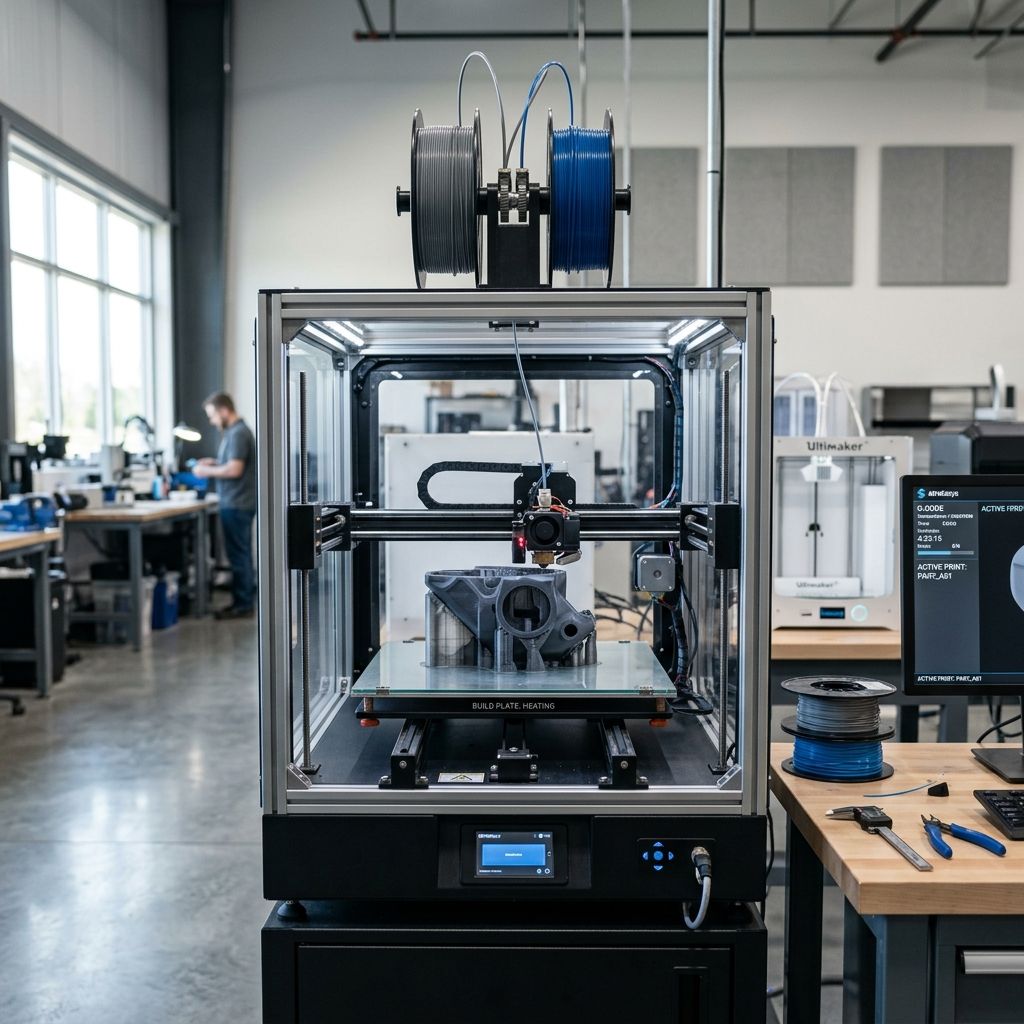
Ender 3 V3 SE, KE, and CoreXZ: Battle-Tested Fixes for Real-World Shop Floors
An unvarnished teardown of design flaws, mechanical failures, and field-tested solutions for Creality's modern budget platforms.
Executive Specs & Core Performance Data
These machines try to bridge the gap between hobbyist budget bedslingers and reliable toolroom workhorses. If you are struggling with surface quality issues or inconsistent extrusions, use our 3D Printer Troubleshooting Tool to pinpoint your slicer and mechanical errors before tearing down the gantry.
- Input Shaper Limits (SE/KE): Max recommended acceleration: 3500 mm/s² (SE), 5000 mm/s² (KE).
- Extruder System: Sprite direct drive with dual steel gears, 1:3.5 reduction ratio.
- Z-Axis Geometry: Dual Z-screws linked by timing belt (SE/KE); CoreXZ dual belt system (CoreXZ).
- Nozzle Compatibility: Spider high-flow format (KE/CoreXZ), standard MK8 short format (SE).
I have spent hundreds of hours operating, rebuilding, and occasionally cursing at Creality's Ender 3 V3 lineup. Underneath the sleek plastic shrouds and marketing copy touting "worry-free auto leveling," these machines are still built to meet strict cost-cutting targets. The moment you run them in a production environment or crank the acceleration past 3,000 mm/s², the compromises start to show. Whether you are dealing with the budget-minded SE, the Klipper-powered KE, or the mechanically ambitious CoreXZ, you are going to face structural flex, thermal drift, and extruder failures. This is the practical manual for keeping these machines running cleanly on your workbench.
The Physics of Load-Cell Bed Leveling & Thermal Creep
The Ender 3 V3 series relies heavily on an automated strain gauge system (load cell) mounted under the bed or behind the hotend assembly to measure the distance between the nozzle and the build plate. While this promises a perfect first layer without manual leveling knobs, it fails to account for basic thermal physics under load.
The core issue is that mechanical parts expand when heated. The coefficient of thermal expansion ($\alpha$) of the 6061 aluminum alloy bed plate is approximately $23 \times 10^{-6} \text{ K}^{-1}$, while the brass nozzle is roughly $19 \times 10^{-6} \text{ K}^{-1}$. We can calculate the thermal expansion ($\Delta L$) of these components using the formula:
$$\Delta L = \alpha \cdot L_0 \cdot \Delta T$$
Where $L_0$ is the initial length or thickness and $\Delta T$ is the change in temperature. For a 220mm aluminum bed heated from a room temperature of 20°C to an operating temperature of 60°C ($\Delta T = 40\text{ K}$), the linear expansion across the bed plane is:
$$\Delta L = (23 \times 10^{-6}) \cdot 220 \cdot 40 \approx 0.202\text{ mm}$$
Because the bed is rigidly constrained at its four mounting posts by hard plastic spacers, this horizontal thermal expansion cannot escape outward. Instead, it forces the aluminum plate to bow upward in the center a phenomenon we call "potato-chipping." If you run your auto-calibration routine when the bed is cold, or even during its initial heat-up cycle before the aluminum has fully heat-soaked, your bed mesh will be highly inaccurate within fifteen minutes of starting the print.
Failure #1: The Dreaded Z-Offset Drift & Bed Leveling Discrepancy
The most common complaint on the SE and KE is that the nozzle occasionally scrapes the bed plate during a print, or floats 0.5mm above it, despite a successful auto-calibration run. The strain gauge operates by detecting micro-voltage changes when the nozzle physical taps the bed. This system has three primary fail points:
- Filament Ooze: If there is even a tiny droplet of cooled, hardened PLA or PETG on the tip of the nozzle during the homing sequence, the plastic acts as a buffer. The sensor registers the tap too early, resulting in an offset that is too high.
- V-Roller Stiction (SE model): The Z-axis on the SE uses rubber V-rollers running in aluminum extrusions. If these rollers are too tight, they introduce mechanical "stiction." The stepper motor struggles to micro-step downward smoothly, causing the gantry to bind slightly and tricking the strain gauge into registering a false touch point.
- Loose Carriage Screws: The strain gauge sensor assembly on the KE is mounted to a small metal sub-frame. If the two M3 screws holding this frame are loose, the entire print head tilts slightly when touching the bed, skewing the sensor readings.
Step-by-Step Calibration Fix
To eliminate Z-axis drift permanently, follow this physical adjustment sequence:
- Clean the Tip Hot: Heat the nozzle to 220°C and use a brass wire brush to scrub away all residual plastic from the nozzle tip. Do not use steel brushes; they will wear down the brass nozzle or short out the heater cartridge wires.
- Adjust V-Roller Tension (SE Only): Use the included open-ended wrench to adjust the eccentric nuts on the inner V-rollers of the Z gantry. The rollers should be tight enough that you cannot spin them easily with your bare finger, but loose enough that the gantry drops smoothly under its own weight when the lead screws are decoupled.
- Verify Bed Mounts: Peel off the PEI sheet, unscrew the four counter-sunk bed screws, and inspect the black plastic spacers. If they are unevenly worn or cracked, replace them with 16mm silicone compression columns. Tighten the screws in a star pattern to a torque of approximately 0.8 Nm to ensure even down-pressure.
Failure #2: Extruder Heat Creep & The "Blob of Death"
The direct-drive assembly on these printers is extremely compact. While this reduces weight on the X-axis carriage, it places the stepper motor, dual drive gears, and hotend assembly in very close proximity. Under sustained workloads especially when printing inside an enclosure or in a hot garage the heat from the hotend migrates up through the heatbreak into the cold section. This is known as heat creep.
When heat creep occurs, the filament softens inside the drive gears before it reaches the melt zone. The dual drive gears lose their grip on the softened plastic, grinding it into dust and causing a complete extrusion jam. Worse, if you are printing high-flow materials or PETG with aggressive retraction settings, the molten plastic can back up through the heatbreak threads, leaking out of the heater block. This creates a massive, solid block of plastic that wraps around the entire hotend assembly often referred to by the community as the "Blob of Death." This can easily tear the delicate thermistor and heater cartridge wires out of the ceramic block during extraction.
To rebuild the assembly after a plastic leak or jam, follow this structured process:
| Step | Action | Tool Required | Precaution |
|---|---|---|---|
| 1 | Soft-heat the block to 180°C to soften the outer plastic shell. | Printer Interface / Host Console | Do not exceed 200°C to prevent thermal run-away or fumes. |
| 2 | Carefully peel away the softened blob using needle-nose pliers. | Pliers / Heat Gun (optional) | Avoid touching the delicate red heater wires and white thermistor wires. |
| 3 | Remove the heatbreak fan and clear the cooling fins of debris. | 2.0mm Hex Key / Compressed Air | Ensure fan blades are not chipped; broken blades reduce airflow by up to 30%. |
| 4 | Clean out the internal drive gears of any ground filament. | Wire Brush / Dental Pick | Ensure the gear teeth are sharp and clean to prevent future slip. |
When setting up retractions, excessive values will pull hot filament too far up into the cold zone. This is a common issue when migrating profiles from older Bowden-tube setups, which we've also observed when debugging Common Cura Slicing Errors: Missing Layers and Retraction Blobs. For these direct-drive extruders, keep retractions strictly between 0.5mm and 1.2mm.
Failure #3: High-Acceleration Ringing & Linear Rail Slop
Creality advertises extreme speeds for the KE and CoreXZ (up to 500 mm/s or 600 mm/s respectively). At these velocities, structural resonance becomes a major problem. The KE uses a linear rail on the X-axis but retains dual cylindrical linear rods on the Y-axis. The CoreXZ uses dual linear rails for X and Z, but relies on a complex network of belts to coordinate motion.
At high speeds, the inertial forces of the heavy heated bed (bedslinger design of the SE/KE) shifting back and forth along the Y-axis cause the thin sheet-metal vertical frame to flex. This flex introduces "ringing" or "ghosting" artifacts on the printed surface. If you push the acceleration too high without proper calibration, the stepper motors will lose sync, leading to severe layer shifts, similar to our findings during high-velocity runs on other platforms, as detailed in our Fixing Layer Shift in Simplify3D: Acceleration Settings guide.
CoreXZ Belt Tension Tuning
The CoreXZ mechanism operates on a continuous belt loop. Unlike standard Cartesian printers, the belt tension of both left and right loops must be precisely balanced. If one side is tighter than the other, the X-axis carriage will tilt slightly as it travels across the gantry, creating uneven layer lines and accelerated wear on the linear carriage bearings.
To tune the CoreXZ belts correctly without professional tension meters, use the frequency method:
- Download a guitar tuner or frequency analyzer app on your smartphone.
- Pluck the longest exposed run of the belt on the left side of the frame.
- Adjust the tension screw until the resonant frequency reads approximately 110 Hz to 120 Hz.
- Repeat the measurement on the right side belt run, adjusting until it matches the left side within ±2 Hz.
- Under-tensioned Belts (<90 Hz): Causes backlash, sloppy corners, and poor dimensional accuracy.
- Over-tensioned Belts (>140 Hz): Causes stepper motor overheating, premature bearing failure, and vertical fine pitch banding (VFP).
- Optimal Balance Target: 115 Hz provides the best compromise between belt longevity and sharp corners.
Comprehensive Preventative Maintenance Workflow
To keep these machines running reliably on a production floor, you cannot just set them and forget them. You need to establish a strict schedule of preventative maintenance to address wear points before they cause a print failure.
Bi-Weekly Maintenance Checklist
The linear rods on the SE and the linear rails on the KE and CoreXZ require regular cleaning and lubrication. Dusty shop environments will quickly turn grease into an abrasive grinding paste.
- Clean the Rods and Rails: Wipe down all linear rods and rails with a lint-free microfiber cloth soaked in 99% Isopropyl Alcohol (IPA). Slide the carriages back and forth to force out any packed debris from inside the bearing blocks, then wipe down the rails again.
- Apply Lubricant: For the linear rails (KE/CoreXZ), use a low-viscosity synthetic grease containing PTFE (such as Super Lube 21030). Apply a thin bead along the rail tracks. Do not use WD-40 or thin household oils; they break down quickly and do not offer enough film strength for high-speed linear movements. For the polished rods (SE Y-axis), use a few drops of 3-in-1 oil or light sewing machine oil.
- Check the Lead Screws: Clean the Z-axis lead screws on the SE/KE and apply a dry PTFE lubricant. Wet grease on lead screws attracts airborne dust and filament debris, leading to Z-banding.
Monthly Structural Audits
Vibration will loosen fasteners over time. Once a month, take your hex keys and check the tightness of the following critical junctions:
- The two main bolts securing the vertical gantry uprights to the plastic base frame.
- The set screws (grub screws) on the stepper motor drive pulleys. A slightly loose pulley set screw is the root cause of 90% of unexplained layer shifts.
- The mounting bracket screws for the hotend assembly.
Field Troubleshooting Matrix
This quick-reference matrix covers the most common operational errors we see with the Ender 3 V3 family, from out-of-the-box setup issues to long-term wear failures.
| Symptom | Root Cause | Diagnostic Verification | Shop-Floor Solution |
|---|---|---|---|
| First layer too thin on one side of the bed. | Uneven gantry leveling or warped bed frame. | Run auto-leveling mesh and look for a variance delta greater than 0.8mm. | Manually align the dual Z lead screws by holding one still and rotating the other until the gantry is parallel to the base frame. Replace stock spacers with silicone columns. |
| Clicking noise from extruder during fast prints. | Nozzle restriction, low hotend temperature, or excessive speed. | Check if clicking stops when you slow the print down to 50% via the feed-rate override. | Increase hotend temp by 10-15°C, or clean the nozzle using a cold-pull (atomic pull) method to clear debris. |
| Rippling shadows on vertical walls (Ghosting). | Excessive acceleration or loose belt/frame assembly. | Print a 50mm test cube at 150 mm/s and observe the ghosting frequency next to sharp corners. | Tighten the gantry gussie brackets, balance the belt tensions, or run the Input Shaper calibration using an external ADXL345 accelerometer (standard on KE, optional mod on SE). |
| Severe layer shift along the Y-axis. | Y-axis stepper motor overheating or belt slipping. | Touch the Y-axis stepper motor. If it burns your finger (over 80°C), it is pulling too much current or struggling against mechanical resistance. | Loosen Y-axis belt slightly, check for binding in the bed bearings, and lower the Y-axis acceleration settings in your slicer. |
Frequently Asked Questions
Why does my Ender 3 V3 SE fail to save the Z-offset after powering down?
This is usually due to a corrupted EEPROM file on the microSD card or outdated motherboard firmware. Ensure you have a high-quality microSD card formatted to FAT32 with 4096-byte allocation blocks, and flash the latest official firmware from Creality to restore persistent memory storage.
Can I upgrade the Ender 3 V3 SE to Klipper without buying a Nebula Pad?
Yes, you can run Klipper on a standard Raspberry Pi by flashing the printer's mainboard with custom firmware compiled for the GD32F303 or STM32F401 chip (depending on which chip version your SE board shipped with). You will need to construct a custom serial connection cable or use the rear USB-C port on the front of the machine.
Why is my CoreXZ gantry binding when it reaches the top of the Z-axis?
This indicates that your vertical frame extrusions are not perfectly parallel, a common assembly defect from the factory. Loosen the top frame mounting bolts, raise the Z-axis carriage to its maximum height to naturally align the vertical rails, and then re-tighten the frame bolts securely while the carriage is at the top.
Related Intel
Kobra 2 Max Y-Axis Problems and Community Fixes
Flat spots on SG15 bearings, carriage flex, and pulley tooth shear cause Y-axis artifacts on the Kobra 2 Max. Fixes: lubricate rails, reduce acceleration, and check belt tension.
Fixing Kinematic Binding on RatRig V-Core 3.1
RatRig V-Core 3.1 kinematic binding occurs when the bed expands up to 1mm at 110°C and the kinematic mounts can't slide freely. Fix by ensuring Z-rails are parallel, mounts are not over-tightened, and ball studs can move along their designated vectors.
Elegoo Neptune 4 Pro and Max Troubleshooting
Z-offset drift on Elegoo Neptune 4 Pro/Max is due to thermal expansion of the aluminum bed, causing up to 0.4 mm height change. Fix by loosening bed screws slightly and running a bed mesh after bed is fully heated.