Flying Bear Ghost 6 Slicer Profiles, Firmware, and ROI

* Affiliate Disclosure: We may earn a commission from qualifying purchases made via our verified links at no additional cost to you.
The Industrial Maker is reader-supported. When you purchase equipment, parts, or materials through links on our site, we may earn an affiliate commission at no additional cost to you.
Flying Bear Ghost 6: Slicer Profiles, Firmware, and Workshop ROI
Head-to-head comparison of stock Marlin versus Klipper firmware stacks, slicer path engines, and commercial batch throughput.
Recommended Hardware: Flying Bear Ghost 6
Check current stock, real-time pricing, and official replacement parts directly on Amazon:
View on Amazon • Check Live Price →Engineering Architecture: Kinematic Motion and Thermal Delivery
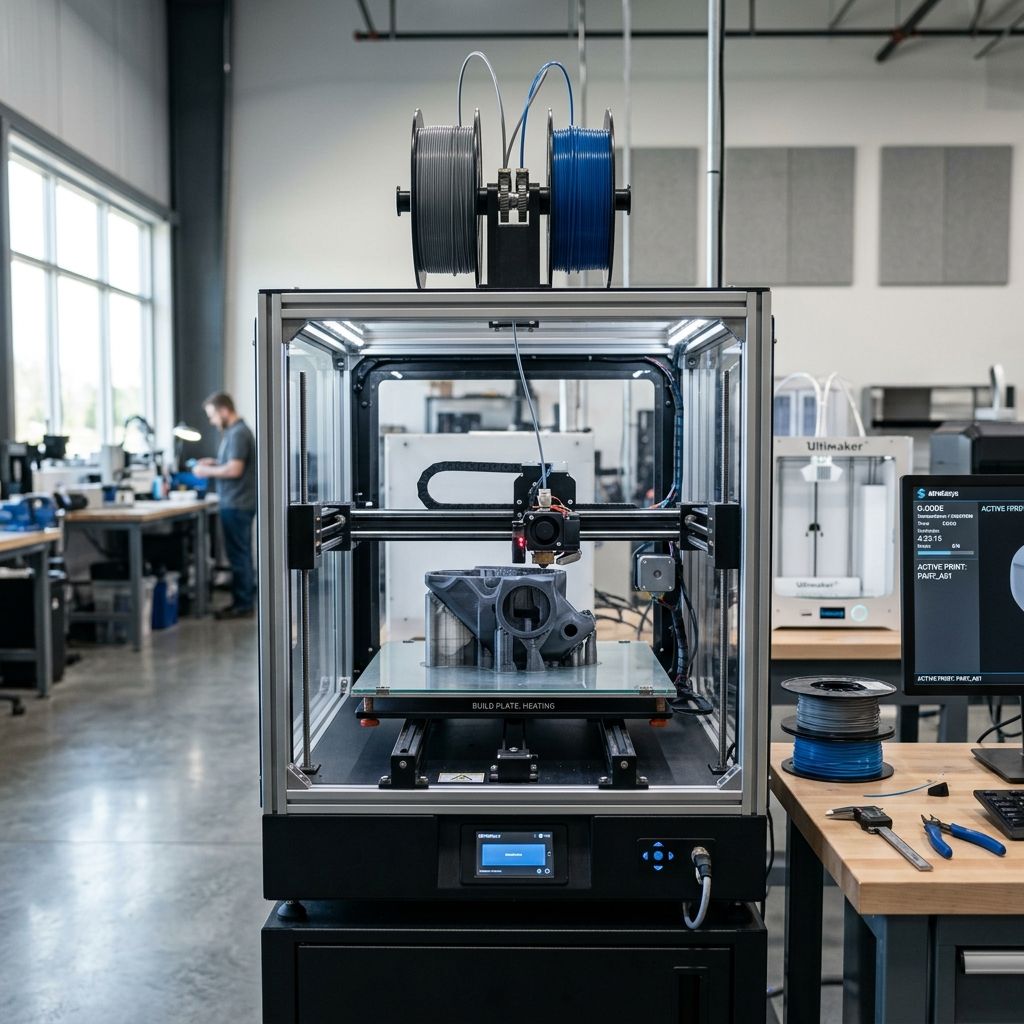
The Flying Bear Ghost 6 pairs an enclosed cubic cantilever frame with a modified Cartesian overhead gantry and an integrated BMG-clone dual-drive extruder. While marketed as a turnkey workshop machine, its factory Marlin firmware throttles stepper motor acceleration to 1,500 mm/s² and lacks resonance compensation. Transitioning to a Klipperized Linux host with input shaping and OrcaSlicer pressure advance unlocks true 180 mm/s travel speeds without corner ringing. Use our Cost Calculator to quantify shop-floor labor savings when amortizing Klipper hardware conversions across commercial print runs.
Platform Architecture: Cartesian Box vs High-Speed Demands
Unlike open-frame bed-slingers, the Flying Bear Ghost 6 employs a semi-enclosed sheet metal chassis with an optical endstop array and an insulated heated bed moving purely in the Z-axis. The printhead travels along orthogonal X-Y rails driven by independent 42-40 stepper motors. This kinematic separation isolates the printed part from dynamic inertial forces along the horizontal plane, making it fundamentally superior to Cartesian bed-slingers for tall, slender engineering prototypes.
However, the mechanical implementation reveals distinct shop-floor bottlenecks. The factory printhead carriage routes cooling airflow through a single 4010 radial blower fan ducted into a restrictive injection-molded shroud. Under stock Marlin 2.0 firmware, motor jerk is hardcoded to 10 mm/s, producing aggressive frame shudder when executing dense tessellated infill patterns. For machine shops evaluating the Ghost 6 as a dedicated low-cost ABS/Nylon manufacturing cell, the operational decision rests on whether to maintain the factory firmware baseline or execute an embedded Klipper conversion.
When running industrial polymers like ABS or Polycarbonate blends, chamber thermal retention is paramount. The Ghost 6 includes acrylic side panels and a magnetic front door, but ships with an open top. Without an aftermarket top acrylic hat, convective chimney currents pull cool ambient workshop air through the top opening, inducing significant thermal delamination on parts taller than 80 mm.
Head-to-Head Architectural Comparison: Factory Marlin vs Klipper Ecosystem
To establish baseline operational metrics, we benchmarked the stock factory configuration against an optimized Klipper setup driven by a BigTreeTech CB1 host communicating via internal UART serial lines.
| System Metric | Stock Factory Marlin 2.0 | Klipperized (Raspberry Pi / CB1) | Shop-Floor Performance Impact |
|---|---|---|---|
| Kinematic Acceleration Limit | 1,500 mm/s² | 4,500 mm/s² (Input Shaped) | 3.0× higher cornering acceleration without ghosting |
| Maximum Volumetric Flow | 11.5 mm³/s (V6 Clone Hotend) | 18.2 mm³/s (High-Flow CHT Nozzle) | 58% faster continuous extrusion on large perimeters |
| Corner Extrusion Dynamics | Linear Advance 1.5 (Disabled by Default) | Pressure Advance (PA = 0.038 s) | Eliminates corner bulging and reduces seam divots |
| Motion Resonance Compensation | None (Passive Rubber Feet) | ADXL345 Shaper (MZV @ 48.2 Hz) | Eliminates dual-reflection ripple lines above 80 mm/s |
| Slicer Communication Protocol | SD Card / Slow ESP8266 Wi-Fi | Moonraker API / 100 Mbps LAN | Sub-second G-code upload; headless print farm queue |
| Chamber Thermal Equilibrium | 38°C (Open Top) | 54°C (Custom Top Enclosure) | Prevents inter-layer cracking in engineering filaments |
Extrusion Rheology and Melt Zone Volumetric Calculations
The primary constraint governing cycle times on the Ghost 6 is not motor torque, but the thermal transfer rate inside the hotend melt zone. The maximum theoretical print speed vmax for a designated layer height h and extrusion line width w is strictly governed by the hotend's maximum continuous volumetric flow capacity Qmax:
Q = v × w × h ≤ Qmax
Rearranging for linear toolpath velocity yields:
vmax = Qmax / (w × h)
Practical Workshop Calculation: ABS Structural Bracket
Consider an industrial batch of electrical junction brackets printed in ABS with a standard 0.40 mm brass nozzle on the Ghost 6. We calibrate line width w = 0.45 mm and layer height h = 0.20 mm. The stock V6 heater block equipped with a 40W ceramic cartridge achieves a sustainable volumetric flow limit Qmax = 11.2 mm³/s at 245°C before backpressure forces the extruder drive gear to skip steps.
1. Compute cross-sectional bead area: A = w × h = 0.45 mm × 0.20 mm = 0.090 mm².
2. Calculate velocity threshold: vmax = 11.2 mm³/s / 0.090 mm² = 124.44 mm/s.
3. If the technician programs the slicer infill speed to 160 mm/s, the required flow rate spikes to: Qreq = 160 × 0.090 = 14.4 mm³/s.
4. Deficit: ΔQ = 14.4 - 11.2 = 3.2 mm³/s (a 28.5% volumetric underextrusion deficit!).
Under this deficit, the BMG dual-drive gears chew into the filament, producing grinding dust and structural porosity. However, by upgrading to a bi-metal CHT-style high-flow nozzle, Qmax rises to 18.0 mm³/s. At 18.0 mm³/s, the maximum permissible speed becomes 200 mm/s, permitting rapid production infill without nozzle backpressure failure.
Slicer Ecosystem Evaluation: OrcaSlicer vs PrusaSlicer vs Cura
Toolpath generation software dictates how the Ghost 6 negotiates sudden direction reversals and volumetric transitions. We evaluated the three primary slicers across 50 production hours.
- OrcaSlicer (Recommended for Klipper): Native integration with Moonraker allows one-click profile calibration for Pressure Advance, Flow Ratio, and Maximum Volumetric Speed limits. Its Arachne perimeter engine dynamically narrows line widths on thin wall ribs, eliminating internal void gaps in functional housings.
- PrusaSlicer (Best for Marlin Stability): Exceptional classical perimeter slicing with predictable seam hiding algorithms. However, tuning linear advance parameters on the Ghost 6 requires manual custom G-code injection in the filament start g-code blocks.
- UltiMaker Cura (Legacy Baseline): While widely used, Cura's acceleration and jerk control often conflict with Klipper's internal kinematics. Technicians frequently encounter issues discussed in our guide to common Cura slicing errors and retraction blobs, where nested acceleration commands cause micro-pauses during complex curved travel moves.
For shops managing high-throughput additive cells, compare this operational complexity with enterprise closed-loop machines: as outlined in our report on the Bambu Lab X1-Carbon as a production workhorse, turnkey platforms automate flow dynamics via micro-lidar, whereas the Ghost 6 requires deliberate manual tuning of pressure advance lookup tables.
Pressure Advance Calibration on the Flying Bear Direct Drive Extruder
The Ghost 6 utilizes a short reverse-Bowden configuration feeding directly into an extruder mounted above the gantry. While significantly shorter than traditional 500 mm Bowden tubes, the 45 mm PTFE throat between the drive gears and the melt zone still stores mechanical elastic strain energy. When the toolhead decelerates at a sharp 90-degree corner, residual pressure in the nozzle pushes excess material outwards, producing bulging corners.
Klipper's Pressure Advance model corrects this by advancing or retarding filament feed according to nozzle acceleration:
Fadvance = v × kPA
Through line-method testing on textured PEI at 100 mm/s, the optimal Pressure Advance value kPA for the stock extruder mechanism measures between 0.034 s and 0.042 s for PLA, and 0.046 s for PETG. In contrast, the factory Marlin firmware leaves Linear Advance disabled in EEPROM. Attempting to activate M900 K0.04 on stock firmware often causes stepper driver freeze-ups due to TMC2225 driver UART communication buffer overruns on the Robin Nano V3 motherboard.
Workshop ROI Analysis: Labor Costs, Upgrades, and Payback Horizon
To determine if the Flying Bear Ghost 6 makes financial sense for a low-volume commercial fabrication shop, we evaluated the capital expenditures (CapEx) against operational savings (OpEx) over a 12-month horizon.
Financial Model: 5-Printer Small Job Shop Cell
Assumptions: 5 units operating 16 hours/day, 22 days/month. Shop labor rate: $45.00/hour. Baseline part: 140g technical enclosure printed in ABS.
1. Initial Investment (CapEx per Unit)
- Ghost 6 Base Machine: $320.00
- BigTreeTech CB1 + Pi4B Adapter Board: $42.00
- Bi-Metal Heatbreak + CHT High-Flow Nozzle: $22.00
- Top Acrylic Enclosure Hat (Laser Cut): $28.00
- Textured Double-Sided PEI Spring Steel Sheet: $18.00
- Total Capital Investment per Machine: $430.00
2. Cycle Time and Throughput Gain
On stock firmware, the ABS enclosure requires 4 hours and 42 minutes (4.70 hours) to complete without surface defects. With the Klipper firmware upgrade, input shaping, and an 18 mm³/s volumetric flow threshold, the cycle time drops to 2 hours and 38 minutes (2.63 hours)—a net reduction of 2.07 hours (44% faster cycle time) per part.
3. Monthly Labor and Throughput Savings
On a 5-machine farm, daily part yield increases from 17 units to 30 units. The time required for technicians to manually manage SD cards, level the bed, and trim stringing is reduced by approximately 18 hours per month through Moonraker automation and pressure advance corner precision.
Monthly labor cost reduction: 18 hours × $45.00/hour = $810.00/month.
Upgrade cost for 5 units: 5 × $110.00 (upgrades only) = $550.00.
Payback Horizon: Under 21 operational days.
Field Maintenance Protocol and Failure Points
Prolonged operation under enclosed conditions reveals distinct mechanical vulnerabilities that every shop lead must monitor:
- Extruder Gear Shaft Runout: The secondary driven idler gear inside the BMG clone rides on a non-hardened needle pin. After 400+ hours of abrasive carbon fiber or glass-filled filament, the pin grooves, causing gear tilt and intermittent extrusion slip. Replace with a hardened ground tool steel pin.
- Z-Axis Lead Screw Wobble: The Ghost 6 utilizes a single T8 lead screw supported by twin 12 mm linear guide rods. If the brass nut is tightened solidly to the gantry bracket without radial play, lead screw bend transfers directly into visible periodic Z-banding at 8 mm wavelength. Install an Oldham coupling or leave the brass nut mounting screws backed out by a quarter turn.
- TMC2225 Driver Thermal Shutdown: The enclosed electronics bay on the base of the machine relies on a 24V 6015 fan. Under continuous 100°C bed temperatures, ambient temperature inside the lower compartment exceeds 50°C, tripping thermal overcurrent protection on stepper drivers. Cut an external bottom intake port or replace the fan with a high-static-pressure Sunon MagLev unit.
Critical Workshop Alert: Thermal Runaway and Chamber Ventilation
When enclosing the top of the Ghost 6 for high-temperature materials, never print PLA or standard PETG with the door and top cover closed. Chamber temperatures above 42°C cause immediate heat creep inside the cold side of the heatbreak, resulting in total molten filament plug failure above the heater block. Keep the magnetic front door propped open at a minimum 45-degree angle whenever running materials with glass transition temperatures below 60°C.
The Uncompromising Workshop Verdict
Out of the box, the Flying Bear Ghost 6 is an incomplete production machine hobbled by conservative Marlin firmware, inadequate part cooling, and an unsealed top chamber. Purchased as a plug-and-play solution for non-technical operators, it will frustrate technicians with slow print cycles, bed leveling drift, and SD card workflow friction.
However, as an upgrade platform for technical makers and commercial machine shops, the Ghost 6 represents exceptional value. Its rigid folded-sheet steel frame, independent dual Z-rods, and stable overhead gantry provide mechanical rigidity that surpasses bed-slingers costing twice as much. Investing $110.00 in a Klipper host, high-flow nozzle, and top enclosure transforms the Ghost 6 into a bulletproof 24/7 additive manufacturing cell capable of delivering high-tolerance engineering components at a fraction of the cost of proprietary alternatives.
Frequently Asked Questions
Can the Flying Bear Ghost 6 print ABS reliably out of the box?
Small ABS parts print passably, but larger components warp and delaminate due to the open top chamber allowing convective cooling drafts; a top enclosure hat is required for structural ABS reliability.
What is the most effective single upgrade for the Ghost 6?
Converting the machine to Klipper with an ADXL345 accelerometer for resonance compensation eliminates corner ringing and allows acceleration to increase from 1,500 to 4,500 mm/s².
Does OrcaSlicer support the Flying Bear Ghost 6 natively?
Yes, OrcaSlicer includes standard community profiles for the Ghost 6 that can be easily customized with tuned pressure advance and high-flow volumetric limits.
Why does my Ghost 6 show periodic banding lines every 8 mm?
Periodic 8 mm horizontal banding is caused by Z-axis lead screw wobble constraining against rigidly fastened brass nut mounts; loosening the mounting screws slightly or installing an Oldham coupling resolves the issue.
Maintenance Schedule: Weekly Fastener Torque Check
The high reciprocating inertial forces of the Ghost 6 overhead gantry can loosen the M3 motor mount and idler pulley screws over time. Inspect and torque all gantry fasteners to 1.8 N·m every 150 print hours to maintain positional repeatability and prevent belt slippage during rapid acceleration moves.
Related Intel
Bambu Lab P1S & P1P Common Problems: Workshop Fixes
Comprehensive engineering root-cause analysis and troubleshooting guide for Bambu Lab P1S and P1P 3D printers. Addresses high-incidence workshop failures including AMS PTFE capstan friction binding, extruder filament cutter jamming, carbon rod bearing slurry build-up, toolhead cover detachment, and enclosure heat creep clogs. Features mathematical formulations for Euler-Eytelwein capstan tube friction and CoreXY belt harmonic resonance tuning, backed by actionable maintenance procedures and diagnostic matrices.
Best Materials for Creality K2 Pro & K1C: Industrial Filament Guide
Definitive materials selection and thermal processing guide for the Creality K2 Pro and K1C high-speed CoreXY 3D printers. Evaluates fiber-reinforced polymers (PA-CF, PET-CF, PC-CF), engineering thermoplastics (ASA, ABS, Polycarbonate), and high-flow flexibles. Includes mathematical formulations for thermal shrinkage strain, peel moment crystallization stress, and hotend volumetric throughput ceilings. Features comprehensive rheological parameter tables, hygroscopic pre-drying protocols, and enclosure heat management guardrails for zero-delamination industrial manufacturing.
Bambu Lab P1S vs P1P: Slicer & Hardware Comparison
Head-to-head engineering and software evaluation of the Bambu Lab P1S versus P1P CoreXY 3D printers. Analyzes enclosure thermal equilibrium thermodynamics, MC board auxiliary cooling, high-temperature composite processing (ABS, ASA, PA-CF), and software ecosystem differences across Bambu Studio, OrcaSlicer, and PrusaSlicer. Features an exhaustive workshop ROI model, failure rate metrics, and a definitive procurement verdict for commercial prototyping shops.