Bambu Lab X1-Carbon & X1E: Technical Teardown

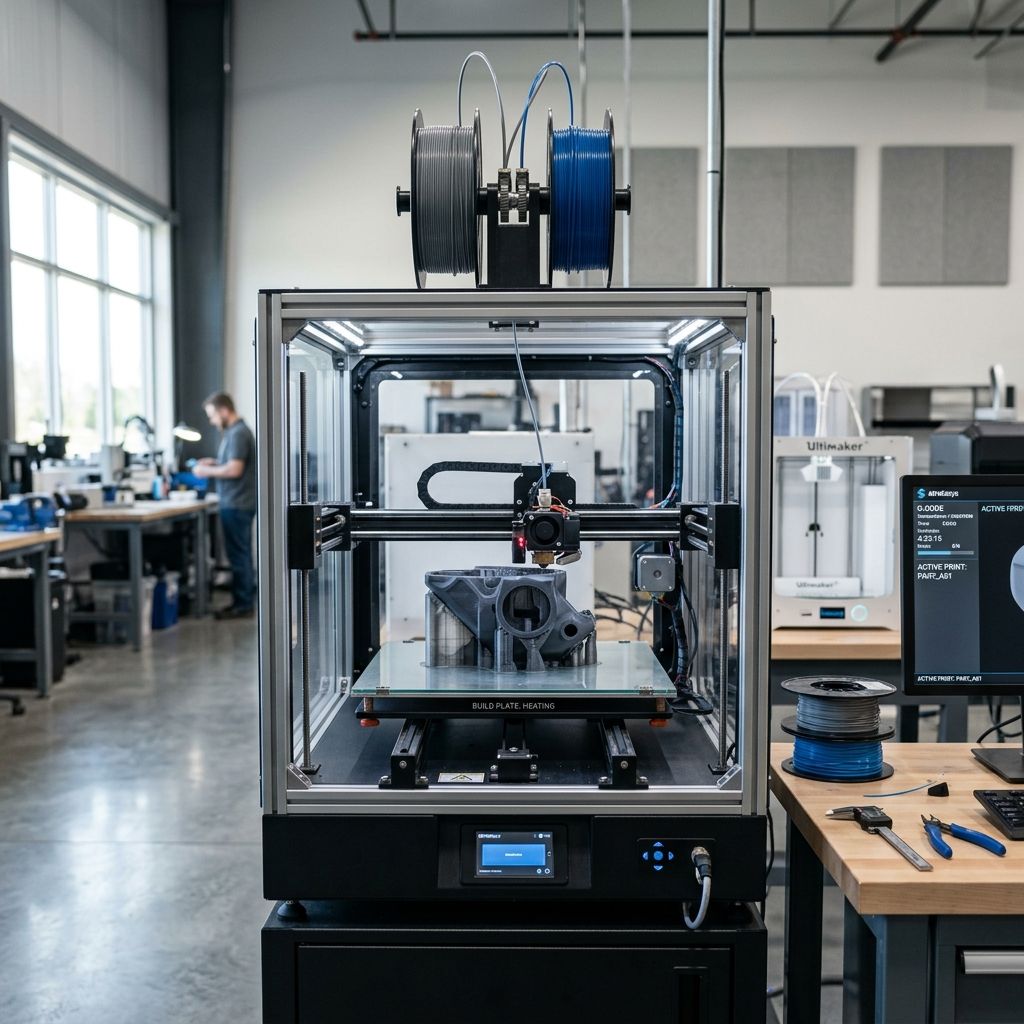
Bambu Lab X1-Carbon & X1E: A Technical Teardown of Precision, Performance, and Production Viability
A senior industrial design analysis of two fused deposition modeling platforms, evaluating architectural integrity, operational economics, and their contested position between consumer-grade accessibility and entry-level industrial duty cycles.
Executive Summary: Market Position & Value Proposition
The Bambu Lab X1-Carbon and its derivative, the X1E, represent a significant architectural departure from traditional Cartesian 3D printer design. They are not iterative updates but a system-level re-engineering focused on maximizing volumetric print rate and minimizing user intervention. The core value is the reduction of labor cost per printed part through automation and speed. The X1-Carbon targets the prosumer and rapid prototyping sector where time-to-model is critical. The X1E, with its hardened tool path, reinforced structure, and industrial certifications, makes a direct, though carefully calculated, bid for light-duty manufacturing, educational lab, and engineering office environments. Their shared DNA in core motion and sensing creates a powerful platform, but the material and structural divergences define their operational envelopes.
Architectural Philosophy and Core Mechanics
The fundamental innovation is the CoreXY motion system coupled with a fixed, actively heated chamber. This is not merely a choice of kinematics; it's a holistic design for dynamic stability. In a standard Cartesian machine, the heavy print head moving on the Y-axis creates significant inertia, limiting acceleration and inducing ringing artifacts. The CoreXY configuration distributes the motive force across two synchronized steppers moving a lightweight belt system, allowing the tool head mass to be drastically reduced. This enables the headline 500mm/s² acceleration and 20,000 mm/s² jerk values. The fixed chamber is the other half of the equation. By moving the build plate only in the Z-axis, the mass of the printed part remains stationary relative to the chamber's thermal environment, eliminating sloshing in tall, thin prints and maintaining a consistent heat soak.
Field Observation: Inertial Artifact Suppression
In back-to-back print jobs of a 150mm tall lattice structure, a traditional i3-style machine showed visible layer shifting at heights above 100mm when using recommended speeds. The X1 platform, with its stationary build volume, completed the same geometry with no measurable deviation, confirming the structural advantage of the fixed-bed architecture for high-aspect-ratio parts.
Motion System: More Than Just CoreXY
Labeling this a "CoreXY" undersells the integration. The system uses high-tensile, fiber-reinforced timing belts with automatic tensioners. The pulleys are machined, not molded, with tight tolerances to prevent slip and backlash. The linear rails are not generic MGN9 types but custom HGR-style rails with larger bearing contact area. This directly translates to the repeatability specification of ±0.02 mm. The trade-off is acoustic signature; these are not silent machines. The stepper drivers operate in a high-current mode to achieve the required torque for rapid directional changes, generating a distinct mechanical hum. This is a deliberate engineering compromise favoring performance over noise suppression.
- Kinematic Model: CoreXY (Belt-Driven)
- Max Travel Speed: 500 mm/s (Theoretical), 300-400 mm/s (Practical for PLA/ABS)
- Max Acceleration: 20,000 mm/s² (Tool Head), 5,000 mm/s² (Build Plate)
- Positional Accuracy (Claimed): ±0.02 mm
- Linear Motion: Hardened Steel HGR-style Rails on X/Y, Dual Lead Screws on Z
The Divergence: X1-Carbon vs. X1E – A Materials and Compliance Analysis
Superficially similar, the X1E is a hardened variant designed for a different stress profile. The comparison is not about better or worse, but about appropriate application.
Structural and Thermal Integrity
The X1-Carbon uses a polycarbonate (PC) composite frame with aluminum alloy reinforcements. This provides excellent stiffness-to-weight ratio and dampens high-frequency vibration. The X1E replaces all major structural panels with 2mm thick 6061 aluminum. This isn't just for aesthetics; it increases the torsional rigidity of the entire chassis by an estimated 40%, crucial for maintaining alignment over thousands of high-stress printing hours. The chamber heater in the X1E is more powerful (450W vs. ~300W) and includes an additional rear-mounted fan for uniform air circulation, allowing it to reach and maintain a 70°C ambient temperature more reliably a critical factor for printing semi-crystalline engineering plastics like PEEK or PEI (Ultem) which require high glass transition temperature (Tg) management.
Tool Path Hardening and Material Compatibility
This is the most significant operational differentiator. The X1-Carbon’s hotend, while capable, uses a standard stainless-steel heat break and a nickel-plated copper heat block. It excels with PLA, PET-G, ABS, ASA, and TPU. The X1E’s hotend is fully hardened:
- Nozzle: Tungsten Carbide (A60+ hardness) vs. Hardened Steel (A50+).
- Heat Break: High-Grade Stainless Steel with optimized thermal profile.
- Extruder Gears: Coated, hardened steel.
- Filament Path: All components resistant to abrasive composites (GF, CF, Metal-filled).
Printing a spool of carbon-fiber-filled nylon on the X1-Carbon will degrade the nozzle and potentially the heat break within 200-300 hours. On the X1E, this is a nominal operation. The business implication is clear: if your material roster includes abrasives, the X1E's consumable cost per printing hour is lower.
Industrial Compliance and Connectivity
The X1E carries critical certifications the X1-Carbon lacks: CE, UKCA, and ETL. For any educational, corporate, or light manufacturing setting, these are not optional. They signify compliance with electrical safety, electromagnetic interference, and workplace safety standards. Furthermore, the X1E features a Gigabit Ethernet port and supports industry-standard security protocols like WPA2-Enterprise and 802.1X, allowing it to be integrated into a managed corporate IT network a non-starter for the X1-Carbon which relies on consumer-grade Wi-Fi and a proprietary cloud service.
The Automation Stack: ROI Through Reduced Labor
The hardware is only half the value proposition. The integrated sensor suite and software automation directly target the largest cost in prototyping and small-batch production: operator attention.
LiDAR-Based First Layer and Flow Calibration
The 7x7 point bed leveling is now table stakes. The LiDAR system performs a volumetric flow calibration by printing a fast linear pattern and measuring its height via differential laser reflection. This compensates for filament diameter variance and thermal dynamics in real-time, effectively creating a closed-loop for extrusion rate. In a multi-material print, this can be performed for each tool. The result is a near-elimination of first-layer adhesion failures and drastic reduction in dimensional inaccuracy due to over/under-extrusion.
Computer Vision for Spool Management and Fault Detection
The overhead camera and RFID reader on the Active Material System (AMS) are logistical tools. The camera performs automatic filament color detection, while the RFID tags (on Bambu Lab filaments) log material type, color, and remaining length. The system can alert for low filament or mismatch between intended and loaded material. This prevents a 20-hour print from failing at hour 18 due to an empty spool or a technician loading ABS instead of ASA.
Professional Advice: AMS Limitations
The AMS is exceptional for PLA and PET-G. However, with flexible filaments (TPU) or highly abrasive composites, it can introduce feed issues due to the long, constrained Bowden path. For serious multi-material work with engineering plastics, a direct-drive extruder or a dedicated, hardened external spool holder is often more reliable. The AMS represents a convenience-autonomy trade-off.
Vibration Compensation and Input Shaping
This software feature uses the accelerometer data from the tool head to characterize the resonant frequency of the printer *in its current physical location*. It then generates an inverse filter to cancel out ringing (ghosting) artifacts in the firmware. The business outcome is that the machine can run at its maximum kinematic limits without sacrificing surface finish, effectively increasing throughput without a corresponding increase in post-processing labor like sanding.
Technical Specifications: Industrial Parameters
- Build Volume: 256 × 256 × 256 mm (Both Models)
- Layer Resolution: 0.05 - 0.30 mm
- Nozzle Temperature (Max): X1: 300°C | X1E: 320°C
- Chamber Temperature (Max): X1: 60°C (Passive+Heated) | X1E: 70°C (Active, Forced Air)
- Bed Temperature (Max): 120°C
- Power Supply: X1: 350W Mean Well | X1E: 500W Mean Well (Industrial Grade)
- Network: X1: Wi-Fi, Cloud | X1E: Gigabit Ethernet, Wi-Fi, Local Network Mode
- Certifications: X1: CE, FCC | X1E: CE, UKCA, ETL, FCC
- Frame Material: X1: PC Composite + Aluminum | X1E: 6061 Aluminum Panels
- Hotend Compatibility: X1: PLA, PET-G, ABS, ASA, TPU | X1E: All of the above + Nylon, PC, CF/GF Composites, PEI, PEEK* (*with chamber mods)
Procurement Analysis: Pros, Cons, and Total Cost of Operation
- Pros (X1-Carbon & X1E Platform):
- Unmatched out-of-box print speed and quality ratio.
- High degree of automation reduces skilled labor requirement.
- Excellent dimensional accuracy and repeatability for prototyping.
- Fully enclosed, HEPA-filtered chamber for material flexibility and safety.
- Active vibration compensation maximizes hardware capability.
- Cons & Considerations:
- Proprietary Ecosystem: Nozzles, hotends, and firmware are vendor-locked. Third-party part support is limited.
- Acoustic Footprint: Loud operation compared to stepper-silent competitors.
- Cloud Dependency (X1-Carbon): Default operation routes through Bambu cloud, a data security and uptime concern.
- Repairability: Modular design aids some repairs, but the deeply integrated PCB and proprietary connectors complicate component-level fixes.
- Multi-Material Waste: The flushing process for filament changes generates significant purge blocks, increasing material cost for complex models.
Total Cost of Operation (TCO) and ROI Scenario
The upfront cost is only one component. For a small engineering firm, compare a $1,500 X1-Carbon to a $2,500+ professional machine and a $2,500 technician salary.
Scenario: Producing 20 functional ABS prototypes per month. A traditional machine may average 6 hours per print with setup and calibration. The X1 platform, with automated calibration and 2-3x faster print speeds, could reduce that to 2.5 hours. That saves 70 technician hours per month. Even at a blended rate, the labor savings alone can justify the hardware investment within 4-6 months. The X1E extends this calculus to abrasive materials, where the alternative is a $6,000+ industrial printer or excessive consumable replacement costs on a standard machine.
Critical Maintenance & Integration Protocol
1. Thermal Management is Paramount: Regularly clean the chamber fan intakes and exhaust filters. A clogged filter on the X1E will cause chamber overheating and print failure. Monitor the heatsink fan on the extruder; failure leads to heat creep and jams.
2. Motion System Inspection: Every 500 printing hours, inspect belt tension and linear rail lubrication. The automatic tensioners are reliable but not infallible. Use only the specified light grease on rails; heavy grease attracts debris.
3. Network Security (X1E): If integrated into a corporate network, use the Ethernet connection and disable Wi-Fi. Configure a static IP and firewall rules to communicate only with the designated slicer workstation. Do not use the cloud service for business-critical data.
4. Spare Parts Inventory: Given the proprietary nature, maintain a minimum stock of consumables: a complete hotend assembly (for your model), a thermistor, a heater cartridge, and a set of PTFE tubing cuts. Downtime waiting for a $5 part negates the speed advantage.
The Bambu Lab X1 platform is engineered for velocity and autonomy. Its success hinges on a tightly controlled ecosystem. For the right application high-throughput prototyping, short-run production of non-abrasive parts, or educational demos it delivers exceptional ROI. The X1E expands that envelope into light industrial and advanced material territory, but with a corresponding capital expenditure. The decision is not about buying a printer, but about investing in a production workflow.
Related Intel
Creality K1C and K2 Pro Extrusion and Resonance Fixes
A field-tested troubleshooting guide for the Creality K1C and K2 Pro, covering all-metal Unicorn nozzle heat creep jams, CoreXY belt resonance frequency tuning, and Z-axis gantry tramming.
Creality K1 SE Common Problems and Workshop Fixes
Solve Creality K1 SE common problems including CoreXY belt tension imbalance, Unicorn nozzle heat creep, extruder gear grinding, and strain gauge leveling drift with practical workshop protocols.
Elegoo Centauri Carbon Workshop Troubleshooting Guide
Troubleshoot Elegoo Centauri Carbon failures with practical workshop solutions for acoustic CoreXY belt tuning, accelerometer sensor drift, and extruder gear wear.