Bambu Lab X1-Carbon & X1E: Professional 3D Printing Analysis

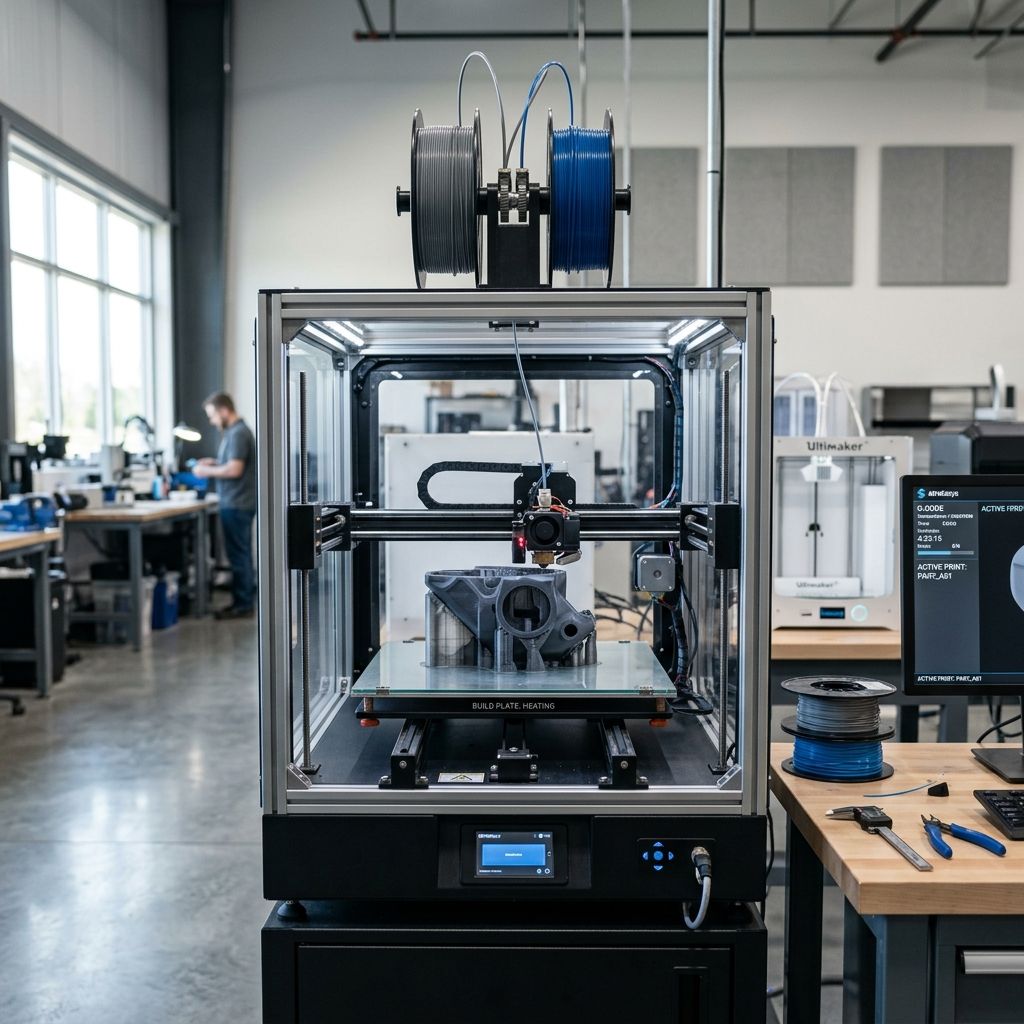
Bambu Lab X1-Carbon & X1E: Deconstructing the Architectural Shift in Professional-Grade Additive Manufacturing
A technical analysis of the CoreXY kinematics, active thermal management, and closed-loop AI calibration systems that redefine production-grade 3D printing efficiency, precision, and operational ROI.
Executive Engineering Overview
The Bambu Lab X1-Carbon and its industrial variant, the X1E, represent not an incremental update, but an architectural paradigm shift. They integrate high-velocity CoreXY kinematics, a proprietary active vibration cancellation (Ams) system, and a closed-loop LiDAR-based calibration suite into a single, tightly coupled production unit. This convergence directly targets the primary constraints of professional print farms and engineering workshops: variable operational cost, inconsistent first-layer success rates, and the labor-intensive overhead of manual calibration. The X1E extends this architecture with an actively heated chamber, an all-metal toolhead, and reinforced structural members, explicitly addressing the thermal management and material compliance demands of advanced engineering polymers. The business outcome is a deterministic reduction in mean time between failures (MTBF) and an increase in mean print success rate, translating directly into predictable throughput and lower cost-per-validated-part.
Core Architectural Framework & Kinematic Analysis
The foundational superiority of the X1 series stems from its rigid, deterministic motion platform. Unlike traditional i3-style Cartesian printers with independent X and Y axes, the CoreXY kinematics utilize a parallel, belt-driven system where two motors cooperate to move the toolhead in the XY plane. This centralizes moving mass to the lightweight print head, enabling extreme acceleration (up to 20,000 mm/s²) and travel speeds (500 mm/s) without inducing significant ringing artifacts or structural resonance.
Structural Integrity and Vibration Dampening
The chassis employs a combination of 3D-printed structural lattices, precision die-cast aluminum elements, and carbon-fiber reinforced polymer rods. This hybrid approach optimizes for stiffness-to-weight ratio and passive damping. The critical innovation is the Active Vibration Compensation system. An integrated accelerometer on the toolhead samples resonance frequencies in real-time. This data feeds into a proprietary algorithm that dynamically adjusts stepper motor input shaping, effectively canceling out harmonics *during* the print. The result is high-speed printing with surface finish quality typically associated with speeds 60-70% slower.
- Motion System: CoreXY Kinematics, Linear Carbon Fiber Rods (X1-Carbon) / Hardened Steel Rails (X1E), 0.9° Stepper Motors.
- Dynamic Performance: Max Accel: 20,000 mm/s², Max Travel Speed: 500 mm/s, Max Flow Rate: 32 mm³/s (PLA).
- Vibration Control: Integrated 3-Axis Accelerometer, Real-Time Input Shaping, Automatic Frequency Response Calibration.
- Frame Stiffness: Die-Cast Aluminum Core, Reinforced Polymer Joints, Triangulated Structural Design.
Hotend Thermodynamics and Material Compliance
The hotend is the critical bottleneck for throughput and material versatility. The standard X1-Carbon utilizes a high-performance ceramic heater and a hardened steel nozzle, capable of reaching 300°C. The X1E transitions to an all-metal, industrially rated hotend with a maximum temperature of 350°C, essential for polymers like PEEK, PEKK, and Ultem (PEI) which require precise high-temperature control to achieve crystallinity and prevent warping.
Active Chamber Thermal Management (X1E)
This is the primary differentiator for engineering materials. An actively heated chamber, with a target temperature of up to 70°C, is not merely for ambient warmth. It systematically reduces the thermal gradient between the deposited bead and its environment. This minimizes internal stress, prevents layer delamination, and controls the crystallinity rate in semi-crystalline polymers. The chamber heater is PID-controlled and monitored separately from the hotend and bed, creating a stable, homogeneous thermal envelope. This allows the X1E to reliably process materials with glass transition temperatures (Tg) above 100°C, which would otherwise warp catastrophically on an open-frame or passively heated system.
- X1-Carbon Hotend: Ceramic Heater, 300°C Max, Hardened Steel Nozzle, 32 mm³/s Flow.
- X1E Hotend: All-Metal Industrial Heater, 350°C Max, Tungsten Carbide Nozzle Option, 35+ mm³/s Flow.
- Chamber System (X1E): Active Heater, Target 70°C, Multi-Zone Insulation, Forced Air Circulation for Homogeneity.
- Critical Material Support: PLA, PETG, ABS, ASA, PA-CF, PC, PPS-CF (X1E), PEKK (X1E).
The Closed-Loop Calibration Ecosystem: LiDAR and AI Integration
Manual bed leveling and flow calibration represent non-value-added labor. The X1 series automates this via a 7-point LiDAR scanner mounted on the toolhead. This system performs two primary functions: First-Layer Bed Mapping and Non-Contact Filament Flow Calibration.
First-Layer Bed Mapping Mechanics
The LiDAR emits a laser line across the print surface. The deformation of this line, captured by an onboard sensor, generates a high-resolution topographical map of the build plate, accounting for microscopic warping, residual adhesive variance, and thermal expansion. The firmware then dynamically adjusts the Z-height for the first layer in real-time, compensating with micron-level precision. This eliminates "first-layer roulette" and ensures optimal adhesion and dimensional accuracy from the foundational layer.
Non-Contact Flow Rate & Pressure Advance Calibration
This is a seminal advancement. The printer prints a series of test patterns. The LiDAR then scans the external dimensions and surface texture of these patterns. Machine learning algorithms analyze this data to detect over-extrusion (rounded edges, elephants foot) and under-extrusion (gaps, poor layer adhesion). The system automatically calculates and applies corrections to the filament flow rate and pressure advance (a setting that compensates for nozzle pressure inertia) for that *specific* spool of filament, accounting for brand, colorant, and humidity-induced diameter variance.
Business Value Translation: From Technical Specs to Operational ROI
The integration of these systems has a multiplicative effect on operational efficiency in professional settings.
Cost-Per-Validated-Part Reduction
Failed prints represent pure waste: material, machine time, and labor. The closed-loop calibration system drives first-print success rates above 95% for common materials, drastically reducing this waste stream. For a print farm running 100 prints per day, even a 5% failure rate translates to 5 lost machine-days per 100 days of operation. Eliminating these failures directly improves asset utilization and material yield.
Labor Arbitrage and Skill Gap Mitigation
The automation of calibration reduces the need for highly skilled technicians to perform repetitive tuning tasks. A junior operator can load filament and initiate a print with confidence. The AI-based monitoring (via the built-in camera and spaghetti detection) further reduces the need for constant human supervision, enabling lights-out, multi-shift operations. This shifts personnel focus from machine babysitting to higher-value tasks like design for additive manufacturing (DFAM), post-processing, and quality assurance.
- ROI Factor: Uptime: Automated calibration reduces non-print hours by 15-25% weekly.
- ROI Factor: Material Yield: Calibration & AI failure detection can reduce material waste by 10-30%.
- ROI Factor: Labor Efficiency: Reduces skilled technician time on calibration by an estimated 1-2 hours per machine per week.
- ROI Factor: Throughput: High-speed capable kinematics can reduce cycle times by 30-50% vs. comparable quality on legacy systems.
Operational Integration and Edge-Case Logistics
Deploying these machines in an industrial context requires understanding their dependencies and limitations.
Network Infrastructure and Data Security
The Bambu Handy app and cloud-based slicing (Bambu Studio) enable powerful remote management and queueing. However, this necessitates a robust, low-latency Wi-Fi or Ethernet (X1E) connection. For IP-sensitive environments, the "LAN-only" mode is critical, though it disables some remote features. Print farms must plan network segmentation to handle the data traffic from multiple machines streaming video and telemetry.
Multi-Material Unit (AMS) Logistics
The AMS is a core differentiator, enabling seamless multi-color and multi-material prints. However, its engineering imposes constraints. The PTFE tubing path and internal cutter mechanism are not compatible with abrasive (filled) or flexible (TPU) filaments beyond limited use. For pure production, a dedicated single-material setup often yields higher reliability. The AMS excels in prototyping, presentation models, and limited-run production where color is a functional requirement.
Maintenance Cycle Predictability
High-speed, high-load operation accelerates wear on consumables. The carbon fiber rods on the X1-Carbon, while lightweight, may wear more predictably than the hardened steel linear rails on the X1E. Nozzle wear, especially with abrasive composites, is a fixed cost. Implementing a preventative maintenance schedule based on operational hours, rather than reactive fixes, is essential for maintaining the systems' precision tolerances (±0.1mm general / ±0.2mm for X1E with advanced materials).
Senior Workshop Lead Advisory: Critical Maintenance & Safety Protocol
DANGER: The toolhead, build plate, and chamber (X1E) operate at extreme temperatures. Always allow the system to cool to ambient temperature before performing any internal maintenance. Disconnect power before servicing electrical components.
Preventative Maintenance Checklist (50-200 Operational Hour Intervals):
- Motion System: Inspect carbon fiber rods (X1-C) / linear rails (X1E) for dust accumulation. Clean with 99% isopropyl alcohol and apply a thin coat of specified lithium grease (rails only). Check belt tension for consistency (~140Hz frequency).
- Hotend Integrity: Perform a "cold pull" to remove carbonized debris. Visually inspect the nozzle orifice for wear and elongation, especially after abrasive filaments. Torque check nozzle to heatbreak connection (heated to 250°C) to prevent hotend leaks.
- Filament Path: Disassemble and clear the extruder gears of plastic dust. Inspect AMS PTFE tubes for kinks or internal wear; replace if filament movement exhibits high resistance.
- Calibration Validation: Manually initiate a full LiDAR calibration sequence and compare results to a known-good baseline. Print a single-layer validation square to visually confirm first-layer uniformity across the entire build plate.
- Structural Inspection: Check all frame screws and roller eccentric nuts for any signs of loosening due to vibration. Ensure the printer remains on a level, massively rigid surface to prevent frame deflection.
Material Compliance Warning: Printing advanced engineering polymers (PEEK, PEKK) on the X1E requires strict adherence to manufacturer-specified chamber temperature profiles. Insufficient chamber heat will cause delamination; excessive heat may exceed the glass transition temperature of structural plastic components within the printer itself, leading to catastrophic failure. Always consult the material's technical data sheet (TDS) and establish validated print profiles before production runs.
Related Intel
Creality K1C and K2 Pro Extrusion and Resonance Fixes
A field-tested troubleshooting guide for the Creality K1C and K2 Pro, covering all-metal Unicorn nozzle heat creep jams, CoreXY belt resonance frequency tuning, and Z-axis gantry tramming.
Creality K1 SE Common Problems and Workshop Fixes
Solve Creality K1 SE common problems including CoreXY belt tension imbalance, Unicorn nozzle heat creep, extruder gear grinding, and strain gauge leveling drift with practical workshop protocols.
Elegoo Centauri Carbon Workshop Troubleshooting Guide
Troubleshoot Elegoo Centauri Carbon failures with practical workshop solutions for acoustic CoreXY belt tuning, accelerometer sensor drift, and extruder gear wear.