Bambu Lab X1-Carbon & X1E: Industrial FFF Analysis

* Affiliate Disclosure: We may earn a commission from qualifying purchases made via our verified links at no additional cost to you.
The Industrial Maker is reader-supported. When you purchase equipment, parts, or materials through links on our site, we may earn an affiliate commission at no additional cost to you.
Industrial-Grade Fused Filament Fabrication: A Material Science and Systems Architecture Analysis of the Bambu Lab X1-Carbon & X1E Ecosystem
A technical audit of hardware, software, and material dynamics transforming rapid prototyping into deterministic, production-adjacent manufacturing.
Recommended Hardware: Bambu Lab X1-Carbon & X1E
Check current stock, real-time pricing, and official replacement parts directly on Amazon:
View on Amazon • Check Live Price →Executive Technical Synopsis
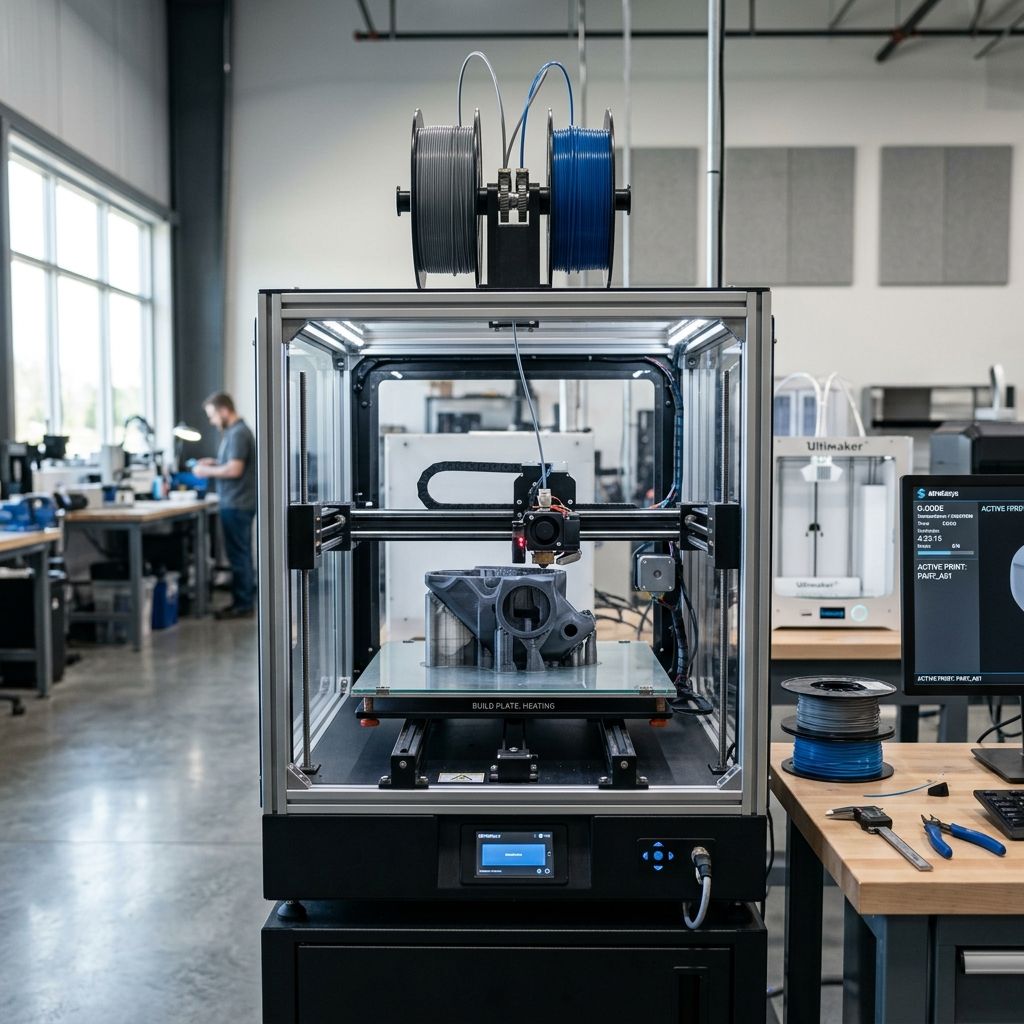
The Bambu Lab X1-Carbon and its industrial counterpart, the X1E, represent a systemic leap in accessible, high-reliability Fused Filament Fabrication (FFF). This analysis deconstructs the platform not as a consumer product, but as an integrated manufacturing cell. Key to its performance is the triad of a hardened toolhead with LiDAR-assisted closed-loop calibration, an actively heated chamber for managing thermal stress, and a proprietary software stack that governs the entire process chain. The business value proposition is the reduction of operator-dependent variables, translating to predictable first-pass success rates >90% for engineering-grade polymers, directly impacting prototype iteration speed, tooling pre-production, and low-volume manufacturing ROI.
1. Hardware Architecture: Precision Through Systemic Redundancy
The industrial viability of the X1 series stems from its departure from open-loop assumption-based printing. Each subsystem is designed for measurement and compensation, a critical shift for professional environments.
1.1 Core Motion & Frame Dynamics
The CoreXY motion system, coupled with linear rods and high-stiffness bearings, minimizes moving mass to the toolhead assembly. This configuration enables rapid directional changes (acceleration > 20,000 mm/s²) without introducing significant frame harmonics. The X1E's hardened steel reinforced frame and industrial-grade PSU are not merely "ruggedized" options; they are necessities for sustained operation in environments with fluctuating line voltage and ambient particulate, ensuring dimensional consistency over 10,000+ operational hours. Frame resonance is a critical, often overlooked variable affecting surface finish and dimensional tolerances on tall, slender features.
1.2 Toolhead: Multi-Sensor Fusion for Closed-Loop Control
The toolhead is a sensor-dense module. Key components include:
- High-Flow Hotend (Ceramic Heater, Hardened Steel Nozzle): Capable of sustained 300°C+ operation and 32 mm³/s melt rates. The hardened steel is essential for abrasive composites (CF-PA, GF-PET).
- Integrated LiDAR: Executes a non-contact topography scan of the first layer. It measures volumetric extrusion consistency and bed planar alignment by analyzing reflected signal distortion, compensating for minor warpage or residue.
- Strain Sensor: A quasi-load cell detecting nozzle contact with the build plate. This sets the Z-offset with micron-level repeatability, eliminating manual "paper test" variability.
- Active Chamber Temperature Management (X1-Carbon/X1E): Unlike passive chambers, an active heater raises ambient temperature to 45-65°C. This drastically reduces the thermal gradient (ΔT) between the extruded melt and its environment, the primary driver of warping and inter-layer delamination in semi-crystalline polymers like Nylon (PA).
2. Material Science & Polymer Processing Dynamics
The printer's capability is meaningless without material compatibility. The system is engineered for high-performance engineering thermoplastics, which demand precise thermal and atmospheric management.
Material Compatibility & Parameter Matrix
Critical processing parameters for common industrial filaments. Note: Chamber temperature is a force multiplier for inter-layer adhesion and dimensional stability.
- Polycarbonate (PC): Nozzle: 300-320°C | Bed: 100-110°C | Chamber: 55-65°C | Key Challenge: Hydrolysis. Mandates filament drying < 0.02% moisture.
- Carbon Fiber Reinforced Nylon (CF-PA/PAHT): Nozzle: 290-310°C | Bed: 100°C | Chamber: 50-60°C | Abrasive. Requires hardened nozzle. Chamber prevents crystallization-induced warping.
- ASA (UV-Resistant Alternative to ABS): Nozzle: 250-270°C | Bed: 100°C | Chamber: 45-55°C | Chamber is critical to prevent layer splitting from draft-induced cooling.
- Polypropylene (PP): Nozzle: 220-240°C | Bed: 85°C | Chamber: 40-50°C | Low adhesion. Requires engineered build plate (PEI/PEX) and chamber for reliable release from warp.
- Polymers (PET-G, PLA): Benefit from chamber for consistency but can print without. For PLA, chamber temp should remain <45°C to avoid softening prior to glass transition.
2.1 The Moisture Management Imperative
Hyroscopic materials (PA, PVA, TPU) absorb ambient moisture, which vaporizes in the hotend, causing voids, poor layer adhesion, and surface defects. The AMS (Automatic Material System) includes silica gel desiccant, but it is a holding solution, not a drying one. Professional protocol mandates:
- Pre-process drying in a dedicated, circulated air dryer (e.g., 70°C for 6+ hours for Nylon).
- In-line or post-printing storage in climate-controlled dry boxes (<10% RH).
- The LiDAR's first-layer analysis can sometimes detect extrusion inconsistency caused by moisture, but prevention is a feedstock logistics issue, not a printer correction.
2.2 Thermal Expansion Coefficients and Stress Modeling
Software must account for material-specific thermal expansion. A part designed in CAD at 20°C, printed in a 60°C chamber, and cooled to 20°C undergoes shrinkage. Bambu Slicer's "Arachne" engine and stress-aware parameters adjust toolpaths and cooling profiles to mitigate anisotropic shrinkage, which manifests as tolerance deviation (e.g., a 100mm pin becoming 99.7mm) or bed adhesion failure due to accumulated residual stress.
3. Software Stack: From Slicer to Shop Floor Integration
The Bambu Lab ecosystem is bound by its software, which functions as a Digital Thread, connecting design intent to physical outcome through constrained automation.
3.1 Bambu Slicer: The Process Constraint Engine
Based on Orca Slicer (a fork of PrusaSlicer), it introduces critical professional features:
- Arachne Variable Width Perimeter Generator: Dynamically adjusts extrusion width to fill narrow spaces and corners without over-extrusion, improving dimensional accuracy on fine features.
- Machine-Learning-Based Supports (Organic): Topology-optimized support structures reduce contact points by up to 70%, minimizing post-processing damage and surface scarring on complex geometries.
- Multi-Material Flushing Volumes Calculator: Automatically calculates the purge volume required when switching materials to prevent cross-contamination a critical function for soluble supports (PVA) or material combinations (TPU to PLA). Incorrect flushing is a primary failure point in multi-material prints.
3.2 Bambu Studio & Handy: The MES Layer
Bambu Studio and the Handy app provide a rudimentary Manufacturing Execution System (MES) layer. They enable remote job queuing, real-time monitoring via streaming video, and granular control of print parameters. For the X1E, this includes ISO 27001-compliant LAN-only mode, segregating production equipment from external networks a non-negotiable requirement for IP-sensitive industries (aerospace, defense).
3.3 Closed-Loop Calibration Workflow
The software orchestrates a pre-print calibration routine that is non-negotiable for quality:
- Bed Leveling: The strain sensor creates a mesh map.
- Vibration Compensation: The toolhead induces known vibrations; onboard accelerometers measure resonant frequencies and adjust input shaping filters in real-time.
- First Layer Calibration: LiDAR scans a test pattern, assessing line width and adhesion, fine-tuning flow rate and Z-height.
This 5-minute routine eliminates hours of manual calibration drift common in traditional printers.
4. Integration Challenges & Operational Edge Cases
Deploying this system in an industrial context reveals dependencies and limitations.
4.1 Supply Chain & Material Certification
While compatible with third-party filaments, optimal performance requires Bambu Lab's proprietary material profiles. This creates a vendor lock-in scenario. For certified production (e.g., FAA-approved parts), a full material pedigree from resin pellet to printed part is required. The current ecosystem does not provide this level of traceability, limiting its role to prototyping, tooling, and non-critical end-use parts.
4.2 Maintenance Logistics and Mean Time Between Failure (MTBF)
The high-reliability design shifts maintenance from constant adjustment to scheduled component replacement. Predictive maintenance logs within the software should track:
- Nozzle Wear: Abrasive composites degrade orifice diameter. Print hours per material type should be logged.
- Carbon Rod Lubrication: Required every 500-1000 print hours to prevent high-frequency stuttering.
- Filter Replacement: The volatile organic compound (VOC) filter in the X1E has a finite capacity for UFPs and styrenes from ABS/ASA.
- Belt Tension: Automatic tensioning reduces drift, but periodic manual verification is needed.
4.3 Thermal Management Limitations
The active chamber, while effective, is limited to ~65°C. High-Tg materials like PEEK or PEKK require chamber temperatures >100°C and an all-metal, high-temperature hotend (>400°C). The X1 series is not a solution for ultra-performance polymers. Its sweet spot is PA, PC, ASA, and their composites materials covering ~80% of industrial prototyping needs.
Professional Implementation & Maintenance Protocol
Safety & Operational Advisory: To achieve stated ROI and repeatability, adhere to the following shop-floor protocols:
- Filament Conditioning is Non-Negotiable: Invest in industrial dryers (e.g., Froment or Hydra) and store all hygroscopic materials in dry boxes with humidity monitors. Assume "fresh from vacuum seal" filament is already at 30% RH.
- Establish a Calibration Baseline: Upon installation, run a full calibration suite and print a certified benchmark part (e.g., a 3DBenchy with critical dimensions measured via CMM). Archive this data. Re-run this benchmark monthly or after any significant maintenance to detect performance drift.
- Implement a Preventative Maintenance Schedule:
- Weekly: Clean carbon rods with 99% IPA, inspect extruder gears for debris.
- Monthly: Lubricate rods with PTFE-based lubricant, check all belt tensions manually, clean LiDAR lens and chamber glass.
- Per 500h of abrasive material: Inspect and replace hardened steel nozzle. Do not wait for print quality degradation.
- Network Security (X1E Critical): If using LAN-only mode, ensure your local network segment for manufacturing equipment is air-gapped from corporate IT networks to prevent latent vulnerabilities.
- Waste Stream Management: The multi-material purge block is a mixed-polymer waste stream. It is not recyclable through standard filament recycling channels. Partner with a specialized polymer recycling service or investigate in-house pelletizing for non-critical parts.
Failure to institutionalize these protocols relegates the system to the variability of consumer-grade equipment, negating its core business value of deterministic output.
Related Intel
Bambu Lab P1S & P1P Common Problems: Workshop Fixes
Comprehensive engineering root-cause analysis and troubleshooting guide for Bambu Lab P1S and P1P 3D printers. Addresses high-incidence workshop failures including AMS PTFE capstan friction binding, extruder filament cutter jamming, carbon rod bearing slurry build-up, toolhead cover detachment, and enclosure heat creep clogs. Features mathematical formulations for Euler-Eytelwein capstan tube friction and CoreXY belt harmonic resonance tuning, backed by actionable maintenance procedures and diagnostic matrices.
Best Materials for Creality K2 Pro & K1C: Industrial Filament Guide
Definitive materials selection and thermal processing guide for the Creality K2 Pro and K1C high-speed CoreXY 3D printers. Evaluates fiber-reinforced polymers (PA-CF, PET-CF, PC-CF), engineering thermoplastics (ASA, ABS, Polycarbonate), and high-flow flexibles. Includes mathematical formulations for thermal shrinkage strain, peel moment crystallization stress, and hotend volumetric throughput ceilings. Features comprehensive rheological parameter tables, hygroscopic pre-drying protocols, and enclosure heat management guardrails for zero-delamination industrial manufacturing.
Bambu Lab P1S vs P1P: Slicer & Hardware Comparison
Head-to-head engineering and software evaluation of the Bambu Lab P1S versus P1P CoreXY 3D printers. Analyzes enclosure thermal equilibrium thermodynamics, MC board auxiliary cooling, high-temperature composite processing (ABS, ASA, PA-CF), and software ecosystem differences across Bambu Studio, OrcaSlicer, and PrusaSlicer. Features an exhaustive workshop ROI model, failure rate metrics, and a definitive procurement verdict for commercial prototyping shops.